Written by: Dr. Peerzada Muneer
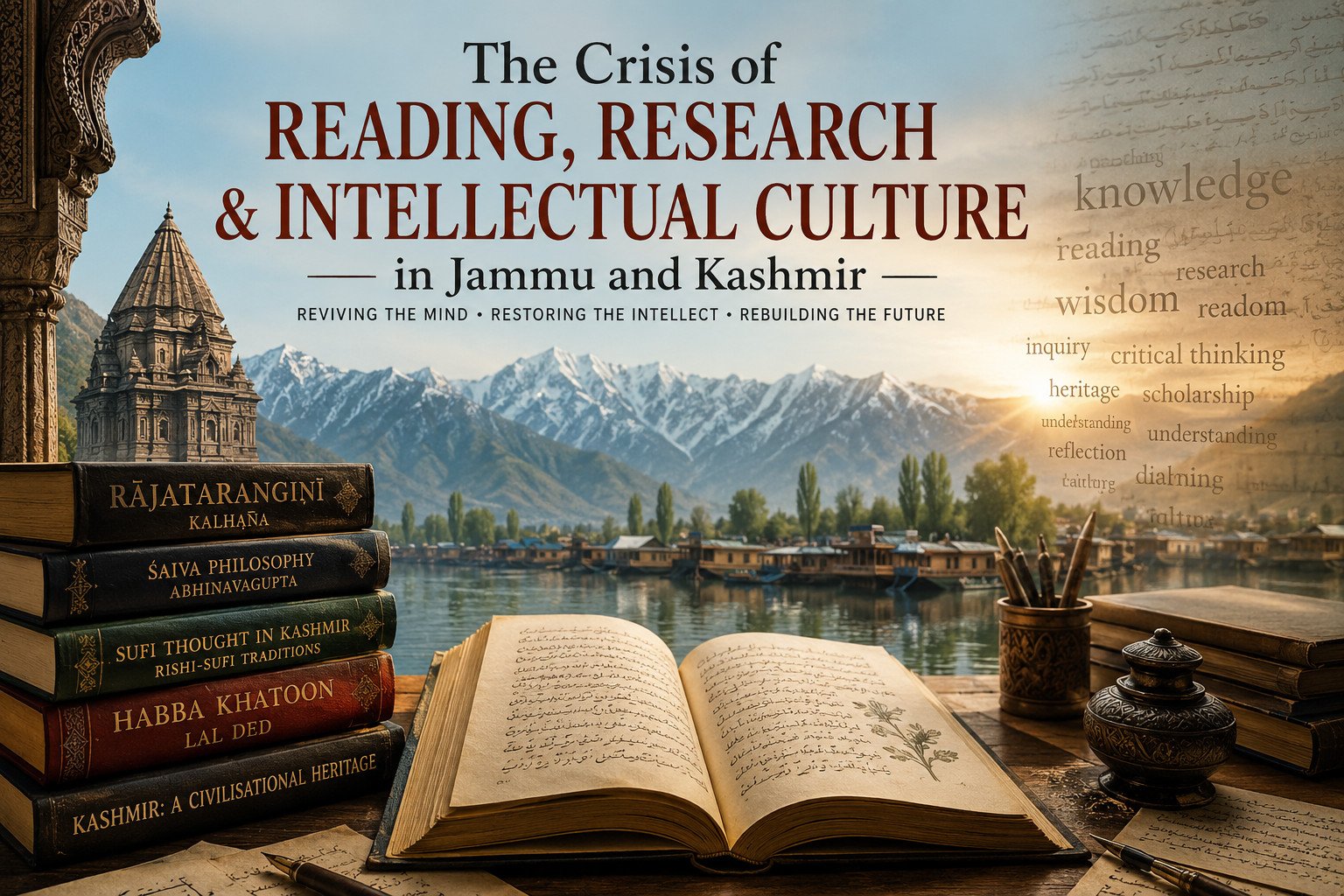
Jammu and Kashmir possesses one of the richest and most layered intellectual inheritances in the Indian subcontinent. Its history cannot be reduced to political conflict, territorial contestation or religious identity alone. For centuries, Kashmir represented a remarkable civilizational space in which literature, poetry, philosophy, theology, mysticism, architecture, historiography, astronomy, medicine, linguistics and diverse systems of knowledge interacted with one another. It produced thinkers and traditions whose intellectual influence travelled far beyond the Valley, while also absorbing ideas from Central Asia, Persia, the wider Indian subcontinent and other regions. The land that produced Kalhaṇa’s Rājataraṅgiṇī, one of the most remarkable works of historical writing in premodern India, also developed profound traditions of Śaiva philosophy, Buddhist thought, Sufi metaphysics, Persian and Kashmiri literature, poetry and mystical reflection. Its intellectual history demonstrates that Kashmir was never merely a recipient of ideas. It was, at important moments, a producer, interpreter and transmitter of knowledge.
The Kashmir of Abhinavagupta, Kalhaṇa, Lalleshwari, Nund Rishi, Habba Khatoon, Sheikh Yaqub Sarfi and numerous scholars, poets, philosophers, saints, chroniclers, architects, astronomers and teachers was not intellectually significant merely because exceptional individuals happened to be born there. These figures emerged from a wider culture in which knowledge was cultivated through institutions, traditions, disciplines, conversations and intellectual lineages. Scholarship involved sustained reading, debate, memorisation, interpretation, observation and, above all, humility before knowledge. A scholar was not simply a person who possessed information, held a title or occupied an institutional position. Scholarship demanded intellectual discipline. It required the recognition that the pursuit of knowledge was a lifelong process and that every answer could open the door to deeper questions.
This intellectual culture was also diverse in its methods. Knowledge was not organised according to the rigid categories that often define contemporary academic institutions. Philosophy could interact with aesthetics, mysticism with poetry, astronomy with mathematics, religious thought with ethics and social practice, and historical writing with political reflection. The boundaries between disciplines were often more porous because knowledge itself was understood as an interconnected enterprise. Kashmir’s intellectual heritage, whether located in Sanskritic, Buddhist, Persian, Islamic or indigenous Kashmiri traditions, reveals a civilisation that could absorb multiple intellectual worlds without necessarily surrendering its own distinctive character.
Yet one of the central questions confronting Jammu and Kashmir today is whether this civilizational inheritance continues to inform its contemporary intellectual life in any meaningful sense. The answer, unfortunately, appears increasingly uncertain. There is no shortage of institutions, universities, colleges, departments, conferences, seminars, journals, scholars, doctoral candidates, research projects or publications. There has perhaps never been a greater numerical expansion of higher education and formal research in the region. Thousands of dissertations and theses have been produced. Enormous resources have been invested in campuses, infrastructure, research programmes and accreditation processes. Rankings, impact factors, citations, institutional scores and various forms of academic measurement have become increasingly important. Yet the fundamental question remains: what has all this intellectual activity actually changed?
The crisis is not the absence of information. It is, paradoxically, the abundance of information without a corresponding culture of knowledge. We increasingly live in a world where information is mistaken for understanding, publication for scholarship, visibility for intellectual achievement and institutional affiliation for intellectual authority. The consequences of this confusion are visible across domains. A culture of speeches, ceremonies, conferences and public oratory has often displaced the slower and more demanding culture of reading. The ability to speak confidently is frequently mistaken for the ability to think deeply. The ability to quote selectively is mistaken for comprehension. The production of an article, dissertation or book is sometimes treated as evidence of scholarship irrespective of whether it introduces a serious argument, engages meaningfully with existing knowledge or contributes anything that can transform understanding.
The problem is not that Jammu and Kashmir lacks intelligent people. It possesses an enormous reservoir of talent, particularly among its young population. Nor is the problem a lack of access to educational institutions. The region has witnessed substantial expansion in higher education. The deeper crisis lies in the weakening of intellectual habits. Serious scholarship begins with reading, but reading itself appears to be losing its place as a disciplined practice. Reading does not mean merely scanning material for quotations, references or information that can support a pre-existing argument. It requires patience, attention, disagreement and the willingness to allow one’s assumptions to be challenged. A serious reader enters a text not simply to extract what is useful, but to understand the intellectual universe from which that text emerges.
Without such a culture of reading, research becomes shallow by necessity. A dissertation may contain hundreds of pages while possessing little intellectual depth. A research paper may contain dozens of citations while demonstrating minimal engagement with the works it cites. An academic may publish repeatedly while rarely contributing an original idea. Quantity then replaces quality as the dominant measure of intellectual productivity. The question becomes how many papers have been published, how many conferences attended, how many projects completed or how many citations accumulated. Far less frequently do we ask whether a particular work changed the way a problem was understood, generated a new policy approach, influenced public debate, improved an institution or transformed even a small intellectual community.
This is particularly significant in Jammu and Kashmir because the region faces challenges that demand serious and sustained intellectual engagement. Questions of ecology, climate change, water security, tourism, urbanisation, unemployment, education, social transformation, mental well-being, cultural preservation, border development, agriculture, technology and governance cannot be adequately addressed through ceremonial scholarship. They require long-term research, interdisciplinary collaboration and the ability to connect knowledge with policy. Yet much of the research ecosystem remains detached from the problems it claims to study. Research is frequently undertaken because a degree requires it, a career rewards it or an institutional system measures it. The result is a vast accumulation of academic material that often remains confined to university libraries, departmental repositories and professional circles.
Even when serious research is undertaken, another institutional failure becomes evident. Knowledge rarely travels from the researcher to the policymaker, administrator or community. There is an absence of effective mechanisms through which research findings can inform governance. A carefully researched study may identify weaknesses in education, environmental management, tourism policy or rural development, but there is often little institutional architecture to convert its findings into administrative experimentation or policy reform. Research and governance thus continue to operate in parallel worlds. Universities produce knowledge without necessarily shaping policy, while administrations formulate programmes without always drawing systematically upon the research capacities available within their own region.
This separation is one of the most serious failures of the contemporary knowledge ecosystem. A society cannot claim to value research merely by funding universities or celebrating academic accreditation. The ultimate significance of knowledge lies not only in publication but also in its capacity to deepen understanding and, where appropriate, transform reality. This does not mean that all scholarship must produce immediate utilitarian outcomes. Philosophy, literature, history and the study of culture possess intrinsic value beyond measurable economic or administrative returns. However, even non-utilitarian scholarship should enrich intellectual life, expand imagination, preserve knowledge, challenge assumptions and generate deeper forms of human understanding. When neither practical transformation nor intellectual enrichment takes place, the question of scholarly purpose becomes unavoidable.
Another feature of the present crisis is the increasing prevalence of what may be called performative intellectualism. There is a tendency to display knowledge rather than cultivate it. Public events are filled with speeches about civilisation, culture, history, development, spirituality, science and education, but sustained engagement with primary sources, serious scholarship and methodological questions is often missing. Oratory has its place, and public communication is essential in a democratic society. The problem arises when speech becomes a substitute for study. A society that speaks constantly about its intellectual heritage without reading the texts that constitute that heritage risks transforming knowledge into symbolism.
This tendency is also visible in the selective appropriation of tradition. Kashmir’s civilizational past is frequently invoked, but often in fragmented ways. Particular figures, episodes or traditions are highlighted according to contemporary preferences, while the complexity and plurality of the intellectual heritage is ignored. Genuine engagement with tradition demands more than celebration. It requires philology, translation, historical criticism, comparative study and an honest willingness to confront contradictions. It requires scholars who can read manuscripts, understand languages, reconstruct intellectual contexts and connect historical traditions with contemporary questions without artificially forcing the past to confirm present ideologies.
The challenge, therefore, is neither to reject tradition in favour of modernity nor to romanticise the past as a golden age. The task is to recover the intellectual methods that made Kashmir’s traditions dynamic in the first place. These included rigorous learning, transmission through teacher-student relationships, intellectual debate, engagement with competing ideas and a recognition that knowledge required moral as well as intellectual discipline. The traditional scholar was expected not merely to know but also to recognise the limits of what he or she knew. This humility is increasingly absent from contemporary intellectual culture.
The information explosion has intensified this problem. Digital technologies have made unprecedented quantities of material accessible. Artificial intelligence has further accelerated the ability to generate summaries, arguments, essays and apparently sophisticated academic language within seconds. These developments are not inherently destructive. They can democratise access to knowledge, assist research and improve productivity. However, they also create a dangerous illusion of competence. A person can now produce the appearance of scholarship without undergoing the process through which scholarship is traditionally formed. Artificial intelligence can generate a literature review, summarise complex thinkers and produce polished prose, but it cannot replace the intellectual labour of reading a text carefully, questioning an argument, verifying a source or developing an independent judgment.
The danger is the emergence of a new form of pseudo-scholarship in which rudimentary familiarity is presented as expertise. Information is assembled rapidly, terminology is borrowed from different disciplines and sophisticated language is used to conceal conceptual weakness. This produces work that may appear academic but lacks intellectual substance. The problem is particularly acute when institutional systems reward output more than originality. If a university primarily measures success through the number of papers, projects, citations or degrees, it should not be surprising when scholars adapt their work to those measurements.
The same problem exists beyond universities. Civil society organisations, think tanks, cultural institutions and public platforms also face the temptation to prioritise visibility over intellectual depth. The challenge for institutions is therefore not simply to add another voice to an already crowded public sphere. The real challenge is to create a different culture of knowledge. This requires resisting the pressure to produce constant commentary on every event and instead investing in slower, deeper and more sustained research. It requires reading groups, archives, translation projects, policy laboratories, interdisciplinary forums and long-term studies that remain with a problem long enough to understand it.
Jammu and Kashmir needs institutions capable of bridging the distance between knowledge and society. Universities should not function as isolated degree-producing spaces. Their research must enter public life. Think tanks should not become merely platforms for conferences and speeches. Their work should produce serious policy interventions. Government departments should develop stronger relationships with independent researchers and academic institutions. Scholars should be encouraged to work with administrators, communities, educators, environmentalists, technologists and other practitioners. Policy itself should become more receptive to evidence, experimentation and critical evaluation.
Equally important is the need to restore reading as a social practice. Libraries must become living intellectual spaces rather than silent repositories of books. Schools and colleges must encourage students to read beyond examination requirements. Universities must create environments where disagreement is intellectually productive rather than personally threatening. Young researchers should be taught not simply how to format a dissertation but how to formulate a question. Methodology should not be reduced to a compulsory chapter containing technical vocabulary. It should become a way of thinking about evidence, truth, interpretation and the limits of one’s conclusions.
The measure of intellectual success must also be reconsidered. Grades, jobs, positions, rankings, accreditation, publication counts and citation indexes may serve administrative purposes, but they cannot be the ultimate indicators of scholarship. A scholar with fewer publications may contribute more to human understanding than someone who produces a constant stream of technically compliant but intellectually insignificant work. The deepest measure of scholarship lies in intellectual seriousness, originality, rigour, humility and the capacity to produce transformation. That transformation may be internal, changing how individuals understand themselves and their world, or external, influencing institutions, policies, communities and public imagination.
Kashmir’s intellectual future will therefore depend on whether it can move beyond the celebration of knowledge towards the practice of it. The region does not need merely more conferences, more speeches, more ceremonial publications or more dissertations written to satisfy institutional requirements. It needs readers before writers, researchers before commentators and thinkers before performers. It needs scholars who are willing to spend years understanding a subject rather than weeks assembling information about it. It needs institutions that value the difficult and often invisible labour of intellectual formation.
The civilizational inheritance of Kashmir cannot be revived by nostalgia. It can only be renewed through intellectual work worthy of that inheritance. The objective should not be to reproduce ancient forms of knowledge exactly as they existed, but to recover their seriousness and combine it with the best methods and technologies of the contemporary world. Traditional knowledge systems, languages, texts and intellectual traditions must be critically studied and placed in dialogue with modern science, social research, technology and public policy.
Such a renewal would require a cultural shift. Knowledge must once again become something pursued for understanding, not merely for certification. Scholarship must become an ethical discipline rather than an institutional performance. Intellectual authority must emerge from learning rather than position. Technology, including artificial intelligence, must become an instrument of deeper inquiry rather than a shortcut around it. Most importantly, Jammu and Kashmir must rebuild the connection between knowledge and transformation.
The true crisis of reading, research and intellectual culture in Jammu and Kashmir is therefore not simply a crisis of institutions. It is a crisis of intellectual aspiration. A civilisation once distinguished by its ability to produce profound systems of thought must ask whether its contemporary knowledge ecosystem is capable of producing ideas equal to the challenges of its time. The answer will not be found in another accreditation certificate, another statistical report on publication output or another ceremonial declaration about the importance of education. It will emerge only when reading becomes deeper, research becomes more rigorous, scholarship becomes humbler and knowledge once again acquires the power to transform both the individual and the world beyond the institution.
Kashmir does not lack a great intellectual past. What it requires is the courage and seriousness to build an intellectual future worthy of it. The revival of that culture will not be measured by the number of scholars it produces, but by the depth of their questions, the integrity of their methods, the humility of their learning and the transformations their ideas are capable of generating. In that sense, the renewal of intellectual culture is not a luxury for Jammu and Kashmir. It is an essential condition for imagining and building a more thoughtful, confident and capable future.
About the Author