Author: Peerzada Muneer
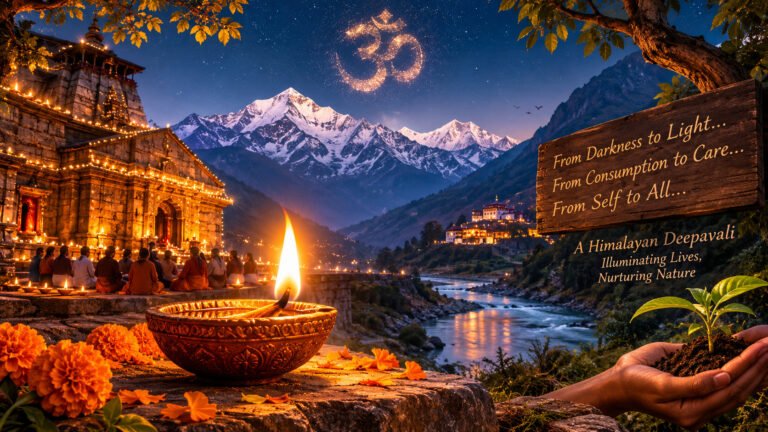
There is something profoundly paradoxical about celebrating light on the darkest night of the lunar month. Deepavali, or Diwali, takes place on Amavasya, when the moon withdraws its visible presence and darkness appears to possess the entire sky. Yet it is precisely on this night that millions of lamps are kindled, homes are illuminated, prayers are offered, and communities gather to celebrate renewal. Perhaps this is the festival’s most enduring philosophical proposition: light is not meaningful because darkness does not exist; it is meaningful because darkness exists, and yet need not have the final word. Deepavali, conventionally understood as a row of lamps, is consequently much more than an annual celebration of prosperity, religious victory, or domestic happiness. It represents humanity’s enduring negotiation with ignorance, suffering, uncertainty, mortality, and the possibility of renewal.
Deepavali: Historical Plurality, Religious Memories, and the Evolution of Celebration
The history of Deepavali cannot be adequately explained through one foundational event. Like many ancient Indian festivals, it developed through the gradual convergence of seasonal observances, agricultural rhythms, ritual practices, regional traditions, and religious interpretations. The Sanskrit expression Deepavali combines dīpa, meaning lamp, and āvali, meaning a row or series. Historical references to festivities involving lights appear in different literary and historical sources, including the Kamasutra, the Nāgānanda, and the Nīlamata Purana of Kashmir. P. K. Gode’s historical investigations, alongside references in Al-Biruni’s eleventh-century account of India and medieval inscriptions, provide important evidence for the antiquity and geographical spread of related celebrations. These references, however, must be interpreted carefully: not every ancient festival involving lamps was necessarily identical to contemporary Diwali. What they establish is that the cultural world from which Deepavali developed was considerably older and more diverse than its familiar modern narratives suggest.
Its historical development was also connected with seasonal and agricultural transitions. The period around October and November broadly corresponds to the conclusion of the monsoon and the transition towards winter in much of northern India. Such transitions historically provided occasions for thanksgiving, household purification, renewal of economic relationships, remembrance, and communal celebration. Cleaning homes, lighting lamps, preparing seasonal foods, worshipping prosperity, and exchanging gifts were embedded within the rhythms of agrarian and mercantile life. The festival thus connected religious imagination with the material conditions of existence.
The plurality of Deepavali becomes especially apparent in its Hindu interpretations. In northern India, its dominant association is with Rama’s return to Ayodhya after fourteen years of exile and his victory over Ravana. The illumination of Ayodhya signifies collective joy, the restoration of righteous sovereignty, and the return of moral order after a period of disruption. In several western and northern Indian traditions, the festival is associated with Lakshmi, the goddess of wealth, fertility, abundance, and auspiciousness. In southern India, Naraka Chaturdashi, commemorating Krishna’s destruction of Narakasura, receives particular prominence. In Bengal and certain eastern regions, the occasion is closely associated with Kali Puja, through which the divine feminine is approached in her fierce, protective, and transformative manifestations. These variations demonstrate that Deepavali is not a religiously uniform event but a constellation of interconnected traditions.
The festival also unfolds through a wider sequence of observances, commonly extending across five days. Dhanteras, or Dhantrayodashi, introduces the themes of wealth and health through its associations with Lakshmi and Dhanvantari, the divine physician connected with Ayurveda. Naraka Chaturdashi introduces purification and liberation from destructive forces. The principal Amavasya day is devoted in many traditions to Lakshmi Puja, frequently accompanied by the worship of Ganesha, whose association with discernment and auspicious beginnings suggests that prosperity requires wisdom. Govardhan Puja and Annakut, observed on the following day, introduce an ecological dimension through the celebration of the mountain, pastures, cattle, water, agricultural resources, and nourishment. Bhai Dooj concludes the familiar sequence in many regions by celebrating familial affection and responsibility. Taken together, these observances move from material resources to health, from purification to illumination, and from ecological gratitude to social reciprocity.
The significance of Deepavali becomes even more interesting when considered alongside Jainism and Sikhism. Jain tradition associates the occasion with the nirvana of Mahavira, the twenty-fourth Tirthankara, at Pavapuri. The lamps illuminated by his followers are understood in relation to the light of knowledge and the departure of the enlightened teacher. Here, illumination signifies liberation from karmic bondage rather than material acquisition or political victory. The Jain emphasis on ahimsa also offers a particularly important ethical interpretation: spiritual illumination remains incomplete without compassion towards living beings.
For Sikhs, Diwali is associated with Bandi Chhor Divas, commemorating the release of the sixth Guru, Guru Hargobind Sahib, from imprisonment at Gwalior Fort during the reign of Jahangir. Sikh historical tradition remembers that the Guru secured the release of fifty-two imprisoned rulers alongside his own. The significance of this event exceeds the celebration of an individual’s freedom. The designation Bandi Chhor means the liberator of prisoners; liberation becomes a moral responsibility rather than an exclusively personal achievement. Freedom remains incomplete when it is enjoyed by oneself while others continue to suffer imprisonment. The Sikh principles of seva, sarbat da bhala and miri-piri consequently provide a framework for understanding the occasion through justice, collective responsibility, and the welfare of all.
Diwali also became an important occasion for Sikh congregational gatherings and collective deliberation. The historical association of such assemblies with the Sarbat Khalsa, alongside the martyrdom of Bhai Mani Singh in connection with the attempted Diwali assembly of 1737, reveals its significance as a site of collective memory, resistance, and institutional solidarity. The illumination of Harmandir Sahib in Amritsar therefore recalls not merely celebration but also liberation, sacrifice, and historical endurance.
The historical transformation of Deepavali is inseparable from the changing material conditions of Indian society. It would be simplistic to imagine that ancient India celebrated the festival in precisely the manner in which contemporary households do. Clay oil lamps, household purification, natural decorations, seasonal foods, worship, and community exchange were historically important, although practices varied considerably across regions and periods. With the development of urban centres, mercantile networks, royal patronage, temple institutions, and expanding markets, the public and commercial dimensions of festivals gradually developed. Abul Fazl’s Ain-i-Akbari, for instance, records the festival within its account of Indian social and cultural life.
Modernity has transformed its material expression even more dramatically. Industrial manufacturing, electrical infrastructure, mass advertising, urbanisation, increasing disposable incomes, and consumer markets have introduced elaborate decorations, commercial fireworks, expensive gifts, and digitally mediated celebrations. There is nothing inherently objectionable about technological innovation or economic prosperity. The difficulty arises when the symbolic meaning of a festival becomes subordinated to the logic of consumption. Purchasing gold, clothing, electronic goods, and other commodities is increasingly presented as an essential expression of auspiciousness, while social media converts domestic celebration into a performance of prosperity. The experience of togetherness can consequently become overshadowed by the pressure to acquire, decorate, photograph, and exhibit.
This transformation produces a particularly serious contradiction. The festival that symbolises the triumph of light over darkness can generate environmental darkness through air pollution, noise, chemical contamination, electricity consumption, and waste. Research published in Mausam documented significant increases in particulate matter and gaseous pollutants associated with Diwali fireworks in Delhi during 2013–2015. Subsequent environmental research has similarly identified substantial pollution increases during fireworks events. The issue, therefore, is not whether religious devotion should be criticised, but whether practices associated with celebration can justifiably compromise the health of other living beings. The most meaningful historical continuity may lie not in preserving every existing ritual form but in recovering the ethical and philosophical purposes that gave those forms significance.
The Metaphysics of Light: Deepavali, Human Consciousness, and the Crisis of Modernity
The deeper significance of Deepavali emerges when it is read beyond its historical narratives and ritual expressions. Its lamp can be understood as a metaphor for consciousness, knowledge, ethical responsibility, and the possibility of transformation. The Upanishadic invocation Tamaso mā jyotir gamaya—lead me from darkness to light—provides an especially illuminating philosophical framework. Darkness here need not signify the physical absence of light; it represents ignorance, confusion, attachment, and the inability to recognise the deeper nature of existence. Light, correspondingly, signifies knowledge, discernment, self-realisation, and an awakened relationship with reality. The movement towards light is not necessarily the acquisition of something external; it may instead involve uncovering what has remained obscured within consciousness.
The Bhagavad Gita provides another interpretive dimension through its discussions of dharma, self-mastery, attachment, and ethical action. Rama’s victory over Ravana, for example, may be read as the restoration of moral order and the struggle against destructive desire. Yet symbolic interpretation should deepen historical and theological understanding rather than reduce complex narratives to simplistic psychological allegories. Similarly, the association with Lakshmi invites us to reconsider prosperity itself. Can wealth be understood independently of justice, ecological stability, generosity, and the well-being of others? Wealth accumulated through exploitation or environmental destruction may be materially impressive but philosophically impoverished.
The Jain interpretation offers a particularly powerful corrective. Mahavira’s liberation represents freedom from karmic entanglement, inseparable from the ethical discipline of non-violence. The Sikh understanding of Bandi Chhor Divas similarly establishes that freedom acquires its deepest moral significance when it includes the liberation of others. Rama’s return, Mahavira’s nirvana, and Guru Hargobind’s release belong to distinct religious histories, yet their association with Deepavali opens a broader philosophical question: what does it mean to overcome darkness? Is it merely the removal of external constraints, or does it also require the transformation of consciousness, the restoration of justice, and responsibility towards others?
The lamp itself offers a profound mystical metaphor. It does not abolish the night; it illuminates a limited space within it. Its light is finite, vulnerable, and dependent upon fuel, yet its vulnerability does not diminish its significance. Human beings, similarly, may not possess the power to eliminate all suffering or injustice, but they retain the responsibility to resist them. A single lamp illuminates a small space; thousands of lamps create a landscape of collective illumination. The light of one does not diminish when another is kindled. Knowledge, compassion, freedom, and ethical responsibility are not finite commodities. Deepavali thus invites a movement from possessive existence towards participatory existence.
This symbolism acquires particular urgency in the contemporary post-truth and capitalist age. We inhabit a world in which information circulates at unprecedented speed, yet the capacity to distinguish truth from manipulation is increasingly contested. Algorithmic amplification, ideological polarisation, misinformation, commercial interests, and the commodification of attention have produced an epistemic crisis in which factual accuracy competes with emotional gratification and manufactured perceptions. The contemporary struggle against darkness must therefore involve intellectual responsibility: the ability to question, verify, deliberate, and distinguish genuine knowledge from convenient falsehood. The lamp becomes a metaphor for intellectual integrity and the responsibility to illuminate public life rather than contribute to its confusion.
Consumer capitalism presents an equally serious challenge. Contemporary culture frequently equates happiness with acquisition and prosperity with the visible accumulation of commodities. Yet wealth and well-being are not identical. A society may experience economic growth while witnessing increasing inequality, environmental degradation, psychological distress, and the erosion of community relationships. Deepavali’s association with Lakshmi should therefore encourage a more comprehensive understanding of prosperity, one that includes health, justice, generosity, social responsibility, and ecological stability. The perennial wisdom of the festival does not demand the rejection of material prosperity; it requires its ethical transformation.
Towards a Himalayan Deepavali: Ecological Wisdom, Ethical Prosperity, and the Perennial Art of Living
If Deepavali is to recover its perennial significance, the Himalayas offer a particularly meaningful philosophical and ecological framework through which to reinterpret it. The Himalayas are not simply a geographical mountain system but a civilisational landscape in which nature, spirituality, livelihood, memory, and cultural imagination have historically remained interconnected. Rivers, glaciers, forests, mountains, springs, pastures, and sacred sites are not merely physical resources; they have also constituted the foundations of religious imagination, community identity, and everyday existence. In many Himalayan traditions, a river is simultaneously a source of water, a livelihood resource, and a sacred presence; a mountain is both an ecological system and an object of reverence. Such relationships resist the separation of the sacred from the material.
The ecological significance of Govardhan Puja becomes particularly relevant here. Krishna’s protection of the inhabitants of Braj and his association with Govardhan invite reflection upon the ecological conditions that sustain collective life. The mountain, pastures, cattle, water, and soil constitute an interdependent world. The Himalayan landscape makes this interdependence especially visible. Its rivers originate in glaciers and snowfields; agriculture depends upon seasonal precipitation and water availability; forests regulate hydrological systems and soil stability; and settlements remain vulnerable to landslides, floods, cloudbursts, and other environmental disturbances. Ecological destruction is consequently not an abstract concern but a direct threat to livelihoods, cultural continuity, public health, and the future of communities.
Kashmir provides a particularly compelling cultural and philosophical setting for this reflection. Its religious and intellectual traditions have long explored the relationship between consciousness, nature, and existence. Kashmir Shaivism, especially the Pratyabhijna tradition, develops an elaborate understanding of consciousness through the concepts of Prakasha (illumination) and Vimarsha (self-reflexive awareness). Consciousness is not merely a passive light through which objects become visible; it possesses the capacity to recognise itself and its own manifestations. This offers an interesting philosophical parallel to Deepavali: the light that illuminates the external world must also turn inward, enabling human beings to examine their conduct, desires, and relationship with the world. This is not a claim that Kashmir Shaivism historically originated Deepavali, but rather that its philosophical resources can deepen the festival’s contemporary interpretation.
The wider Himalayan world also contains traditions of reverence for sacred groves, springs, mountains, and forests, alongside community practices of collective resource management. These traditions should not be romanticised as universally sustainable, nor should contemporary scientific knowledge be displaced by appeals to inherited wisdom. Their significance lies in demonstrating that human relationships with nature can be organised through obligations, restraint, reciprocity, and reverence rather than unrestricted extraction. Himalayan wisdom, in this sense, is not simply the romantic celebration of mountains; it is the recognition that human flourishing is inseparable from ecological flourishing.
A Himalayan Deepavali would therefore require a reconsideration of the relationship between ritual and ecology. The objective would not be to abandon celebration but to recover forms of celebration compatible with the continued flourishing of human and non-human life. Locally produced clay lamps and responsibly sourced materials could restore the significance of traditional illumination while supporting local artisans. Reducing polluting fireworks and excessive noise would express concern for public health, animals, and fragile ecosystems. Govardhan Puja and Annakut could become occasions for renewing relationships with local food systems, farmers, pastoralists, forests, and water sources through seasonal produce, reduced food waste, and community meals. The principles of dāna, seva, and sarbat da bhala could be translated into practical commitments to support vulnerable households, displaced communities, artisans, and those whose livelihoods are threatened by ecological change.
The festival could also become an occasion for ecological restoration through the protection of community forests, restoration of traditional springs, conservation of native species, and cleaning of local water bodies. Such initiatives must be scientifically informed and ecologically appropriate; poorly planned plantation drives or unsuitable species can themselves cause environmental harm. Equally important would be the recovery of silence and contemplation as dimensions of celebration. The stillness of snow-covered mountains, the sound of flowing water, the emergence of dawn, and the quiet presence of a lamp in a mountain dwelling suggest that celebration need not always be measured through spectacle. Reflection, prayer, storytelling, music, shared meals, and intergenerational conversations can restore its contemplative character.
A Himalayan Deepavali must ultimately cultivate an ethic of intergenerational responsibility. The mountains are inherited from previous generations, but they are also held in trust for generations yet to come. A celebration that leaves future inhabitants with polluted rivers, depleted forests, unstable landscapes, and degraded ecosystems contradicts the very idea of auspicious renewal. This approach does not demand the rejection of modern technology or economic development; it asks that both be evaluated through ecological knowledge, scientific evidence, cultural sensitivity, and long-term responsibility.
The enduring significance of Deepavali lies in its capacity to renew the human imagination. Its historical narratives speak of return, liberation, victory, enlightenment, and the restoration of ethical order. Its religious philosophies invite reflection upon knowledge, non-violence, justice, self-realisation, and the responsibilities accompanying prosperity. Yet its perennial wisdom cannot be preserved merely through the repetition of inherited forms. Traditions remain alive when their underlying principles respond meaningfully to changing historical circumstances. The ancient aspiration to move from darkness to light must, in our time, acquire an ecological, intellectual, and social meaning: from ignorance towards knowledge, exploitation towards reciprocity, excess towards sufficiency, and indifference towards compassion.
Perhaps, therefore, the most important question to ask on Deepavali is not how many lamps we have illuminated, but what kind of darkness we have allowed to persist. A lamp outside the house is beautiful, but a lamp of compassion within society is indispensable. A decorated home is auspicious, but a protected river is equally so. The acquisition of wealth may bring comfort, but the ability to share it brings ethical fulfilment. The celebration of freedom is meaningful, but freedom becomes morally complete only when it includes concern for those who remain unfree.
The Himalayan understanding of Deepavali would thus be a celebration in which the lamp does not compete with the stars, the human being does not dominate the mountain, and prosperity does not come at the expense of the earth. It would be a festival in which illumination becomes an act of care. The perennial wisdom of Deepavali is not merely that light triumphs over darkness; it is that light must become a way of living. To light a lamp on the darkest night is ultimately not to deny the darkness of the world, but to accept our responsibility for making it less dark.
References
- Gode, P. K. (1945). Studies in the history of Hindu festivals: Some notes on the history of Divālī festival (between c. A.D. 50 and 1945). Annals of the Bhandarkar Oriental Research Institute, 26(3/4), 216–262.
- Kane, P. V. (1958). History of Dharmaśāstra (Vol. V, Part I). Bhandarkar Oriental Research Institute.
- Al-Bīrūnī. (1910). Alberuni’s India (E. C. Sachau, Trans.). Kegan Paul, Trench, Trübner & Co.
- Abū al-Fażl ibn Mubārak. The Ain-i-Akbari (H. S. Jarrett, Trans.). Asiatic Society.
- Vālmīki Rāmāyaṇa.
- Śrīmad Bhagavad Gītā.
- Bṛhadāraṇyaka Upaniṣad.
- Chāndogya Upaniṣad.
- Skanda Purāṇa.
- Padma Purāṇa.
- Nīlamata Purāṇa.
- Kāmasūtra of Vātsyāyana.
- Nāgānanda of King Harṣavardhana.
- Jaini, P. S. (1979). The Jaina Path of Purification. University of California Press.
- Jaini, P. S. (2000). Collected Papers on Jaina Studies. Motilal Banarsidass.
- Singh, H. (Ed.). (1992). The Encyclopaedia of Sikhism. Punjabi University, Patiala.
- Singh, K. (1963). A History of the Sikhs (Vol. I). Princeton University Press.
- Dyczkowski, M. S. G. (1987). The Doctrine of Vibration: An Analysis of the Doctrines and Practices Associated with Kashmir Shaivism. State University of New York Press.
- Muller-Ortega, P. E. (1989). The Triadic Heart of Śiva: Kaula Tantricism of Abhinavagupta in the Non-Dual Shaivism of Kashmir. State University of New York Press.
- Singh, J. (Trans.). (1980). Pratyabhijñāhṛdayam: The Secret of Self-Recognition. Motilal Banarsidass.
- Torella, R. (2002). The Īśvarapratyabhijñākārikā of Utpaladeva: With the Author’s Vṛtti. Motilal Banarsidass.
- Lawrence, D. P. (1999). Rediscovering God with Transcendental Argument: A Contemporary Interpretation of Monistic Kashmiri Śaiva Philosophy. State University of New York Press.
- Peshin, S. K., Sinha, P., & Bisht, A. (2017). Impact of Diwali firework emissions on air quality of New Delhi, India during 2013–2015. MAUSAM, 68(1), 111–118. https://doi.org/10.54302/mausam.v68i1.438.
- Fuller, R., et al. (2022). Pollution and health: A progress update. The Lancet Planetary Health.
About the Author