Author: Zahid Sultan (Kashmir Based Independent Researcher)
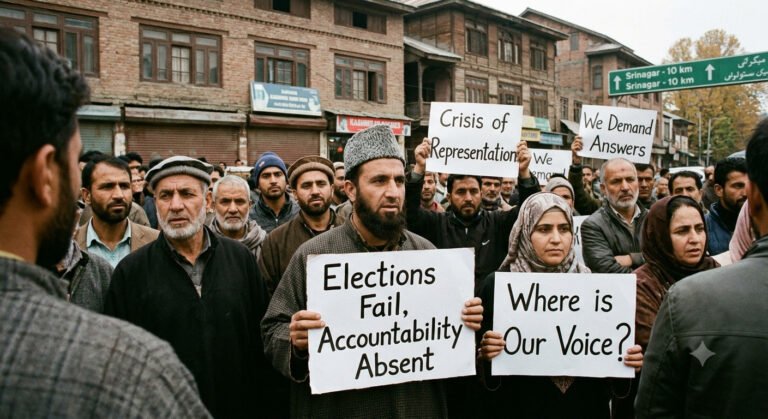
The central crisis of democracy in Kashmir is not necessarily the absence of electoral participation; it is the widening distance between electoral participation and substantive political accountability. Elections may periodically renew the legitimacy of political representatives, but they do not, by themselves, guarantee that those entrusted with public authority will become answerable to the people they claim to represent. This distinction is particularly consequential in a political setting where questions of constitutional status, institutional autonomy, political identity and the relationship between the state and society have historically occupied an overwhelming share of public discourse. The problem, therefore, is not simply whether Kashmiris vote, or whether political parties succeed in mobilising them. It is whether the electoral process produces a political class capable of translating popular preferences into accountable government, institutional reform and demonstrable improvements in public life.
The distinction between representation and accountability is fundamental to democratic theory. Representation is not exhausted by the act of authorising someone to exercise political power; it also entails a continuing relationship of responsiveness, justification and responsibility. A representative does not acquire an unrestricted political mandate merely because a majority of voters have endorsed them. Electoral victory confers an obligation to govern, explain decisions, defend public interests and remain answerable for institutional performance. When this relationship becomes attenuated, democracy risks being reduced to a periodic exercise in political authorisation, detached from the everyday expectations through which citizens evaluate their representatives. In such circumstances, elections remain meaningful as political events, but their capacity to discipline power becomes considerably weaker.
The 2024 Assembly elections in Jammu and Kashmir were invested with precisely this expectation of democratic re-entry. After the dissolution of the erstwhile Assembly in 2018, the reorganisation of the former state in 2019 and an extended period of central administration, the return of an elected legislature carried significance beyond the ordinary transfer of political power. The electorate was presented with an opportunity to reassert its political agency through the ballot. The National Conference emerged as the largest party with 42 seats in the 90-member Assembly, while the Bharatiya Janata Party secured 29. The Congress won six seats, and the People’s Democratic Party, which had secured 28 seats in 2014, was reduced to three. The results indicated a substantial reconfiguration of the political landscape. They also demonstrated that electoral behaviour in Jammu and Kashmir could not be adequately explained through the familiar categories of political loyalty and ideological allegiance alone.
The significance of this election, however, lies as much in the expectations it generated as in the arithmetic of its outcome. For an electorate that had experienced prolonged political uncertainty and an institutional displacement of its elected representatives, voting represented an opportunity to recover a measure of political efficacy. Yet, the restoration of an electoral process should not be confused with the restoration of representative government in its substantive sense. A legislature can be elected without possessing the institutional authority necessary to exercise meaningful control over the executive apparatus. Likewise, a government can enjoy electoral legitimacy while remaining constrained in its ability to fulfil the expectations on which its mandate was secured. The distinction between the existence of elected institutions and their effective capacity is therefore indispensable to understanding the contemporary predicament of Jammu and Kashmir.
The present institutional arrangement has produced a particularly complicated structure of responsibility. Jammu and Kashmir continues to function as a Union Territory, with an elected government operating alongside a Lieutenant Governor who exercises constitutionally and statutorily defined powers over significant areas, including public order, police and specified administrative matters. The reorganisation framework, together with the subsequent changes to the Transaction of Business Rules, has created an asymmetry between electoral authority and administrative control. This is not a peripheral constitutional difficulty. It has direct implications for the relationship between citizens, elected representatives and the bureaucracy.
The democratic problem becomes apparent when responsibility and authority cease to coincide. Citizens approach their elected representatives with demands concerning employment, infrastructure, public services, land administration and local development. Representatives, in turn, are expected to secure administrative responses. But when the authority required to act is located elsewhere, the representative’s capacity to deliver becomes contingent upon institutions over which they exercise limited control. The result is a fragmented chain of accountability in which citizens may hold elected representatives responsible for decisions they cannot independently make, while administrative authorities exercise powers without being directly answerable to the electorate through the same representative relationship.
This institutional disjunction has been reported by several elected legislators themselves. In January 2026, Scroll documented complaints from members of the Assembly about bureaucratic unresponsiveness, administrative delays and the constraints experienced by legislators in addressing constituency-level demands. Their accounts suggested that the elected representative’s relationship with the administrative machinery had undergone a significant alteration. Such complaints should not automatically be accepted as a complete explanation of governance failures; legislators also have an interest in defending their institutional relevance. Nevertheless, they point towards a serious democratic question: what is the substantive value of electoral representation when the institutions expected to respond to elected representatives operate through a different chain of authority?
Yet it would be analytically inadequate to attribute the entire crisis of political representation to the post-2019 constitutional arrangement. Institutional centralisation is an important part of the explanation, but it does not absolve the political class of its own historical responsibilities. The weaknesses of representative politics in Kashmir predate the reorganisation of the state. Political patronage, personalised leadership, uneven accountability, factional competition and the recurrent conversion of public grievances into electoral mobilisation have long complicated the relationship between citizens and political parties. The institutional constraints of the present cannot retrospectively erase the failures of the past.
One of the persistent weaknesses of electoral politics in Kashmir has been the tendency to privilege political symbolism over the sustained articulation of a governance agenda. Constitutional questions, political identity, autonomy and the relationship between Kashmir and the Union have understandably occupied a central place in electoral discourse. These are not artificial concerns, nor can they be dismissed as distractions from material governance. Constitutional arrangements determine the distribution of power, the scope of political agency and the institutional conditions under which citizens are governed. The problem emerges when these questions become an almost exclusive vocabulary of political competition, leaving insufficient space for a serious examination of public administration, economic policy, institutional performance and social development.
Political parties frequently mobilise around the language of historical grievance, political betrayal and constitutional restoration. Such mobilisation may be electorally effective because it speaks to deeply embedded political anxieties. But the capacity to articulate a grievance should not be mistaken for the capacity to resolve it. A political class that repeatedly invokes public discontent without developing a credible programme of institutional correction risks turning grievance into a permanent political resource. The electorate is then invited to participate in an endless cycle of political anticipation: the next election will restore dignity, the next government will deliver justice, and the next political arrangement will resolve the accumulated contradictions of the past. The promise of political transformation becomes renewable precisely because its fulfilment remains indefinitely deferred.
There is, in this respect, a troubling distinction between the politics of representation and the politics of mobilisation. Representation requires a continuing engagement with the consequences of public decisions. Mobilisation, by contrast, can survive on the intensity of political sentiment. It can generate electoral enthusiasm without necessarily producing institutional competence. A party may successfully mobilise voters around a constitutional demand, a regional identity or a collective grievance, but the more demanding test begins after it assumes office. How does it approach unemployment? What is its policy towards the declining quality of public education? How does it address the weaknesses of municipal governance, healthcare delivery and local administration? What institutional mechanisms does it establish to make public officials answerable? These questions are not secondary to the larger political question. They constitute the everyday substance of democratic government.
The problem is also reflected in the condition of political opposition. A functioning democracy requires more than a government that periodically faces an electoral challenge. It requires an Opposition capable of scrutinising public expenditure, interrogating policy decisions, exposing administrative failures and presenting credible alternatives. Opposition politics cannot be reduced to the production of criticism, nor can parliamentary confrontation be treated as an adequate substitute for legislative scrutiny. The purpose of an Opposition is not merely to demonstrate that the government is wrong; it is to establish, through evidence and argument, how public policy could be made better.
Unfortunately, electoral competition in Kashmir has often been characterised by a limited conception of political disagreement. Parties may contest each other’s legitimacy, question their historical positions or invoke competing claims of political authenticity, but these confrontations do not necessarily translate into sustained policy competition. The result is an impoverished democratic conversation in which political parties are frequently more concerned with establishing their credentials as authentic representatives of public sentiment than with demonstrating their capacity to govern. The electorate is left with competing claims to represent the people, without a sufficiently rigorous comparison of what each party proposes to do with the authority it seeks.
The consequences are visible in the political economy of public expectations. Government employment, for instance, remains one of the most consequential electoral concerns among educated youth. Yet the dependence on public recruitment as the principal measure of economic opportunity reflects a deeper structural problem. A serious political programme must address the relationship between education and employment, private investment, industrial diversification, entrepreneurship and the productive capacity of the regional economy. It must also explain why educational attainment has not translated into proportionate economic opportunity. Promises of recruitment may provide immediate political reassurance, but they cannot substitute for a coherent employment strategy. The same applies to healthcare, public transport, urban planning and environmental protection. These issues require sustained institutional attention rather than episodic electoral recognition.
There is also a tendency to personalise political representation. The representative is increasingly imagined as an individual capable of securing administrative favours, intervening in local disputes or facilitating access to public resources. Constituents consequently evaluate representatives not only through their legislative performance but also through their capacity to obtain individualised benefits. This relationship is politically understandable in an environment where administrative procedures are often experienced as inaccessible or unresponsive. Yet it carries a democratic cost. When access to public services depends excessively upon personal intervention, the distinction between citizenship and patronage begins to weaken. Citizens cease to approach the state primarily through enforceable rights and increasingly depend upon the mediation of politically influential individuals.
Such a system may produce visible forms of constituency-level responsiveness, but it does not necessarily strengthen democratic institutions. Indeed, it can reproduce the very administrative dependence that representative politics is supposed to overcome. The representative becomes a broker between the citizen and the bureaucracy rather than an institutional agent working to make the bureaucracy answerable to citizens. Political influence is then measured through the capacity to secure exceptions, not through the ability to improve rules and procedures for everyone. This is a particularly consequential limitation in a society where institutional trust and administrative accessibility remain central public concerns.
The deeper issue, therefore, concerns the nature of political accountability itself. Accountability has at least three dimensions. Electoral accountability requires representatives to answer to citizens at the ballot box. Institutional accountability requires the executive to remain answerable to the legislature and other constitutional bodies. Social accountability requires public institutions and political representatives to remain open to scrutiny by citizens, journalists, civil society and independent intellectual debate. A democracy becomes fragile when these dimensions are disconnected. Elections may continue, but legislative scrutiny can remain weak; public criticism may exist, but institutional responses may be limited; and political representatives may retain their electoral legitimacy without developing a corresponding culture of public justification.
The crisis in Kashmir should also be understood through this broader framework. The electorate cannot be expected to shoulder the entire burden of democratic accountability. Citizens can vote representatives into office, question their decisions and withdraw support at subsequent elections. But the effectiveness of these mechanisms depends upon the institutional environment in which political authority operates. A representative legislature must possess meaningful powers of scrutiny. The bureaucracy must function within a transparent and intelligible framework of responsibility. Local government institutions must have adequate authority and resources. The media and civil society must be able to examine public decisions without political intimidation or institutional indifference. Without these conditions, electoral participation risks becoming an isolated democratic achievement rather than the foundation of an accountable political order.
Equally, the Union Government cannot invoke the restoration of electoral politics as sufficient evidence of democratic normalisation while leaving unresolved the institutional questions that determine the effective authority of elected representatives. The restoration of statehood, the clarification of executive responsibilities and the strengthening of legislative authority are therefore not merely demands of political symbolism. They concern the basic democratic principle that those who exercise public power must be identifiable and answerable. However, the restoration of statehood, important as it is, should not become an excuse for the elected political class to postpone its own responsibilities. Greater institutional authority must be accompanied by greater institutional accountability.
The political class in Kashmir faces a choice that it has too often avoided. It can continue to treat electoral politics as a contest over historical legitimacy, political identity and the ownership of collective grievances, or it can begin to regard representation as an obligation that extends beyond the electoral calendar. The former may sustain political relevance; the latter is necessary for democratic credibility. This requires a transformation in political practice: manifestos that contain measurable commitments, legislative sessions devoted to substantive scrutiny, public reporting on the implementation of promises, transparent recruitment processes, stronger local institutions and a willingness among political parties to defend positions through reasoned argument rather than emotional mobilisation.
Ultimately, the crisis of political representation in Kashmir is not simply that elected representatives lack sufficient power, although this remains an important institutional concern. It is also that the political relationship between the representative and the represented has not been adequately reconstructed around accountability. The electorate is repeatedly invoked as the ultimate source of political legitimacy, but its everyday concerns do not always occupy a corresponding place in the priorities of political institutions. The people are central to electoral rhetoric, yet their capacity to demand explanations, evaluate outcomes and influence the conduct of government remains uneven.
Democracy cannot be sustained by the periodic celebration of electoral participation alone. Its credibility depends upon what happens between elections: whether public institutions respond, whether representatives explain, whether governments accept scrutiny and whether political promises acquire measurable consequences. The ballot is an instrument of democratic authorisation, not a permanent certificate of political innocence. Those who receive a mandate must remain answerable for how they exercise it; those who oppose them must demonstrate that they are capable of offering an alternative; and those who govern through appointed authority must be subject to transparent institutional responsibility.
Kashmir does not need a political class that merely speaks in the name of the people. It needs one that is prepared to answer them. The distinction is fundamental. For democracy to become more than an electoral ritual, representation must cease to be a claim of political ownership and become an enforceable relationship of public responsibility. The real test of democratic politics is not how successfully leaders invoke the electorate before an election, but how seriously they respond to its demands after acquiring power. Until that relationship is restored, elections may continue to produce governments, but they will remain insufficient to produce the accountability on which democratic legitimacy ultimately depends.
About the Author