Author: Peerzada Muneer
Introduction
The mountains of Jammu and Kashmir constitute much more than a geographical feature; they are the ecological, economic and social foundation of the region’s developmental existence. From the Pir Panjal and Greater Himalayan ranges to the mountainous districts of Chenab Valley, Pir Panjal and the northern border regions, the mountain ecosystem sustains river catchments, forests, agricultural systems, biodiversity and a substantial proportion of rural livelihoods. It also provides the natural foundation for tourism, horticulture, hydropower and other economic activities. However, this ecological wealth is accompanied by considerable vulnerability. Steep slopes, fragile geological formations, climatic variability, seismic exposure and increasing human intervention make mountain environments particularly sensitive to poorly planned development.
For several decades, the development discourse in Jammu and Kashmir has understandably emphasised infrastructure creation, road connectivity, tourism expansion, energy generation and improved access to public services. These priorities remain important, particularly for geographically isolated and economically underserved communities. Nevertheless, the growing frequency of environmental disruptions raises an important policy question: can conventional development models adequately address the distinctive ecological and geographical conditions of a Himalayan region? A road that improves connectivity but destabilises a hillside, a tourism destination that generates income but exceeds local water and waste-management capacity, or an infrastructure project that creates economic assets while increasing downstream disaster exposure may produce immediate developmental gains at considerable long-term cost.
The need for a different approach has acquired renewed significance following the 13th Sustainable Mountain Development Summit held at Sher-e-Kashmir University of Agricultural Sciences and Technology of Kashmir (SKUAST-K), Srinagar, from 12 to 14 October 2026, in collaboration with the Integrated Mountain Initiative. The summit brought the formulation of a dedicated Sustainable Mountain Development Policy for Jammu and Kashmir into the policy discourse. The Chief Minister called for a practical and locally grounded approach that balances environmental protection, economic development and livelihoods, while the Lieutenant Governor emphasised science-based planning, climate-resilient infrastructure, regenerative livelihoods and a zero-waste mountain economy.
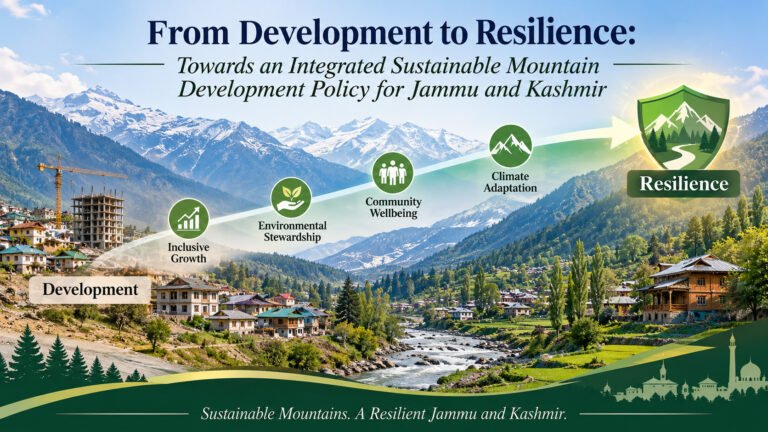
This emerging policy initiative provides an important opportunity to move beyond the treatment of environmental protection as a supplementary consideration in development planning. Jammu and Kashmir requires a transition from development measured primarily through infrastructure expansion and economic output to development evaluated through ecological stability, livelihood resilience and institutional capacity. Such a transition does not imply restricting development; rather, it requires making development geographically appropriate, environmentally sustainable and socially inclusive.
The Development–Ecology Dilemma in Jammu and Kashmir
The principal challenge confronting mountain development in Jammu and Kashmir arises from the contradiction between the developmental requirements of its population and the ecological limitations of its terrain. Mountain communities require roads, schools, hospitals, electricity, markets, telecommunications and employment opportunities. Yet the construction and expansion of these facilities, when undertaken without adequate attention to geological conditions, drainage patterns, slope stability and land-use characteristics, can increase environmental vulnerability.
Road infrastructure provides a particularly important illustration. Difficult terrain makes road connectivity indispensable for access to healthcare, education, agricultural markets and emergency services. However, indiscriminate hill cutting, inadequate slope stabilisation, inappropriate drainage arrangements and the disposal of excavated material can contribute to landslides and repeated damage to public infrastructure. The resulting cycle of construction, environmental disturbance, damage and reconstruction imposes costs upon public finances while exposing communities to additional risks. Addressing this problem requires a shift from evaluating infrastructure primarily through construction expenditure and connectivity achieved to assessing its entire life-cycle costs, including environmental degradation, maintenance requirements and disaster exposure.
Tourism presents a similar dilemma. The expansion of tourism has created employment and entrepreneurial opportunities, but concentrated tourist activity in ecologically sensitive destinations can place pressure on water resources, waste-management systems, sewage infrastructure and local habitats. The Chief Minister’s observations at the October 2026 summit regarding the need to develop tourism destinations with adequate sewage and solid-waste management arrangements are significant in this context. The policy challenge is not to discourage tourism but to ensure that its expansion is consistent with the environmental and infrastructural capacities of individual destinations.
The underlying problem, therefore, is not development itself but the absence of sufficiently integrated mechanisms for assessing its cumulative ecological consequences. Mountain development cannot be governed effectively through isolated departmental decisions when the consequences of road construction, tourism expansion, forest diversion, hydropower development and urbanisation are interconnected. A sustainable mountain policy must address this institutional fragmentation.
Climate Change and the Growing Imperative of Mountain Resilience
Climate change has emerged as a major structural challenge to the sustainability of mountain ecosystems in Jammu and Kashmir. Changes in snowfall patterns, rising temperatures, prolonged dry spells, intense precipitation and the increasing incidence of extreme weather events have implications extending beyond the natural environment. They affect water availability, agricultural productivity, horticultural cycles, hydropower generation, infrastructure stability and the security of mountain communities. Consequently, climate change must be understood not merely as an environmental concern but as a cross-sectoral developmental challenge requiring coordinated institutional responses.
The Government of India’s National Action Plan on Climate Change dashboard identifies Jammu and Kashmir as a climate-sensitive Himalayan territory facing glacier retreat, flash floods, changing snow patterns and biodiversity stress. It records nine national missions, 235 activities, 35 indicators and the involvement of 18 departments in the Union Territory’s climate-action framework. Significantly, modelling cited on the dashboard indicates that 39 per cent of forested grids could undergo change under one projected scenario and 34 per cent under another. These figures should not be interpreted as forecasts of actual forest loss, but they indicate the scale of potential ecological transformation requiring attention.
The vulnerability of the region is also reflected in the growing attention to glacial lake outburst floods (GLOFs). In a parliamentary response dated April 2026, the Ministry of Environment, Forest and Climate Change reported that the Central Water Commission had expanded its monitoring of Himalayan glacial lakes and water bodies exceeding ten hectares from 902 to 2,843. This inventory includes 76 glacial lakes and 16 water bodies in Jammu and Kashmir. The response also identified 15 J&K glacial lakes under risk categories 3 and 4 in the reported risk-indexing exercise. Such monitoring developments demonstrate the importance of scientific surveillance, although monitoring alone cannot guarantee effective disaster preparedness. It must be connected to downstream vulnerability assessments, early-warning communication, evacuation planning and institutional response capacity.
The implications are particularly serious for mountain settlements and infrastructure. Roads, bridges, hydropower installations, agricultural land and habitations located in vulnerable valleys may be exposed to multiple interacting hazards. A September 2026 report in The Indian Express documented proposed early-warning systems at the Baglihar, Upper Sindh and Parnai hydropower projects, alongside plans for a GIS-based multi-hazard risk atlas. Such initiatives indicate a movement towards anticipatory disaster management, but their effectiveness will depend on operational implementation, data-sharing arrangements and the ability of district administrations and local communities to respond to warnings.
A sustainable mountain policy must therefore institutionalise climate-risk assessment as a prerequisite for development planning. Major road, hydropower, tourism, housing and industrial projects should undergo climate and disaster-risk screening before financial and administrative approval. Such assessments must consider not only immediate construction-site risks but also cumulative watershed impacts, downstream settlements and the long-term consequences of changing climatic conditions. The use of geospatial mapping, remote sensing, hydrological modelling and locally generated environmental information should become a regular component of planning rather than an occasional research exercise.
Equally important is the need to strengthen community-level adaptation. Mountain communities possess considerable practical knowledge concerning seasonal water availability, weather patterns, agricultural cycles, forest resources and local hazards. This knowledge should complement scientific assessment rather than remain outside formal decision-making. Village-level disaster preparedness committees, community-based monitoring of springs and streams, local emergency communication networks and participatory watershed management can help translate scientific information into practical resilience.
Towards an Integrated Policy Framework: Institutions, Livelihoods and Ecological Governance
The formulation of a Sustainable Mountain Development Policy for Jammu and Kashmir must begin with a recognition that ecological resilience and economic security are mutually dependent. Environmental conservation cannot succeed if it is perceived as an obstacle to the livelihoods of communities that depend upon natural resources. Similarly, economic development cannot remain sustainable if it progressively undermines the ecological foundations of agriculture, tourism, water security and rural employment.
The economic importance of this relationship is evident from the composition of Jammu and Kashmir’s economy. According to the Economic Survey 2025–26, agriculture and allied activities are estimated to contribute 20.45 per cent of Gross State Value Added, while the sector employed approximately 42.99 per cent of the workforce according to Periodic Labour Force Survey 2023–24 figures cited in the official UT profile. These figures demonstrate that rural and natural-resource-based livelihoods remain central to the region’s socioeconomic structure.
Horticulture, particularly apple cultivation, walnut production, saffron and other high-value crops, illustrates the economic significance of mountain ecosystems. Agricultural productivity depends upon climatic conditions, water availability, soil quality, pollination systems and the stability of rural infrastructure. Climate variability, soil degradation, water stress and inadequate post-harvest facilities can therefore undermine not only agricultural output but also household income and employment. NITI Aayog’s Roadmap for Horticulture Development in the UT of Jammu and Kashmir, released in April 2026, provides an important policy foundation for strengthening production systems, cold-chain infrastructure, value addition and market linkages. However, these interventions should be integrated with climate-resilient farming, watershed restoration, soil conservation and sustainable land management.
Mountain agriculture also requires differentiated policy responses. The agricultural requirements of the Kashmir Valley cannot simply be equated with those of the Chenab Valley, Pir Panjal region or the mountainous districts of Jammu. Altitude, slope, rainfall, irrigation access, market connectivity and cropping patterns differ considerably. A uniform agricultural policy may therefore fail to address the specific vulnerabilities of different mountain communities. District-specific agroecological planning, promotion of locally suitable crops, improved irrigation efficiency, climate-resilient horticultural varieties and stronger farmer-producer organisations should form part of the proposed policy.
Tourism requires equally careful treatment. The region’s mountain landscapes constitute a major tourism asset, but the economic benefits of tourism must be balanced against its environmental costs. Unplanned construction, excessive pressure on water resources, inadequate sewage treatment, solid-waste accumulation and disturbance of fragile habitats can diminish the very ecological attractiveness upon which tourism depends. The solution lies in destination-specific planning rather than indiscriminate expansion. Tourism carrying capacity should be assessed through measurable parameters, including water availability, waste-treatment capacity, traffic pressure, slope stability and the capacity of local institutions to provide essential services. Environmental standards should apply equally to established destinations and emerging tourism circuits. Community-based tourism, homestays, local handicrafts, nature interpretation and regulated ecotourism can help retain a greater proportion of tourism income within local economies.
The proposed policy must also recognise the importance of forests and watersheds as economic and ecological infrastructure. The Economic Survey 2025–26 records forest cover of 20,194 square kilometres, equivalent to 47.8 per cent of the geographical area reported for the Union Territory. It also identifies the contribution of forests to biodiversity conservation, ecological stability, tourism and livelihoods.
However, forest conservation should not be reduced to plantation targets or the expansion of protected areas alone. It requires watershed restoration, protection of natural drainage systems, sustainable forest management, prevention of forest fires, control of illegal extraction and meaningful participation of forest-dependent communities. Springs, wetlands, alpine meadows and catchment areas deserve particular attention because their ecological functions extend beyond their immediate geographical boundaries. The proposed mountain policy should consequently adopt a landscape-based approach that recognises the interconnectedness of forests, water resources, agricultural systems and human settlements.
Perhaps the most important institutional requirement is the establishment of an effective mechanism for coordinating mountain development across departments. At present, the responsibilities relevant to mountain sustainability are distributed across multiple institutions dealing with forests, environment, public works, tourism, agriculture, horticulture, water resources, energy, disaster management and rural development. Although these departments operate within their respective mandates, their interventions frequently have interconnected ecological and socioeconomic consequences. Without a common planning framework, one department’s developmental intervention may inadvertently undermine another department’s conservation or resilience objectives.
Jammu and Kashmir should therefore consider establishing a dedicated Sustainable Mountain Development Council or an equivalent statutory coordination mechanism, supported by a technical secretariat and district-level institutional structures. Such a body should not unnecessarily duplicate existing departments. Its principal function should be to coordinate planning, establish common environmental standards, assess cumulative impacts, facilitate scientific consultation and monitor policy implementation. Representatives from relevant departments, universities, research institutions, local governments, civil society organisations and mountain communities should participate in its functioning.
The policy should also introduce a scientifically grounded mountain zoning framework. Different areas should be categorised according to ecological sensitivity, geological vulnerability, water availability, land-use characteristics and developmental requirements. Such zoning must not become a blanket instrument for restricting the economic activities of local populations. Instead, it should distinguish between activities that are environmentally compatible, activities requiring additional safeguards and activities that are unsuitable in particularly vulnerable locations. Development permissions should be linked to transparent scientific criteria, while affected communities should have access to consultation and grievance-redressal mechanisms.
An equally significant reform concerns the integration of ecological considerations into public expenditure and project appraisal. Development projects are often assessed through immediate financial costs, construction timelines and anticipated economic returns. Mountain regions require a broader assessment that includes ecological externalities, disaster exposure, maintenance expenditure and the long-term cost of environmental degradation. A road constructed at a lower initial cost but requiring repeated reconstruction because of slope instability may ultimately prove economically inefficient. Similarly, tourism infrastructure that does not account for water and waste-management requirements can generate substantial public expenditure in the future.
Consequently, the proposed policy should introduce a mountain-specific environmental and economic appraisal framework for major public investments. This could incorporate life-cycle costing, climate-risk assessments, cumulative environmental impact evaluation and social impact assessments. Public agencies and contractors should be held accountable for preventable environmental damage, while independent technical scrutiny should be strengthened for projects in ecologically sensitive areas.
Conclusion
The proposed Sustainable Mountain Development Policy represents an important opportunity to redefine the developmental priorities of Jammu and Kashmir. Its significance lies not simply in the possibility of introducing another sectoral policy, but in creating an integrated institutional framework capable of reconciling economic development with ecological sustainability and social welfare. The discussions surrounding the October 2026 Sustainable Mountain Development Summit have brought this requirement into sharper focus. However, the effectiveness of the proposed initiative will ultimately depend upon whether its recommendations are translated into enforceable standards, adequately funded programmes and accountable institutional arrangements. The summit’s policy discussions should therefore be understood as an important starting point rather than evidence that a comprehensive policy framework has already been operationalised.
A meaningful transition from development to resilience requires a fundamental change in the criteria through which developmental progress is evaluated. The number of roads constructed, tourism facilities established, hydropower projects commissioned and investment proposals approved cannot, by themselves, provide a comprehensive assessment of mountain development. These indicators must be complemented by measures of ecological health, watershed stability, disaster preparedness, agricultural sustainability, household livelihood security and equitable access to essential services. Development must be judged not only by the economic opportunities it creates in the present but also by its capacity to preserve those opportunities for future generations.
Importantly, such a transition should not create an artificial opposition between environmental conservation and the developmental aspirations of mountain communities. Roads, electricity, healthcare, education, markets and employment remain legitimate and essential developmental requirements. The objective of sustainable mountain governance should be to ensure that these requirements are fulfilled through geographically appropriate and ecologically responsible interventions. A sustainable mountain policy must therefore be people-centred without becoming ecologically indifferent, and environmentally conscious without disregarding the economic realities of local populations.
For Jammu and Kashmir, the way forward lies in developing a model of mountain development that integrates scientific knowledge, institutional coordination, community participation and economic opportunity. The proposed policy must move beyond broad declarations of environmental protection and establish clear implementation responsibilities, district-specific action plans, measurable performance indicators and transparent monitoring arrangements. It should also recognise the geographical diversity of the Union Territory and avoid imposing uniform developmental prescriptions upon communities facing different ecological and socioeconomic conditions.
Ultimately, the mountains of Jammu and Kashmir should not be regarded merely as resources to be exploited for economic growth or landscapes to be protected from human activity. They constitute living ecological and socioeconomic systems upon which the region’s long-term prosperity depends. The real measure of development, therefore, lies in the ability to improve human welfare while maintaining the stability of these systems. Jammu and Kashmir must move from a paradigm in which development takes place despite ecological vulnerability to one in which development itself becomes an instrument of ecological resilience. This is the fundamental objective that an integrated Sustainable Mountain Development Policy must seek to achieve.
Selected references:
The following sources provide the principal documentary and empirical foundation for the article.
- Government of Jammu and Kashmir. (2026). Economic Survey 2025–26. Planning, Development and Monitoring Department. Read the Economic Survey.
- Ministry of Environment, Forest and Climate Change. National Action Plan on Climate Change Dashboard: Jammu and Kashmir. Climate action dashboard.
- NITI Aayog. (2026). Roadmap for Horticulture Development in the UT of Jammu and Kashmir. Access the report.
- Integrated Mountain Initiative and SKUAST-Kashmir. (2026). 13th Sustainable Mountain Development Summit, 12–14 October 2026. Summit website.
- Central Water Commission. (2026). Glacial lake and water-body monitoring information, as reported in the Ministry of Environment, Forest and Climate Change’s parliamentary response of April 2026. Access
- The Indian Express. (2026). Reporting on proposed early-warning systems and multi-hazard risk assessment in Jammu and Kashmir. The Indian Express
About the Author