Author: Peerzada Muneer
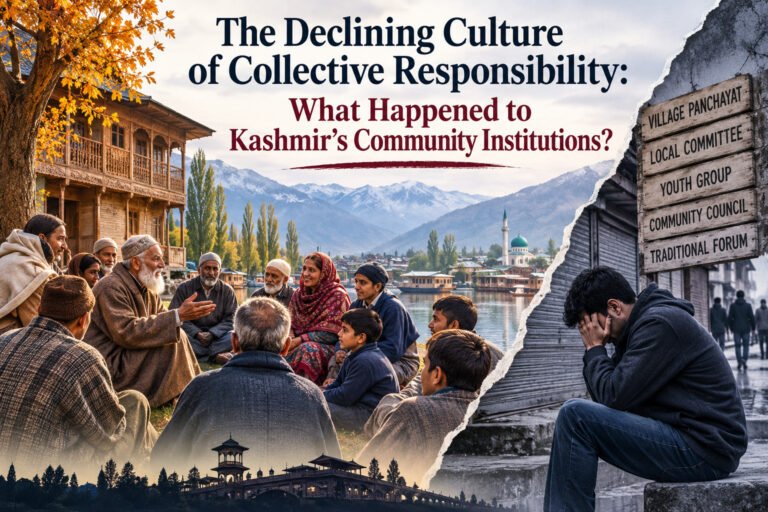
There was a time when the social life of Kashmir was sustained not merely by the institutions of the state, the market or the family, but by an intricate network of community relationships through which people assumed responsibility for one another. A wedding was not simply a private celebration but a collective undertaking; a bereavement was not confined to the immediate family but became an occasion for neighbourhood solidarity; a household facing hardship could often depend upon the moral and material support of its neighbours; and religious spaces were not exclusively places of worship but also centres of social interaction, charity, mediation, learning and collective welfare. Whether through the institution of madad, the neighbourhood gathering, the shared preparation of meals, the community organisation of religious and social occasions, or the hospitality extended to strangers, Kashmir possessed a repertoire of everyday practices through which responsibility was distributed across society. These practices were neither always formally organised nor necessarily free from social hierarchies, but they cultivated an important moral understanding: individual life was embedded in collective existence, and the well-being of one household was, to some extent, the concern of the community.
Today, however, an uncomfortable question confronts Kashmiri society: what has happened to this culture of collective responsibility? Why are increasingly visible forms of social distress, economic vulnerability, addiction, loneliness, environmental neglect and weakening interpersonal relationships not consistently generating equally strong forms of organised community response? Why do many social occasions that once mobilised neighbourhood participation increasingly depend upon commercial arrangements and hired services? Why are public spaces, local institutions and shared resources often treated as somebody else’s responsibility? These questions should not be mistaken for an argument that Kashmiris have ceased to be compassionate or that community solidarity has disappeared. Indeed, extraordinary instances of public generosity, voluntary assistance and humanitarian intervention continue to emerge during crises. The more fundamental concern is that collective responsibility, once woven into the ordinary organisation of social life, appears increasingly episodic, fragmented and dependent upon particular individuals rather than sustained community institutions.
The problem, therefore, is not simply a decline in kindness. It is the possible weakening of the social arrangements through which kindness was translated into responsibility, responsibility into organised action, and organised action into durable institutions. What appears to be a moral crisis may, in fact, be equally a sociological, economic, political and institutional crisis. Reversing it requires more than nostalgic appeals to Kashmir’s past. It requires understanding the forces that have transformed its social relationships and rebuilding the institutional foundations of collective welfare.
From a Community of Relationships to a Society of Individuals
Historically, Kashmiri social organisation was characterised by overlapping networks of kinship, neighbourhood, occupation, religious affiliation and locality. The mohalla was more than a geographical designation; it was a social environment in which people encountered one another regularly, developed reciprocal obligations and acquired a sense of belonging. Community participation was expressed through practices surrounding marriage, death, religious observances, seasonal hardship, agricultural work and the management of shared spaces. In many localities, neighbourhood elders and respected community members played informal roles in resolving disagreements, coordinating assistance and maintaining social relationships. Such arrangements constituted an important form of social capital: resources embedded in relationships of trust, reciprocity and cooperation.
Émile Durkheim’s understanding of social solidarity offers a useful framework for interpreting this transformation. Society does not remain cohesive merely because individuals occupy the same geographical territory or share cultural symbols. It requires relationships, shared norms and institutions that connect individual interests to collective obligations. Similarly, Robert Putnam’s work on social capital demonstrates how networks of civic engagement, reciprocity and trust facilitate cooperation and strengthen democratic life. Applied to Kashmir, these perspectives invite us to look beyond the visible disappearance of particular customs and examine whether the social infrastructure that made collective action possible is being weakened.
One of the most consequential transformations has been the increasing individualisation of social and economic life. Education, employment, migration, consumerism and changing aspirations have expanded individual opportunities, but they have also altered the nature of social relationships. The household increasingly functions as an economic and social unit responsible for securing its own education, healthcare, housing, recreation and security. Neighbourhood relationships, meanwhile, can become increasingly transactional, limited to occasional interaction rather than sustained participation in one another’s lives. This is not an argument against individual autonomy or modernisation. Rather, it is a recognition that individual advancement, when disconnected from collective responsibility, can produce a society that is materially aspirational but institutionally fragmented.
The changing character of weddings offers an illustrative example. Traditionally, neighbours and relatives contributed labour, time, hospitality and organisational support. The preparation and serving of food, management of guests, arrangements for accommodation and numerous other tasks were undertaken through collective participation. Today, professional catering, event management, commercial venues and specialised services increasingly perform functions that were once embedded in neighbourhood cooperation. Commercialisation is not inherently undesirable, and professional services can improve efficiency. The concern arises when the replacement of collective participation also means the disappearance of opportunities through which younger generations learn cooperation, service and responsibility. A wedding may become more elaborate while the community becomes less involved; expenditure may increase while participation decreases. The distinction is between purchasing a service and cultivating a relationship.
This transformation is also visible in the changing relationship between households and their immediate surroundings. Urban expansion, apartment living, mobility, professional commitments and the fragmentation of neighbourhood spaces have altered everyday encounters. In rapidly transforming urban settlements, neighbours may share buildings without necessarily sharing responsibilities. The geographical proximity of households no longer guarantees social intimacy. The result is a paradox: people can be more connected digitally while becoming less available to one another in their immediate physical environments.
The Institutional Foundations of Kashmiri Solidarity
The historical significance of Kashmir’s community life cannot be understood without examining the institutions through which its ethical traditions acquired social expression. Khanqahs, shrines, mosques, astans, temples, gurdwaras, neighbourhood associations, community kitchens and informal charitable networks have, in different ways and across different communities, contributed to the region’s social and moral landscape. Their significance extended beyond ritual observance. They created spaces of encounter, preserved collective memory, facilitated charitable giving, transmitted ethical teachings and provided opportunities for social assistance. Chitralekha Zutshi’s historical work on Kashmir’s shrine culture demonstrates how religious spaces were deeply embedded in the region’s social geography and the formation of cultural identities. Cambridge University Press.
The Kashmiri Rishi-Sufi tradition is particularly relevant to this discussion. Its ethical vocabulary, associated with compassion, simplicity, service, restraint and concern for fellow human beings, helped shape a conception of spirituality that was not confined to personal religious experience. The legacy of Sheikh Noor-ud-Din Noorani, Lal Ded and other spiritual figures became part of a wider cultural imagination in which the moral worth of a person was connected to conduct, humility, compassion and the treatment of others. The langar, the shared meal, the open door and the willingness to assist a traveller or stranger were not merely expressions of hospitality; they represented the social enactment of an ethical worldview.
This is where the Kashmiri concept of hospitality deserves particular attention. Hospitality is often reduced to the presentation of food, the welcoming of guests or the ceremonial display of generosity. Its deeper meaning, however, lies in the willingness to recognise another person’s vulnerability and assume some responsibility for their well-being. In this sense, hospitality is not simply a cultural ornament but a moral relationship. Emmanuel Levinas’s philosophy of responsibility towards the Other provides a particularly illuminating interpretation: ethical responsibility begins when the presence and vulnerability of another person interrupts our self-centred existence and calls us to respond. A society that welcomes a guest but remains indifferent to the suffering of a neighbour risks preserving the performance of hospitality while losing its ethical substance.
Religious teachings across Kashmir’s communities reinforce this understanding. The Qur’an commands believers to cooperate in righteousness and piety (5:2), encourages kindness towards neighbours and travellers (4:36), and condemns the neglect of the vulnerable (107:1–7). Prophet Muhammad’s teaching that believers are like one body, in which the suffering of one part is felt by the rest, expresses an understanding of social solidarity that goes far beyond individual charity. Similarly, the Sikh institution of langar embodies equality, service and the shared dignity of human beings through the collective preparation and consumption of food. These traditions should not be reduced to interchangeable theological doctrines, but their ethical convergence around service, compassion and human dignity offers a valuable foundation for rebuilding community responsibility.
The institutional question is therefore crucial. What happens when religious institutions retain their ritual and ceremonial significance but their capacities for sustained social welfare, neighbourhood engagement and collective problem-solving become limited? The answer is not to diminish religious observance, but to reconnect it with social ethics. Religious institutions possess spaces, organisational networks, moral authority and, in some cases, financial resources that could support education, elderly care, addiction prevention, environmental protection, emergency relief and assistance to economically vulnerable households..
Importantly, this discussion must not romanticise the past. Traditional community institutions could also reproduce social hierarchies, exclude marginalised groups, privilege influential families and restrict the participation of women. The history of Kashmir’s marginalised occupational communities, including the discrimination faced by the sweeper community, reminds us that cultural solidarity was never universally experienced in equal measure. Contemporary Voice of Dalit. Reclaiming the community ethos must therefore mean recovering its compassionate and participatory foundations while rejecting exclusion, inherited inequality and unaccountable authority.
The Political Economy of Declining Collective Responsibility
Community institutions do not exist independently of economic conditions. Their strength depends upon people’s time, material security, institutional resources and confidence in collective action. Economic insecurity can weaken participation because households struggling to meet basic needs have fewer resources available for voluntary service. Migration for employment, competitive examinations and professional opportunities can also remove active members from local networks. The growing monetisation of everyday activities further transforms relationships that were previously sustained through reciprocal obligations into market transactions.
This transformation is particularly important in a region where economic aspirations have expanded alongside persistent livelihood uncertainties. The Jammu and Kashmir Economic Survey 2025–26 estimates real GSDP growth of 5.82 per cent for the year and identifies the tertiary sector as contributing 61.02 per cent of Gross State Value Added. These figures indicate economic expansion and structural transformation, but aggregate growth alone cannot reveal the condition of neighbourhood solidarity, the distribution of economic security or the capacity of households to participate in community life. Economic Survey 2025–26.
The expansion of consumer culture has introduced another dimension. Social recognition is increasingly associated with visible consumption, the scale of celebrations, the quality of residential property, educational achievement and the ability to access commercial services. The problem is not consumption itself, but the possibility that social prestige becomes disconnected from contribution to collective welfare. When a household’s standing is measured more by what it possesses than by what it contributes, the moral economy of reciprocity becomes vulnerable. A culture of giving can gradually be replaced by a culture of display.
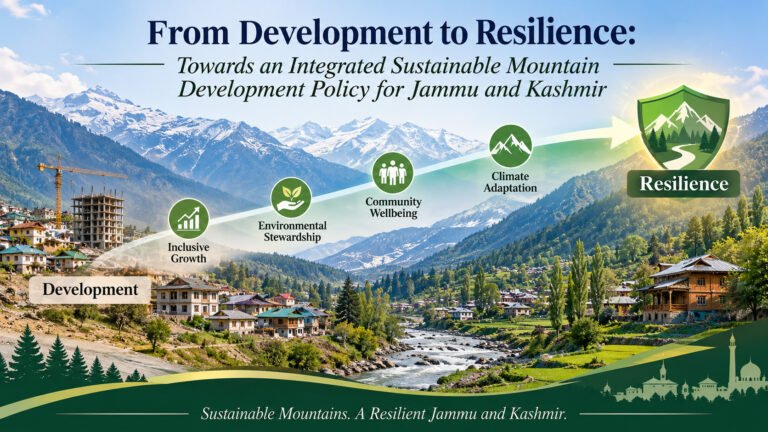
The weakening of collective responsibility also has a geographical dimension. Kashmir’s mountainous terrain, dispersed settlements, harsh winters, difficult road connectivity and vulnerability to floods, landslides and other climatic hazards have historically made cooperation essential. In such an environment, neighbours are not simply social acquaintances; they can be critical sources of assistance during emergencies, agricultural disruptions, illness and seasonal isolation. Community solidarity has therefore possessed a practical economic value alongside its moral significance. It has helped households manage risks that neither individual resources nor distant institutions could always address adequately.
The vulnerability of elderly people provides a contemporary illustration. A 2026 qualitative study of older adults in Srinagar, based on 22 in-depth oral narratives, examines how climatic variability, inadequate heating, housing conditions and infrastructural limitations affect their everyday well-being. Its findings underline the importance of considering older people not merely as beneficiaries of formal welfare programmes but as members of communities whose access to care, mobility and social support is deeply interconnected. Study on ageing and climatic vulnerability. In a society experiencing migration and changing household arrangements, neighbourhood-based systems of checking on elderly residents, helping with medicines, facilitating transport and providing assistance during severe weather can become an essential complement to formal healthcare and social security.
The same logic applies to addiction, unemployment and family vulnerability. These are not exclusively individual problems. They affect households, neighbourhoods, educational environments and the wider social fabric. A response based entirely on policing, institutional treatment or occasional charitable assistance cannot substitute for sustained community engagement. Prevention requires trusted relationships, accessible support, youth participation, counselling, meaningful activities and the involvement of families and local institutions. Collective responsibility must therefore be understood as a form of social infrastructure that reduces vulnerability before it becomes a crisis.
The Contradiction of Participation Without Empowerment
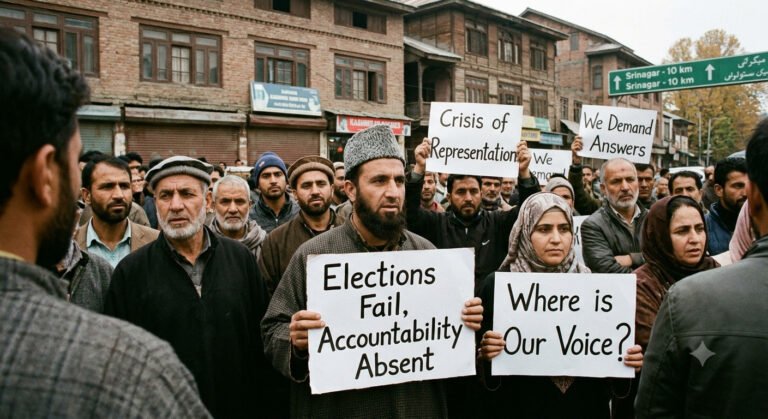
The weakening of community institutions cannot be attributed solely to social change. It must also be examined in relation to the political organisation of local governance. Communities become more capable of addressing shared problems when they possess meaningful institutions through which they can deliberate, decide, mobilise resources and hold representatives accountable. Where participation is reduced to consultation, periodic administrative outreach or the identification of local demands without corresponding decision-making authority, the development of collective agency remains limited.
The 73rd Constitutional Amendment established a framework for democratic decentralisation through Panchayati Raj Institutions, while the 74th Amendment recognised the importance of urban local self-government. In principle, these institutions provide a constitutional basis for citizens to participate in decisions affecting their immediate environments. Yet institutional existence does not automatically produce institutional empowerment. The transfer of responsibilities must be accompanied by adequate finances, administrative capacity, trained personnel and genuine autonomy.
The Ministry of Panchayati Raj’s Devolution Index Report 2024, published in February 2025, evaluates decentralisation through dimensions including functions, finances, functionaries, capacity enhancement and accountability. Its assessment identifies weaknesses in Jammu and Kashmir relating to the autonomy of Panchayats, assigned functions, own-source revenue mobilisation and the availability of funds. The report also notes shortcomings in the functioning of District Planning Committees. These findings are significant because they demonstrate that grassroots participation cannot be sustained merely through the creation of elected structures; it requires institutional powers and resources. Devolution Index Report 2024.
A recent academic assessment of the Back to Village programme in Jammu and Kashmir similarly identifies a tension between participatory forms and substantive decentralisation. Published in the Journal of Public Affairs in March 2026, the study argues that participation can remain consultative when it is organised through bureaucratically managed processes without a corresponding transfer of authority to local institutions. This is an important distinction: inviting people to articulate grievances is not equivalent to enabling them to govern their collective affairs. Mir and Sidique, 2026.
The political significance of community institutions lies precisely in their capacity to transform citizens from passive recipients of services into active participants in public life. A functioning Gram Sabha, an accountable neighbourhood association, a village development committee or a community-based welfare organisation can create spaces where residents collectively identify priorities, monitor public resources and organise local responses. Such institutions do not compete with the state. They strengthen the state’s democratic foundations by making public administration more responsive to the lived realities of citizens.
The Paradox of Institutional Expansion and Social Fragmentation
Interestingly, the argument that community responsibility is weakening must be considered alongside evidence that some forms of community organisation are expanding. The Jammu and Kashmir Rural Livelihoods Mission provides an important example. According to figures placed before the J&K Legislative Assembly in September 2026, 96,498 Self-Help Groups had been promoted across the Union Territory, involving more than 2.7 lakh women identified as Lakhpati Didis. The same disclosure recorded 652 Cluster Level Federations, of which 288 had been registered, alongside 249 Farm Producer Groups and 12 Farmer Producer Organisations. These are significant developments in the institutionalisation of women’s participation, financial inclusion and collective livelihood initiatives. Kashmir Life, September 2026.
These figures complicate any simplistic narrative of social decline. They suggest that collective organisation has not disappeared; rather, its forms, purposes and institutional locations are changing. The challenge is to connect emerging institutional arrangements with the wider social responsibilities that communities have historically performed. Self-help groups, for instance, can become more than mechanisms for savings, credit and income generation. With appropriate institutional support, they can also facilitate community health awareness, nutrition initiatives, elderly care, environmental protection, educational support and assistance to vulnerable households. Women’s collectives, in particular, possess considerable potential to transform the organisation of community welfare because their members are often closely connected to everyday household and neighbourhood concerns.
The distinction between the number of institutions and their social effectiveness is nevertheless important. The existence of thousands of groups does not automatically demonstrate the strength of collective solidarity across society. The same Legislative Assembly disclosure noted that SHGs primarily function as institutions for savings, internal lending and financial inclusion, while members generally pursue individual livelihood activities. It also did not provide a separate average annual turnover figure for financially self-sustaining groups. This does not diminish their achievements; it highlights the need to evaluate community institutions through broader measures of sustainability, participation, social impact and collective agency.
The challenge, therefore, is not to restore an imagined institutional past but to create a productive relationship between traditional community ethics and contemporary organisational forms. The historical mohalla and the modern neighbourhood association, the religious charitable institution and the professionally managed social welfare organisation, the traditional culture of mutual assistance and the contemporary women’s self-help group need not exist in isolation. They can reinforce one another if connected through transparent, participatory and locally responsive arrangements.
Reconstructing the Ethos of Responsibility
Reclaiming Kashmir’s culture of collective responsibility requires a fundamental shift in how community welfare is understood. It should not depend exclusively upon occasional charitable initiatives, individual generosity or emergency mobilisation. It must become a sustained institutional commitment. The first step would be to revitalise neighbourhood-level organisations across urban and rural settlements. Such organisations could bring together residents, youth, women, elderly people, teachers, religious representatives and other community members to identify local needs and organise practical interventions. Their responsibilities could include neighbourhood cleanliness, assistance to elderly residents, support for economically vulnerable households, educational mentoring, blood donation networks, emergency preparedness and the protection of shared spaces.
In urban Kashmir, particularly in Srinagar, the revival of neighbourhood associations could provide an institutional response to the increasing fragmentation of residential life. These organisations need not be politically affiliated or administratively burdensome. Their legitimacy should arise from voluntary membership, transparent procedures, inclusive representation and demonstrable public service. In rural areas, existing Panchayats, self-help groups, village organisations and community-based institutions could be connected through locally designed platforms for collective welfare. Such arrangements would allow communities to identify needs that frequently fall between the responsibilities of different government departments.
Religious institutions also deserve a renewed social mandate. Mosques, shrines, khanqahs, temples and gurdwaras can serve as important centres for ethical education and community welfare, provided their initiatives remain inclusive, accountable and attentive to the needs of the wider population. Zakat, Sadaqah, Waqf, voluntary donations, langar and other charitable traditions could be connected with transparent local welfare mechanisms. Rather than limiting charitable assistance to occasional distribution, institutions could develop systematic programmes for educational scholarships, medical assistance, vocational training, elderly care and rehabilitation support. The objective should be to transform charity from an episodic act of giving into an organised instrument of social development.
Equally important is the restoration of youth participation. Kashmir’s young population should not be understood merely as a demographic category requiring employment, education or administrative attention. It is also a potential source of civic leadership, innovation and social transformation. Universities, colleges, schools and civil society organisations could encourage structured community service, including literacy initiatives, environmental restoration, assistance to disadvantaged children, digital literacy for elderly people and voluntary support during emergencies. Such participation should be recognised as a valuable component of education and citizenship, not treated as an extracurricular activity without wider significance. A generation that learns to compete for individual success must also acquire the capacity to cooperate for collective well-being.
Women’s participation must similarly extend beyond the economic objectives of self-help programmes. The institutional networks developed under JKRLM offer an opportunity to establish women-led community welfare initiatives. Women who have acquired experience in financial management, collective decision-making and local enterprise can become important agents of social development. Their participation must not, however, reproduce the expectation that women will absorb additional unpaid responsibilities while remaining excluded from decision-making. Genuine empowerment requires authority, recognition, resources and an equitable distribution of care work.
The state has an equally important responsibility. It should facilitate, rather than unnecessarily control, voluntary community action. Local institutions need access to training, transparent grants, public spaces and mechanisms for coordination with district administration. Panchayats and urban local bodies should be enabled to collaborate with registered civil society organisations, religious institutions, educational establishments and neighbourhood associations. A district-level community welfare framework could identify vulnerable households, map local voluntary resources, coordinate emergency assistance and monitor the effectiveness of community initiatives, subject to privacy safeguards and independent accountability.
This institutional reconstruction must also incorporate environmental responsibility. Kashmir’s lakes, springs, forests, rivers, neighbourhood parks and traditional water sources are not merely administrative assets; they are shared ecological inheritances. Their protection cannot be left exclusively to government agencies. Community monitoring, school-based environmental education, neighbourhood cleanliness initiatives, local water conservation and participatory restoration programmes can reconnect ecological protection with everyday citizenship. The relationship between community and geography is particularly important in a mountainous region where environmental vulnerability is inseparable from livelihood security and public welfare.
Ultimately, the success of such interventions should be evaluated not simply by the number of organisations registered, meetings conducted or funds distributed, but by whether communities become more capable of identifying problems, mobilising resources, protecting vulnerable members and sustaining cooperation beyond individual projects. Institutional performance must be measured through trust, participation, inclusion and tangible improvements in collective well-being.
Conclusion: Recovering the Moral Meaning of Community
The question of what happened to Kashmir’s community institutions cannot be answered by attributing social change to a single cause or by assuming that an idealised past can simply be restored. Economic transformation, migration, urbanisation, consumerism, prolonged uncertainty, changing family structures, administrative centralisation and the weakening of neighbourhood relationships have interacted in complex ways. Some traditional practices have disappeared, others have changed their character, and new forms of collective organisation have emerged. The central concern is whether the ethical principle that once connected individual well-being with collective responsibility is receiving adequate institutional expression in contemporary Kashmiri society.
Kashmir does not necessarily suffer from an absence of compassion. Its people continue to demonstrate extraordinary generosity during bereavements, emergencies, natural disasters and moments of collective vulnerability. The more pressing challenge is to ensure that this generosity does not remain confined to exceptional circumstances. A society cannot depend upon moments of crisis to rediscover its capacity for solidarity. Compassion must become organised, hospitality must become a sustained social ethic, and collective responsibility must acquire institutional continuity.
There is also a need to reconsider what it means to preserve Kashmiri ethos. Cultural preservation cannot be restricted to language, dress, cuisine, music, architecture, religious ceremonies or the celebration of historical figures. A culture survives most meaningfully when its ethical principles shape the everyday conduct of its people. The hospitality of Kashmir must be visible not only in the warmth extended to visitors but also in the dignity afforded to workers, the assistance offered to struggling families, the care provided to elderly neighbours, the inclusion of marginalised communities and the protection extended to those who cannot defend their own interests. Its spiritual inheritance must be reflected not only in the maintenance of religious spaces but also in the compassion, honesty, service and responsibility practised within society.
Perhaps the most important lesson is that community is not simply something to which people belong; it is something for which they must remain responsible. The mohalla cannot survive merely as a geographical space, the khanqah merely as an architectural inheritance, the langar merely as a ceremonial arrangement, or hospitality merely as a cultural performance. Their enduring significance lies in the relationships and obligations they cultivate. Kashmir’s historical ethos of mutual assistance and hospitality will have meaning in the present only when translated into inclusive institutions capable of addressing contemporary social and economic vulnerabilities.
The future of Kashmir will undoubtedly depend upon economic opportunity, effective governance, political stability, educational advancement and sustainable development. But it will also depend upon something less easily quantified: the willingness of people to recognise one another’s well-being as a shared concern. Roads, buildings, institutions and economic indicators can measure material progress, but they cannot independently produce a cohesive society. That requires trust, reciprocity, participation and a sense of moral obligation towards others.
What Kashmir needs, therefore, is neither a retreat into nostalgia nor an uncritical celebration of modernisation. It needs a renewed social compact in which individual aspiration and collective responsibility reinforce rather than undermine one another. The real measure of a society’s cultural inheritance is not how eloquently it remembers its past, but how faithfully it translates the wisdom of that past into the moral and institutional practices of the present. Kashmir’s greatest inheritance may not be merely its celebrated hospitality, but the idea underlying it: that another person’s need is never entirely somebody else’s concern.
About the Author