Author: Zahid Sultan (Independent Researcher Based in Srinagar,India)
There is something fundamentally troubling about a political arrangement in which public institutions continue to exercise authority, public money continues to be spent, development projects continue to be announced, and bureaucratic offices continue to function, yet the ordinary citizen increasingly finds himself without an identifiable political authority to question when things go wrong. In Jammu and Kashmir, the problem of governance is not simply that public institutions fail to perform their assigned functions. It is that the institutional architecture through which such failures are supposed to be questioned, contested and corrected has become progressively weaker. The distinction matters. Administrative inefficiency is a problem of performance; an accountability deficit is a problem of political structure. The former concerns what institutions fail to deliver. The latter concerns who must answer for that failure, before whom, and with what consequences.
Jammu and Kashmir offers a particularly revealing illustration of this predicament. Roads are constructed and subsequently abandoned to disrepair; drainage systems remain inadequate despite recurring expenditure; public health institutions struggle with deficiencies that have long ceased to be exceptional; developmental schemes are announced with considerable administrative enthusiasm but often encounter a less impressive reality at the point of implementation. Citizens approach government departments, submit applications, pursue grievances and make repeated visits to administrative offices. Yet the distance between the authority that makes decisions and the citizen who experiences their consequences remains considerable. The problem is not necessarily an absence of government. It is the increasing difficulty of locating responsibility within government.
This distinction exposes a deeper contradiction in the contemporary discourse of governance. Governments frequently invoke efficiency, transparency, digital delivery and institutional modernisation as evidence of administrative progress. But the existence of a portal does not establish accountability; the expenditure of public money does not establish public participation; and the completion of a government project does not, by itself, demonstrate democratic responsiveness. Governance cannot be evaluated exclusively through the number of schemes sanctioned, the amount of expenditure incurred or the targets claimed to have been achieved. It must also be evaluated through the capacity of citizens to question priorities, scrutinise expenditure, demand explanations and impose political consequences upon those who exercise public authority. Without these conditions, development risks becoming an administrative transaction conducted in the name of people rather than a democratic process organised around their agency.
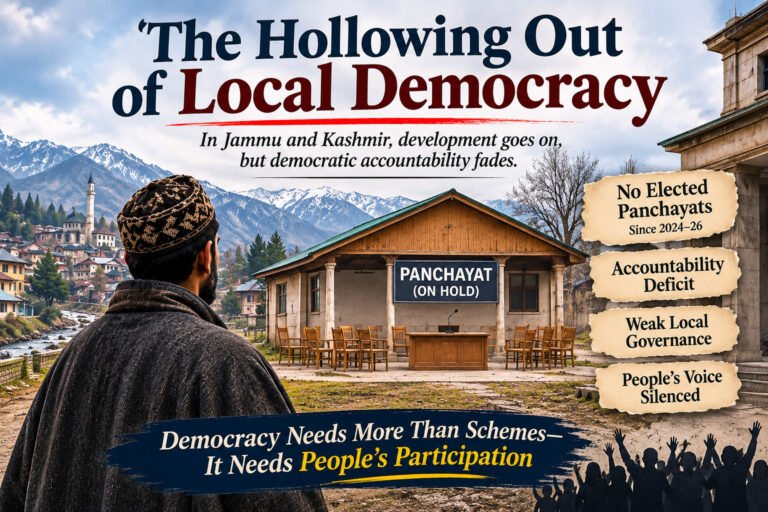
The most consequential illustration of this institutional weakness is the prolonged absence of elected Panchayati Raj Institutions in Jammu and Kashmir. The terms of Halqa Panchayats and Block Development Councils expired on 9 January 2024. The District Development Councils, whose tenure ended on 24 February 2026, have also ceased to function as elected institutions. Consequently, Jammu and Kashmir entered a situation in which all three tiers of its rural local-government structure were without elected representatives. The Ministry of Panchayati Raj’s November 2026 status report confirms that the terms of all three tiers have expired and that no elected representatives are presently heading the district, block or panchayat levels. Electoral-roll revision was initiated, with the final Panchayat electoral roll scheduled for publication on 15 May 2026. Yet an electoral-roll exercise is not an election, and administrative preparation cannot be presented as a substitute for democratic representation.
The implications are considerably more serious than the postponement of another electoral exercise. Panchayats are not decorative extensions of the administrative machinery. Their constitutional significance lies in the institutionalisation of popular participation in local decision-making. The 73rd Constitutional Amendment was premised upon the recognition that democracy cannot remain confined to Parliament and state legislatures while the everyday affairs of citizens are administered through distant bureaucratic structures. It sought to give institutional expression to the principle that decisions concerning local development, public amenities and community priorities should involve those who are directly affected by them. In Jammu and Kashmir, the Panchayati Raj framework was subsequently strengthened through amendments that introduced the three-tier arrangement and District Development Councils. The 2018 Panchayat elections, the 2019 Block Development Council elections and the 2020 DDC elections were presented as important steps towards decentralisation.
But decentralisation cannot be established merely by creating institutions, conducting elections once and subsequently allowing their mandates to expire without timely renewal. An institution is not democratic simply because it was democratic at some point in its history. Its legitimacy is sustained through the continuity of representation, periodic elections and the capacity to exercise meaningful authority. When elected representatives disappear from the institutional landscape, the administrative apparatus does not disappear with them. It continues to function, but the democratic relationship through which its decisions are supposed to acquire popular legitimacy becomes attenuated. This is precisely where the accountability deficit begins.
The question of Panchayat elections has acquired an additional dimension because the explanation for their delay has itself become a matter of institutional ambiguity. Reports have pointed to the unresolved question of reservation for Other Backward Classes, following the submission of the Dedicated Backward Classes Commission’s report in February 2025. The government has indicated that elections will be held at an appropriate time, while the State Election Commission has maintained that the preparatory work within its remit has progressed and that it is awaiting the necessary governmental decisions. The Rural Development Department has also clarified that the statutory authority to conduct elections rests with the State Election Commission, not the department itself. Each of these institutional positions may have a legal or administrative basis. But the accumulation of explanations does not resolve the political question. If the electoral process requires decisions from several institutions, which authority is responsible for ensuring that those decisions are taken within a reasonable and publicly declared timeframe?
This is not an argument against reservation. On the contrary, the political representation of historically disadvantaged communities is indispensable to the democratic legitimacy of local institutions. The constitutional imperative of inclusion cannot be dismissed in the name of administrative convenience. But neither can the process of determining reservation become an indefinitely renewable justification for the absence of elected local government. Constitutional inclusion and electoral continuity are not mutually exclusive objectives. A government committed to both must demonstrate the institutional capacity to reconcile them. Otherwise, a legitimate question of representation risks becoming an administrative alibi for democratic postponement.
There is also a larger political contradiction here. Jammu and Kashmir has repeatedly been assured that democratic institutions are being strengthened, governance is becoming more participatory and development is being brought closer to the people. Yet, at the very level where the citizen should have the greatest institutional proximity to government, representation is absent. A resident of a village may have a Member of the Legislative Assembly, but an MLA cannot reasonably substitute for a Panchayat, a Block Development Council and a District Development Council. These institutions perform different functions, operate at different scales and provide different forms of representation. To treat them as interchangeable is to misunderstand the architecture of representative democracy itself.
Indeed, the absence of elected Panchayats raises a more fundamental question about the meaning of decentralisation in Jammu and Kashmir. Is decentralisation understood as the transfer of decision-making authority to elected local institutions, or merely as the geographical distribution of administrative offices? The distinction is not semantic. A Block Development Officer can administer a development programme, process files and execute departmental instructions. But an appointed administrator does not possess the same democratic mandate as an elected representative. The former derives authority from an administrative hierarchy; the latter derives legitimacy from a constituency. Administrative competence, even when present, cannot reproduce political representation.
The danger is that the language of decentralisation may survive even when its democratic substance has been depleted. Government departments can continue to invoke local participation while decisions remain concentrated within bureaucratic structures. Development plans can be prepared in the name of communities without giving those communities a meaningful opportunity to determine priorities. Public expenditure can be justified through technical procedures while the political question of whose needs are being addressed remains unanswered. This is not decentralisation in any substantive democratic sense but administrative deconcentration masquerading as popular empowerment.
The consequences are visible in the everyday relationship between citizens and public institutions. Consider a village where a road remains incomplete, a drinking-water facility becomes dysfunctional or a drainage project is executed without addressing the actual requirements of the locality. Under an effective system of local self-government, citizens have an identifiable representative to question, a Gram Sabha through which collective concerns can be articulated, and an elected institutional structure that can demand explanations from the implementing administration. None of these mechanisms guarantees competent governance. Elected representatives can be indifferent, corrupt, politically compromised or entirely incapable. But democratic institutions provide a mechanism through which such failures can be exposed and politically contested. Their absence removes an important layer of scrutiny between the citizen and the bureaucracy.
This is why the accountability deficit cannot be understood simply as a problem of administrative corruption or incompetence. It is also a problem of institutional distance. When responsibility is distributed across departments, directorates, district administrations and implementing agencies, citizens often find themselves trapped in a circuit of referrals. One office redirects them to another; one official invokes the jurisdiction of a different department; a complaint is registered without producing a meaningful remedy. Responsibility becomes fragmented, while the authority to demand an answer remains concentrated. The result is a peculiar asymmetry: citizens encounter the state everywhere, but struggle to locate the person or institution that must answer for its failures.
The same problem extends beyond rural local government. Urban local bodies completed their terms in October-November 2023, and their absence has further weakened elected representation in municipal governance. Questions concerning sanitation, drainage, street lighting, waste management, public spaces and urban infrastructure are consequently removed from the immediate scrutiny of elected municipal representatives. These are not marginal administrative matters. They constitute the everyday substance of citizenship. The quality of democracy is experienced not merely through the right to vote every few years, but through the ability to influence decisions that determine the conditions under which people live.
The institutional consequences become particularly troubling when one considers the relationship between public expenditure and public accountability. Government spending is frequently presented as an achievement in itself. But expenditure is an input, not an outcome; a sanctioned project is not necessarily a completed project, and a completed project is not necessarily a useful one. The citizen is entitled to ask whether a road was built according to specifications, whether a drainage project addressed the actual problem, whether a public facility is functional and whether the allocation reflected the priorities of the community. These questions require more than financial statements and departmental progress reports. They require institutional arrangements through which public expenditure is subjected to continuous democratic scrutiny.
The absence of elected local bodies weakens precisely this relationship. It does not necessarily mean that development work has stopped or that every administrative decision is illegitimate. Such a claim would be both analytically careless and empirically indefensible. The more serious point is that development without adequate democratic mediation becomes vulnerable to bureaucratic discretion and political patronage. When citizens lack effective representative institutions, the process of identifying priorities can become increasingly dependent upon administrative preferences, informal influence and the accessibility of individuals to those occupying positions of authority. The issue, therefore, is not simply whether money is being spent. It is who decides how it is spent, whose priorities shape the decision and who can be held answerable when the outcome fails to serve the public interest.
There is an uncomfortable political question that the present arrangement cannot evade: why should the citizen be expected to remain accountable to the state through taxes, documentation, regulations and administrative compliance when the institutions exercising authority are not equally accessible to public scrutiny? Democratic accountability is reciprocal. It is not a one-way obligation imposed upon citizens. The state demands compliance, but it must also furnish explanations. It exercises authority, but that authority must remain answerable. It spends public money, but the public must retain meaningful avenues to question its use. The legitimacy of the government cannot rest exclusively upon its capacity to issue orders and implement programmes.
Nor should the restoration of local elections be treated as a technical exercise whose importance begins and ends with the announcement of a polling schedule. Elections are necessary, but they are not sufficient. Jammu and Kashmir’s experience with the earlier Panchayati Raj institutions demonstrated that elected representation can coexist with bureaucratic domination, limited financial autonomy and considerable restrictions on institutional functioning. Local representatives cannot be reduced to intermediaries who merely forward demands to higher authorities or endorse decisions already taken elsewhere. If the purpose of elections is to produce meaningful local self-government, elected institutions must possess clearly defined functions, adequate funds, trained personnel and the authority to participate in planning, implementation and oversight.
The familiar formulation of the three Fs- funds, functions and functionaries- therefore remains relevant. Transferring responsibilities without financial autonomy produces institutions that are accountable for outcomes they lack the capacity to control. Allocating funds without granting meaningful decision-making powers reduces elected representatives to passive recipients of administrative instructions. Providing personnel without establishing clear lines of institutional accountability merely adds another layer to an already complicated administrative structure. Decentralisation requires the simultaneous strengthening of all three dimensions.
There must also be a revival of the Gram Sabha as a substantive deliberative institution. Its purpose should not be reduced to the ceremonial approval of development proposals or the completion of procedural requirements. It must become a forum where citizens can scrutinise local priorities, question expenditure, identify exclusion and demand explanations from public officials. Public hearings, social audits, accessible project records and time-bound grievance redressal should be integral to local governance rather than occasional administrative exercises. Equally, the government must publish a clear and binding timetable for the restoration of all tiers of local government, explain the decisions that remain pending and identify the authorities responsible for completing them.
Ultimately, the accountability deficit in Jammu and Kashmir is a test of the political seriousness with which democracy is understood. It is easy to celebrate democratic participation during election campaigns and invoke the language of empowerment in official documents. It is considerably more difficult to tolerate the institutional consequences of an empowered citizenry: questions, scrutiny, disagreement and demands for explanations. Yet these are not inconveniences to be managed. They are the very conditions that distinguish democratic governance from administrative command.
The absence of elected Panchayats, Block Development Councils, District Development Councils and Urban Local Bodies should therefore concern more than those who once occupied these positions. It should concern every citizen who expects public institutions to function in accordance with public needs rather than administrative convenience. The question is not whether government offices are open, whether officials are attending meetings or whether development schemes are being announced. The question is whether citizens possess the institutional power to hold those offices and officials accountable.
A government cannot claim meaningful decentralisation while the institutions through which decentralisation is supposed to operate remain vacant. Nor can an administration invoke efficiency as a substitute for democratic legitimacy. The state may continue to govern in the absence of elected local representatives, but governing and being democratically answerable are not the same thing. The former requires administrative authority; the latter requires institutional accountability.
Perhaps the most revealing feature of the present situation is that the citizen is still expected to negotiate with the state, but increasingly lacks an elected institutional intermediary through which that negotiation can acquire political force. He is asked to submit applications, register complaints, follow procedures and wait for administrative decisions. What he cannot always identify is the authority that must answer when those procedures produce nothing. This is the paradox of governance without adequate accountability: the state remains present in the lives of citizens, but the channels through which citizens can make the state answerable become progressively absent. Democracy is not exhausted by the periodic act of voting. It is sustained by the continuous possibility of questioning those who govern. And when the institutions closest to the citizen are allowed to remain without elected representatives, the deficit is not merely administrative. It is democratic.
About the Author