Fasil Ali Dar (Padmashree Awardee)
The Himalayan arc, stretching across northern India, has long stood as a geography of inspiration, asceticism, and endurance. Among its most awe-inspiring regions, Jammu and Kashmir has always represented more than a mere terrain, it is a living continuity of Indian civilization’s spiritual and physical quest for harmony. Its mountains and rivers are both material and metaphysical forces: sublime teachers that invite the human body to struggle, adapt, and transcend. In this ambient theatre of snow and silence, the ethos of sport, discipline, effort, and self-overcoming, finds its most natural home. The sports spirit in Jammu and Kashmir, when seen against its historical legacies and modern aspirations, can become one of the most powerful tools for healing, unity, and progress.
To understand this transformative potential, one must view sport not in isolation but as a continuation of the region’s cultural and philosophical lineage. For centuries, the shaping of the body and the shaping of the mind were one and the same. In early Indic thought, vyayam, physical exercise, was enshrined in texts such as the Ayurveda and the Hatha Yoga Pradipika as a sacred discipline, intended as much for spiritual evolution as for bodily vigour. The Kashmiri philosophical tradition, particularly the profound metaphysics of Kashmiri Shaivism, viewed the body as a microcosm of divine energy. Yoga, born of this fusion, was not just a series of poses but a lived science of energy, mindfulness, and control. As the centuries unfolded, the Yoga path traversed religions and rearticulated itself through Buddhism, Sikhism, and later through Islamic Sufi practices. Each tradition, while modifying its form, recognised in the disciplined body the possibility of transcendence.
In medieval Kashmir, the Buddhist monks who journeyed across the high valleys in search of spiritual knowledge, and the Sufi saints like Sheikh Noor-ud-din Noorani, who meditated and walked through mountain forests, shared the same physical endurance and inner clarity demanded of athletes today. Their pilgrimage to nature’s lap was both spiritual and athletic. This shared legacy dissolves any divide between body and soul, between movement and meditation. Thus, to revive sports in Jammu and Kashmir is, in essence, to revive its ancient pedagogy of strength, where physical health, moral discipline, and divine aspiration coexist.
At the heart of this reflection lies the modern Kashmiri youth. Decades of political strife, social fragmentation, and limited opportunity have left psychological and social scars. Marginalization, unemployment, and the attraction toward substance abuse or extremism are not merely outcomes of socioeconomic deprivation but also of the absence of creative and collective outlets for energy. In such a context, sports emerge as both a physical therapy and a moral compass. They transform raw emotion into structured effort, impulsive anger into goal-oriented focus, and alienation into team belonging. Every football match in a village ground, every cricket tournament in a school courtyard, and every youth trek across alpine passes carries a symbolic weight, it represents the reclamation of life, community, and self-worth.
The Himalayas teach the same values that sports instil: patience, humility, endurance, and respect for limits. The act of ascending a peak parallels the human need to confront fear and discover fortitude. In the process of climbing or competing, one confronts the same existential questions that spiritual seekers face in their meditative trials. The athlete’s sweat and the monk’s prayer belong to the same moral economy of effort. When young people in Jammu and Kashmir take part in physical activity, they are not only engaging their muscles but also recovering a metaphysical connection with their environment.
From a public health standpoint, sports have a crucial role in shaping a resilient society. The World Health Organization consistently links regular physical activity with reductions in non-communicable diseases, anxiety, and depression. In Jammu and Kashmir, where access to advanced healthcare is still uneven and where the social fabric has been strained, promoting sports can serve as a grassroots form of preventative medicine. Open-air activities, whether football on village fields, mountainside runs, or skiing in Gulmarg, enhance cardiovascular health and mental well-being alike. Moreover, collective sports foster social interaction across religious, ethnic, and linguistic divides, countering isolation, and distrust. The playground becomes a secular site of cooperation, an amphitheatre of shared humanity.
Economically, a thriving sports culture can catalyse growth, innovation, and employment. The global sports economy, encompassing infrastructure, event management, physiotherapy, tourism, and media, is one of the fastest-growing sectors. For a region like Jammu and Kashmir, rich in natural resources but struggling with industrial diversification, this offers immense potential. Building sports infrastructure can create sustainable local jobs for coaches, equipment suppliers, tour guides, and hospitality workers. Sports festivals and tournaments can attract investment, while adventure sports tourism can inject vitality into peripheral economies.
Gulmarg’s snow-covered slopes, Pahalgam’s green meadows, and the pristine waters of Dal and Wular lakes are not only venues for leisure but could be branded as hubs for skiing, trekking, kayaking, and mountain cycling. With careful planning and environmental regulation, sports tourism can thrive without compromising the fragile Himalayan ecosystem. International events, such as ski marathons or mountaineering expeditions, could become symbols of peace and of the region’s re-entry into global networks. When athletes from different countries compete together in the shadow of the Pir Panjal, what emerges is not just economic opportunity but a subtle form of cultural diplomacy, one that bypasses politics and operates through mutual respect and participation.
To appreciate the full moral dimension of sport, one must also see it as an antidote to the two greatest contemporary threats: drug abuse and terrorism. Substance abuse, alarmingly rising among youth in several districts, represents both a psychological escape and a symptom of disconnection. Sports invert this logic. They demand presence instead of escape, discipline instead of surrender, community instead of isolation. A young person trained in physical endurance and mindful routine is far less susceptible to the temptations of chemical or ideological intoxication. Sports provide purpose where nihilism thrives. Every goal scored, every victory earned, rebuilds confidence at the personal and collective level, substituting destructive adrenaline with creative expression.
Similarly, sports cultivate a language of peace. In post-conflict zones around the world, from Bosnia to Rwanda, sports have served as vehicles for reconciliation. They bring adversaries into shared physical spaces, enforcing rules that demand mutual respect. In the cricket grounds of Srinagar or the volleyball courts of Kupwara, young athletes from different communities learn coexistence not through slogans but through teamwork. The ethic of fair play implicitly challenges the logic of violence. When teams play together, they enact a miniature utopia of order within the chaos of daily uncertainty. The field becomes an experiment in democracy: each player contributes, obeys rules, and takes collective responsibility for both victory and defeat.
The argument for sports as national reconstruction is reinforced by its deep resonance with India’s civilizational ethos. Ancient Indian texts, the Rig Veda, the Mahabharata, or the Arthashastra, never separated physical prowess from moral or intellectual excellence. Warriors, yogis, and kings were expected alike to master their bodies before governing others. The modern reinterpretation of this idea lies in using sports to democratize physical culture, turning it into a shared foundation for citizenship. For Jammu and Kashmir, aligning with India’s National Sports Policy means more than building stadiums; it means reclaiming a collective faith in effort and merit. Integrating local sports practices, such as traditional wrestling (dangal), snow polo, or archery, into modern structures can unite history and modernity.
Policy reform must become both visionary and grounded. Investment in rural playgrounds and scientific training centres is essential. Scholarships for young talent, exchange programs linking Kashmiri athletes to India’s premier sports institutes, and grassroots mentorship networks can make opportunity visible. Beyond physical structures, the education system must embed sports into its core curriculum, not as recreation but as civic preparation. When youth in Pulwama, Poonch, or Gurez grow up seeing sports as a dignified career, not a diversion, the economy and society will both benefit. Moreover, partnerships between public institutions and private enterprise, through corporate social responsibility initiatives, can accelerate this ecosystem while ensuring inclusivity for girls and marginalized communities.
Yet, infrastructure and policy alone cannot sustain a sports revolution. There needs to be a cultural awakening around the idea of sports spirit. True sportsmanship transcends victory. It is about learning humility in triumph and resilience in defeat, mirroring the philosophical principles that have defined Kashmir’s spiritual legacy. The Buddhist middle path, the Sufi doctrine of surrender, and the Sikh belief in seva (selfless service) all converge in the idea that mastery begins with discipline and ends with compassion. An athlete who internalizes these values becomes not only a competitor but a moral citizen.
The Himalayan environment, so intimately bound with Kashmiri life, serves both as a metaphor and as a literal training ground for this philosophy. Trekking through its passes, one encounters nature in its pure pedagogic form. The pilgrim to Amarnath or Kausarnag learns patience, coordination, and spiritual humility, qualities identical to those demanded of marathoners or mountaineers. The pilgrimage, therefore, merges with sportsmanship, representing humanity’s ongoing negotiation with its limits. Environmental consciousness, already ingrained in this journey, could further reinforce the principle of ecological sports, a model where adventure and conservation coexist. In this view, trekking and mountaineering are not just hobbies but moral engagements with climate and geography, reinterpreting ancient pilgrimages into secular rituals of endurance.
Climate itself plays a critical role in shaping both the character and challenges of sports in Jammu and Kashmir. Harsh winters, glacial melt, and shifting monsoon patterns increasingly affect accessibility and safety. Therefore, adapting sports policy to climate realities, through year-round facilities, climate-resilient design, and environmental education, is vital. Integrating climate-sensitive sports infrastructure would make Jammu and Kashmir a pioneer in sustainable mountain athletics. By teaching youth to see nature as both a challenge and a partner, sports can become a platform for ecological citizenship, a consciousness the ancient yogic and Sufi traditions already revered.
The trajectory of youth engagement in sports thus extends from personal health to planetary health. A physically active young generation translates into reduced healthcare burdens, heightened productivity, and enriched civic participation. Social psychologists have consistently correlated regular sports engagement with improvements in cognitive performance, empathy, and collective trust. For the youth of Jammu and Kashmir, the field becomes a training ground for democracy itself, where rules, respect, and recognition are co-created by practice, not imposed by authority. In societies recovering from conflict or disillusionment, this participatory ethic of sport can be revolutionary.
As sports develop, their ripple effects will reach the domains of media, education, and cultural diplomacy. Local storytelling through sports journalism, documentaries, and film can reshape global perceptions of Kashmir from a zone of turbulence to a zone of triumph. Athletes who succeed nationally and internationally become ambassadors of possibility. When a Kashmiri skier wins a medal or a young footballer joins a major league, they symbolically rewrite the narrative of the valley, from resistance and pain to perseverance and potential. At that moment, they carry not only their personal dreams but also the collective dignity of their region.
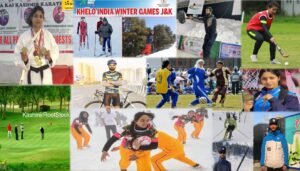 Sports also redefine gender roles in conservative societies. Encouraging participation by women and girls dismantles inherited hierarchies and creates new spaces for visibility and agency. In recent years, young women from Kashmir have begun breaking barriers in martial arts, cycling, and winter sports, earning recognition across India. Their visibility signals a profound cultural shift, where empowerment is neither imported nor enforced but earned through merit. Every female athlete stepping onto a field represents a victory for inclusion, equality, and progress.
On a conceptual plane, the relationship between sports and spirituality encapsulates one of the most profound continuities of Kashmiri heritage. Both are grounded in the same triad: discipline, surrender, and self-knowledge. The athlete, like the ascetic, adheres to a routine, faces pain without resentment, learns humility before achievement, and discovers equanimity in struggle. In both paths, ego dissolves and identity expands. The thin air of the Himalayas becomes a metaphor for purification, the stripping away of comfort and illusion. Athletic training in such a context is therefore a spiritual exercise, not an escape from the world but an elevation within it. To ascend a mountain physically is to also ascend the self morally.
Promoting sports in Jammu and Kashmir is therefore not a temporary development project but a civilizational renewal. It reactivates the suppressed cultural energies of the region, its Yoga heritage, its devotional rigor, its ecological consciousness. It counters despair by transforming motion into meaning. When a young Kashmiri runs, climbs, or plays, they participate in the inheritance of both saint and soldier, the heritage of endurance that binds the region to its mountains. Through such engagement, religion itself reclaims its practical humanism: Hindu discipline, Buddhist compassion, Sikh service, and Islamic surrender find their lived expression in collective athletic effort.
Policy must, of course, provide consistent institutional support. The creation of integrated sports hubs in Srinagar, Jammu, Leh, and frontier districts; the formalization of youth sports academies; and inclusion of physical education in all schools will be decisive steps. Collaborations with defense forces for mountain sports, and integration with the tourism ministry to promote adventure events, could create new circulation between security, economy, and recreation. The vision should not be limited to competition but should encompass inclusivity, sports for all, not just the elite athlete.
All these initiatives converge on a single idea: sports are the language through which youth communicate hope. In a place long defined by its tragic headlines, sports can offer narratives of joy, perseverance, and unity. They remind society that peace is not the silence after conflict but the hum of collective effort, the sound of feet on running tracks, laughter across football fields, and cheers echoing against snow peaks.
In envisioning a progressive Jammu and Kashmir, the sports spirit thus becomes the moral and physical heartbeat of transformation. It animates the youth with purpose, heals communities through shared play, and transforms geography into destiny. The mountains that once marked isolation now represent ascent; the rivers that once divided now symbolize flow and renewal. It is through sports that the valley can rediscover both its body and its soul, harmonizing health, thought, work, and faith.
To build a new Jammu and Kashmir, then, is to build an ethos where every young person knows that striving itself is sacred. The rivers must not only irrigate fields but race with rowers. The meadows must not only be admired but resound with games. The summits must not merely be gazed upon but climbed with courage. Every act of movement becomes a declaration of peace, every game an offering of hope. Sports, in this sense, are not merely activities; they are the collective heartbeat of a society ready to rise beyond its past, to reclaim its future with grace, endurance, and joy.
About the Author