Written by: Irshad Ahmad Bhat ( Research Scholar )
What does it mean for a state to feed on a province while starving its people? Balochistan has asked this question for nearly eight decades, mostly to silence. It is the largest province in pakistan by land, its richest in gas, copper and coastline, and its poorest by almost every measure of human life. That contradiction alone would be worth attention. What makes it urgent now is the darker fact sitting beside it: a record of enforced disappearance so sustained that an entire generation of Baloch women has organised its public life around one demand, tell us where our men are. The life sentence handed to the human rights defender Dr Mahrang Baloch fuses both facts into one courtroom. It lays bare the gap between what Pakistan says about human rights abroad and how it behaves at home. This August, as Baloch communities marked their independence day in cities across the world, the pattern held, as it always does. Gas kept flowing out of the province. Its graves kept filling, most of them without names.
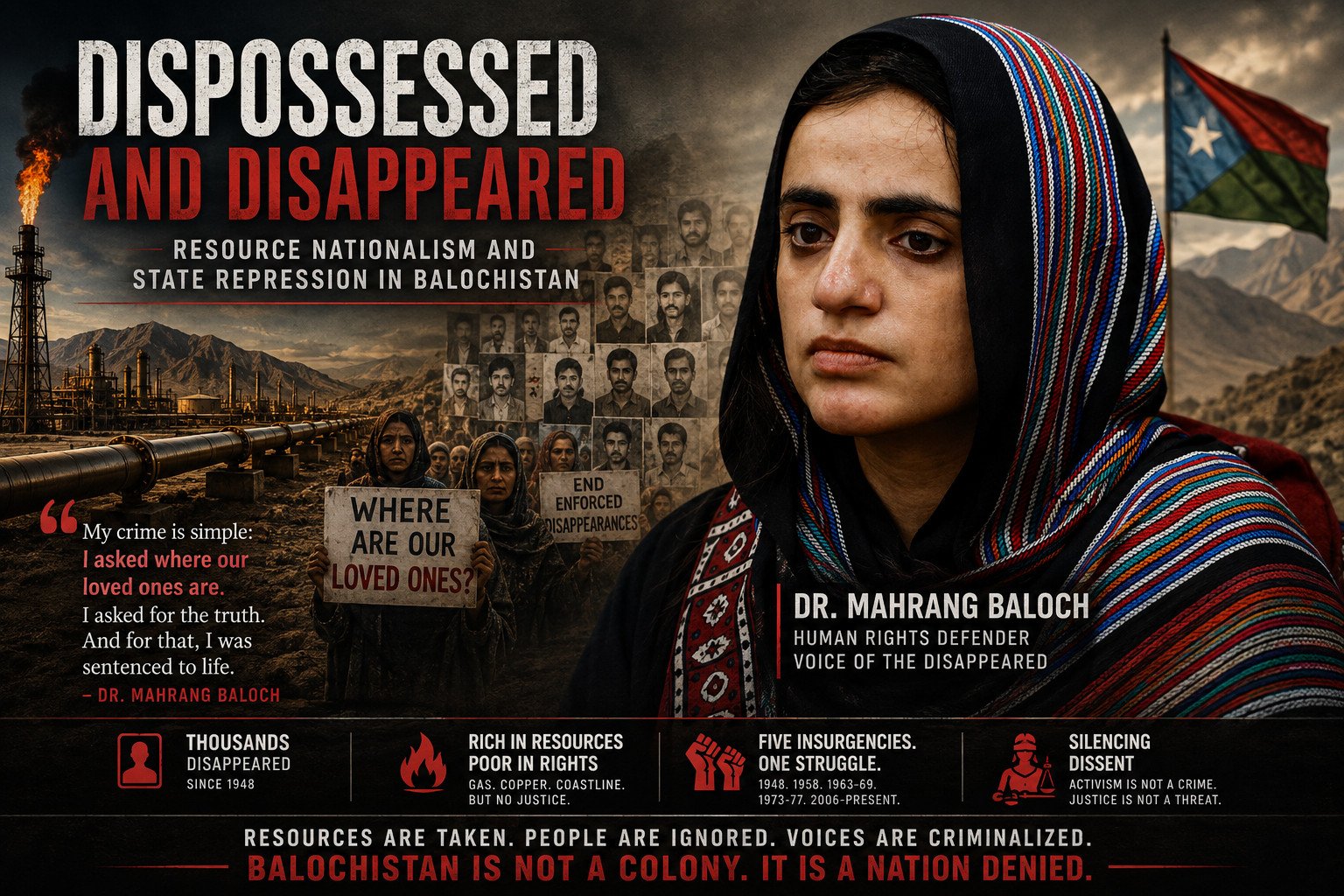
None of this happened without resistance, and the resistance has a shape worth naming before the rest unfolds. Balochistan has lived through five insurgencies since 1948, each rising from the same grievances: a contested accession many Baloch never accepted as legitimate, decades of rule imposed from Islamabad with little local consent, a share of national wealth that never matched the wealth extracted from Baloch land, and a security response built on force rather than settlement. Economists call the pattern underdevelopment by design. Baloch nationalists call it occupation. Either way, each crackdown breeds the next generation of grievance, and the state moves no closer to a fair political and economic settlement.
In Turbat, a woman keeps a photograph folded into her shawl. It shows her son on the day he left for the fruit market. He never came home. That was three years ago. She has walked the length of the country with that photograph. She has slept on pavements. She has asked every official she meets the same question. Is my son alive? Or can I bury him now? No one answers. She is not unusual. She is one of thousands. Her waiting is the backdrop to everything else in this story.
On 22 June 2026, an anti-terrorism court in Quetta sentenced Dr Mahrang Baloch to life in prison. The state says her crime was linked to unrest after a police crackdown on protesters in March 2025. Anyone who has followed her work knows the real story. Her offence was refusing to stop asking where the disappeared have gone. Baloch is 32. She is a medical doctor. She chairs the Baloch Yakjehti Committee, a movement built largely by women whose sons, husbands and fathers vanished into state custody and never returned. Her case is not an aberration. It is the clearest sign yet of a system that has run, almost unbroken, since 1948.
A merger nationalists call fraudulent
Go back to 1947. British rule ends. The Khanate of Kalat, the largest of Balochistan’s princely states, briefly declares independence. For a few months, Kalat exists as a country recognised by no one. In March 1948, under what Baloch nationalists have always called coercion, and what Pakistani officials have always called a lawful and final merger, the Khan signs the instrument of
accession. Pakistani troops move into Kalat within days. The Khan’s own brother, Prince Abdul Karim, refuses to accept it. He leads the first armed revolt that same year.
That contested beginning was never settled. It was only buried under new grievance. A second uprising follows in 1958, after the One Unit scheme dissolves Balochistan’s identity into a single West Pakistan province run from Lahore. A third breaks out through the 1960s. A fourth, the largest before this one, consumes the province between 1973 and 1977. Zulfikar Ali Bhutto’s government sends tens of thousands of troops, backed by Iranian air power, against Baloch insurgents. Estimates of the dead run into the thousands. The insurgency now under way is the fifth. It is the longest. It intensified sharply after the military killed the tribal leader and former chief minister Akbar Bugti in 2006. Today it is fought as much through peaceful mass movements like the Baloch Yakjehti Committee as through the armed groups Islamabad prefers to talk about. The late American scholar Selig Harrison traced each uprising to the same root: a periphery treated by the centre as territory to be secured, not a people to be represented.
Gas without a return
What followed 1948 was not integration. It was extraction, organised and sustained across three generations. Balochistan has supplied the natural gas that has heated homes and powered industry across Punjab and Sindh since the Sui field entered production in the early 1950s. For decades, gas piped out of Sui travelled the length of the country. Dera Bugti, the district that hosts the field, waited far longer for a domestic connection of its own. Balochistan holds some of the world’s largest untapped copper and gold reserves at Reko Diq, now under an international arbitration settlement that critics say still leaves most profits flowing outward. It hosts Gwadar, the deep-water port built as the flagship of the sixty-two-billion-dollar China-Pakistan Economic Corridor, ringed by checkpoints that residents say restrict their own movement more than any outsider’s.
And yet, on almost every measure of human development, health, education, access to clean water, Balochistan sits at or near the bottom of Pakistan’s provincial rankings. Development economists call this underdevelopment by design, not accident. Successive governments in Islamabad, and a military establishment widely seen in the province as Punjabi-dominated, have treated Balochistan’s minerals, gas and coastline as national assets to be secured, not as a homeland to be developed. That gap between what is taken and what is returned is close to the cause of the insurgency itself.
A province rich enough to power a country, too poor to educate or heal its own children.
The counting of the disappeared
Pakistan’s answer to insurgency has been counter-insurgency, run largely by the military and intelligence services with little civilian or judicial oversight. Rights researchers inside Pakistan and abroad, Amnesty International, Human Rights Watch, the Human Rights Commission of Pakistan, the UN Working Group on Enforced Disappearances, have documented the same pattern for two decades. Men taken from their homes or off the street. Held without charge. Sometimes surfacing weeks or years later in what locals call kill-and-dump operations. More often, not surfacing at all.
The toll has not slowed this year. Rights monitors including Paank, the Baloch National Movement’s human rights department, and the Human Rights Council of Balochistan recorded well over a hundred fresh disappearances in January alone. More than two hundred in February. Dozens more in each month since. Students. Labourers. A diesel-pump operator picked up on a business trip. A health worker taken from a nursing hostel. Teenagers among them. Women among them. Families describe the same pattern case after case. Men held for months without charge. Tortured in unacknowledged detention. Then either released, broken and afraid to speak, or found weeks later in what security agencies call staged encounters and relatives call executions. One farmer was taken from a mosque near his home in Dukki in June 2025. He was held for seven months before his body was dumped in January 2026. A student was disappeared in Turbat. A graduate in Gwadar. Whole neighbourhoods in Quetta have watched security forces detain a hundred people at a time, with no evidence produced to justify it.
When bodies are returned at all, they typically come back without post-mortems or DNA verification. Occasionally the state buries them itself, in unmarked graves, before relatives get the chance to identify them. This is enforced disappearance not as an occasional excess, but as an operating method. It removes a person from the record entirely. No death certificate. No trial. No named grave. No legal path to justice, since a person not confirmed dead cannot be mourned, inherited from, or compensated for under Pakistani law. It is a brutality with a bureaucracy behind it. It is the single largest reason the demand for Baloch liberation has outlived every crackdown sent to crush it.
The women who carry the movement
What has changed in the past three years is who is doing the demanding. The Baloch rights movement was once associated mainly with young armed men in the hills. Its public, peaceful form is now led overwhelmingly by women. Mothers holding photographs of missing sons at highway blockades. Wives who have not been allowed to properly grieve, because grief requires a body and the state will not produce one. Sisters and daughters organising long marches from Turbat to Islamabad in the winter cold.
This is a feminist story as much as a nationalist one. Baloch society has historically been conservative about women’s presence in public political life. The disappearance crisis broke that convention, not through ideology, but through necessity. Mahrang Baloch became the face of that shift because she refused to be quiet. She used the tools of a younger, more online generation. Social-media threads documenting each disappearance, case by case. Livestreamed sit-ins. Direct appeals to foreign correspondents and UN rapporteurs. That digital visibility is precisely what the state has tried hardest to shut down, through arrests, airport blacklists and the throttling of mobile networks during protests. For it, she was named to Time’s 100 Next list and nominated twice for the Nobel Peace Prize. Then she was blocked from travelling abroad, arrested in March 2025, and sentenced to life in June 2026, tried partly by video link from the cell where she had already spent more than a year.
Grief requires a body, and the state will not produce one.
An independence day Islamabad refuses to see
This year the argument moved, briefly, from the courtroom to the calendar. And it moved further than it has in years. On 11 August 2026, Baloch nationalist organisations and diaspora communities marked what they call Balochistan’s Independence Day, the anniversary of the Khanate of Kalat’s short-lived 1947 declaration, three days ahead of Pakistan’s own national holiday. This year the commemorations were no longer confined to a handful of exile hubs. Rallies, seminars, flag marches and cultural events were reported in cities across Britain, continental Europe, North America and the Gulf. In every location, organisers repeated the same appeal: recognition for a Republic of Balochistan that Pakistan has never accepted and the international community has never formally engaged with. The diaspora insists on marking it anyway, loudly, and this year more visibly than before.
Inside the province, the day looked very different. Authorities imposed public-gathering restrictions under Section 144. Paramilitary checkpoints went up across Quetta, Mastung and Gwadar. More than a dozen organisers were detained overnight. Markets shut under an informal strike call. Long-distance bus routes were grounded. Three days later, on 14 August, some of the same nationalist groups observed what they call a Black Day, in protest at Pakistan’s own independence celebrations. The gap between the two dates is small. The gap in how each is allowed to be marked, freely abroad, under armoured escort at home, says most of what needs saying about who Pakistan believes owns the story of Balochistan.
A state’s double standard
Islamabad’s official position deserves to be stated plainly, because it will be stated forcefully at the UN, at the OIC, in front of any audience that will listen. The government maintains that the Baloch Yakjehti Committee has links to separatist militants, and that its operations in the province are legitimate counter-terrorism, not a campaign against a civilian population. These are contested claims, not settled facts. Any honest account of Balochistan has to hold them alongside the testimony of the families.
But contested claims do not explain away bodies buried without forensic identification, as rights advocates allege happened after the March 2025 Quetta crackdown. They do not explain why a state confident in the legality of its actions tries a defendant by video link from her own jail cell rather than in open court. And they do not explain the deeper asymmetry. The same state that raises the banner of Muslim solidarity, and that positions itself internationally as a defender of Muslim minority rights, cannot produce its own missing citizens. It cannot explain why a doctor asking for their names is safer in a courtroom charged with terrorism than free in the street asking the question. That contradiction is not a debating point. It is the whole story, told in one sentence.
Balochistan’s crisis will not be solved by another crackdown, another list of the disappeared, another activist silenced. It was created, across seven decades and five insurgencies, by a state that took the province’s gas, its copper, its coastline, and gave back checkpoints. Mahrang Baloch is in prison for saying that plainly and refusing to stop. Hundreds of thousands of Baloch women are still waiting for the state to tell them where their sons, husbands and fathers are buried. Pakistan’s standing on human rights, at home and at the podiums where it lectures others, will remain hollow for as long as that wait continues.
The woman in Turbat is still walking. She does not know Mahrang Baloch personally. But she knows her story by heart, because it is also her own. Somewhere behind a court order and a life
sentence, that is the fact the state has not managed to bury: a mother, a photograph, a question asked every single day, and no answer coming back.
About the Author