Written by: Sheeraz Zaman ( Socio Political Activist )
The true measure of a political system’s strength is not elections or periods of stability, but when common citizens decide to challenge those in power. Citizens march because they believe that their voices matter. They gather because they expect institutions to listen. Political scientist Robert Dahl contended that democracy is not only elections but also public participation and contestation (Dahl, 1989). The real measure of a political system is thus not whether dissent exists, but rather how the state responds when citizens opt for peaceful and constitutional means to express it.
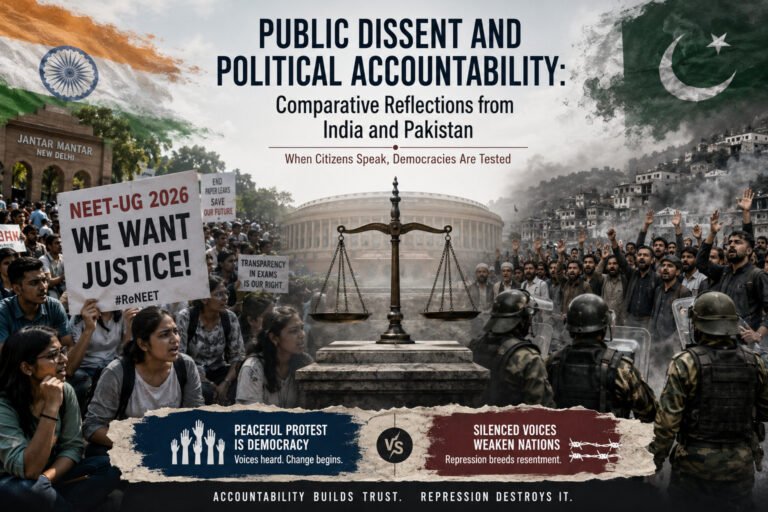
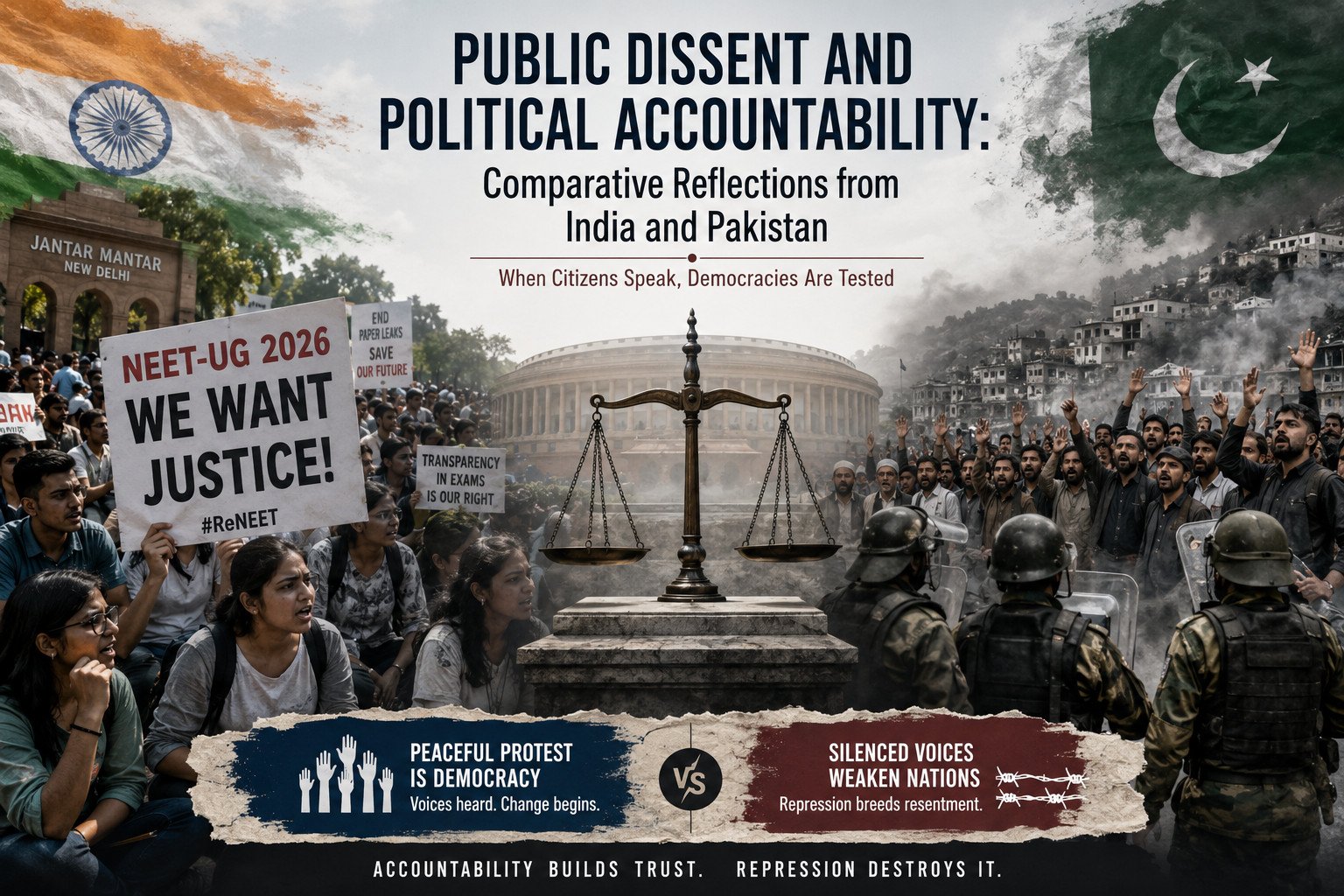
One powerful case in point is recent developments in South Asia. In India, thousands of students gathered at Delhi’s Jantar Mantar and cities across the country, after the purported NEET-UG 2026 paper leak threw the futures of millions of medical aspirants into uncertainty. Across the Line of Control, Rawalakot and other parts of Pakistan occupied Jammu and Kashmir witnessed sustained protests for greater accountability, better governance and political representation. Both movements are born out of public frustration. Both were led largely by ordinary citizens and young people. Yet the responses of the two states followed markedly different trajectories. Those differences reveal as much about political institutions as they do about the protests themselves.
The Indian protests had their origins in a matter that concerned almost every family aspiring to higher education. The purported leak of the NEET-UG examination paper and the consequent cancellation of the examination were not merely administrative lapses. To the students who had prepared for one of the most competitive examinations in India for years, it was a gross breach of faith. The national outrage was heightened by reports of student suicides linked to the examination upheaval. But the problem soon shifted from a debate over education reform to one about the need for government accountability.
The movement was taken over by the Cockroach Janta Party (CJP), led by Abhijeet Dipke. What started as a satirical youth initiative grew into one of the largest student mobilisations in recent times. Protests broke out in universities and major cities, and Jantar Mantar once again became the symbolic hub for democratic protests. Students demanded transparency in public examinations, punishment for those responsible for repeated paper leaks, structural reforms in recruitment and testing agencies, and the resignation of Union Education Minister Dharmendra Pradhan.
The demonstration was heavily policed and included some detentions, but for the most part it remained peaceful. Students organised marches, sit-ins, public rallies and digital campaigns which steadily drew in parents, teachers, civil society organisations and public intellectuals. Political sociologist Charles Tilly described social movements as sustained public campaigns through which ordinary citizens make collective claims upon authorities (Tilly, 2004). The NEET movement reflected precisely this process. Individual frustration was transformed into organised democratic participation. The sustained pressure from the public eventually had political consequences. The Education Minister resigned, and the government announced reforms to restore confidence in India’s examination system. Whether these reforms will ultimately succeed remains to be seen, but the movement proved that peaceful mobilisation can generate institutional accountability without descending into widespread violence.
Almost simultaneously, a parallel movement was unfolding across the border in Rawalakot and the adjoining areas of Pak occupied Jammu and Kashmir. Protesters raised issues about governance, political representation, and the relationship between local communities and federal authorities. As the protests grew larger, however, the state’s response became increasingly security-oriented. Security deployments were stepped up, the encounters between protesters and authorities became more frequent, and a number of civilians lost their lives in the course of the unrest. Rather than evolving into a sustained political dialogue, the protests came to be increasingly viewed through the prism of security and public order.
The deaths of civilians fundamentally altered the character of the movement. Where political participation can entail lethal consequences, dissent is not merely a constitutional matter, but a humanitarian one. Governments have a duty to uphold law and order, but democratic legitimacy also relies on them protecting citizens’ rights to protest grievances peacefully. Every civilian death in a protest risks deepening the rift between the state and society.
The comparison between these two movements should not be taken to suggest that India is free from democratic shortcomings. It is not. Democracies are flawed because they are always negotiating competing interests, competing rights and competing political visions. But democratic systems have an important institutional advantage. They create mechanisms through which public dissatisfaction can feed into political decision-making. India’s democratic history includes periods when governments have placed curbs on public dissent, from the Emergency to more recent controversies around various protest movements.
Article 19 of the Constitution of India guarantees the freedoms of speech, peaceful assembly and association, subject to reasonable restrictions. These guarantees are an expression of what the constitutional scholar Granville Austin called the Constitution’s commitment to reconciling liberty and democratic governance (Austin, 1999). The Supreme Court has time and again recognised peaceful protest as an integral part of constitutional democracy, affirming that dissent is not an exception to the democratic life but one of its essential expressions. As Dr B.R. Ambedkar cautioned in the Constituent Assembly, constitutional methods must remain the primary means of achieving political and social change. Peaceful protest, therefore, is not a challenge to constitutional democracy. It is one of the ways through which democracy renews itself.
Pakistan’s political development has followed a different institutional path. Since independence, the military establishment has been a major player in national politics, foreign policy and internal security. This long-standing civil-military imbalance has often limited the scope for political negotiation during periods of instability. Consequently, sustained public mobilisation is more likely to be understood in the language of security than in the language of democratic participation. The different responses witnessed in Rawalakot cannot be understood without taking this broader institutional context into account.
Ultimately, the comparison between Jantar Mantar and Rawalakot is not about declaring one nation flawless or reducing another to a single moment of crisis. It is about understanding what happens when citizens, particularly young people, lose faith in institutions and conclude that the streets are the only remaining arena where their voices can be heard. Every political system encounters dissent. Every government faces criticism. The defining question is not whether protests occur, but how states choose to respond when those protests remain peaceful and seek accountability rather than confrontation.
The NEET movement in India demonstrated that sustained public mobilisation, even amid tension and accusations of heavy-handed policing, largely remained within the constitutional framework and led to political accountability, including the Education Minister’s resignation and the promise of institutional reforms. But in Rawalakot, the protests became more and more embedded within a security framework, where the use of force eclipsed opportunities for political dialogue, and the subsequent loss of civilian lives turned a movement demanding accountability into a deeper crisis of trust between the state and its citizens.
This contrast points to a larger truth about democratic governance. As Granville Austin has observed, the Indian Constitution was designed not only to establish institutions of government but to create a political order in which liberty, accountability and public participation reinforce each other. Dr B.R. Ambedkar similarly reminded the nation that constitutional methods must remain the principal means of pursuing political and social change. Peaceful protest, therefore, is not an interruption of democracy but one of its most visible expressions. It is through dissent that democracies correct themselves, expose institutional failures, and renew their public legitimacy.
The two movements also reaffirm an enduring lesson of political history. Student protests rarely concern a single examination, a single policy, or a single grievance. Such protests are more likely to reveal deeper issues of justice, opportunity and the legitimacy of public institutions. Governments that opt for dialogue, accountability and institutional reform can build democratic legitimacy even in a time of crisis. But governments that resort to coercion to deal with dissent might be able to restore order in the short term, but risk further widening of the divide between state and society.
History suggests that societies do not become stronger because their streets remain silent. They become stronger because citizens continue to believe that peaceful participation can influence public life. The students who assembled at Jantar Mantar and the protesters who marched through Rawalakot were separated by geography, political systems, and immediate grievances, yet they shared a common aspiration: to be heard by those who govern them. Whether that aspiration is answered through constitutional engagement or through coercive state power ultimately shapes not only the fate of a protest movement but also the character and legitimacy of the political system itself. In that sense, the legacy of these two movements goes far beyond the moments that brought people to the streets; they have become a reminder that a nation’s health is not measured by the absence of dissent, but by its citizens’ confidence that their dissent can still make a difference.
About the Author