Written by: Sheeraz Zaman ( Socio Political Activist )
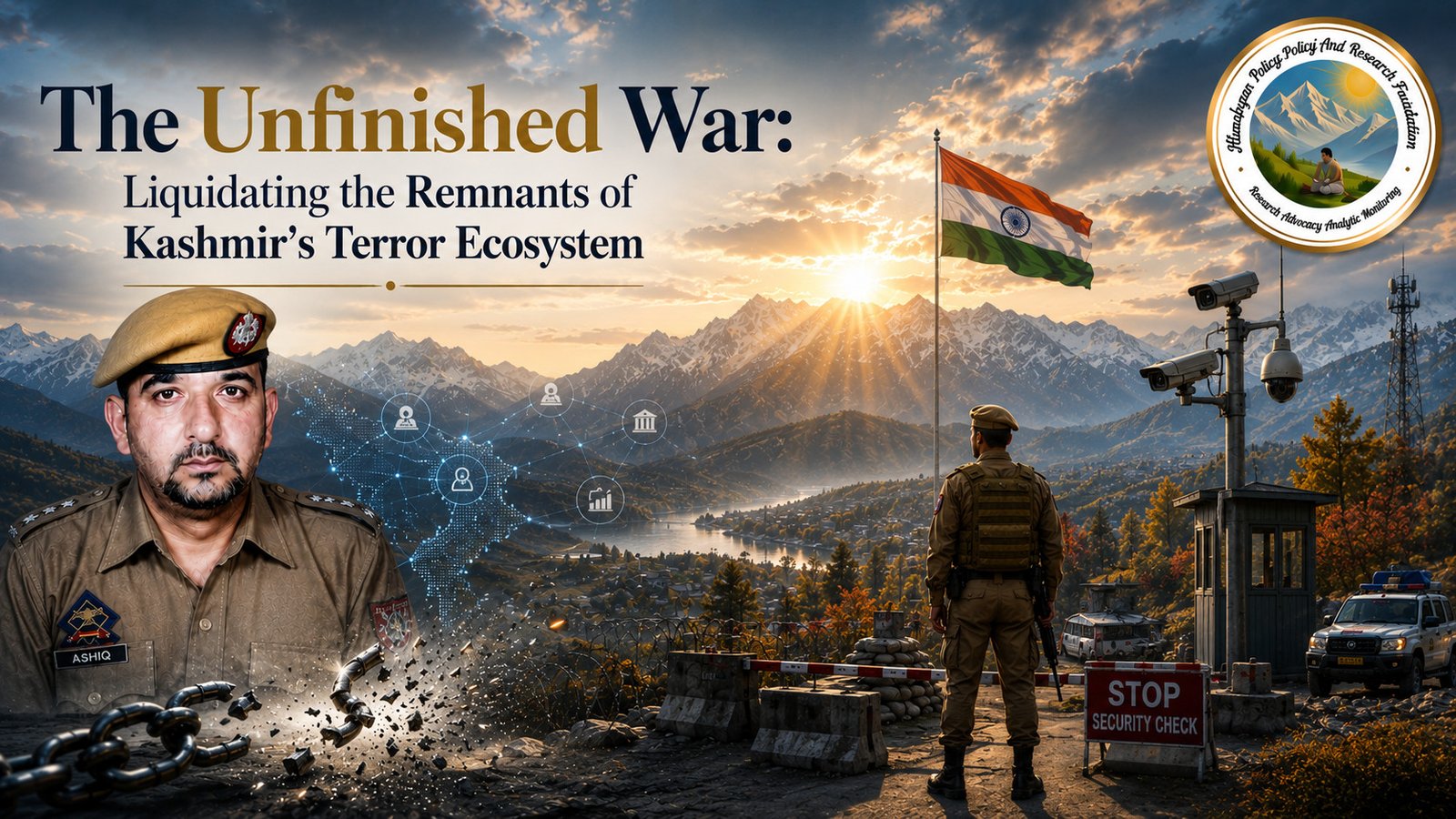
It should trouble a democracy far more than it evidently does that the killing of a policeman can still be discussed, in some quarters, in the conditional language of grievance rather than the unconditional language of crime. Head Constable Ashiq Hussain Qureshi did not die in an abstraction. A father lost his son. A son lost his hope. A wife lost her everything. The state lost a brave officer, deployed to protect pilgrims, shot down in a crowded square by a gunman whose actions were made possible by a support structure that still, after two decades of counter-terrorism, finds enough oxygen to survive. If there is a provocation worth stating plainly at the outset, it is this: sympathy for the ecosystem that enables such killings — however dressed in the language of historical grievance or political nuance — is not neutrality. It is a form of complicity by omission. The terror we are fighting is no easy war, and our tribute to such brave hearts is not compensation, not salutes, but the elimination of terrorism itself.
A National Doctrine Under Empirical Test
India’s counter-terrorism posture, as consistently articulated at both the national and multilateral level, rests on a doctrine that admits no interpretive softening: there is no good terrorist and no bad terrorist, and no permissible distinction between the man who pulls the trigger and the architecture — financial, logistical, ideological — that arms, shelters, and legitimises him. This zero-tolerance framework has been operationalised through concrete institutional instruments: the National Investigation Agency’s pursuit of terror-financing networks to their source rather than their periphery; the Unlawful Activities (Prevention) Act’s use to proscribe fronts and seize the assets of organisations that once provided terrorism a legal and political shield; and a whole-of-government model that treats counter-terrorism as a coordinated function of intelligence, financial regulation, diplomacy, and local administration rather than a policing exercise alone.
The scholarly value of the Kashmir case is that it offers a rare, empirically observable test of this doctrine’s efficacy over a sustained period. Judged against that record, the trajectory is unambiguous: the ecosystem the state confronts today is structurally smaller, more externally dependent, and more socially isolated than at any point since the insurgency began. That the doctrine has demonstrably worked is precisely why its consistent application to what remains cannot be permitted to lapse into managed tolerance.
Post–5 August: A Measurable Turning Point
The abrogation of Article 370 on 5 August 2019 constitutes the clearest inflection point in this trajectory, and its effects are legible in institutional, political, and economic data rather than in rhetoric alone. The political architecture that once gave separatism organisational form and public visibility — capable of enforcing valley-wide shutdowns and converting encounter sites into mobilisation theatres — has been substantially dismantled through proscription and sustained investigation. Local recruitment into militant ranks, which numbered in the low hundreds annually through the mid-2010s, has fallen to a fraction of that figure. Infiltration across the Line of Control has been compressed by fencing and technology-enabled surveillance. The restoration of panchayat, municipal, and assembly-level democratic participation has extended mainstream political competition into spaces separatist politics once monopolised uncontested. Tourist and pilgrim volumes — including the scale of Amarnath Yatra movement that Qureshi was himself protecting when he was killed — have reached levels that would have been structurally impossible under the coercive street politics of the preceding decade, and constitute a credible proxy for restored public confidence.
None of this licenses complacency; Anantnag is proof enough of that. But it establishes the empirical baseline against which the remaining threat must be assessed: not as evidence of a persistent insurgency, but as the residue of one that has already been substantially broken, sustained now chiefly by external sponsorship rather than domestic momentum.
The Remnant Problem
Pakistan’s adaptation to this compression has been to miniaturise its investment in Kashmir rather than to withdraw it. The Resistance Front, which claimed the Anantnag attack, functions as a rebranded, deniable proxy for Lashkar-e-Taiba, allowing cross-border handlers and financing structures to escape direct attribution while sustaining a residual operational capability through hybrid recruits — local individuals with no prior militant record, activated for a single act and reabsorbed into civilian life. This is not evidence of adaptive strength; it is the signature of an ecosystem under sustained pressure, retreating to the smallest footprint capable of remaining lethal.
Precisely because that footprint is small, its complete liquidation demands a different order of precision than the large-scale operations that broke the ecosystem’s earlier, larger architecture. It requires the tracing of individual financial transactions rather than reliance on broad proscriptions; intelligence-led identification of hybrid overground workers rather than blanket operations that risk eroding the community cooperation such identification depends on; and sustained multilateral pressure — including continued advocacy at forums such as the Financial Action Task Force — to deny cross-border sponsors the deniability that rebranded fronts are designed to manufacture. A remnant tolerated at low, manageable intensity is not a stable equilibrium. It is dormant capacity awaiting the moment institutional pressure eases.
The Price Paid — Personal and Institutional
Any analysis of counter-terrorism that does not account for its human cost is incomplete as scholarship and dishonest as policy. Ashiq Hussain Qureshi was thirty-five, a resident of Budgam serving in Anantnag, killed on duty protecting a pilgrimage. His family’s loss is total and non-transferable — a loss disproportionately borne, across the decades of this campaign, by Kashmir’s own sons serving in its police force, a fact that itself dismantles any narrative casting this as an external force arrayed against a uniformly hostile population.
The institutional cost compounds alongside the personal. Every such killing diverts a security apparatus already stretched across yatra protection, law and order, and counter-infiltration duties into reactive cordon-and-search operations; every cycle of mourning and redeployment extracts a toll on morale that produces no headline. This compounding cost is the strongest argument, on strictly institutional grounds, for treating the zero-tolerance doctrine as a matter of operational necessity rather than political posture: a war sustained indefinitely at diminished intensity is not a cheaper war. It is a permanent tax on the institution asked to fight it, levied in officers and in the families behind them.
The Extended Cognitive Front
If the kinetic ecosystem has been reduced to a manageable remnant, the adversary’s cognitive warfare apparatus has expanded, deliberately, to compensate — and it now operates across a considerably wider spectrum than counter-terrorism doctrine conventionally accounts for.
At the tactical layer, encrypted channels and social media platforms are used to glorify attacks within hours of their occurrence, converting a single gunman’s action into content engineered for maximum reach and disproportionate psychological effect relative to the operation’s actual scale. At the domestic narrative layer, sustained disinformation campaigns work to reframe every counter-terror response — a demolition, a detention, a cordon operation — as evidence of state overreach, deliberately targeting the same population whose cooperation future intelligence depends upon, and thereby converting the state’s own enforcement actions into recruitment material for the adversary. At the diplomatic-strategic layer, the rebranding of proxies such as TRF is itself a cognitive operation: it is designed less to deceive Indian security agencies, who understand the linkage clearly, than to furnish plausible deniability before international and multilateral audiences, complicating attribution at exactly the forums where sustained pressure on Pakistan’s terror-financing architecture must be maintained.
A fourth, less examined layer operates through sympathetic academic, diasporic, and civil-society intermediaries who, whether wittingly or not, lend intellectual legitimacy to the framing that Kashmir’s residual violence reflects unresolved political grievance rather than externally sponsored proxy war. This layer is the hardest to counter precisely because it does not present itself as propaganda; it presents itself as scholarship, journalism, or human-rights advocacy, and its effect is cumulative rather than immediate — shaping the interpretive frame within which each individual attack, including Qureshi’s killing, comes to be understood by external audiences.
Contesting this front requires instruments fundamentally different from those used against armed cadres. It requires credible local religious and civil-society voices capable of delegitimising violence with an authenticity no state broadcast can replicate; rapid, transparent official communication after every operation that denies disinformation the vacuum it depends on; sustained academic and diplomatic engagement to correct the record in precisely those international spaces where the fourth-layer narrative gains traction; and, underpinning all of it, a governance dividend substantial enough that lived experience becomes the most persuasive rebuttal available to grievance narratives manufactured abroad.
Conclusion
The empirical record since 5 August 2019 demonstrates what a consistently applied, doctrine-backed counter-terrorism policy can achieve: an ecosystem measurably smaller, weaker, and more externally dependent than at any point in a generation. The killing of Head Constable Ashiq Hussain Qureshi does not contradict this record; it clarifies what remains within it — a residual, deniable, cognitively reinforced remnant that retains the capacity to inflict grief that is total for the families who bear it. What is required now admits no ambiguity: the complete liquidation of this remnant — its last hybrid recruits, its last financing conduits, its last deniable fronts, and the cognitive infrastructure sustaining all three — rather than its indefinite management. Anything short of that leaves the state’s tribute to its fallen incomplete, and leaves more fathers, sons, and wives to bear the cost of a war the record shows can, in fact, be finished.
About the Author