Written by: Muzamil Nabi Dar ( Research Scholar)
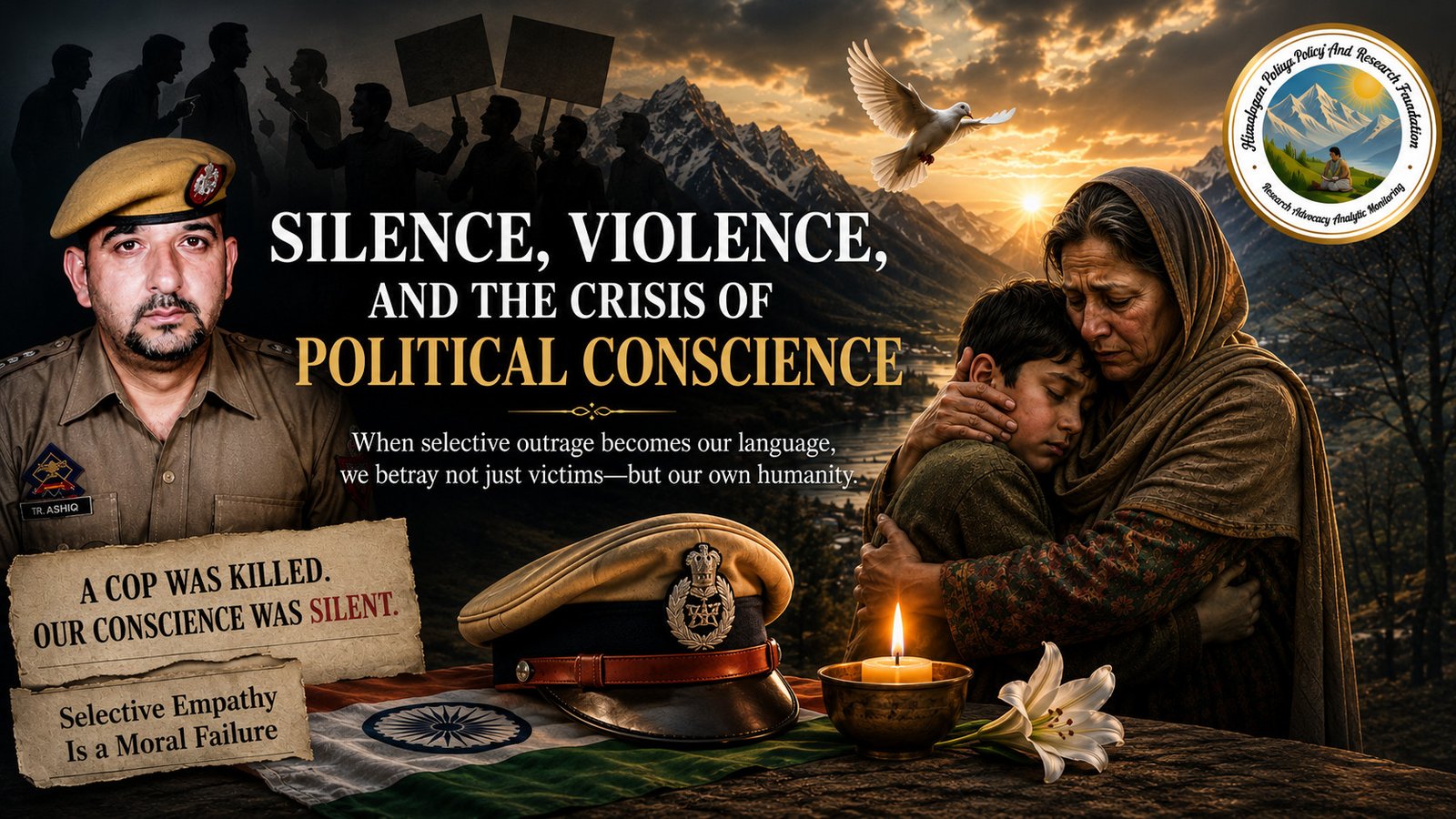
Every conflict produces its own casualties. Some lose their lives, others lose their homes, and many lose the certainty that tomorrow will resemble today. Yet prolonged conflicts also produce another, less visible casualty, the erosion of moral consistency. Over time, societies begin to mourn selectively, political actors become increasingly guarded in expressing compassion, and human suffering is filtered through ideological preferences. The recent killing of a Jammu and Kashmir Police officer in Anantnag is not merely another tragic episode in Kashmir’s troubled history. It is also a moment that exposes a deeper ethical failure within the Valley’s political discourse: the growing inability of its political leadership to respond to violence with a universal moral language.
The officer who lost his life was not merely a functionary of the state. He was a Kashmiri. He belonged to this land, spoke its language, shared its culture, and lived within the same social fabric that every political party claims to represent. Before he wore a uniform, he was someone’s son. He was a husband. Perhaps a father. A neighbour. A friend. Like thousands of other Kashmiris, he left home to perform his duty. Unlike countless others, he never returned.
For his family, this is not an event that will disappear from newspaper headlines after a few days. It is a permanent fracture in the architecture of their lives. His children, if they are young, will remember him through photographs more than conversations. His wife must now shoulder responsibilities that were meant to be shared. His parents, if they survive him, must endure the profound sorrow that no parent should ever experience, the burial of a child. Every official statement of condolence eventually fades; the family’s grief does not.
Yet what deserves equal attention is not only the brutality of the killing but the remarkable restraint, and in many cases complete silence, of significant sections of Kashmir’s political class. Such silence is never politically neutral. Silence itself communicates priorities. It reveals which deaths are considered worthy of public grief and which are quietly absorbed into the background of an already violent landscape.
This is where Kashmir’s political discourse increasingly confronts a crisis of credibility. Across the Valley, political leaders frequently invoke the language of democracy, constitutionalism, civil liberties and human rights. These are not merely legitimate concerns; they are indispensable principles within any constitutional democracy. Whenever allegations of excessive force arise, whenever individuals accused of anti-state activities are detained, arrested or killed, political voices emerge with remarkable speed. Statements are issued. Press conferences are held. Social media timelines are filled with expressions of concern. Legal safeguards, due process and constitutional protections rightly become matters of public debate.
No democratic society should object to such interventions. Every individual, regardless of accusation or ideology, deserves the protection of law. Constitutional rights are meaningful precisely because they apply even to those with whom society disagrees.
However, democratic principles acquire legitimacy only when they are applied consistently. The uncomfortable question that inevitably arises is this: where does this moral urgency disappear when the victim happens to be a local police officer? Why does the vocabulary of human dignity suddenly become hesitant? Why does compassion become qualified? Why do elaborate statements defending constitutional values become conspicuously absent when the person killed is himself a Kashmiri serving in a public institution?
These questions are not rhetorical provocations. They strike at the heart of political ethics. The Jammu and Kashmir Police occupy a uniquely complex position within the Valley. Unlike many security institutions that are perceived as external, the overwhelming majority of police personnel are local recruits. They come from villages and towns across Kashmir. Their parents continue to live among ordinary citizens. Their children attend local schools. Their families shop in the same markets and participate in the same social life. Their identities cannot be separated from the society around them.
When a Kashmiri police officer is assassinated, Kashmir itself loses one of its own. Reducing such individuals merely to representatives of the state is sociologically inaccurate and morally inadequate. Their deaths are not abstract institutional losses; they are deeply personal tragedies experienced by local communities. Every targeted killing leaves behind grieving families whose suffering bears no ideological label.
At the same time, security institutions must also recognise that the ultimate strength of any force lies not only in its operational capabilities but in the trust and confidence it builds among the people it serves. Every life lost in the line of duty is a reminder of the human cost borne by those who protect public order. Strengthening intelligence networks, ensuring better protection for personnel deployed in vulnerable areas, and providing sustained institutional support to their families are essential components of a humane security framework. Security cannot be measured merely by the prevention of attacks; it must also be reflected in the dignity, preparedness, and welfare of those who stand at the frontline. A resilient security architecture is one that combines firmness against violence with compassion towards its own personnel and their families.
Targeted killings have always possessed objectives that extend far beyond the immediate victim. Their purpose is psychological as much as physical. They seek to cultivate fear, demonstrate vulnerability, weaken institutional confidence and remind society that violence remains capable of reaching anyone at any time. The immediate victim dies once. The larger society is expected to live with uncertainty indefinitely.
The consequences therefore extend beyond policing. Every teacher, every public servant, every elected representative and every ordinary citizen quietly absorbs the message that violence remains an available instrument of intimidation. In this sense, targeted killings are
not isolated criminal acts. They are calculated attempts to reshape public behaviour through fear.
Precisely because of this, political condemnation assumes enormous significance. Condemnation does not resurrect the dead. It does something equally important. It establishes the moral boundaries of society. It tells citizens that regardless of political disagreement, certain acts remain unacceptable because they violate the fundamental sanctity of human life.
When political leaders hesitate to articulate this principle with clarity, they inadvertently weaken those very moral boundaries. Perhaps the most troubling feature of contemporary politics in Kashmir is not disagreement over constitutional questions, autonomy, statehood or governance. Democracies thrive upon disagreement. The deeper concern is the gradual emergence of differentiated empathy, a situation in which compassion itself becomes conditional upon political identity.
A society enters dangerous moral territory when it begins asking not what happened to the victim, but who the victim was before deciding whether grief is appropriate. Once this hierarchy of victims becomes normalised, the ethical foundations of public life begin to erode.
The philosopher Hannah Arendt once observed that politics ultimately depends upon our willingness to inhabit a shared world with others. That shared world cannot survive if human worth itself becomes selective. A democratic culture requires what may be called moral universality, the recognition that every life possesses equal dignity irrespective of profession, ideology or institutional affiliation.
This is where Kashmir’s political class must engage in serious introspection. Political leadership cannot claim to represent society while expressing compassion only for those deaths that reinforce existing political narratives. Representation demands something more demanding than ideological consistency; it demands ethical consistency.
One may criticise governmental policies. One may question laws, challenge administrative decisions and advocate constitutional reform. Such debates are integral to democracy. Yet none of these positions absolves political leaders from acknowledging the humanity of a police officer who loses his life while performing his duty.
There is no contradiction between defending civil liberties and mourning a slain policeman. There is no inconsistency between advocating constitutional rights and recognising the sacrifice of a public servant. Indeed, genuine constitutionalism requires precisely such consistency. What ultimately distinguishes principled politics from partisan politics is the refusal to divide human suffering into categories of greater and lesser significance.
Conflict has already extracted an extraordinary price from Kashmir across generations. Thousands of families irrespective of political affiliation, profession or ideology have experienced bereavement, displacement and insecurity. The Valley has accumulated enough
grief to understand that every death creates consequences extending far beyond the individual.
The recent killing in Anantnag should therefore not become another fleeting headline. It should compel a broader reflection on the ethical responsibilities of leadership. Political influence is measured not merely by electoral success or rhetorical skill, but by the capacity to articulate a moral vision that includes every member of society. Leadership begins where selective empathy ends.
If Kashmir is to move towards a more democratic, more humane and more politically mature future, its public discourse must recover the language of equal compassion. It must become possible to mourn every innocent life without first examining its political utility. It must become possible to condemn violence without calculating electoral consequences. Above all, it must become possible to recognise that the life of a Kashmiri does not derive its value from the institution he serves but from his inherent human dignity.
The police officer killed in Anantnag deserved that recognition, not because he wore a uniform, but because he was a human being whose life mattered, whose family now carries an immeasurable loss, and whose death reminds us that the greatest test of any political culture is not how passionately it speaks for those with whom it agrees, but how consistently it affirms the equal worth of every human life.
About the Author