Written By: Arshia Malik
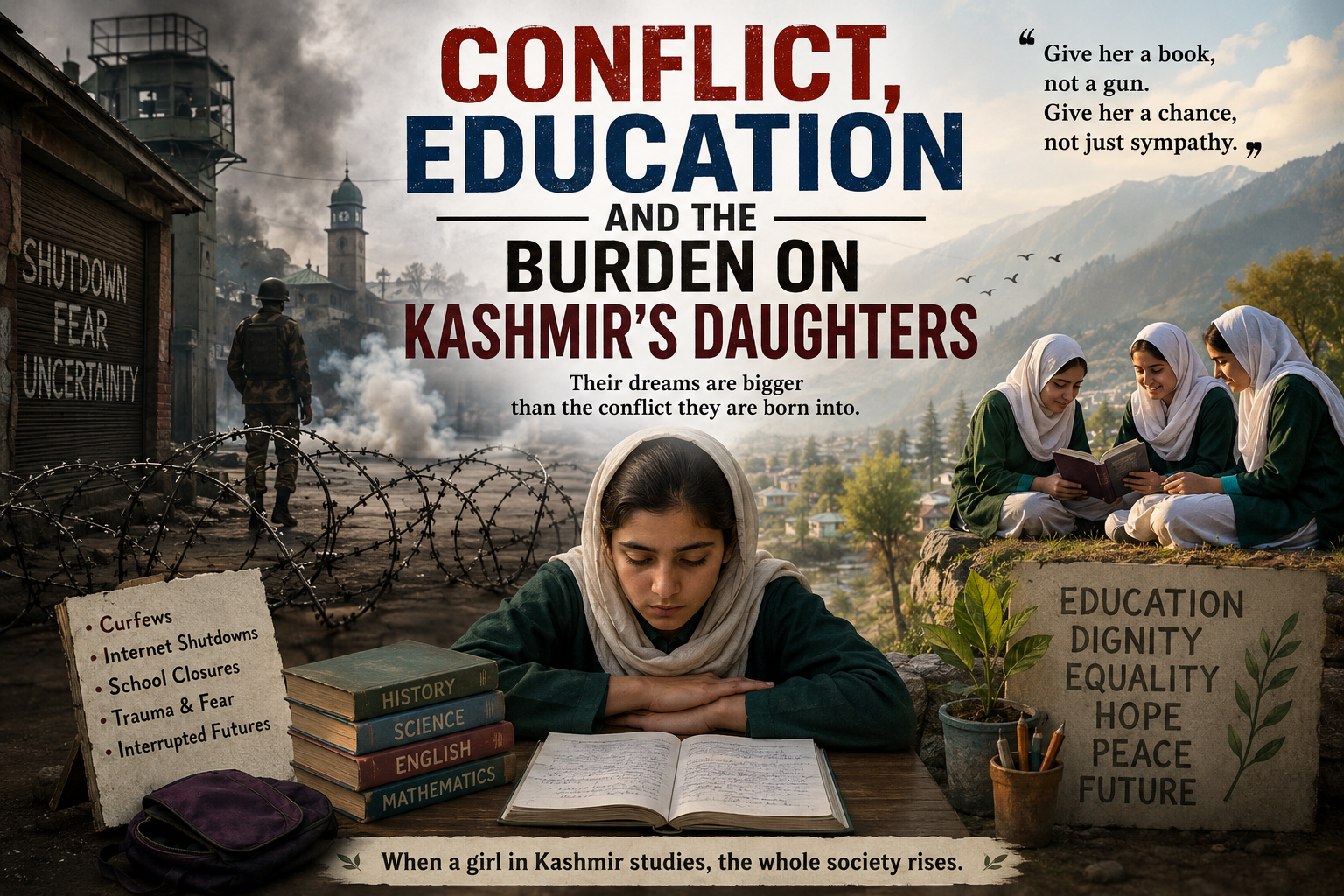
Conflict zones rarely destroy only buildings. They destroy routines, trust, mobility, institutions, childhood, and the quiet expectation that tomorrow will be more stable than today. Education is among the first casualties because schools depend on continuity: open roads, functioning transport, predictable exams, teachers who can reach classrooms, parents who believe children will return home safely, and students who are emotionally able to learn. In protracted conflicts, this continuity breaks again and again. Children suffer first because childhood is time-sensitive; a lost school year at age nine or fourteen cannot simply be recovered by political rhetoric later. Within children, girls often bear the heaviest burden because conflict does not suspend patriarchy; it intensifies it.
Across South Asia, the pattern is visible. In Afghanistan, the Taliban’s return to power converted gender ideology into state policy: UNESCO reported in 2025 that Afghanistan remains the only country where girls and women are formally barred from secondary and higher education, with nearly 2.2 million girls excluded beyond primary level. The same UNESCO statement notes that between 2001 and 2021, girls’ primary enrolment had risen above 80%, showing that the current exclusion is not cultural inevitability but political reversal. (UNESCO) In Myanmar, children are not barred from school through one nationwide gender decree, but through civil war, displacement, airstrikes, landmines, and the collapse of safe civilian space. UNICEF reported that in 2024 around six million children were enduring worsening humanitarian conditions, while children made up more than a third of nearly 3.5 million internally displaced people. (UNICEF)
Pakistan shows another form of the same gendered violence: militant hostility to girls’ education. UNICEF condemned the 2024 bombing of a girls’ school in North Waziristan, reportedly the only girls’ school in that area; the attack occurred in a country already confronting around 26 million out-of-school children. (UNICEF) Bangladesh, though not itself a conventional civil-war battlefield today, hosts the educational consequences of Myanmar’s violence: UNICEF warned in 2025 that the education of around 230,000 Rohingya refugee children in Cox’s Bazar was at risk because of funding collapse, with learning centres facing closure and children exposed to recruitment, abduction, migration pressures and violence. (UNICEF) Sri Lanka’s civil war offers a longer-term lesson: qualitative research from Jaffna found that displacement, loss of livelihoods and war trauma caused some children to lose interest in schooling and drop out, while those who stayed in school often depended on unusually secure family support. (European Scientific Journal)
Kashmir must be understood within this regional history of conflict and gendered educational harm. Its story cannot be reduced to a single cause. Jammu and Kashmir has suffered from a long conflict involving India-Pakistan rivalry, Pakistan-backed militancy, separatist mobilisation, counterinsurgency, curfews, school closures, communication restrictions, economic disruption, patriarchal family structures, and ideological pressures that have at times policed women’s behaviour. The result has not been one isolated educational crisis but a repeated breaking of the educational chain.
The effect of armed conflict on Kashmiri children is not merely anecdotal. Anton Parlow’s study of the Kashmir insurgency in the 1990s found that children exposed to the insurgency suffered measurable educational losses. The study’s most striking finding was that girls in urban Kashmir exposed to violence had up to 3.5 fewer years of schooling compared with less-affected girls. It also found that children more affected by violence were less likely to complete primary schooling. (Munich Personal RePEc Archive) This matters because it gives empirical weight to what many families experienced directly: violence did not only produce fear; it changed educational attainment.
The mechanisms are clear. When armed groups operate, when protests and shutdowns become routine, when schools are burned or closed, when families fear encounters on the road, and when security responses include curfews or cordon-and-search operations, education becomes fragile. Girls are especially affected because families often respond to insecurity by restricting daughters’ mobility before sons’. A boy may still be permitted to travel for coaching or exams; a girl may be withdrawn because the road is unsafe, the school is far, the bus route is unpredictable, or the family fears harassment, public disorder, gossip, or dishonour. Conflict therefore turns existing patriarchy into educational exclusion.
Pakistan-backed militancy and separatist violence have caused severe damage to Kashmir’s educational life. This should be stated plainly. Militancy normalised the gun as a political instrument, turned civilian areas into security zones, disrupted schools through fear and shutdowns, and created an ideological environment in which conservative and coercive actors could more easily police women’s mobility. A 2024 review on Kashmiri women notes that Pakistan has supported separatist insurgency in the Valley and that women’s safety and movement have been affected by militants, armed personnel and stricter security regulations. (Nature) Militant intimidation and separatist coercion did not liberate Kashmiri girls; they narrowed the space in which girls could study, travel, speak and imagine a future.
But a serious analysis must also avoid the opposite simplification. It is not academically credible to say that only terrorism harmed girls’ education and that militarised governance had no educational cost. Security measures may be necessary in response to terrorism, but necessity does not erase consequence. Checkpoints, curfews, school closures, communication blackouts, raids, surveillance, and repeated public restrictions shape childhood. The Ministry of Home Affairs itself described post-2019 security strategies in Jammu and Kashmir as including round-the-clock checkpoints, intensified cordon-and-search operations, day-and-night area domination and preventive operations. (Press Information Bureau) Such measures may reduce terrorist violence, but they can also affect how children, especially adolescent girls, access public space.
This is the central analytical point: in conflict zones, the gun held by the militant and the gun held by the state do not have identical moral status, but both can enter the child’s world. A rights-based framework can condemn Pakistan-sponsored terrorism and separatist coercion while still evaluating whether enforcement practices protect or disrupt children’s education. The question is not whether the state has a duty to fight terrorism; it does. The question is whether counterterrorism is designed with children’s rights, girls’ mobility, school continuity and mental health as explicit priorities.
The educational damage in Kashmir has also come from direct disruption to schooling infrastructure and academic calendars. Action on Armed Violence recorded the impact of explosive violence in Kashmir, including deaths and injuries from explosive weapons and disruption of civilian infrastructure. It reported that heavy shelling and ceasefire violations closed schools along the border, including nearly 300 schools in Jammu, Samba and Kathua districts in 2016, and that prolonged shutdowns damaged syllabus completion and learning quality. (AOAV) Humanium similarly noted that during the 2019 post-abrogation restrictions, parents were reluctant to send children to school because they placed safety above education, while lack of phone connectivity made it difficult to contact school authorities. (Humanium)
The overlap of political lockdown and COVID-19 deepened this educational fragility. A 2024 article on schooling in Kashmir describes the region as marked by armed conflict and then by the unprecedented disruption of the pandemic, producing “dual lockdowns”—one political and one viral—that affected school education in a region already accustomed to closures, curfews and insecurity. (Springer) This is crucial for interpreting post-2019 outcomes. Any honest reading must separate three things: the immediate disruption caused by restrictions and internet shutdowns, the later decline in recorded terror incidents, and longer-term educational trends that began before 2019.
Post-2019 data show a mixed but important picture. There is evidence of improved security indicators. The Ministry of Home Affairs reported that terrorist-initiated incidents in Jammu and Kashmir fell from 228 in 2018 to 43 up to 30 November 2023, while civilian deaths and security personnel fatalities also declined. (Press Information Bureau) This decline is not educational data, but it is educationally relevant: safer roads, fewer encounters, and lower fear can improve school attendance, teacher mobility, tourism-linked livelihoods and girls’ access to colleges or coaching centres.
Literacy and enrolment indicators also show that Kashmir should not be frozen in old data. The PLFS 2023–24 estimated Jammu and Kashmir’s literacy rate for persons aged seven and above at 82.0%, slightly above the all-India estimate of 80.9%. (Digital Sansad)
The school-level picture for girls is encouraging at entry level but worrying at adolescence. UDISE+ 2024–25 data show girls’ Gross Enrolment Ratio in Jammu and Kashmir at 114.5 in primary, 80.0 in upper primary, 67.5 in secondary, and 46.6 in higher secondary. The steep fall from primary to secondary and higher secondary is the key policy concern. Dropout data confirm this: in 2024–25, girls’ dropout in J&K was 1.1% at primary level and 3.2% at upper primary level, but rose to 12.2% at secondary level, above the national girls’ secondary dropout rate of 9.6%. In simple terms, many girls enter school, but too many are lost during adolescence.
Higher education data are more positive. AISHE 2021–22 recorded 207,469 female higher-education enrolments in Jammu and Kashmir out of 400,423 total, meaning women formed a little over half of total higher-education enrolment. Yet this too should be interpreted carefully. Female participation in higher education was not created overnight after 2019; AISHE data show that female GER in J&K was already higher than male GER in 2017–18 and remained so through 2021–22. The stronger conclusion is not that one constitutional event suddenly rescued girls’ education, but that Kashmiri society has long contained a powerful aspiration for female education despite conflict.
Patriarchy remains the silent multiplier of every crisis. In stable societies, patriarchal norms may already push girls toward domestic labour, early marriage, modesty restrictions, and reduced mobility. In conflict zones, these pressures acquire the language of protection. Families may say, often sincerely, that they are keeping daughters safe; but the cumulative effect is educational deprivation. A girl who misses school during shutdowns may be asked to help at home. A girl who falls behind may be married early. A girl who cannot travel safely may be shifted from school to private tuition, then from tuition to nothing. The conflict does not invent patriarchy; it gives patriarchy new arguments.
False religious indoctrination intensifies this effect. The problem is not religion itself. Kashmiri Muslim families, like families across South Asia, have often made extraordinary sacrifices for daughters’ education. The problem is coercive political religion: the claim that girls’ mobility is dishonourable, that modern education corrupts women, or that female autonomy threatens community identity. Afghanistan is the extreme case, but Pakistan’s attacks on girls’ schools and Kashmir’s own episodes of militant or conservative coercion show how girls become symbolic territory. When conflict turns identity into a battlefield, women’s clothing, speech, schooling and movement are treated as markers of collective control.
The way forward in Kashmir must therefore reject slogans and build institutions. First, Jammu and Kashmir needs a transparent Girls’ Education and Conflict Impact Dashboard. It should publish district-wise, gender-wise and grade-wise data on enrolment, attendance, dropout, transition, exam completion, teacher vacancies, transport, toilets, hostels, school closure days, internet disruption days and reported safety incidents. Without such data, public debate will remain vulnerable to cherry-picking.
Second, secondary education must become the centre of policy. The data show that the crisis is not primarily primary-school access; it is adolescent retention. Safe transport, girls’ hostels, female teachers, menstrual hygiene facilities, counselling, bridge courses, scholarships for Classes 9–12, and community mentoring can reduce the pressures that push girls out. Third, security planning must include education continuity. Counterterror operations should protect schools from being used as security sites except in genuine emergencies, minimise disruption around exam periods, and maintain educational access during restrictions wherever possible.
Fourth, counter-radicalisation must be educational and community-led. Extremist narratives are not defeated only through policing; they are weakened when respected local teachers, mothers, doctors, religious scholars and women graduates publicly defend girls’ education as morally legitimate, economically necessary and socially rooted. Finally, trauma-informed schooling is essential. Children who have lived through raids, encounters, shutdowns, funerals, displacement or fear cannot learn well in institutions that ignore mental health.
Kashmir’s daughters have not been held back by one force alone. They have been harmed by a long conflict in which Pakistan-backed terrorism, separatist coercion, militarised enforcement, patriarchal norms, religious extremism, poverty, weak infrastructure and repeated institutional disruption have interacted. The most honest position is therefore both anti-terrorist and rights-based: security is necessary, but security must be judged by whether it expands or restricts a child’s future. The real test of peace in Kashmir will not be only lower violence statistics. It will be whether every girl can safely enter school, remain through adolescence, complete her education, and step into public life without fear.
About the Author