Written by: Irshad Ahmad Bhat ( Research Scholar )
The recent crackdown on the Joint Awami Action Committee, or JAAC, is not merely another episode of unrest in a disputed region. It is a collapse of the central fiction on which Pakistan’s Kashmir policy has rested for decades: that Islamabad speaks for Kashmiris, protects Kashmiris, and champions their freedom. The contradiction is now visible. A state that has spent generations accusing India of repressing Kashmiris has proscribed a grassroots Kashmiri civic movement under anti-terror law, cut communications, arrested activists and journalists, and deployed force against people protesting over basic economic and political grievances.
On 5 June 2026, authorities in Pakistan-administered Jammu and Kashmir designated the JAAC as a proscribed organisation under the Azad Jammu and Kashmir Anti-Terrorism Act, 2014. Amnesty International described the JAAC as a grassroots movement advocating economic and political rights, and called the terrorism designation disproportionate, unlawful and a violation of freedom of association. Amnesty also reported an internet and mobile shutdown, mass arrests, the sealing of JAAC offices, the arrest of journalist Sohrab Barkat, and deadly violence in Rawalakot.
That is the heart of the matter. The protesters were not demanding secession from Pakistan through armed revolt. Their demands were painfully ordinary: subsidised wheat, affordable electricity, better services, and changes to a political system that reserves legislative seats for refugees from Indian-administered Kashmir living in Pakistan. The Associated Press reported that the JAAC’s 38-point charter included subsidised wheat and electricity, while one of the unresolved issues concerned the 12 reserved legislative seats.
This is why the crackdown matters beyond the immediate violence. It reveals the deeper structure of governance in Pakistan-occupied Kashmir: extraction without accountability, representation without real autonomy, and security laws used to silence civic demands.
The myth of “Azad” Kashmir meets the reality of coercion
The word “Azad” was always meant to do political work. It allowed Pakistan to present the territory as free, self-governing and morally superior to Indian-administered Jammu and Kashmir. But freedom cannot be measured by slogans. It is measured by whether citizens can protest, organise, publish, vote meaningfully, and demand services from the authority that governs them.
By that standard, the recent events are devastating for Pakistan’s narrative.
A movement of traders, students, lawyers, workers and civil society representatives asked why a territory rich in hydropower potential should suffer high electricity costs and poor supply. It asked why flour should remain unaffordable for ordinary households. It asked why a legislature should include reserved seats that, in the eyes of local protesters, dilute the voice of residents. Instead of answering politically, the authorities answered through proscription, arrests, internet restrictions and force.
Al Jazeera reported that at least 11 people were killed in clashes before a planned JAAC rally and that the group had long demanded greater political rights and abolition of the refugee seats. It also reported that the regional government had designated the JAAC as a proscribed group under anti-terror law before the planned protest. (Al Jazeera)
This is not a minor inconsistency in Pakistan’s Kashmir position. It is the exposure of its foundation. Pakistan’s claim has always depended on portraying itself as the defender of Kashmiri self-expression. Yet when Kashmiris under its own control expressed themselves in civic and economic terms, the state treated them as a security threat.
That is the real argument: Pakistan has not merely contradicted its Kashmir policy; it has revealed what that policy has always been. Kashmir is not treated as a community of citizens whose welfare matters. It is treated as a strategic instrument.
A South Asian pattern: when peripheries ask for rights, states call it security
The violence in Pakistan-occupied Kashmir should also be understood in the larger South Asian context. Across the region, peripheral communities often encounter the state not as a provider of services but as a security machine. When people in borderlands, minority regions or resource-rich peripheries demand accountability, the language of governance is quickly replaced by the language of order, sedition, terrorism and national security.
Pakistan’s own record in Balochistan shows the same pattern. The Human Rights Commission of Pakistan reported in August 2025 that Balochistan faced a serious human rights crisis marked by enforced disappearances, shrinking civic space, erosion of provincial autonomy and unchecked impunity. (HRCP) Amnesty International has also described a relentless crackdown on Baloch activists and protesters. (Amnesty International)
The link between Balochistan and Pakistan-occupied Kashmir is not that the two regions are identical. It is that both expose a common model: centralised control, weak local consent, resource extraction, political management from above, and the criminalisation of dissent when ordinary people demand a share in power or development. This, as Jalal observed of Pakistan’s political economy in The State of Martial Rule (Cambridge University Press, 1990), is a colonial relationship wearing the language of solidarity: the extraction of natural resources by a distant authority that returns rhetoric rather than revenue.
That model is not unique to Pakistan, but Pakistan’s case is especially stark because it has built its international Kashmir diplomacy on the language of rights, self-determination and anti-repression. The world is therefore entitled to ask: if Pakistan believes Kashmiris must be heard, why are Kashmiris in Muzaffarabad and Rawalakot met with blackout and bullets when they speak?
The reason Pakistan-occupied Kashmir has been governed as it has — extracted from, denied autonomy, kept deliberately underdeveloped — is inseparable from what the territory has been used for. Bruce Riedel, the former CIA South Asia analyst and senior fellow at the Brookings Institution, has described Pakistan-occupied Kashmir as the “epicentre of global jihad” — a territory that Pakistani military intelligence converted, from the late 1980s onward, into the primary logistics and training infrastructure for militant campaigns directed at India. In his assessment, the ISI did not merely tolerate these organisations; it built them, sustained them, and protected them from international accountability because their continued operation served the army’s strategic requirements in ways that conventional diplomacy never could.
The global context: anti-terror laws are becoming tools against civic life
The JAAC ban also belongs to a global trend. Governments increasingly use anti-terror and public-order laws against movements that are political, civic or economic in nature. The result is a dangerous blurring of categories. Armed groups and peaceful movements cannot be treated alike without destroying the legal distinction on which democratic order depends.
International human rights standards are clear. The UN’s Basic Principles on the Use of Force and Firearms say law enforcement officials should use force only when strictly necessary and to the extent required, and that abusive or arbitrary use of force must be punished. (OHCHR) The UN Human Rights Committee’s guidance on peaceful assembly recognises assembly as a fundamental right and sets out state responsibilities to protect it. Internet shutdowns also cannot be treated as routine tools of crisis management; the UN human rights office has warned that shutdowns carry serious legal and human-rights consequences. (OHCHR)
Measured against these standards, the response in Pakistan-occupied Kashmir is indefensible. A state may maintain public order, but it cannot convert a broad civic protest into terrorism by administrative notification. It may investigate violence, but it cannot collectively punish an entire movement. It may regulate assemblies, but it cannot seal off a region, choke communications, arrest journalists and then ask the world to accept its version of events.
What must be done now
The immediate response must begin with protection of life and restoration of rights.
First, the ban on the JAAC should be lifted unless authorities can produce specific, credible and judicially testable evidence of criminal conduct by named individuals. Collective proscription of a broad civic platform is not a substitute for lawful investigation.
Second, all detainees should either be released or promptly produced before courts and charged under ordinary criminal law where there is evidence of specific offences. Anti-terror law should not be used to punish protest, association or criticism.
Third, internet and mobile services must be fully restored. Communication blackouts hide abuse, prevent families from checking on one another, obstruct journalism, and make independent verification harder. In any crisis, information access is not a luxury; it is a safeguard against impunity.
Fourth, there must be an independent inquiry into the deaths, injuries, arrests and alleged misuse of force. That inquiry should examine the chain of command, the rules of engagement, the role of paramilitary deployments, the firing incidents, and the treatment of journalists and medical workers. Victims’ families should receive compensation, but compensation cannot replace accountability.
Fifth, international journalists, humanitarian observers and rights organisations should be allowed access. A government confident in its conduct does not need a blackout.
Sixth, the underlying political dispute must be addressed. Affordable wheat, electricity pricing, local control over resources, health services, education, and the composition of the legislative assembly are not extremist demands. They are governance questions. They require negotiation, transparency and institutional reform, not police action.
What should India’s response be?
India’s response must be firm, sustained and evidence-led. It should not be reduced to a few statements of condemnation. Nor should it become reckless military rhetoric that allows Pakistan to change the subject from human rights to escalation. The right response is legal, diplomatic, informational and humanitarian.
India’s constitutional and parliamentary position is clear: Jammu and Kashmir, including the areas under Pakistan’s control, is an integral part of India. The Indian Parliament’s 1994 resolution stated that Jammu and Kashmir is an integral part of India and that Pakistan must vacate the areas under its occupation. (South Asia Terrorism Portal) That position gives India not only a territorial claim but also a moral responsibility to speak for the rights of people living under Pakistan’s control.
India has already said that it hopes the international community will hold Pakistan accountable for rights abuses in Pakistan-occupied Kashmir. The Ministry of External Affairs, through spokesperson Randhir Jaiswal, acknowledged reports of severe police brutality and accused Pakistan of trying to deflect attention from its own failings and human-rights abuses. (Akashvani News) But this should be the beginning of policy, not the end of it.
India should now build a structured international campaign around six steps.
First, New Delhi should prepare a public, regularly updated dossier on Pakistan-occupied Kashmir. It should document dates, orders, casualty reports, arrests, shutdowns, proscription notifications, witness accounts, open-source footage, court filings and statements by credible rights bodies. The purpose should not be propaganda. The purpose should be credibility. Inflated or unverified claims weaken India’s case; documented facts strengthen it.
Second, India should raise the issue at the UN Human Rights Council and through relevant UN Special Procedures, including those dealing with peaceful assembly, freedom of expression, arbitrary detention, extrajudicial killings, counter-terrorism and human rights. The demand should be simple: access, inquiry, accountability, and protection of civic space.
Third, India should brief democratic partners whose parliaments have often debated Kashmir through Pakistan’s framing. The United Kingdom, Canada, the United States, the European Union and Commonwealth platforms matter because Pakistan’s Kashmir narrative has long operated through diaspora politics and rights language in these spaces. India should not merely rebut Pakistan; it should place Pakistan-occupied Kashmir at the centre of the conversation.
Fourth, India should connect Pakistan-occupied Kashmir with the wider pattern of coercive governance in Pakistan’s peripheries, including Balochistan and Gilgit-Baltistan. This must be done carefully. The suffering of Baloch, Kashmiri, Pashtun or Gilgit-Baltistan communities should not be instrumentalised as talking points. But the pattern is real: when peripheral populations demand rights, Pakistan’s security state often treats them as threats.
Fifth, India should amplify local voices rather than speak over them. The most powerful witnesses are the residents themselves: families of the dead, detained activists, journalists, lawyers, doctors, traders, students and civil society groups. India’s role should be to ensure that their demands are heard internationally, not to turn their struggle into a narrow state-to-state propaganda exchange.
Sixth, India must protect its own credibility. The world will compare conditions on both sides of the Line of Control. India’s strongest answer to Pakistan is not only to expose Pakistan’s repression but also to demonstrate democratic confidence in Jammu and Kashmir: elected institutions, transparent development, press access, lawful policing, grievance redressal and respect for peaceful dissent. A rights-based case against Pakistan is strongest when India is visibly committed to rights at home.
The central lesson
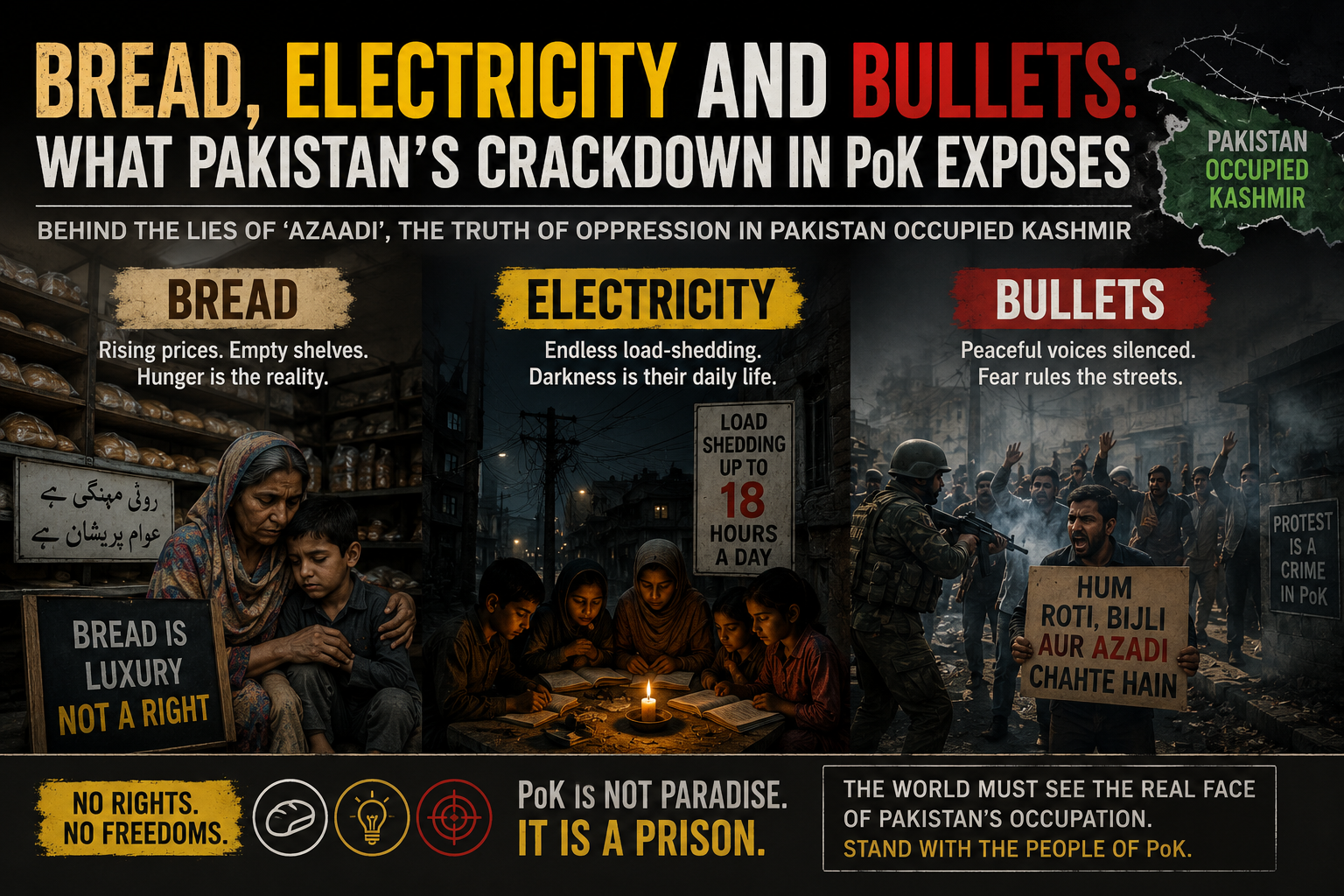
The people of Pakistan-occupied Kashmir asked for bread, electricity and representation. They were met with anti-terror law, arrests and force. That is the entire story in its simplest form.
It shows that the crisis is not only about one banned organisation or one protest march. It is about the failure of a political arrangement that calls a territory “free” while denying its residents meaningful control over resources, representation and dissent. It is about a state that has internationalised the language of Kashmiri rights while suppressing Kashmiri rights under its own authority.
India should respond with seriousness equal to the moment. That means no silence, no episodic outrage, no careless exaggeration, and no empty symbolism. It means sustained documentation, international legal pressure, diplomatic mobilisation, support for independent reporting, and a clear insistence that the people of Pakistan-occupied Kashmir are not strategic props in Pakistan’s Kashmir theatre. They are human beings with rights.
The myth of “Azad” Kashmir has not been broken by Indian argument. It has been broken by the cries of people in Rawalakot and Muzaffarabad asking why their rivers power others while their homes remain in darkness.
India’s answer cannot be silence.
References
- UNDP Human Development Report 2025 — India ranked 130th, HDI 0.685. https://hdr.undp.org/data-center/specific-country-data#/countries/IND
- UNDP Human Development Report 2023–24 — Pakistan ranked 164th, HDI 0.540. https://www.undp.org/pakistan/press-releases/undps-2023-2024-human-development-report-points-global-gridlock-increased-inequality-and-political-polarization
- UNDP HDI Pakistan ranking — Business Recorder, 14 March 2024. https://www.brecorder.com/news/40293733
- Economic Survey of Jammu & Kashmir 2023–24 — Government of J&K, Ministry of Finance. https://jkfinance.nic.in/economic-survey
- UNDP Asia-Pacific Human Development Report 2023 — sub-national HDI trends in South Asia. https://www.undp.org/asia-pacific/publications/asia-pacific-human-development-report-2023
- UN Security Council Sanctions Committee — Jaish-e-Mohammed and Lashkar-e-Taiba designations. https://www.un.org/securitycouncil/sanctions/1267/aq_sanctions_list
- International Federation of Journalists — charges against journalists in Azad Kashmir, June 2026. https://www.ifj.org/media-centre/news/detail/category/press-releases/article/pakistan-ifj-condemns-charges-against-journalists-in-azad-kashmir.html
- Human Rights Commission of Pakistan — statement on AJK violence, June 2026. https://hrcp-web.org/hrcpweb/
- Stockholm International Peace Research Institute (SIPRI) — Pakistan military expenditure as share of government spending, 2024. https://www.sipri.org/databases/milex
- Ayesha Jalal, The State of Martial Rule: The Origins of Pakistan’s Political Economy of Defence — Cambridge University Press, 1990. https://www.cambridge.org/core/services/aop-cambridge-core/content/view/DDBAEAD99B877F8931F678F6DCDE9D0B/S002074380000163Xa.pdf
- Ayesha Jalal, The Struggle for Pakistan: A Muslim Homeland and Global Politics — Harvard University Press, 2014. https://www.hup.harvard.edu/books/9780674979833
- Q&A with Professor Ayesha Jalal on Pakistan’s Kashmir policy and sovereignty — Critical Pakistan Studies, Cambridge Core, May 2024. https://www.cambridge.org/core/journals/critical-pakistan-studies/article/qa-with-professor-ayesha-jalal/4D9CC3D1D38065CF1321D3E768BBC024
- Bruce Riedel, Deadly Embrace: Pakistan, America, and the Future of the Global Jihad — Brookings Institution Press, 2011. https://www.brookings.edu/books/deadly-embrace-pakistan-america-and-the-future-of-the-global-jihad/
- Bruce Riedel, ‘Pakistan and the Jihadist Infrastructure in Kashmir’ — Brookings Institution, 2010. https://www.brookings.edu/articles/pakistan-and-the-jihadist-infrastructure-in-kashmir/
About the Author