When Elections Do Not Settle Sovereignty
By: Bisma Yousuf ( Research Scholar)
Politics often suffers from an illusion peculiar to itself: the illusion that repetition produces legitimacy. That what is done repeatedly eventually becomes right. That the persistence of an arrangement slowly transforms historical ambiguity into political certainty. Yet history is often cruel to such assumptions. There are disputes that refuse closure not because states lack power, but because power itself cannot substitute for legitimacy. There are territories that remain suspended between administration and ownership, between control and consent, between geography and law. Gilgit-Baltistan belongs to this uneasy category.
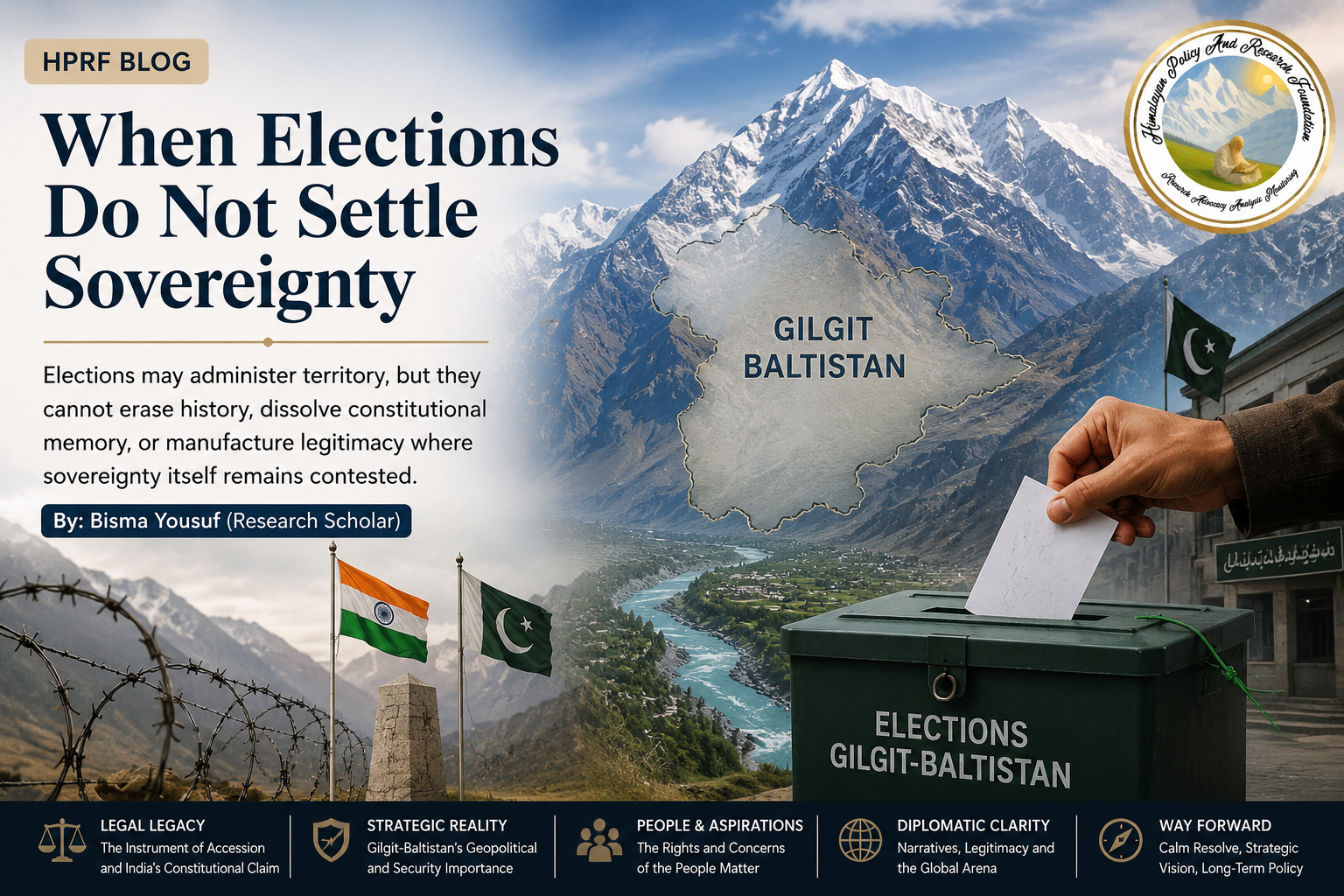
The recent elections in Gilgit-Baltistan have once again revived an old diplomatic ritual. Pakistan conducted an electoral exercise. India objected. Pakistan dismissed India’s objections. International observers largely looked away. At one level, the sequence appears routine, almost mechanical. But beneath this ritual lies a deeper question that India cannot afford either to romanticize or ignore: What do these elections mean for India?
The answer lies not in diplomatic theatrics, but in recognizing that the significance of Gilgit-Baltistan transcends electoral arithmetic. Elections in Gilgit-Baltistan are not merely local democratic exercises; they are political instruments embedded in a larger contest over sovereignty, constitutional legitimacy, and strategic geography. To misunderstand them as routine provincial politics would be to fundamentally misread the grammar of territorial disputes.
India’s position on Gilgit-Baltistan has historically been clear, though often understated. From the standpoint of constitutional continuity and legal inheritance, Gilgit-Baltistan remains part of the erstwhile princely state of Jammu and Kashmir that acceded to India in 1947 through the Instrument of Accession. This claim is neither rhetorical nor symbolic. It derives from a legal architecture upon which the Indian Union has historically based its position on Jammu and Kashmir.
The uncomfortable truth, however, is that in modern geopolitics, law alone rarely settles disputes. Sovereignty today is sustained not merely through legal arguments but through narratives of governance, institutional continuity, and strategic entrenchment. It is precisely here that Pakistan’s electoral exercises in Gilgit-Baltistan demand closer scrutiny.
Pakistan understands something that India sometimes hesitates to acknowledge openly: in territorial disputes, the performance of normalcy matters. Roads, elections, institutions, courts, assemblies, and bureaucracies together create the appearance of permanence. Over time, administration seeks to manufacture inevitability. The message becomes subtle but powerful: if institutions exist, if governments are formed, if elections are held repeatedly, perhaps sovereignty itself has already been resolved.
India must resist this temptation of political amnesia.
The fundamental flaw in interpreting elections as markers of legitimacy is that democratic procedure cannot retroactively settle questions of disputed sovereignty. Elections can confer administrative representation; they cannot, by themselves, adjudicate contested ownership. If this principle were abandoned, international law itself would collapse into political convenience. A disputed territory does not cease being disputed merely because elections are held within it.
The distinction here is crucial. India’s objection is not, and ought not to be framed as, opposition to democratic participation of ordinary people in Gilgit-Baltistan. Such a position would be morally untenable and politically self-defeating. The objection instead lies in the constitutional implication of these exercises when they are projected as evidence of settled political ownership.
This distinction is frequently lost in public discourse.
The people of Gilgit-Baltistan are not abstractions trapped inside geopolitical maps. They possess aspirations, grievances, political demands, and developmental anxieties that deserve recognition independent of the India-Pakistan dispute. For decades, many residents of the region have voiced concerns regarding constitutional ambiguity, limited political representation, economic marginalization, and resource extraction. The tragedy of disputed territories is that ordinary citizens often become spectators to competing sovereignties while remaining insufficiently empowered within either narrative.
Yet empathy for people cannot require strategic naïveté from states.
India cannot afford to ignore the geopolitical transformation occurring in Gilgit-Baltistan. The region is no longer merely an unresolved historical inheritance. It has emerged as one of the most strategically consequential geographies in South Asia. This transformation owes much to the deepening nexus between Pakistan and China, particularly through the China-Pakistan Economic Corridor (CPEC).
CPEC fundamentally alters the strategic equation because Gilgit-Baltistan is not peripheral to it; it is foundational. The corridor traverses territory India claims as its own, creating an unusual geopolitical predicament. China’s infrastructural and financial investments in the region gradually convert a bilateral territorial dispute into a trilateral strategic reality.
India’s challenge therefore is no longer confined to contesting Pakistan’s position. It increasingly concerns managing the consequences of Chinese strategic presence in contested territory. The problem with many Indian discussions on Gilgit-Baltistan is that they oscillate between emotional nationalism and diplomatic passivity. Neither is sufficient.
Emotional nationalism mistakes rhetorical outrage for policy. Diplomatic passivity mistakes restraint for strategy. India requires something more difficult: strategic clarity grounded in constitutional confidence.
What might such clarity entail?
First, India must consistently articulate the constitutional and legal basis of its claim. This requires moving beyond periodic diplomatic protests issued only during elections or constitutional changes. States sustain claims through continuity. India’s position must be visible in parliamentary discourse, diplomatic engagement, strategic documents, and international legal narratives.
Second, India must understand that territorial disputes are increasingly fought through infrastructure, connectivity, and governance capacity. Pakistan and China are investing not only in roads but in political permanence. India cannot respond merely through symbolic objection. Strengthening infrastructure, governance delivery, and strategic preparedness in bordering regions becomes part of a broader geopolitical response.
Third, India must refine its diplomatic vocabulary. Mere assertion rarely persuades. India’s argument should increasingly foreground a constitutional principle that resonates globally: disputed territories cannot be unilaterally transformed through administrative repetition. Such a position aligns not merely with India’s national interest but with broader norms governing territorial disputes.
Fourth, India must avoid the intellectual temptation of simplification. There is a dangerous tendency in contemporary politics to reduce complex territorial questions into binaries of patriotism versus betrayal. But patriotism is impoverished when it abandons nuance. A mature national position must distinguish between supporting democratic rights of local populations and legitimizing constitutional alterations in disputed regions.
There is also a philosophical dimension to this question that India must not ignore.
Territories are rarely sustained by military maps alone. They are sustained through moral imagination. Nations endure because they construct narratives of belonging that outlast temporary occupations, diplomatic setbacks, and geopolitical realignments.
The history of territorial disputes reveals an uncomfortable truth: power often appears permanent until suddenly it is not. Political arrangements assumed irreversible frequently collapse under the weight of history’s unpredictability. The twentieth century alone offers countless examples where territorial certainty dissolved with astonishing speed.
This should not encourage romantic illusions of easy reversals. Gilgit-Baltistan is unlikely to witness dramatic geopolitical transformation overnight. Serious states do not make policy through nostalgia. But nor should India concede intellectually to the assumption that repetition equals legitimacy.
If Pakistan’s elections in Gilgit-Baltistan are intended to signal closure, India’s response must insist upon constitutional memory.
There is another paradox worth considering. Pakistan itself has historically maintained an ambiguous constitutional relationship with Gilgit-Baltistan. Unlike provinces fully integrated into Pakistan’s constitutional framework, Gilgit-Baltistan has often occupied an uncertain legal position, suspended between administrative management and incomplete political incorporation. This ambiguity itself reveals an unresolved anxiety: complete integration risks intensifying international scrutiny over disputed sovereignty.
The irony, therefore, is profound. Pakistan seeks the language of normal democratic administration while simultaneously avoiding the constitutional confidence of unequivocal integration. Elections become both assertion and hesitation.
India must recognize this contradiction.
But recognition alone is insufficient. The deeper challenge before India is intellectual. Does India possess the patience required for long strategic contests? Democracies often struggle with territorial questions because electoral cycles reward immediacy while sovereignty disputes unfold across decades. Strategic endurance requires institutional memory- a quality modern politics frequently lacks.
The temptation will always be to react episodically: object during elections, issue statements, and retreat into diplomatic silence. Such responses are politically convenient but strategically shallow.
A stronger Indian stance would combine legal firmness with geopolitical realism. It would neither exaggerate the immediate implications of elections nor trivialize their cumulative effect. For while one election changes little, repeated institutional normalization over decades can gradually alter international perceptions.
This is the real contest. Gilgit-Baltistan is not merely a question of maps; it is a question of narratives. Pakistan seeks to narrate permanence. India seeks to preserve contestation. China seeks strategic utility. Between these competing ambitions stands a geography whose future remains unresolved. India must therefore resist both complacency and alarmism.
Complacency assumes that legal claims automatically endure without strategic investment. Alarmism mistakes every election for an existential crisis. Neither serves national interest. The wiser approach lies in constitutional confidence combined with strategic patience.
The ultimate significance of the recent elections in Gilgit-Baltistan for India is therefore neither immediate nor theatrical. They do not alter sovereignty overnight. They do not erase constitutional claims. But they remind India of a difficult truth: territorial disputes are not frozen in time. They evolve quietly through institutions, infrastructure, and narratives of legitimacy.
The challenge before India is not simply to protest Pakistan’s actions. It is to ensure that constitutional memory remains stronger than geopolitical fatigue. For nations, as for individuals, forgetting is often more dangerous than defeat.
About the Author