www.himalayanprf.org
By: Mohammad Mursil Bhat (Senior Research Fellow)
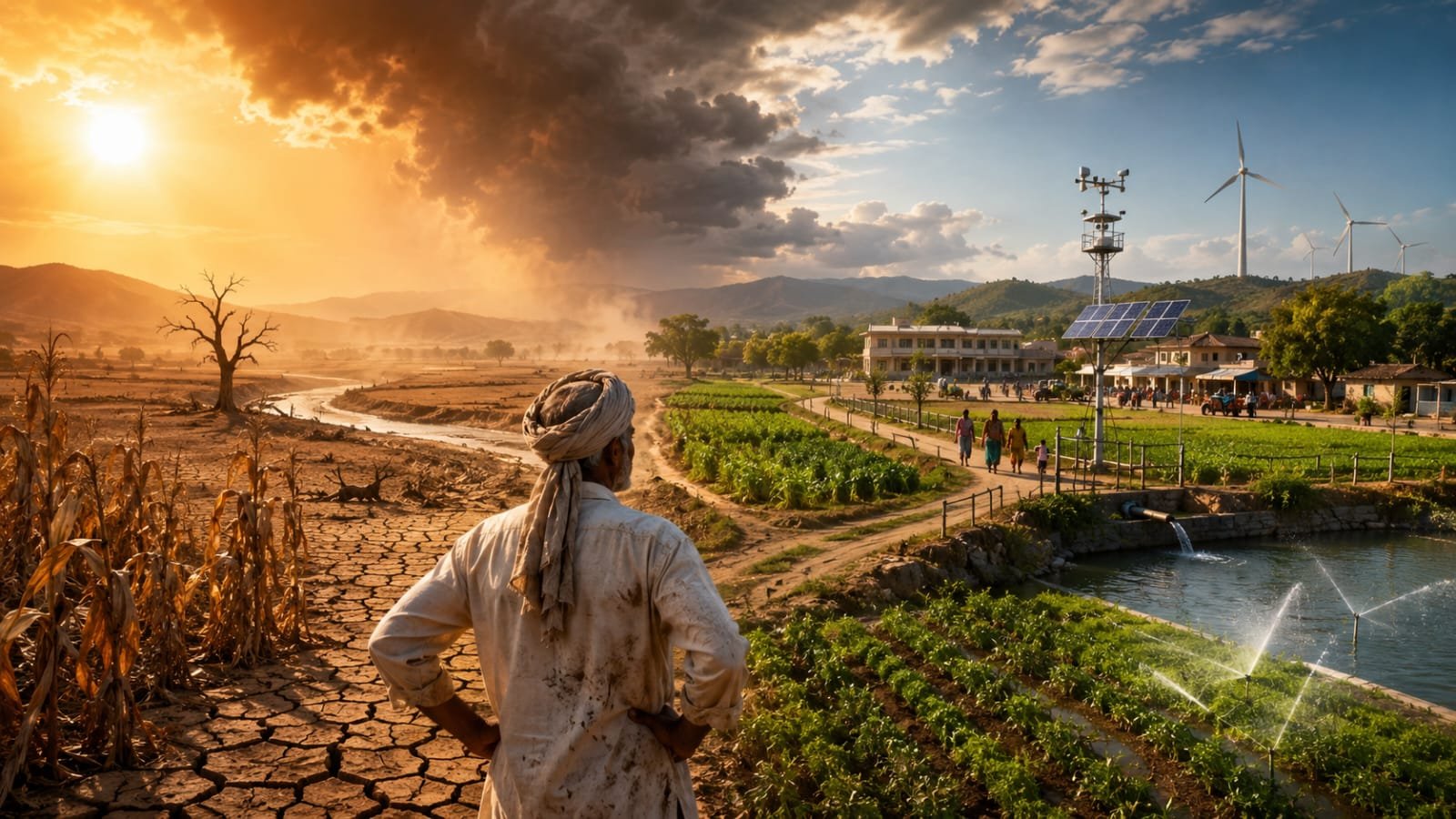
Climate change has transformed agriculture from an economic activity into an existential uncertainty. The Indian farmer no longer contends merely with the familiar risks ofcultivation; he confronts an atmosphere whose rhythms have become increasingly . Rainfall arrives either too late or all at once. Heat waves scorch fields before crops mature. Rivers oscillate between scarcity and inundation. Seasons, once the silent architecture of agricultural life, have become unreliable. What was once regarded as an occasional natural hazard has evolved into a structural condition shaping the future of rural society.
The dominant policy response to this crisis has been the language of climate-smart agriculture. Governments, international organisations and development agencies increasingly advocate drought-resistant seeds, precision irrigation, digital weather forecasting, climate-resilient crop varieties and improved resource management as the pathway towards sustainable agriculture. There is undeniable merit in these innovations. Scientific progress remains indispensable in confronting ecological disruption.
Yet there is an uncomfortable truth that the optimism surrounding climate-smart agriculture often conceals. Climate change is not merely exposing weaknesses in farming practices; it is exposing weaknesses in political institutions. The crisis confronting rural India is not simply one of production. It is a crisis of governance, markets, public investment and democratic priorities.
Technology may improve crops, but it cannot repair institutions. This distinction is crucial because modern policy discourse frequently mistakes adaptation for transformation. It assumes that if farmers are equipped with better technologies, they will naturally become resilient. Such reasoning confuses resilience with productivity. The two are related but fundamentally different. Productivity concerns output. Resilience concerns survival.
A farmer may harvest higher yields one season yet remain one failed monsoon away from bankruptcy. A village may adopt sophisticated irrigation technologies while continuing to suffer from indebtedness, unemployment and migration. Increased production cannot compensate for the absence of secure markets, affordable credit, accessible healthcare or reliable public infrastructure. Resilience is therefore not an agricultural variable. It is a political achievement.
The contemporary fascination with climate-smart farming reflects a broader tendency within development thinking to seek technical solutions for political problems. Complex questions of inequality are translated into questions of innovation. Structural failures become managerial challenges. Public institutions increasingly outsource responsibility to technology,hoping that scientific efficiency can compensate for institutional inadequacy. History repeatedly demonstrates otherwise.
Agricultural transformations have never been purely technological events. The Green Revolution succeeded not because improved seeds miraculously altered rural economies, but because they were accompanied by irrigation networks, procurement mechanisms, public investment, agricultural extension services and political commitment. Technology flourished because institutions sustained it.
Climate-smart agriculture is unlikely to succeed if this historical lesson is forgotten. No drought-resistant seed can substitute for inaccessible markets. No weather application can compensate for collapsing rural credit. No satellite can eliminate the insecurity produced by unstable agricultural prices. The future of farming depends as much upon governance as upon genetics.
This insight demands that climate change be understood not merely as an environmental phenomenon but as a profound political-economic transformation. Climate hazards distribute risks unevenly. Wealthier farmers possess insurance, diversified incomes, storage facilities and financial reserves. Marginal farmers possess little beyond their labour and small plots of land. The same flood that reduces one farmer’s annual income may destroy another’s entire economic existence. Climate therefore magnifies inequality. Environmental disasters do not create social injustice from nothing; they deepen injustices that already exist. For this reason, discussions of climate adaptation must inevitably become discussions of justice. Who bears climate risks? Who receives state support? Who has access to finance? Who possesses the capacity to recover after a disaster?
These are political questions disguised as environmental ones. The language of resilience often obscures this reality. Resilience is frequently presented as an individual virtue- as though farmers simply need to become more adaptive, innovative or entrepreneurial. Such narratives unintentionally shift responsibility away from institutions towards individuals. When resilience becomes a moral expectation placed upon citizens, governments become less accountable for creating the conditions that make resilience possible.
There is something profoundly troubling about celebrating the resilience of those who are continuously abandoned by public policy. Resilience should never become a substitute for justice. Indeed, excessive admiration for resilience risks romanticising suffering itself. Rural communities are praised for enduring droughts, floods and crop failures while the political conditions producing their vulnerability remain unchanged. Endurance becomes a public spectacle, even as structural reform remains conspicuously absent.
The farmer is celebrated for surviving adversity rather than protected from unnecessary adversity. This inversion reveals an uncomfortable feature of contemporary governance. States increasingly excel at managing crises while failing to prevent them. Disaster relief attracts political visibility; long-term institutional investment rarely does. Compensation after crop failure receives greater administrative urgency than investments capable of reducing future failures.
Governments frequently respond to climate disasters as isolated emergencies rather than symptoms of institutional fragility. Such an approach mistakes treatment for prevention. The consequences extend beyond agriculture itself. Rural distress gradually transforms into migration, unemployment and demographic imbalance. Young people increasingly abandon agriculture not because farming lacks dignity, but because uncertainty has overwhelmed predictability. The village ceases to represent economic opportunity and becomes instead a landscape of inherited vulnerability.
Climate change therefore alters not only ecosystems but social aspirations. It reshapes the meaning of rural life itself. This is why discussions of climate resilience cannot remain confined to ministries of agriculture. They belong equally within conversations abouteducation, entrepreneurship, healthcare, financial inclusion and democratic governance. A resilient village is not merely one capable of producing crops under changing climatic conditions. It is one capable of sustaining dignified livelihoods, retaining its youth,
supporting local enterprise and adapting collectively without sacrificing social cohesion. Agriculture has always been more than food production. It is the foundation upon which rural civilization rests. To weaken agriculture is therefore to weaken an entire social order. The challenge before India is consequently larger than introducing climate-smart technologies into farming systems. It is about constructing institutions capable of reducing vulnerability before disasters occur. Rural resilience cannot emerge from innovation alone. It must emerge from trust between citizens and the state, from reliable public investment, from accountable governance and from economic systems that distribute risks more fairly. Climate change is often described as the defining crisis of the twenty-first century. That description is correct, but incomplete. Its defining characteristic is not merely rising temperatures. It is the exposure of political choices that societies have postponed for decades. Climate change ultimately asks a question that extends far beyond agriculture:
Can a society call itself resilient if its institutions remain fragile?
If climate change has exposed the fragility of agriculture, it has also exposed the fragility of the economic imagination that governs rural India. Public discourse continues to approach villages primarily as sites of welfare or agricultural production. Rarely are they imagined as centres of innovation, enterprise and institutional capacity. This narrow imagination has become one of the greatest obstacles to genuine rural resilience.
There is an enduring paradox in India’s development trajectory. The country celebrates entrepreneurship as the engine of economic growth, yet entrepreneurial ecosystems remain overwhelmingly urban. Policy discussions instinctively gravitate towards start-ups, venture capital, technology hubs and metropolitan innovation corridors. Rural entrepreneurship, by contrast, is frequently reduced to self-help groups, microfinance or small-scale livelihood programmes. Such interventions undoubtedly matter, but they seldom alter the structural conditions that constrain rural economies. Resilience cannot flourish where opportunity remains geographically unequal.
This is perhaps the most neglected dimension of climate adaptation. A resilient village is not merely one that can produce crops under adverse climatic conditions. It is one whose economy is sufficiently diversified that agriculture is no longer the sole bearer of risk. Dependence itself constitutes vulnerability. When an entire community relies upon a single climate-sensitive occupation, every drought becomes a collective crisis. Economic diversity is therefore a form of climate insurance.
The future of rural India depends not only on climate-smart farming but on climate-smart economies. Agro-processing, renewable energy, sustainable tourism, digital services, food processing, local manufacturing and ecological restoration are not peripheral activities. They represent alternative centres of economic security capable of reducing dependence upon increasingly uncertain agricultural incomes. Yet such diversification cannot emerge spontaneously through market forces alone. Markets allocate resources. Institutions create possibilities.
The distinction is fundamental. Economic liberalisation has undoubtedly expanded opportunities, but markets rarely invest where institutional deficits remain severe. Entrepreneurs require roads, electricity, digital connectivity, credit, legal certainty and functioning local governance. Innovation cannot thrive in an environment where the costs of uncertainty consistently exceed the rewards of enterprise. Climate resilience is therefore inseparable from state capacity.
This proposition may appear unfashionable in an era increasingly captivated by private-sector solutions. Nevertheless, history consistently demonstrates that societies confronting systemic transformations require capable public institutions. Climate adaptation demands long-term investment whose returns are dispersed across generations rather than immediately captured by markets. Watershed management, flood control, climate research, agricultural extension, ecological restoration and public insurance all belong to this category of collective goods. They are investments that markets often underprovide because their benefits cannot be easilyn monetised.
Only the state possesses both the legitimacy and the temporal horizon necessary to sustain such commitments. Unfortunately, contemporary governance often privileges visibility over durability. Large infrastructure projects produce immediate political symbolism; institutional reforms produce gradual public confidence. Governments therefore become increasingly inclined towards announcing schemes rather than strengthening systems.
The result is a politics of visibility without resilience. This tendency is particularly evident in agricultural policy. Success continues to be measured through acreage covered, subsidies distributed or technologies adopted. Far less attention is devoted to whether institutional relationships between farmers and public agencies have become more reliable. Yet trust constitutes perhaps the most valuable resource in any adaptation strategy. Farmers confronting climatic uncertainty make decisions under conditions of incomplete information. They depend upon weather forecasts, extension officers, financial institutions, procurement agencies and local administrations. Where these institutions function predictably, uncertainty becomes manageable. Where they fail, even scientifically sound innovations lose effectiveness. Trust, therefore, is not a sentimental value. It is a productive capital.
The erosion of institutional trust imposes economic costs that remain invisible within conventional measures of agricultural performance. This brings us to another uncomfortable reality. Climate change is often described as an external threat- as though it were an environmental force imposed upon otherwise stable societies. In truth, climate change increasingly interacts with pre-existing inequalities of caste, class, gender and geography. Environmental vulnerability rarely exists independently of social vulnerability.
A marginal farmer cultivating degraded land without irrigation does not experience climate change in the same manner as a commercial farmer possessing diversified assets and political influence. Women farmers frequently bear disproportionate burdens of water collection, household food security and unpaid care during climatic crises while possessing significantly fewer economic resources and weaker property rights. Climate hazards therefore do not merely affect populations. They stratify them.
The language of adaptation consequently requires an ethical vocabulary alongside a technicalone. Questions of justice cannot remain secondary to questions of efficiency. Policies designed exclusively around aggregate productivity risk reproducing inequalities beneath the appearance of national progress. Development divorced from justice frequently generates new forms of exclusion. This is why resilience must ultimately be understood as a democratic principle rather than merely an environmental objective. Democracy is not tested during periods of abundance. It is tested by how societies distribute vulnerability.
The true measure of public institutions lies not in their capacity to maximise prosperity during favourable conditions but in their ability to protect citizens when uncertainty becomesnormal. Climate change is making uncertainty permanent.
This transformation requires a corresponding shift in political philosophy. For decades, development has largely pursued the objective of increasing efficiency. Climate disruption now compels governments to pursue robustness alongside efficiency. Systems optimised exclusively for maximum productivity often prove remarkably fragile when confronted with unexpected shocks. Nature has always favoured diversity over uniformity. Human institutions would do well to learn the same lesson.
Monocultures maximise yields under ideal conditions but collapse under ecological stress. Diverse ecosystems sacrifice some efficiency in exchange for greater resilience. The analogy extends beyond agriculture. Economies dependent upon narrow sectors become vulnerable to external shocks. Political systems concentrated around centralised authority become less adaptive. Communities lacking local institutions become increasingly dependent upon distant bureaucracies. Resilience emerges through diversity, redundancy and decentralisation. This insight carries profound implications for public policy. Climate adaptation cannot remain confined to ministries responsible for agriculture or the environment. It must reshape fiscal policy, education, urban planning, industrial strategy and local governance. Every public institution increasingly confronts climate change, whether it recognises the fact or not. Perhaps the greatest challenge, however, is conceptual rather than administrative. Climate discourse often portrays adaptation as preparation for the future. In reality, adaptation requires confronting decisions already postponed for decades. Weak rural infrastructure, inadequate public health, fragmented landholdings, declining soil quality, depleted groundwater, institutional neglect and unequal access to markets are not consequences of climate change. They are historical failures whose costs are now being magnified by ecological disruption. Climate change has not created these weaknesses. It has withdrawn the illusion that they could be ignored indefinitely.
There is a tendency within contemporary politics to seek dramatic solutions for gradual crises. Climate change encourages precisely this temptation. Grand technological visions promise transformation while quieter institutional reforms receive comparatively little attention. Yet history suggests that enduring societies are built less through spectacular innovations than through patient institutional accumulation. Resilience is neither invented overnight nor imported from international conferences. It is cultivated through everyday governance.
Ultimately, the debate surrounding climate-smart farming reflects a larger philosophical question concerning the relationship between human societies and uncertainty itself. Modern development has long promised control- control over nature, markets and economic outcomes. Climate change reminds us that complete control is an illusion. The objective of politics is therefore not to eliminate uncertainty. It is to distribute its burdens fairly. That distinction separates resilient societies from merely productive ones.
India undoubtedly requires better seeds, smarter irrigation, improved forecasting and climate-resilient technologies. To reject these innovations would be intellectually irresponsible. But to imagine that technology alone can secure the future of rural India would be equally misguided. The future will not be determined by whether farmers become climate-smart.
It will be determined by whether the state becomes institutionally wise, whether markets become socially inclusive and whether development rediscovers justice as its central purpose. A climate-smart farm may protect a harvest. Only a climate-smart republic can protect the people who depend upon it.
About the Author