Written by: Zahid Sultan ( Research Scholar )
There is a particular tragedy that accompanies the suffering of people living in politically contested regions: their pain often becomes buried beneath competing narratives, strategic calculations, and the language of power. The ordinary citizen disappears behind the larger arguments of states and institutions. Their grief becomes a footnote in geopolitical conversations. Their demands for justice become secondary to questions of territory, security, and political influence.
Pakistan-occupied Kashmir represents one such painful reality. For decades, the people of this region have lived within a complex political environment where questions of identity, representation, governance, and rights remain deeply contested. Yet beyond political arguments lies a more fundamental issue: the dignity and security of ordinary people. The most important question is not only who controls a territory, but how those in authority treat the people living within it.
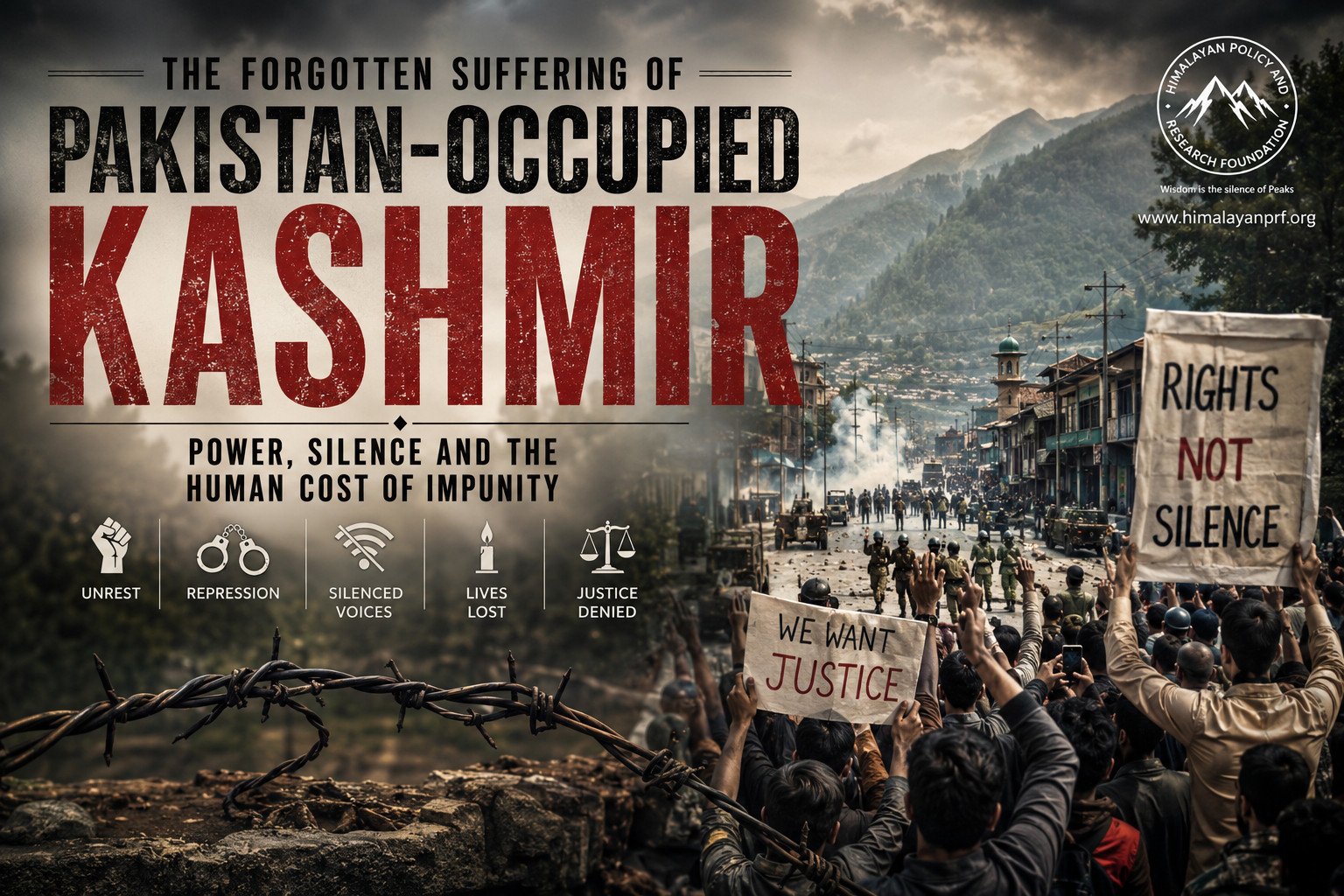
The present crisis did not emerge in isolation. It is part of a pattern of recurring unrest that has unfolded over the last several years. In May 2024, large-scale demonstrations led by the Jammu Kashmir Joint Awami Action Committee (JKJAAC) erupted over soaring electricity tariffs, rising food prices, and what protesters described as long-standing economic neglect. The protests ended in deadly clashes in which both protesters and security personnel lost their lives before the Pakistani government announced a financial relief package and accepted several demands. Yet the concessions addressed immediate economic grievances rather than the deeper structural issues of political representation, institutional accountability, and the relationship between the federal establishment and the people of Pakistan-occupied Kashmir.
The unrest did not end there. During 2025, the region again witnessed widespread mobilisation over governance, regional autonomy, and constitutional arrangements. Protest movements expanded beyond questions of subsidised electricity and wheat prices to broader demands for political reforms, greater local representation, and an end to what many demonstrators viewed as excessive federal interference. Fresh clashes resulted in deaths and injuries, while communications restrictions and large-scale deployments of security forces once again became part of the political landscape. The recurrence of these confrontations suggests that the crisis is no longer episodic; it reflects unresolved structural grievances that continue to resurface despite repeated assurances of reform.
From the deadly 2024 protests, in which four people lost their lives, to the renewed unrest of 2026 that has claimed further lives amid disputed casualty figures, Pakistan-occupied Kashmir has witnessed a recurring cycle of confrontation. Reuters has reported at least 11 deaths in June 2026 clashes, followed by nine more in July, while local protest groups contend that the cumulative civilian toll is significantly higher. The gap between official accounts and protesters’ claims itself underlines the urgent need for independent investigations into every reported death.
The latest phase of unrest has been even more disturbing. In 2026, following the banning of the Joint Awami Action Committee and controversy surrounding electoral arrangements, protests intensified across several districts. Reuters, Amnesty International, and other international observers have reported deadly clashes, restrictions on internet and mobile communications, arrests of activists, and renewed calls for independent investigations into the conduct of security forces. Protest leaders and authorities continue to dispute casualty figures and responsibility for the violence, making independent verification essential.
A state’s legitimacy is ultimately measured not by the strength of its institutions or the power of its security apparatus, but by the manner in which it protects the lives, freedoms, and dignity of its citizens. Recent unrest in Pakistan-occupied Kashmir has once again brought attention to this unresolved question. What began as public anger over economic pressures, governance concerns, and political grievances developed into a broader confrontation between citizens and authorities. The streets became spaces of protest, confrontation, and fear. Reports of deaths, injuries, arrests, communication restrictions, and allegations regarding the conduct of security forces generated serious concerns among rights advocates and observers.
The response to such moments should not be shaped by denial or political convenience. It should be shaped by accountability. When allegations emerge regarding the use of force against civilians, the first responsibility of any state is not simply to defend itself. It is to demonstrate, through transparent and credible processes, that justice remains stronger than authority. The question is not whether a government has the right to maintain order. Every government has that responsibility. The question is whether that power is exercised within the limits of law and human dignity.
History repeatedly demonstrates that when states respond to public grievances primarily through coercion, they may achieve temporary control but often deepen long-term mistrust. The wounds created by excessive force are not limited to the immediate moment. They remain in the memories of families, communities, and generations. A society does not heal merely because streets become quiet. It heals when people believe that their suffering has been acknowledged and that institutions are capable of delivering justice.
This is why accountability matters. Accountability is not an attack on institutions. It is what gives institutions legitimacy. A security force entrusted with protecting citizens must also accept scrutiny when serious questions arise about its conduct. The authority to use force carries with it an even greater responsibility to justify that force.
Power without accountability creates fear. Accountability transforms power into legitimate authority. The experience of people living in conflict-affected regions across the world reveals a similar pattern: ordinary civilians often bear the greatest burden of political disputes they did not create. They are the ones who experience uncertainty, economic disruption, fear, and loss. They are the ones who wait for answers while powerful actors continue their political arguments.
The people of Pakistan-occupied Kashmir cannot be reduced to a statistic, a political slogan, or a strategic argument. Behind every allegation of abuse is a human story. Behind every protest is a grievance. Behind every demand for justice is a belief that human life deserves recognition beyond political boundaries.
The greatest danger in situations involving state power is the normalisation of silence. When allegations remain unanswered and independent scrutiny is absent, uncertainty becomes permanent. Competing narratives continue to grow, while ordinary people remain trapped between accusation and denial. Truth becomes the first casualty.
A responsible state must understand that transparency is not weakness. It is strength. Institutions that investigate themselves honestly do not lose authority; they gain credibility. The refusal to answer difficult questions, however, creates the perception that some forms of power exist beyond accountability. This concern becomes especially serious when security institutions are involved.
Security forces exist because societies require protection. But the very reason they possess extraordinary powers is why they must remain subject to extraordinary responsibility. The ability to use force must always be accompanied by the obligation to justify that force. No institution should be placed above the law.
The human rights question in Pakistan-occupied Kashmir is therefore not merely about individual incidents. It is about a larger principle: whether ordinary people living in politically sensitive regions are entitled to the same protection, dignity, and justice as people anywhere else. Human rights lose their meaning when they become selective. The value of protecting civilians is tested not when it is politically convenient, but when it is difficult.
One of the most troubling realities of contemporary human rights discourse is that suffering does not always receive equal attention. The world is not equally attentive to every tragedy. Some crises dominate headlines, generate international debate, and produce immediate diplomatic responses. Others remain confined to regional conversations, leaving affected communities struggling to make their voices heard. The people of Pakistan-occupied Kashmir have often found themselves within this difficult space- where political complexity, geopolitical interests, and limited international visibility intersect. Their experiences frequently become secondary to larger strategic conversations, while their immediate concerns receive comparatively limited global attention.
This raises an uncomfortable question: does the visibility of suffering depend upon the political importance of those who suffer? Human rights principles cannot survive if they are applied selectively. The value of human dignity is precisely that it should not depend upon geography, political alliances, or strategic calculations. A civilian life lost in a less visible conflict carries the same moral weight as a civilian life lost anywhere else in the world.
The international community therefore has a responsibility not merely to react when crises become impossible to ignore, but to ensure that credible allegations of abuse receive serious examination from the beginning. Media institutions also carry a profound responsibility. Journalism is not simply the recording of events; it is the process through which societies decide what deserves attention. When access is limited, when reporting becomes difficult, or when a conflict receives little sustained coverage, affected communities risk becoming invisible.
The absence of headlines does not mean the absence of suffering. In many conflicts, the greatest injustice faced by victims is not only what happened to them, but the struggle to make the world acknowledge that it happened. Recognition is the first step towards accountability. Silence, by contrast, allows uncertainty and impunity to grow together. This is why independent investigations are so important.
An investigation is not a declaration of guilt. It is a commitment to truth. It allows evidence to replace speculation, facts to replace propaganda, and justice to replace political arguments. For victims and their families, an impartial inquiry represents the possibility that their suffering will not disappear into history without answers.
For institutions, accountability is a test of credibility. A state that claims authority must also accept responsibility. It cannot demand trust from citizens while refusing transparency. It cannot ask people to respect institutions while those institutions remain unwilling to answer serious questions. The relationship between citizens and the state is ultimately built on confidence. Once that confidence collapses, no amount of force can fully restore it.
The deeper lesson from regions affected by political conflict is that stability cannot be manufactured only through control. Real stability emerges when citizens believe that institutions are fair, when grievances can be expressed without fear, and when justice is available regardless of political circumstances. The suffering of civilians must never become collateral damage in political struggles.
Too often, ordinary people become trapped between powerful narratives. Governments speak in the language of security. Political groups speak in the language of resistance. International actors speak in the language of diplomacy. But behind all these narratives are individuals whose lives are affected directly by decisions they did not make.
A mother who fears for her family, a young person whose future is disrupted, a community living under uncertainty, these are not abstract political categories. They are human beings whose dignity deserves protection. The true measure of any authority is how it treats those with the least power. This is why the question of Pakistan-occupied Kashmir cannot be reduced merely to a political disagreement. At its core, it is a question about the limits of state power and the responsibilities that accompany authority. Every government has a duty to maintain order. But order without justice is fragile. Silence without reconciliation is temporary. Control without legitimacy creates deeper divisions.
Political dissent has also become increasingly costly. A number of activists, journalists, and political voices critical of prevailing policies have alleged intimidation, legal pressure, or restrictions on their activities, while some have sought refuge abroad and continued their advocacy from exile. Their departure reflects more than individual decisions; it signals a shrinking space for dissent. When political disagreement is perceived to carry personal risk, exile becomes not merely a destination but a symptom of institutional failure. A society in which critics believe they must leave in order to speak freely raises profound questions about the condition of civic space and political pluralism. Allegations of restrictions on dissent and pressure on activists have been raised by rights organisations, which have called for greater protection of fundamental freedoms.
The long-term solution to political instability does not lie only in stronger security responses. It lies in addressing grievances, strengthening institutions, ensuring transparency, and creating conditions where citizens believe their voices matter. The people of Pakistan-occupied Kashmir deserve nothing less. They deserve answers where questions remain. They deserve transparency where uncertainty exists. They deserve institutions capable of acknowledging mistakes and correcting failures. They deserve a political environment where human dignity is not sacrificed at the altar of power.
The ultimate test of governance is not whether a state can impose its authority. Many states can do that. The real test is whether authority can be exercised with restraint, fairness, and accountability. History has repeatedly shown that societies cannot build lasting peace by ignoring wounds. Unaddressed grievances do not disappear; they become deeper. Unanswered questions do not fade; they become inherited memories. Justice is therefore not only about the past. It is about preventing future cycles of mistrust and suffering.
Perhaps the least discussed consequence of this prolonged instability is its impact on the younger generation. Pakistan-occupied Kashmir possesses a young and educated population, yet many young people describe an environment marked by limited economic opportunities, dependence on public employment, inadequate industrial development, and the absence of meaningful private-sector investment. For many graduates, the promise of education has not translated into employment or social mobility. Economic frustration, combined with recurring political uncertainty, has produced a generation that increasingly feels excluded from decisions affecting its future. The tragedy is not merely unemployment; it is the gradual erosion of hope itself. Recent reporting has highlighted persistent economic neglect and underdevelopment as major drivers of public discontent.
The international community must also reflect on its own responsibilities. A world committed to human rights cannot afford selective concern. It cannot passionately defend civilian dignity in one place while remaining silent in another. Consistency is what gives principles their meaning. Human rights are not valuable because they protect the powerful. They are valuable because they protect those who have the least ability to protect themselves. The story of Pakistan-occupied Kashmir should therefore not be reduced to political competition. It should be understood through the experiences of ordinary people whose lives are shaped by decisions of power.
Their demand is not extraordinary. It is the most basic demand made by citizens everywhere: to be treated with dignity, to have their voices heard, and to live under institutions that are accountable. The final measure of any state is not the strength of its weapons, the reach of its authority, or the silence it can produce. It is the justice it can deliver.
And where questions of civilian suffering remain unanswered, the responsibility of the world is not to look away. It is to listen, investigate, and ensure that human dignity remains stronger than political power.
About the Author