Author: Dr. Zahid Sultan (Independent Researcher Based in Srinagar, India)
The return of the elected government to Jammu and Kashmir was, understandably, received as more than a change in the political executive. After years in which the institutions of representative government had receded from the everyday experience of citizens, elections carried with them a larger promise: that political authority would once again become answerable to the people. The significance of this transition therefore cannot be measured merely by the existence of an elected Assembly, the frequency of political speeches, or the restoration of familiar democratic rituals. Its deeper test lies elsewhere in the mundane, almost unheroic domain of governance. Can the state repair a road without prolonged delay? Can it provide electricity with reasonable reliability? Can a citizen obtain a certificate, resolve a grievance, access a public service or secure an administrative decision without navigating an opaque maze of offices? Democracy ultimately acquires credibility not only in the legislature but in the encounter between the citizen and the ordinary institutions of the state.
This is where Jammu and Kashmir’s present predicament becomes intellectually and politically important. The return of electoral politics has not automatically produced a corresponding transformation in the quality of everyday governance. The problem is not simply that roads remain damaged, drainage systems remain inadequate, electricity supply remains uncertain or administrative processes remain slow. The more fundamental problem is the distance between political legitimacy and administrative capacity. An elected government can possess a democratic mandate and yet inherit institutions that are procedurally slow, fiscally constrained, infrastructurally weak and insufficiently responsive. The danger is that electoral restoration may become an end in itself, when it ought to be the beginning of a more demanding project: reconstructing the capacity of the state to govern effectively.
The distinction matters. Political democracy answers the question of who governs and through what form of authorization. Administrative capacity answers another question: what can the government actually accomplish? A society cannot live indefinitely on the moral capital of elections. Citizens eventually judge governments by whether institutions work. The legitimacy of democratic government is strengthened when public authority becomes visible through functioning schools, hospitals, roads, electricity networks, water systems, municipal services and responsive offices. Conversely, when citizens encounter the state primarily through delays, interruptions and procedural uncertainty, the promise of democratic government begins to appear abstract.
The infrastructure question in Jammu and Kashmir illustrates this contradiction particularly well. There has been substantial public expenditure on infrastructure, and the Union government has approved and implemented major programmes for roads, electricity, water and other sectors. In April 2026, for instance, the Union government announced Rs. 3,566 crore in PMGSY-IV road projects for Jammu and Kashmir, alongside a broader package involving rural development and agriculture. The Press Information Bureau The 2026-27 budget also projects substantial public expenditure, with total expenditure excluding debt repayment estimated at approximately ₹1.06 lakh crore. PRS Legislative Research Yet the existence of expenditure does not necessarily translate into the experience of adequate infrastructure.
This is an important distinction that public debate often misses. Infrastructure is not synonymous with infrastructure spending. A government may announce projects, sanction funds and inaugurate schemes while citizens continue to experience broken roads, inadequate drainage, unreliable water supply or poorly maintained public spaces. The political economy of infrastructure therefore requires us to move from the question of how much money is allocated to the more difficult questions of where it goes, how rapidly it is converted into public assets, who is responsible for maintenance, what standards are used to assess completion, and whether citizens can hold the responsible institution accountable.
The recurring problems reported by residents in urban areas illustrate the point. Recent inspections by the Jammu Municipal Corporation have documented complaints involving damaged internal roads, inadequate drainage, waterlogging, irregular drinking-water supply, sanitation deficiencies and non-functional streetlights. Similar concerns have appeared repeatedly across different wards. Jammu Municipal Corporation These are not spectacular failures of the state. They are more revealing precisely because they are ordinary. A blocked drain or damaged lane rarely makes national headlines. Yet it is through such apparently minor failures that citizens encounter the state most frequently.
There is a tendency in Jammu and Kashmir to discuss governance primarily through the language of large political questions: statehood, constitutional arrangements, security, representation and the relationship between Srinagar and New Delhi. These questions are undeniably important. But a democracy that speaks constantly about sovereignty while failing to maintain a functioning drainage system risks producing an odd hierarchy of political priorities. The sovereignty of the state is experienced by citizens through the competence of its institutions. The citizen does not encounter the state in constitutional abstraction when the street outside the house floods, when electricity disappears during winter, when a public hospital lacks adequate facilities, or when an application remains pending for months. The citizen encounters the state as a road, a transformer, a municipal office, a school, a revenue official or a grievance mechanism.
Electricity presents an even more revealing case because it sits at the intersection of infrastructure, political economy and public expectation. The problem cannot simply be described as administrative incompetence. The Union Ministry of Power informed Parliament in March 2026 that frequent power cuts in Jammu and Kashmir were driven primarily by transmission and distribution constraints alongside unrestricted consumption in unmetered areas. It also noted that substantial investments had already been made in distribution infrastructure, including substations, transformers and transmission and distribution lines. Power Ministry This suggests that the problem is structural rather than reducible to the performance of a particular department.
The financial dimensions are equally revealing. According to the analysis of the Jammu and Kashmir budget for 2026-27, power purchase expenditure is estimated at ₹9,300 crore, constituting around 12 per cent of total revenue expenditure. At the same time, revenue from power is budgeted at ₹7,100 crore and constitutes about 64 per cent of the government’s own non-tax revenue. PRS Legislative Research The figures expose a difficult political economy: electricity is simultaneously a public necessity, a major fiscal burden and an important source of government revenue.
This makes the politics of electricity considerably more complicated than the familiar promise of uninterrupted or inexpensive power. A government must reconcile affordability with financial sustainability, universal access with consumption discipline, infrastructure investment with revenue recovery, and political expectations with the actual economics of electricity distribution. The problem becomes particularly acute when citizens are promised improvements but continue to experience outages or rising tariffs. In August 2026, the debate over a 6.83 per cent electricity tariff increase generated political opposition, while the government defended the increase as a fiscal necessity.
The deeper issue, therefore, is not merely whether electricity is available. It is whether the citizen can reasonably predict the behaviour of the public utility. Reliability is itself a form of public value. A household may tolerate an occasional interruption; what becomes politically corrosive is uncertainty. Students cannot plan their study around unpredictable electricity. Small businesses cannot reliably operate equipment. Hospitals and other essential institutions must compensate for instability. Households increasingly become responsible for acquiring private alternatives- generators, inverters, batteries and solar systems- to compensate for deficiencies in public provision. In this sense, unreliable infrastructure quietly transfers the cost of state weakness from the government to individual citizens.
This is perhaps one of the least discussed consequences of infrastructural inadequacy. When public services fail, the affluent frequently purchase private substitutes. The poor cannot. A generator, private water storage system, better transport arrangement or private educational alternative may soften the consequences of state failure for some households, while making them more severe for others. Infrastructure therefore has a distributive dimension. The quality of public services determines not merely convenience but the social distribution of opportunity.
Administrative delivery presents the same problem in a less visible form. The modern state increasingly presents itself as digital, transparent and citizen-centric. Jammu and Kashmir has introduced several digital governance initiatives, including unified portals intended to simplify urban administrative processes and improve transparency. Jammu Municipal Corporation Such reforms are welcome. But digitisation should not be confused with administrative transformation. A slow bureaucracy can become a slow digital bureaucracy just as easily as a paper bureaucracy.
The real question is whether technology reduces the transaction costs of citizenship. Does the citizen receive a decision faster? Is responsibility clearly assigned? Can an application be tracked? Is rejection accompanied by reasons? Is there an effective mechanism of appeal? Does the official have an incentive to resolve the matter within a specified period? Without institutional answers to these questions, digital governance risks becoming a new interface over old administrative habits.
The persistence of unresolved institutional matters is suggestive. The Comptroller and Auditor General’s records show substantial numbers of outstanding Action Taken Notes across Jammu and Kashmir departments, including Public Works, Power Development, Revenue, Health and Medical Education, Higher Education and Public Health Engineering. The data do not by themselves establish that every delay in public service delivery is caused by these pending audit matters. They do, however, point to a broader institutional problem: administrative systems possess mechanisms for scrutiny, but the conversion of scrutiny into timely corrective action remains uneven. Comptroller and Auditor General of India
This raises a more uncomfortable question about the meaning of accountability. In much of Indian political discourse, accountability is understood primarily as political accountability: whether a minister answers an opposition question, whether a government wins an election, or whether an elected representative faces public criticism. But modern governance requires another form of accountability- administrative accountability. A department must be able to explain not merely what it intends to do but why a particular work has not been completed, why a grievance has remained unresolved, why a sanctioned project has been delayed, and who bears responsibility for the delay.
The return of the elected government therefore creates a paradox. Political representatives have returned to an institutional environment whose administrative architecture was shaped during a prolonged period of bureaucratic governance. The challenge is not simply to govern through this architecture but to make it responsive to democratic politics. The elected government must develop mechanisms through which political priorities are translated into administrative targets and through which administrative performance is periodically measured against those targets.
This is where the distinction between government and governance becomes useful. Government refers to institutions that possess formal authority. Governance concerns the processes through which authority is converted into outcomes. Jammu and Kashmir has a government. The more difficult question is whether it has developed sufficiently strong mechanisms of governance.
The temptation for any newly restored political order is to over-politicise governance. Every pothole becomes evidence of political betrayal; every electricity interruption becomes evidence of administrative failure; every delay becomes an indictment of the government. Such a policy is understandable but inadequate. Many of these problems have structural histories that precede the present administration. Roads, power networks, municipal systems and bureaucratic practices cannot be transformed within a single electoral cycle. The current government should therefore not be judged as though it created every inherited deficiency.
But the opposite temptation is equally dangerous: to invoke inherited problems indefinitely as an excuse for present inaction. Inheritance can explain failure; it cannot permanently excuse it. A government that claims a democratic mandate must progressively demonstrate that inherited institutional constraints are being reduced rather than merely described.
The government’s own rhetoric increasingly recognises this imperative. In July 2026, Chief Minister Omar Abdullah reiterated the commitment to reliable, affordable and quality electricity and called for timely completion of infrastructure projects, greater accountability and sustained reform of the power sector. The significance of such commitments lies not in their rhetorical force but in whether they can be translated into measurable institutional outcomes.
That translation requires a different conception of governance. Instead of judging departments primarily through announcements and expenditure, the government should publish service-delivery benchmarks. How long should it take to repair a transformer? How long should a municipal authority take to clear a blocked drain? How many days should a citizen wait for a certificate? What proportion of grievances should be resolved within a stipulated period? Which infrastructure projects are delayed, by how much and for what reason? Such questions sound technocratic, but they are profoundly democratic because they convert vague governmental promises into obligations that citizens can evaluate.
The political value of such transparency would be considerable. It would also shift political debate away from permanent crisis and symbolic confrontation toward measurable performance. Opposition parties could scrutinise delivery rather than merely allege failure. Ministers would have clearer responsibilities. Bureaucrats would have measurable targets. Citizens would possess more meaningful instruments of evaluation.
The challenge before Jammu and Kashmir is consequently larger than the question of whether the elected government has returned. The more consequential question is whether democratic government can become a capable government. Elections restore representation; they do not automatically restore institutional capacity. Political legitimacy creates the authority to govern; it does not guarantee the ability to govern.
The distinction is particularly important in a society that has experienced prolonged political uncertainty. Citizens have accumulated expectations from multiple directions. They expect security, dignity, employment, development, reliable public services and political representation. A government cannot satisfy all these demands immediately. But it can establish a credible relationship between promise and performance. That relationship is the foundation of democratic trust.
There is also a philosophical point here. The state is often imagined through grand abstractions- sovereignty, authority, citizenship, legitimacy and constitutionalism. Yet the state is ultimately encountered through material arrangements. The road one travels, the electricity one receives, the water one drinks, the school one attends, the hospital one enters and the office where one seeks a certificate are all manifestations of political authority. The everyday state is the concrete form of the constitutional state.
This is why the present moment in Jammu and Kashmir should not be understood merely as a transition from bureaucratic administration to elected government. It should be understood as an opportunity to reconstruct the relationship between citizenship and public authority. The objective cannot simply be to make administration more visible to citizens. It must be to make administration more answerable to them.
There is, finally, a danger in allowing the politics of Jammu and Kashmir to remain permanently suspended between the exceptional and the ordinary. Exceptional questions will continue to matter. Constitutional status, statehood, security and political representation will remain part of the political vocabulary. But a mature democratic politician must also learn to speak about ordinary things without treating them as ordinary problems. A broken road is not merely a broken road when it reflects institutional neglect. An unreliable electricity supply is not merely an inconvenience when households and enterprises bear the cost of public incapacity. Administrative delay is not simply bureaucratic lethargy when citizens are compelled to spend time and resources pursuing rights and services that should already be institutionally available.
The return of elected government has therefore created a democratic opportunity, but it has also created a higher standard of accountability. The government cannot indefinitely claim the moral credit of democratic restoration while citizens judge the state through the continuing deficiencies of everyday governance. The true measure of democratic consolidation will be whether the distance between the citizen and the state becomes smaller.
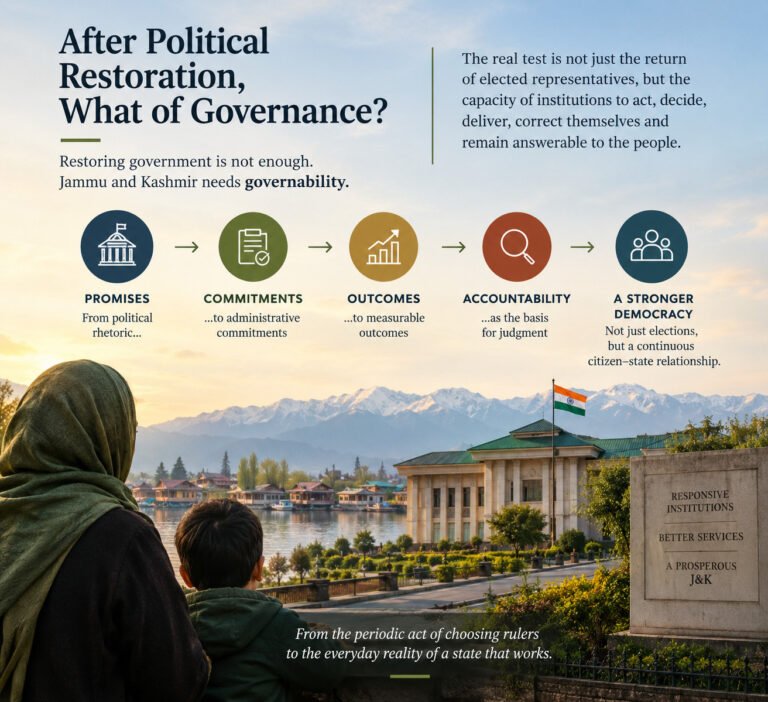
The central task, then, is not simply to restore government but to restore governability: the capacity of institutions to act, decide, deliver, correct themselves and remain answerable to those in whose name they exercise authority. Jammu and Kashmir does not need another politics of promises. It needs a politics in which promises become administrative commitments, commitments become measurable outcomes, and outcomes become the basis upon which governments are judged. That would constitute a more substantive meaning of the return of elected government. Democracy would cease to be merely the periodic act of choosing rulers and become what it ought to be: a continuous institutional relationship in which the citizen can reasonably expect the state not merely to speak, but to work.
About the Author