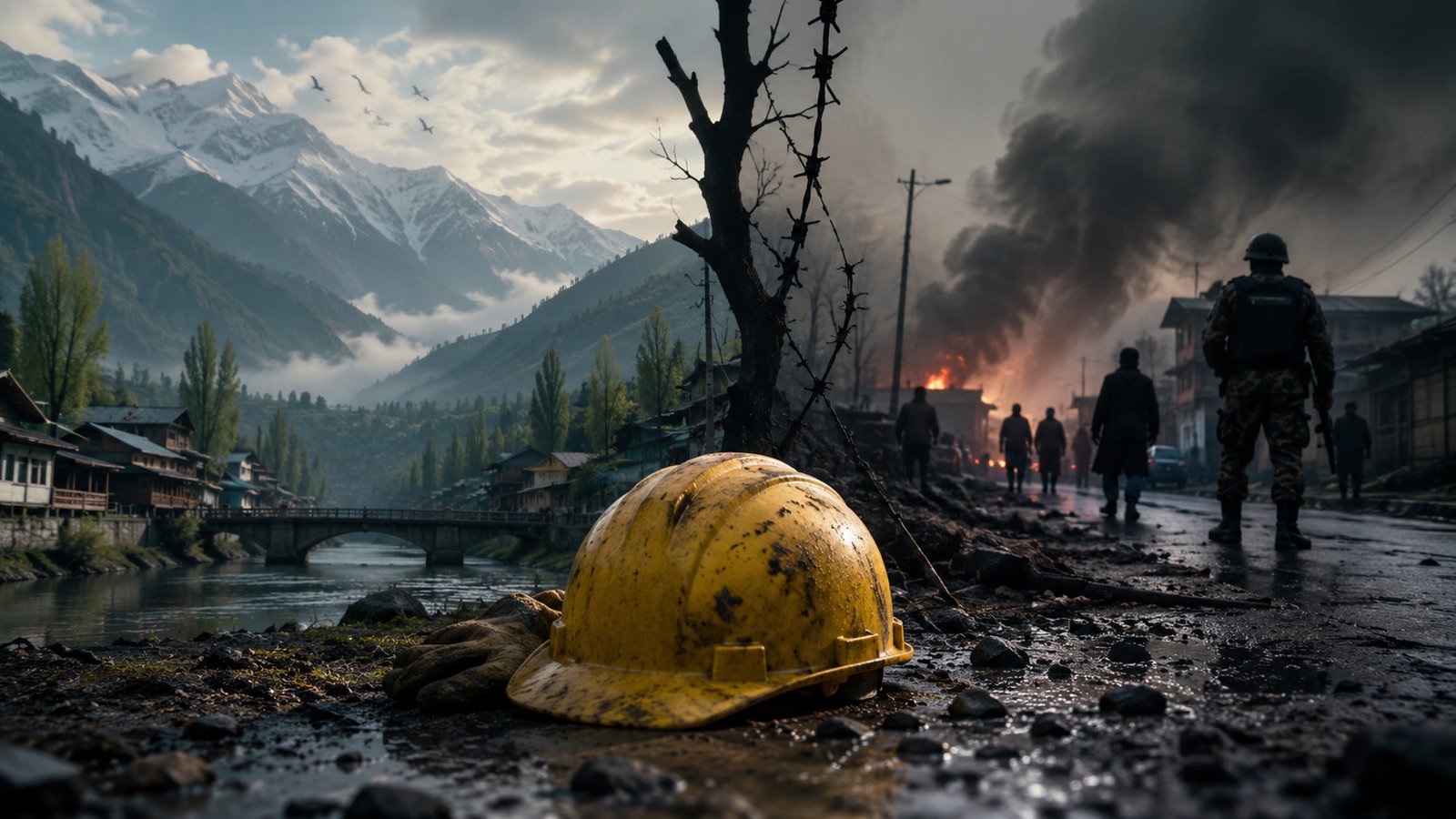
The recent killing of migrant workers in Kulgam, coming only days after the assassination of a policeman, once again confronts Kashmir with an old and painful question. Why do such acts continue to recur even when the Valley has witnessed visible improvements in infrastructure, tourism, economic activity, and security management? The question is not merely about crime or terrorism. It is about the deeper psychology of violence, the politics of fear, and the systematic destruction of human dignity. Every such killing is intended to produce consequences far beyond the death of the immediate victim. It is an assault on confidence, coexistence, and the moral foundations upon which any peaceful society must stand.
A murder committed in public is never only an attack on an individual. It is a carefully constructed message directed at society. The victim becomes the medium through which fear is communicated to thousands of others. A migrant worker carrying bricks, harvesting crops, laying roads, or earning an honest livelihood is not ordinarily a participant in political conflict. Yet his vulnerability makes him symbolically powerful in the eyes of those who believe violence can manufacture relevance. By attacking the seemingly ordinary, the perpetrators seek to create an extraordinary psychological effect.
This is the central logic of terror. It is not measured primarily by the number of casualties but by the magnitude of fear it generates. One murder seeks to influence the behaviour of hundreds. A single attack hopes to discourage thousands of workers from returning, investors from investing, tourists from visiting, and communities from trusting one another. Violence thus functions as psychological theatre where the immediate victim is only the first audience. The real audience is society itself.
The assassination of a policeman follows a similar but distinct psychological logic. Security personnel represent the institutional authority of the state. Their targeted killing is designed to project the illusion that governance itself is vulnerable. The killing of migrant workers serves a complementary objective by suggesting that ordinary life cannot be protected either. Together, such attacks attempt to manufacture an atmosphere where both the state and society appear insecure. The objective is to convert isolated incidents into collective anxiety.
Yet the tragedy extends far beyond strategic calculations. The deepest wound lies in what such killings do to the meaning of personhood itself.
Every victim possesses a biography that cannot be replaced. Behind every labourer stands a family waiting for remittances, children expecting school fees, ageing parents hoping for medicine, siblings dreaming of better opportunities, and a spouse carrying the emotional burden of separation. The worker who leaves home in search of livelihood does not merely transport his labour. He carries responsibilities, hopes, memories, and aspirations. His earnings are often the thin line separating dignity from destitution.
To kill such a person is therefore not merely to extinguish biological life. It is to terminate an entire universe of relationships. It is to orphan dreams before they mature. It is to interrupt children’s education, destroy families’ economic stability, and replace hope with lifelong grief. One bullet enters a single body, but its consequences spread across generations.
Philosophically speaking, murder annihilates not merely existence but possibility. Every human being embodies countless unrealised futures. The book never written, the child never educated, the parent never cared for, the home never built, the kindness never offered, the friendships never formed. Violence destroys all these invisible futures simultaneously. It kills not only who a person is, but who that person could have become.
This is why murder represents perhaps the greatest violation of human dignity. It reduces an infinitely valuable human life into an instrument serving someone else’s ideological objective. The victim ceases to be recognised as a person and becomes merely a symbol or statistic. Such dehumanisation is the necessary psychological precondition for every form of organised violence. Before one can kill another human being in cold blood, one must first stop seeing that person as fully human.
Religion, irrespective of tradition, fundamentally resists precisely this dehumanisation.
The moral injunction commonly expressed as “Thou shalt not kill” represents one of humanity’s oldest ethical foundations. Within the Islamic tradition, the Qur’an declares that whoever kills an innocent person, it is as though he has killed all mankind, while saving one life is as though saving all humanity. Similar moral prohibitions appear throughout Judaism, Christianity, Buddhism, Hinduism, Sikhism, and countless philosophical traditions. The remarkable convergence across civilizations reveals a profound truth. Human life possesses intrinsic worth that no ideology, grievance, or political objective can legitimately override.
Consequently, the murder of an innocent worker seeking honest livelihood contradicts every higher religious ideal that perpetrators may claim to uphold. There exists no spiritual dignity in murdering the defenceless. There is no honour in ambushing civilians. There is no moral courage in targeting those whose only purpose is to provide for their families. Such acts do not defend religion. They betray it.
Indeed, the contradiction is even deeper. Every authentic religious tradition seeks to elevate the human person by cultivating compassion, justice, mercy, restraint, and responsibility. Violence against innocents represents the inversion of these very virtues. It replaces mercy with cruelty, justice with vengeance, courage with cowardice, and reverence for life with contempt for it.
The killers therefore become prisoners of a tragic paradox. In claiming to pursue some higher cause, they simultaneously destroy the very ethical foundations that could give any cause moral legitimacy. Ends cannot sanctify means when the means themselves negate the sacredness of human life.
Kashmir has historically occupied a unique place in the imagination of India and indeed the wider world. It has often been described as paradise on earth, not merely because of its extraordinary landscapes but because of its centuries of cultural coexistence, spiritual traditions, and shared civilizational heritage. The concept of “heaven” associated with Kashmir is not merely geographical. It is moral. Paradise cannot coexist with fear. Heaven cannot be sustained through hatred.
Every targeted killing therefore wounds not only individuals but Kashmir’s civilizational identity itself. The image of a land known for hospitality suffers each time innocent blood is shed. The psychological distance created between communities gradually becomes larger than geographical distances. Suspicion replaces familiarity. Fear replaces trust. Visitors begin asking whether they are welcome. Residents begin wondering whether normalcy is fragile. Such invisible damage often lasts much longer than physical destruction.
Recent reports and public discussions have included allegations that victims in the recent attack may have been singled out because of their religious identity. Whether particular claims are ultimately confirmed through investigation or not, the very perception that identity could determine who lives and who dies is profoundly corrosive. Identity based violence tears at the moral fabric of plural societies because it punishes individuals not for what they have done but simply for who they are perceived to be. Such perceptions deepen polarization, reinforce communal anxieties, and hand exactly the psychological victory that violent actors seek.
Development cannot flourish under such conditions. Roads can be constructed, bridges completed, schools inaugurated, and investments announced. Yet sustainable development ultimately depends upon trust. Entrepreneurs invest where predictability exists. Skilled professionals relocate where families feel secure. Tourists travel where hospitality overcomes anxiety. Students pursue education where futures appear brighter than fears.
Violence systematically attacks each of these conditions. It imposes invisible taxes upon society through insecurity, insurance costs, reduced mobility, declining investor confidence, interrupted education, and psychological trauma. The economic consequences are measurable. The emotional consequences are often immeasurable.
It must equally be acknowledged that security agencies continue to bear an extraordinarily demanding responsibility. Preventing every isolated attack in difficult terrain against adaptive adversaries is among the most complex challenges confronting any security establishment. Intelligence gathering, area domination, technological surveillance, community policing, rapid response, and post incident investigation have all evolved significantly over recent years. Numerous attacks have undoubtedly been prevented, infiltration attempts disrupted, and perpetrators apprehended or neutralised through sustained professional effort. Policemen and soldiers themselves continue to face immense personal risks in protecting civilian life.
Yet security operations alone cannot permanently solve what is simultaneously a psychological, ideological, and social problem.
A purely kinetic approach may eliminate individual perpetrators, but it cannot by itself eliminate the narratives that produce future perpetrators. Every extremist movement depends upon stories. Stories about victimhood. Stories about identity. Stories about divine sanction. Stories about heroism through violence. Stories that gradually reshape moral imagination until killing appears meaningful rather than monstrous.
This is precisely where perhaps the greatest policy deficit remains.
Narrative building has too often been treated as a secondary concern rather than a primary domain of national security. Countering violence requires far more than rebutting propaganda. It demands constructing intellectually persuasive, theologically informed, psychologically sophisticated, and culturally rooted alternatives capable of exposing the moral bankruptcy of extremist worldviews.
Religious scholars, philosophers, psychologists, educators, historians, artists, community leaders, and communication experts must become equal partners in this endeavour. Counter narratives cannot merely declare that violence is wrong. They must patiently explain why it is wrong, how manipulative ideological frameworks distort sacred texts, how dehumanisation operates psychologically, and why genuine courage lies in preserving life rather than destroying it.
Young minds are rarely recruited into violence through arguments alone. They are recruited through emotional narratives offering identity, belonging, significance, and purpose. Counter narratives must therefore offer stronger identities rooted in dignity rather than hatred, belonging rather than exclusion, purpose through service rather than destruction.
Equally important is the cultivation of moral imagination. Education should enable young people to imagine the life behind every stranger. Before reducing another person to an identity label, one must first imagine the waiting mother, the hopeful child, the worried spouse, and the unfinished dreams attached to that individual. Empathy remains perhaps the greatest antidote to ideological dehumanisation.
Kashmir’s future ultimately depends not merely upon preventing violence but upon making violence intellectually, morally, socially, and spiritually indefensible. That requires long term investment in education, dialogue, research, public communication, intercommunity engagement, and credible local voices capable of articulating ethical alternatives.
The Valley has endured decades of conflict. It deserves something better than recurring cycles of grief. Every murdered worker, every fallen policeman, every bereaved family reminds us that peace cannot simply be measured through declining statistics. Peace is measured through confidence. Through trust. Through the ability of an ordinary worker to travel anywhere in search of livelihood without fear. Through the certainty that one’s identity will never become a death sentence. Through the confidence that children inherit hope instead of inherited trauma.
Ultimately, the greatest victory over violence will not be achieved merely when another attacker is arrested or another plot is foiled, important though those achievements undoubtedly are. The greater victory will arrive when the moral imagination of society becomes so strong that the very idea of murdering an innocent human being appears not courageous, not strategic, not religious, not political, but utterly unthinkable.
Only then will Kashmir truly reclaim the meaning of paradise. Not merely through its mountains and lakes, but through the sanctity it accords every human life, every dream, every family, and every future entrusted to its care.
About the Author