By: Dr. Peerzada Muneer
In every tradition that has taken the problem of truth seriously, there emerges at some point a confrontation with the limits of certainty. For Jain philosophy, this confrontation did not lead to despair, nor to dogma, but to a doctrine of profound modesty and moral discipline: Anekantavada. It is often translated as the doctrine of “non-one-sidedness,” or more simply, “non-absolutism.” But these renderings do not capture the full ethical and intellectual seriousness of the idea. Anekantavada is not a trick of rhetoric or a plea for vague pluralism. It is a demanding commitment to truth—truth seen not as possession, but as a horizon, approached cautiously from many angles, and never exhausted by a single one.
The central intuition behind this doctrine is at once simple and unsettling: reality is not flat, not stable in a singular way, and not completely knowable from any single perspective. Objects have multiple aspects. Substances unfold across time and space. Our perceptions are shaped by our standpoint—where we are located, what we seek, how we frame what we see. And because of this, the claims we make about the world are always partial. They may be true in a limited sense, but they are never the whole truth. To pretend otherwise is not just an epistemic mistake; it is a form of violence—a denial of the world’s richness and of others’ ways of encountering it.
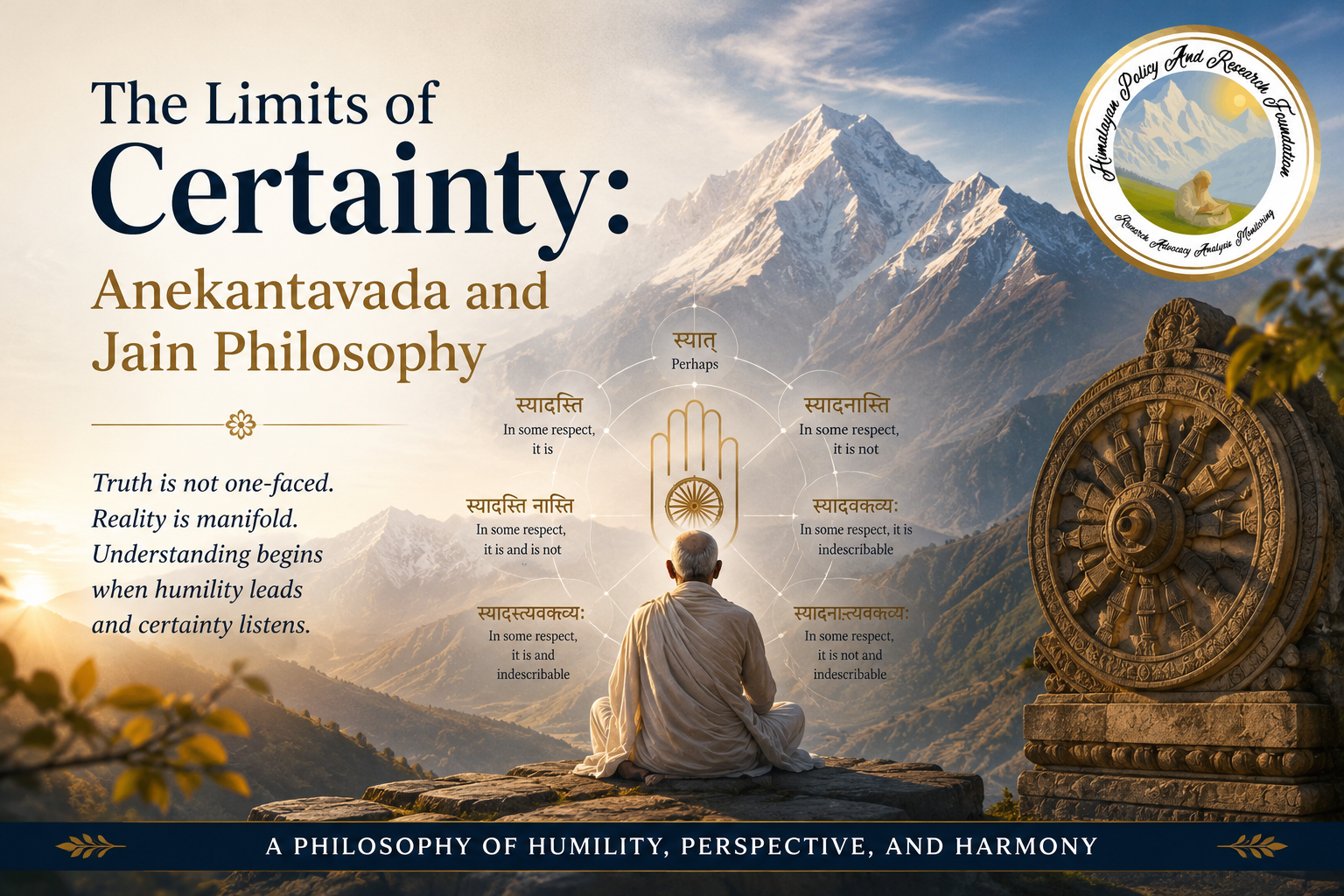
Jain thinkers understood that any proposition about a thing is conditioned. This led to the development of Syadvada, the principle of conditional assertion. Syat, meaning “perhaps” or “from a certain standpoint,” is not an expression of doubt, but of care. It reminds us that every statement must be situated. We say, “from this point of view, the object exists”; from another, “it does not”; from a third, “it both exists and does not.” Each proposition reflects a different way of approaching the object—a different moment, a different relation. These are not contradictions, but overlapping angles of vision, each limited, each necessary. Taken together, they begin to sketch the object’s fuller presence.
This is formalised in the Jain doctrine of Saptabhaṅgi Naya—the sevenfold scheme of predication. It allows us to say that something is, is not, is and is not, is indescribable, and so on. At first glance, this may seem excessive or even evasive. But its purpose is clear. It prevents us from falling into the illusion that one clear sentence can settle the matter. It teaches the restraint of language. It forces us to carry within our speech a recognition of its inadequacy. It also allows us to hold apparent contradictions without flinching. The world is contradictory—not in the logical sense, but in the way that different truths coexist without cancelling each other out.
To appreciate Anekantavada is to begin to see that any account of reality is an encounter—between object and observer, between permanence and change, between clarity and limit. And it is precisely this encounter that demands ethical attention. The ethical dimension of the doctrine cannot be separated from its metaphysical insight. To speak absolutely about something we only partially know is to risk violence—not only toward the truth, but toward others who may see what we do not. Intellectual arrogance is not a neutral error. In Jainism, it is an ethical failure.
That is why Anekantavada is not simply a theory of knowledge. It is a practice of humility. It is a refusal to dominate the world with one’s perspective. And it is an invitation to listen—not passively, but rigorously. In a world marked by clashing certainties, this doctrine offers a different way of being: not to collapse disagreement into relativism, but to carry it patiently, as the condition for a deeper understanding.
Many Jain philosophers elaborated this idea not only through logical schemata, but through analogies and ethical reflections. Siddhasena Divakara famously warned against mistaking the authority of tradition, the loudness of speech, or the weight of majority opinion for truth. Amṛtacandra argued that it is only through the acceptance of Anekanta—manifoldness—that right knowledge can emerge. Vidyānandi’s metaphor of the drop of seawater is well-known: the drop reflects the ocean, contains something of it, but is not the ocean itself. If we insist on treating it as the ocean, we fall into an illusion. If we dismiss it as meaningless, we lose its value. Yasovijayaji extended this further, arguing for the recognition of truths in non-Jain traditions—a rare gesture of interfaith generosity, based not on tolerance but on the belief that truth is too large to fit into one system.
What is striking about these thinkers is not only their logic, but their tone. There is no triumph in their argument. There is only patience. One gets the sense that they wrote not to persuade aggressively, but to guide others—slowly, gently—into a way of seeing. That tone itself is the mark of Anekāntavāda in practice. It does not shout. It suggests.
In modern times, few figures embodied the spirit of this doctrine more than Gandhi. Though not Jain by religious affiliation, he was deeply influenced by Jain ethics and was explicit in his admiration for Anekantavada. He repeatedly insisted that his understanding of truth was partial, evolving, and conditioned. His method of satyagraha—truth-force—was not about the assertion of dogma, but the refusal to dominate. He sought to convert not by violence, but by the slow persuasion of example. And in his fiercest confrontations, he left room for the possibility that his opponent might be seeing something he himself had missed.
In many ways, the Jain doctrine anticipates several currents in modern thought: standpoint epistemology, the critique of objectivity, the awareness of positionality in the social sciences. But it does not reduce to these. It carries a spiritual gravity that is often missing from academic discourse. It demands not just intellectual openness, but a moral posture—an ethic of restraint, of silence, of reverence for the unknown.
And it is, above all, difficult. Anekantavada is not easy to live in. It offers no final answers, no stable resting place. It asks us to keep walking, to keep revising, to hold our convictions lightly and others’ words carefully. It means accepting the discomfort of not knowing fully, and the discipline of staying in conversation. It means speaking with the awareness that we are likely missing something.
But in that difficulty lies its strength. Anekantavada offers us a way to live with complexity—not to dissolve it, but to dwell within it with grace. It tells us that understanding requires patience, and that justice begins not with the assertion of rightness, but with the recognition of limitation. It tells us that truth, if it is to be truth at all, must be shared.
In a world that prizes certainty and fears ambiguity, Anekantavada offers a rare kind of wisdom: not loud, not flashy, but enduring. It asks us to slow down, to speak with care, and above all, to listen—not just to others, but to the silences in our own knowledge. And perhaps that is the beginning of wisdom.
About the Author