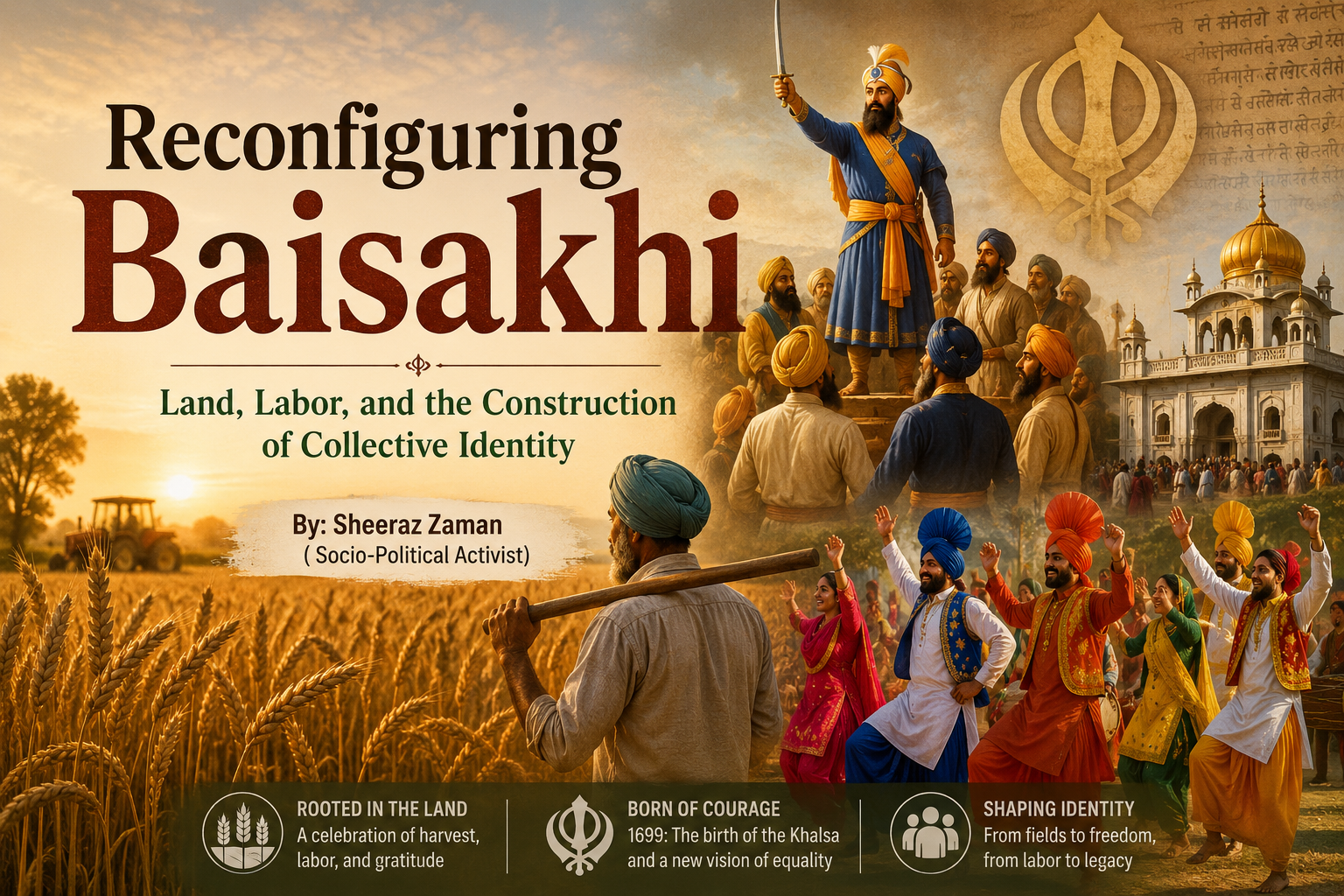
Reconfiguring Baisakhi
By: Sheeraz Zaman ( Socio-Political Activist)
Baisakhi does not merely recur as a calendrical event; it reasserts itself as a dense civilizational moment in which agrarian temporality, historical memory, and ethical imagination converge with unusual intensity. To approach it as a simple harvest celebration is to flatten its conceptual depth and to overlook the intricate ways in which it has been historically reconstituted into a site of meaning-making. It is, more precisely, a living archive- one that encodes within its rituals and resonances the longue durée of social transformation in the northern subcontinent.
At the level of material life, Baisakhi is inseparable from the agrarian ecology of Punjab, where the rhythms of sowing and reaping have historically structured both economy and culture. The ripening of the wheat crop, coinciding with the festival, is not simply an occasion for celebration but a moment of existential reckoning. Agrarian societies do not experience harvest as unqualified abundance; rather, it is apprehended as a fragile culmination of labor performed under conditions of uncertainty- subject to the vagaries of climate, soil, and political economy. The festive expression of gratitude, therefore, must be read alongside an undercurrent of precarity. What appears as celebration is equally an acknowledgment of contingency, a recognition that sustenance itself is neither automatic nor assured.
Yet, to remain within the agrarian frame would be to miss the profound historical re-inscription that Baisakhi underwent at the turn of the late seventeenth century. The events of 1699, under the leadership of Guru Gobind Singh, do not merely add a religious layer to the festival; they fundamentally transform its semantic horizon. The institutionalization of the Khalsa represents a decisive intervention in the politics of identity and authority within the broader context of the Mughal Empire. This was not an event of isolated spiritual significance; it was a radical reconfiguration of subjectivity itself.
The Khalsa, as conceived in this moment, sought to dismantle entrenched hierarchies of caste and inherited status, replacing them with an ethic of equality, discipline, and collective responsibility. It articulated a vision in which the individual was simultaneously sovereign and accountable- endowed with dignity yet bound by a rigorous moral code. The symbolism of initiation, performed on the day of Baisakhi, thus acquires a layered significance. It is at
once an act of spiritual consecration and a declaration of political agency. The festival, in this reconstituted form, becomes a threshold- marking the transition from passive belonging to active self-definition.
What is particularly striking is the manner in which this historical rupture remains anchored in the materiality of agrarian life. The emergence of the Khalsa does not detach itself from the social world of peasants and cultivators; rather, it draws its strength precisely from this embeddedness. The ethical and martial ideals it espouses are not abstract constructs but are grounded in the lived experiences of a community accustomed to labor, resilience, and collective interdependence. In this sense, Baisakhi embodies a rare synthesis: it is at once a celebration of nature’s cycles and a commemoration of human agency.
From an analytical standpoint, Baisakhi illustrates the capacity of festivals to function as dynamic repositories of collective memory. They are not inert traditions transmitted unchanged across generations; they are sites of continuous reinterpretation, where meanings are contested, reworked, and reaffirmed. The endurance of Baisakhi lies precisely in its ability to accommodate this multiplicity of meanings without collapsing into incoherence. Its agrarian, historical, and ethical dimensions do not exist in isolation; they intersect and reinforce one another, producing a complex and layered cultural form.
However, the contemporary articulation of Baisakhi raises critical questions about the fate of such complexity in an age increasingly dominated by commodification and spectacle. The festival, particularly in urban contexts, is often reduced to a series of performative gestures- music, dance, and consumption- that, while vibrant, risk severing the connection to the deeper historical and ethical currents that give it significance. This is not merely a matter of cultural dilution; it reflects a broader transformation in the way traditions are experienced and understood. When festivals are stripped of their historical density, they cease to function as vehicles of memory and become instead objects of consumption.
A rigorous engagement with Baisakhi must therefore resist this tendency toward simplification. It must insist on recovering the festival as a site of critical reflection, one that invites inquiry into the conditions of its own possibility. Such an inquiry would necessarily extend beyond the festival itself, encompassing questions of agrarian distress, social inequality, and the politics of identity in contemporary South Asia. What does it mean to celebrate harvest in a context where the agrarian economy is marked by indebtedness and ecological strain? How are the egalitarian ideals associated with the Khalsa reconciled- or not- with the persistence of hierarchical social structures? To what extent can the ethical vision articulated in 1699 serve as a resource for addressing present-day crises of justice and dignity?
These are not extraneous concerns imposed upon the festival; they are immanent to it. Baisakhi, in its fullest articulation, demands an engagement that is both reflective and critical. It calls for an understanding of history not as a static repository of facts but as an active force that shapes and is shaped by the present. It compels us to recognize that cultural practices are
not neutral; they are imbued with values, aspirations, and contradictions that must be interrogated rather than merely celebrated.
In this expanded sense, Baisakhi emerges as more than a ritual observance. It becomes an interpretive lens through which the interplay of economy, history, and ethics can be examined with greater clarity. It reminds us that the harvest is not merely a material outcome but a metaphor for collective striving- a testament to the capacity of human communities to endure, adapt, and transform. At the same time, it cautions against complacency, insisting that the fruits of labor, whether agricultural or political, are never final but must be continually secured through vigilance and effort.
To engage with Baisakhi, then, is to engage with a tradition that refuses to remain confined within the boundaries of celebration. It is to confront a historical inheritance that is at once empowering and demanding- one that calls not only for remembrance but for responsibility. In an era marked by fragmentation and uncertainty, such traditions acquire an added significance. They offer not ready-made answers, but frameworks within which questions of justice, identity, and belonging can be posed with renewed urgency and depth.
About the Author