
By: Dr Huzaif Rashid Bhat ( Research Scholar)
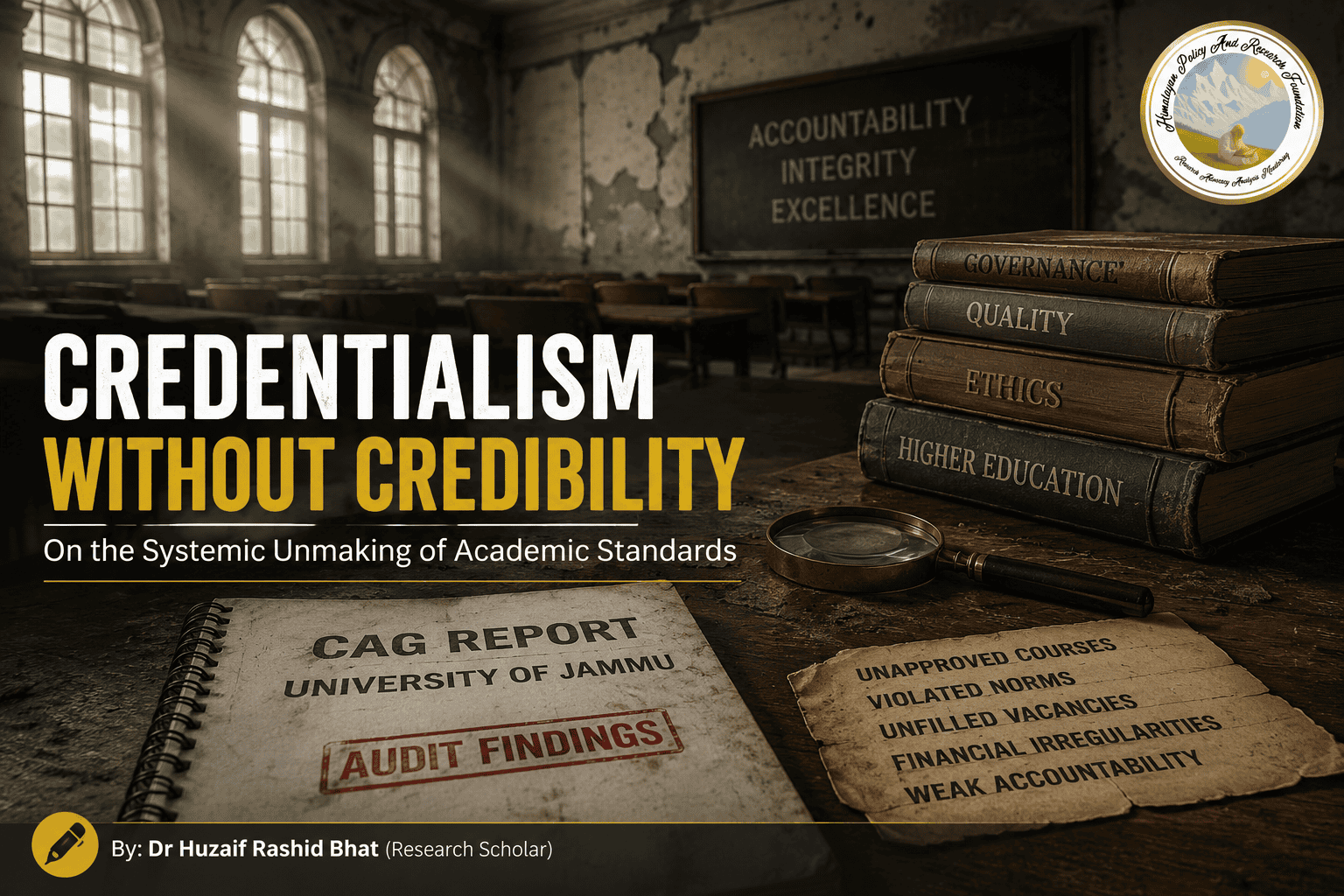
There is something profoundly unsettling about audit reports in India. They are, in principle, instruments of democratic vigilance- documents meant to discipline power through evidence, to compel institutions to answer for their conduct, and to restore a measure of trust between the state and the citizen. Yet, more often than not, they read like post-mortems without consequence: meticulous in detail, devastating in implication, and curiously inert in effect. The recent report by the Comptroller and Auditor General of India on the functioning of the University of Jammu is one such document. It is not merely an indictment of administrative lapses; it is a window into the deeper malaise afflicting public universities in India, a crisis of purpose, governance, and moral imagination.
At one level, the report is a familiar catalogue of failures. Courses run without proper approval. Teacher training programmes conducted without the sanction of the National Council for Teacher Education. Recruitment rules not framed. Vacancies left unfilled. Appointments made in violation of University Grants Commission norms. Infrastructure projects abandoned midway, leaving crores of rupees locked in concrete skeletons. Financial records poorly maintained, funds mismanaged, internal controls weak. Students are subjected to delays in examinations, errors in evaluation, and a general atmosphere of institutional indifference.
But to read these as discrete administrative failures is to miss the larger point. What the audit reveals is not simply inefficiency; it reveals a pattern of institutional decay where rules are optional, accountability is diffused, and purpose is obscured. The university, in this telling, ceases to be a site of intellectual formation and becomes instead a theatre of procedural improvisation.
The first and perhaps most striking aspect of the report is the erosion of academic integrity. A university’s legitimacy rests fundamentally on the credibility of its academic processes- its courses, its examinations, its research standards. When courses are offered without accreditation, or degrees awarded without adherence to established norms, the very meaning of certification is hollowed out. It is not merely a technical violation; it is a moral one. Students invest years of their lives in the expectation that their education will be recognised as valid and valuable. To betray that expectation is to erode the social contract that underpins higher education.
The report’s findings on examination processes are particularly telling. Delays in result declaration, incorrect evaluation of answer scripts, and the setting of out-of-syllabus questions are not minor inconveniences. They signal a breakdown in the most basic function
of the university: the fair and timely assessment of knowledge. In a system where students’ futures hinge on these evaluations, such lapses are not just administrative errors; they are acts of institutional injustice.
Equally troubling is the state of research. Universities are meant to be sites of knowledge production, where inquiry is nurtured and intellectual boundaries are expanded. Yet the audit points to delays in PhD evaluations, non-adherence to minimum standards for research supervision, and a lack of meaningful outcomes from funded projects. Research, in this context, appears less as a pursuit of knowledge and more as a bureaucratic requirement- something to be completed, recorded, and forgotten. The tragedy here is not only the waste of resources but the erosion of intellectual ambition.
If the academic sphere reflects a crisis of purpose, the domain of human resource management reveals a crisis of governance. The absence of clearly defined recruitment rules is particularly alarming. Rules are not merely procedural devices; they are safeguards against arbitrariness. Without them, appointments become susceptible to discretion, and discretion, in the absence of accountability, often degenerates into patronage. The report’s observation that appointments were made without requisite qualifications, or in violation of established norms, underscores this danger.
Vacancies, too, are not neutral facts. When teaching posts remain unfilled, the burden shifts onto existing faculty, often leading to a reliance on contractual appointments. While contractual hiring may offer short-term flexibility, its excessive use can undermine institutional stability and academic continuity. Teachers on short-term contracts are less likely to invest in long-term pedagogical or research commitments. The result is a system that prioritises administrative convenience over academic quality.
The issue of career advancement further complicates this picture. When promotions and incentives are granted irregularly, or without transparent criteria, they distort the incentives that drive academic performance. Merit becomes secondary to manoeuvre, and the ethos of scholarship is gradually replaced by the logic of survival.
The failures in infrastructure management add another layer to this narrative of decline. The report notes significant investments in projects that remain incomplete or abandoned. Idle investments- running into tens of crores, are not merely financial losses; they are symbols of planning without foresight and execution without accountability. The incomplete girls’ hostel, in particular, is emblematic of a deeper insensitivity. Infrastructure is not just about buildings; it is about enabling access, ensuring safety, and creating an environment conducive to learning. When such projects remain unfinished, the consequences are borne disproportionately by the most vulnerable.
The inadequacies in facilities for differently-abled students further highlight the exclusionary nature of this neglect. Inclusion is often invoked as a principle, but it is realised through infrastructure- ramps, accessible classrooms, supportive services. The absence of these is not an oversight; it is a statement about priorities.
Financial management, as detailed in the report, reveals perhaps the most systemic failures. The inability to maintain proper accounts, the non-investment of surplus funds, and the loss of grants due to incomplete projects point to a breakdown in basic financial discipline. Funds allocated for education are not abstract numbers; they are public resources entrusted for a specific purpose. Their mismanagement is not merely inefficient; it is ethically indefensible.
The weaknesses in internal control mechanisms- manifested in discrepancies in cash books and irregularities in procurement- raise deeper questions about oversight. Institutions rely on internal checks not only to prevent misuse but to cultivate a culture of responsibility. When these mechanisms fail, they create an environment where lapses can proliferate unchecked.
Yet, the most disquieting aspect of the report lies not in any single finding but in the pattern that emerges across them. What we see is not a series of isolated failures but a systemic erosion of norms. Regulations exist, but they are not enforced. Procedures are outlined, but they are not followed. Accountability is invoked, but it is not realised. The institution operates in a liminal space- neither fully compliant nor overtly defiant, but persistently adrift.
This raises a larger question about the governance of public universities in India. Over the years, these institutions have been subjected to an increasing density of regulations. Bodies like the University Grants Commission and the National Council for Teacher Education prescribe detailed norms for everything from curriculum design to faculty qualifications. In theory, this regulatory architecture is meant to ensure standardisation and quality. In practice, it often produces a culture of compliance without conviction.
Universities learn to navigate regulations strategically- complying where it is convenient, circumventing where it is not, and negotiating the rest. The result is a form of institutional behaviour that is neither fully autonomous nor effectively regulated. It is a system in which responsibility is diffused and accountability diluted.
The audit report also invites reflection on the relationship between policy and practice. Initiatives such as the National Education Policy 2020 promise a transformation of higher education- greater flexibility, interdisciplinary learning, and a renewed emphasis on research and innovation. Yet, as the report suggests, the gap between aspiration and implementation remains vast. Policies articulate ideals; institutions struggle with basics. The language of reform sits uneasily alongside the reality of dysfunction.
One might argue that these problems are not unique to the University of Jammu. Indeed, many public universities across India face similar challenges- resource constraints, bureaucratic inertia, political interference. But this is precisely what makes the report significant. It is not an outlier; it is a mirror.
The question, then, is what is to be done. Audits, by themselves, cannot reform institutions. They can diagnose, they can recommend, they can even shame- but they cannot enforce. The responsibility for reform lies with multiple actors: university leadership, regulatory bodies, government authorities, and, not least, the academic community itself.
At the institutional level, there is a need to restore the primacy of rules- not as rigid constraints but as enabling frameworks. Recruitment processes must be transparent and merit-based. Academic programmes must adhere to established standards. Financial practices must be disciplined and accountable. These are not ambitious reforms; they are basic requirements.
At the regulatory level, there is a need to rethink the balance between control and autonomy. Excessive regulation can be as damaging as insufficient oversight. What is required is a system that emphasises outcomes over procedures, that rewards compliance with quality rather than mere form.
At the level of political authority, there must be a recognition that universities cannot be governed as administrative departments. They require a degree of intellectual autonomy, but that autonomy must be matched by accountability. The challenge is to create conditions in which universities can function as sites of critical inquiry rather than arenas of bureaucratic negotiation.
Last but not least, there is a need to reclaim the moral purpose of the university. Beyond regulations and resources, institutions are sustained by values- integrity, curiosity, responsibility. When these erode, no amount of procedural reform can compensate. The audit report on the University of Jammu is, in this sense, more than an administrative document. It is a reminder of what is at stake in higher education. Universities are not merely providers of degrees; they are custodians of knowledge, spaces of debate, and engines of social mobility. When they falter, the consequences ripple far beyond their campuses.
There is a temptation, in the face of such reports, to lapse into cynicism- to see them as yet another instance of dysfunction in a system that resists change. But cynicism, while understandable, is ultimately unproductive. What is required instead is a more demanding form of engagement: one that takes these findings seriously, that insists on accountability, and that recognises the centrality of education to the public good.
In the end, the question is not whether the University of Jammu can rectify these lapses. It is whether we, as a society, are willing to demand that it does.
About the Author