Written by: Dr. Peerzada Muneer
Global Evolution of Narco Trafficking and Its Expanding Ramifications
Narco trafficking, more formally known as narcotics trafficking, has grown from a localized trade into a deeply embedded global phenomenon intersecting with economics, politics, and security. At its core, it involves the production, transportation, distribution, and sale of illegal drugs such as heroin, cocaine, methamphetamine, cannabis in restricted jurisdictions, and increasingly, synthetic substances like fentanyl. What distinguishes modern narco trafficking is not only its scale but its complexity. It operates through transnational networks involving organized crime groups, financial intermediaries, corrupt actors, and advanced logistical and technological systems. These networks adapt quickly to shifting global demand and supply, making them resilient and difficult to dismantle.
Historically, the narcotics trade predates modern states, but its contemporary form emerged with global prohibition regimes in the late nineteenth and early twentieth centuries. International treaties regulating substances like opium unintentionally transformed a semi-regulated trade into a highly profitable illicit market. As restrictions tightened, profit margins rose, attracting organized crime. By the mid twentieth century, drug distribution networks in North America and Europe expanded alongside cultivation in Latin America and Asia. The Cold War further complicated the landscape, as geopolitical rivalries sometimes overlapped with illicit economies, creating inconsistent enforcement.
The latter half of the twentieth century saw the rise of powerful drug cartels, particularly in Latin America. These organizations industrialized production and built extensive global trafficking routes, often marked by violence, corruption, and parallel governance in regions with weak state control. At the same time, heroin production expanded in the Golden Crescent and Golden Triangle, embedding narcotics into local economies and conflict zones. Efforts like the global war on drugs aimed to curb this system but often resulted in displacement rather than elimination, with cultivation and routes shifting geographically.
In recent decades, globalization and technology have reshaped narco trafficking. Large cartels have given way to decentralized, networked groups operating with greater flexibility and anonymity. Advances in transportation, communication, and finance have reduced risks while expanding reach. Synthetic drugs mark a significant shift, as production is no longer geographically bound. Substances like methamphetamine and fentanyl can be produced in small facilities, complicating detection. Digital platforms, encrypted communication, and cryptocurrencies further enable cross-border operations with minimal exposure.
The consequences are profound. In production regions, trafficking fuels violence, weakens institutions, and entrenches corruption. Transit regions face undermined governance and rising crime, while consumer regions grapple with public health crises and addiction. The opioid crisis highlights the human cost. Beyond immediate impacts, narco trafficking perpetuates poverty, disrupts social cohesion, and erodes institutional trust, revealing a persistent gap between policy intentions and outcomes.
Narco Terrorism, Proxy Warfare, and the Conflict Economy in South Asia
Narco terrorism represents a significant evolution in illicit economies, where drug trafficking converges with ideological and political violence. Unlike conventional narcotics trade driven largely by profit, narco terrorism combines financial motives with strategic goals. Armed and extremist groups either directly engage in drug production and trafficking or rely on it for funding. This creates a self-reinforcing cycle in which drugs finance violence, and violence in turn protects and expands the drug trade.
Global recognition of narco terrorism grew as it became clear that several insurgent groups were deeply embedded in drug economies. Across regions, such groups have used narcotics revenue to sustain operations, acquire weapons, and maintain territorial control. Over time, this relationship evolved from indirect taxation of trafficking routes to direct involvement in production and distribution. As a result, the line between criminal networks and ideological groups has blurred, making both more adaptive and harder to dismantle.
In South Asia, narco terrorism takes on added complexity due to geography, political tensions, and proximity to major drug-producing areas. Afghanistan has long been one of the world’s largest opium producers, and revenues from this trade have been linked to various armed groups, influencing regional conflicts and complicating stabilization efforts. Pakistan, acting as a transit corridor, faces challenges such as porous borders and limited governance in certain regions, enabling smuggling networks and militant elements to operate in parallel.
India, though not a major producer, experiences significant downstream effects, particularly in border regions like Punjab and Jammu and Kashmir. The flow of drugs across contested borders presents both public health and national security concerns. There is growing evidence that proceeds from trafficking help finance extremist activities, linking addiction with instability. In this context, narco terrorism is often seen as a form of proxy warfare, where cross-border smuggling is not just criminal but strategically aimed at weakening social structures and supporting disruptive networks.
The notion of a “K to K” strategy reflects concerns about the use of drug networks to influence sensitive regions. While debated, it underscores a broader issue: drug inflows create social crises, especially among youth, while profits sustain militant operations. Funds are funneled to handlers and operatives, supporting recruitment, logistics, and communication, allowing networks to function with relative independence.
This dynamic contributes to what is often termed a conflict economy, where prolonged instability creates its own incentives. Political actors may benefit from narratives of insecurity, while certain business interests profit from contracts or shadow economies. Locally, individuals may participate in informal or illicit roles as a means of survival.
Additional complexity arises from overground workers who blend into society while supporting illicit networks, making detection difficult. Land mafias also exploit weakened governance to acquire property, while even security structures face risks of corruption or coercion. Together, these actors form an ecosystem that, in different ways, benefits from ongoing instability.
Perhaps most concerning is the impact on youth. In conflict-affected regions, unemployment and uncertainty make young people vulnerable to both addiction and recruitment. They become both consumers and operatives, weakening the social fabric. Over time, this leads to cycles of dependency, community fragmentation, and declining productivity, making recovery increasingly difficult and perpetuating long-term instability.
LG’s Zero Tolerance Approach and the Path Ahead
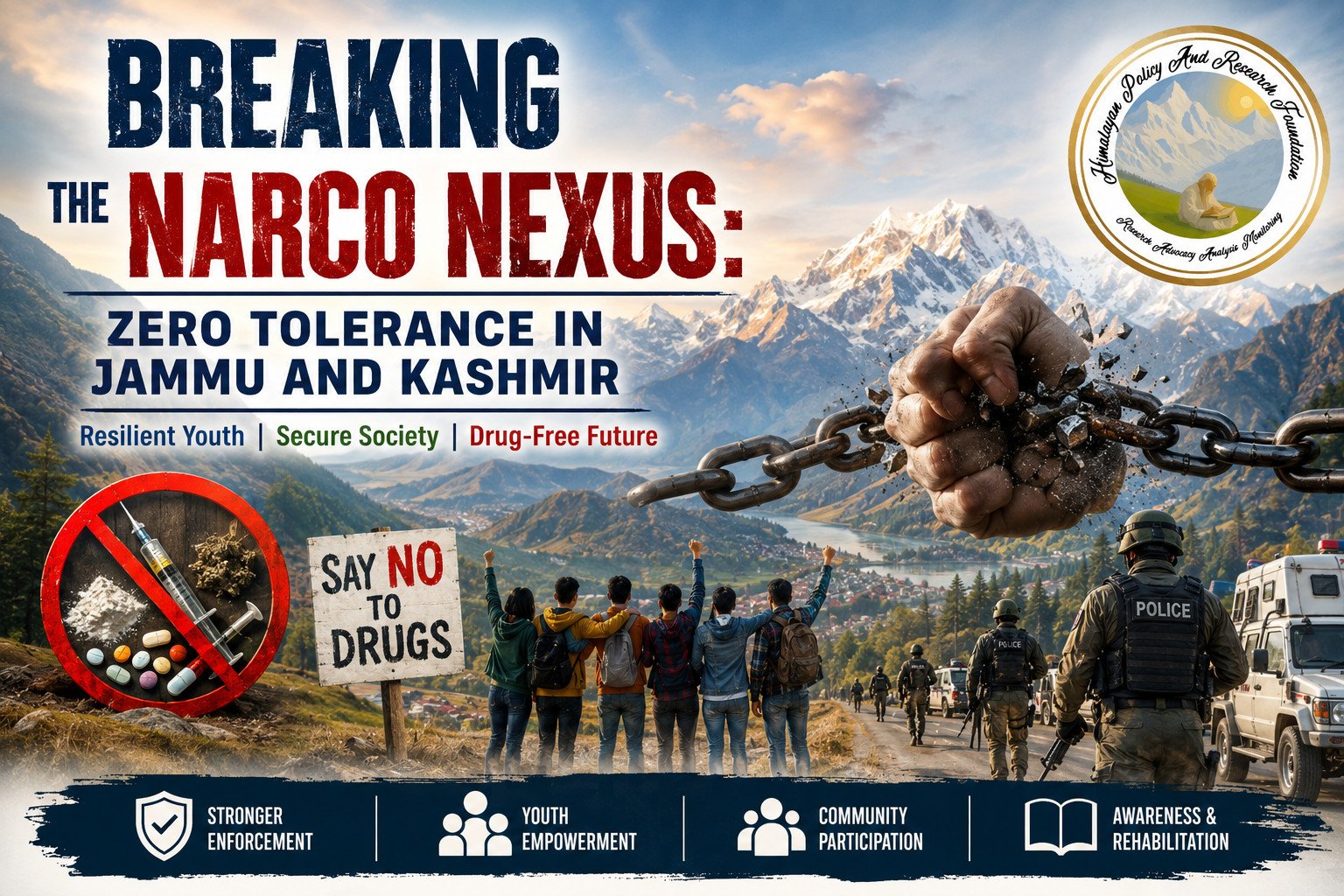
The recent anti-drug position taken by Jammu and Kashmir Lieutenant Governor Manoj Sinha marks a significant shift from routine enforcement to a more comprehensive and openly articulated campaign against the drug economy and its security linkages. What distinguishes this intervention is not only the force of the language used, but also the breadth of measures announced. In statements reported by The Hindu, The Times of India, Greater Kashmir, Kashmir Life, Kashmir Observer, and related coverage, the Lieutenant Governor has framed the drug menace not merely as a criminal law problem, but as a social, economic, and national security threat that must be addressed in an integrated manner. The emphasis on “zero tolerance,” along with a “whole of government” and “whole of society” approach, reflects an effort to redefine drug control as a public mission rather than a narrow policing exercise. (The Times of India)
At the launch of the 100-day “Nasha Mukt Jammu Kashmir Abhiyaan,” Manoj Sinha stated that the administration would not allow youth, families, or communities to fall into addiction and described the coming months as “pivotal.” He characterized drug abuse as one of the region’s gravest challenges and emphasized that statistics alone cannot capture the pain experienced by affected families. He also linked the issue with cross-border destabilization, stating that a neighbouring country is using smuggling routes to poison communities and damage the region’s future. In another address, he described drug abuse as a “social cancer” and stressed that the response must extend beyond law enforcement to every layer of society. His statement that the administration intends to “map every hotspot” and act with the precision of a “surgical strike” suggests an operational model focused on targeted disruption rather than symbolic action. (Daily Excelsior)
The structure of the campaign is equally important. The anti-drug drive has been designed as a 100-day intensive initiative beginning in April 2026 and progressing through multiple phases, including awareness drives, youth-focused activities, community engagement, strict enforcement, rehabilitation, and evaluation. This design indicates that the administration is not limiting itself to seizures and arrests. Instead, it seeks to combine punitive action with prevention, public participation, and treatment. The campaign is intended to operate from the panchayat and ward levels up to the Union Territory administration, suggesting an effort to embed anti-drug work within local governance rather than confining it to police agencies. (The Times of India)
The operational strategy can be understood as a three-layer framework involving legal coercion, financial disruption, and social mobilization. The legal component is strict and clearly defined. According to reported measures, passports, driving licences, Aadhaar-linked privileges, and arms licences of drug traffickers may be revoked. Lookout notices are to be issued against absconders, and both peddlers and ringleaders are expected to face swift prosecution. Alongside this, financial disruption has been prioritized. Authorities have indicated that both movable and immovable properties of traffickers will be attached, bank accounts frozen, and financial investigations strengthened. This reflects a shift from earlier approaches that often ended with arrests and seizures, toward dismantling the economic base that sustains the narcotics trade. (The Times of India)
The social mobilization aspect is one of the strongest features of the current approach. Manoj Sinha has emphasized that drugs cannot be defeated by one department alone and has called for coordinated action across administration, police, educational institutions, panchayats, ward bodies, and civil society. The call for women’s vigilance committees at the local level highlights the role of families and communities in early detection and intervention. At the same time, outreach to youth stresses that drug use is not a symbol of modernity but a form of dependence and harm. This approach distinguishes clearly between traffickers and addicts, combining strict action against suppliers with a rehabilitative stance toward victims. (Greater Kashmir)
Another important feature is the focus on grassroots intelligence and surveillance. The Lieutenant Governor has directed officials to involve panchayats, mohalla committees, chowkidars, and ward-level bodies in identifying and monitoring drug-related activities. Reports also suggest that traffickers are being listed at the police-station level to strengthen accountability and deterrence. This reflects an effort to shift from reactive policing to a more localized, intelligence-driven model. Such an approach can improve detection and reduce the ability of traffickers to operate unnoticed, although it requires careful safeguards to prevent misuse or violations of due process. The Lieutenant Governor has stressed that innocent individuals must not be harassed while ensuring that guilty actors are held accountable. (Daily Excelsior)
A related administrative step is the notification of the Jammu and Kashmir Substance Use Disorder Treatment, Counselling and Rehabilitation Centres Rules, 2026. This highlights that the anti-drug campaign is not limited to enforcement but also addresses treatment and recovery. The administration has acknowledged the need for properly staffed and regulated rehabilitation centres and has indicated that those operating illegally or without adequate facilities will face action. This is important because ineffective or exploitative treatment systems can undermine broader anti-drug efforts. By integrating rehabilitation with enforcement and financial measures, the administration is moving toward a more complete anti-narcotics framework. (Daily Excelsior)
The campaign is being viewed positively because it attempts to address the drug problem as a full ecosystem rather than a series of isolated incidents. Many earlier efforts have focused on arrests and seizures while leaving financial networks, social enablers, and demand-side factors largely untouched. The current approach combines a strong public message with concrete mechanisms and broad-based mobilization. Measures such as cancellation of privileges, freezing of assets, property attachment, and community participation indicate a more structured understanding of the problem.
If implemented consistently and lawfully, the policy could produce several important outcomes. It could reduce the economic attractiveness of trafficking by increasing the risks and long-term consequences for those involved. Financial investigations could disrupt links between drug trade profits and other illicit or destabilizing activities. Increased focus on treatment and awareness could reduce demand and encourage earlier intervention by families. The campaign could also strengthen public confidence by demonstrating that the state is addressing both immediate crimes and their underlying causes.
The significance of this approach becomes clearer in the context of Jammu and Kashmir’s recent history. Drug trafficking in the region intersects with cross-border smuggling, local vulnerabilities, and concerns about financing disruptive activities. Each instance of trafficking can have multiple effects, including addiction, social disruption, and potential financial linkages to unlawful networks. Recognizing this interconnected nature gives the policy greater strategic depth and urgency. (The Week)
At the same time, it is important to acknowledge the scale of the challenge. A 100-day campaign can generate momentum, but it cannot eliminate a complex and adaptive narcotics ecosystem on its own. Sustained effort will be required beyond the initial phase. This includes consistent enforcement, transparent legal processes, credible rehabilitation systems, and ongoing coordination among institutions. Maintaining a clear distinction between addicts and traffickers will also be essential to ensure both effectiveness and public legitimacy. (The Times of India)
Overall, the current approach stands out as one of the more comprehensive anti-drug policy efforts in Jammu and Kashmir in recent years. It combines strong rhetoric with structured planning and recognizes the need for both enforcement and social intervention. By addressing financial networks, community participation, and rehabilitation alongside policing, it attempts to dismantle the broader framework that sustains drug trafficking. If sustained with consistency, fairness, and institutional commitment, the initiative has the potential to produce long-term benefits, including improved public health, stronger communities, and greater stability.
About the Author