Written By: Irshad Ahmad Bhat ( Reasearch Scholar )
Jammu & Kashmir’s floriculture and medicinal plant sectors represent an ecological and commercial endowment of subcontinent-wide significance. That this endowment was systematically suppressed across three decades of violence — producing a measurable developmental divergence from the national average — constitutes the foundational context for evaluating the state’s current corrective policy architecture.
Any rigorous analysis of Jammu & Kashmir’s floriculture and medicinal plant sectors must be grounded in an acknowledgement of the historically specific conditions under which their developmental trajectories were suppressed. Between the onset of armed insurgency in 1989 and the phased stabilisation that followed, J&K’s agrarian and natural resource economy was subjected to a prolonged and structurally consequential interruption — one whose effects on investment patterns, institutional capacity, and supply-chain organisation were cumulative, compounding, and in certain respects, irreversible in the short term. The developmental deficit observable in these sectors today is not adequately explained by policy inertia alone; it reflects, more precisely, the economically disorganising effects of sustained violence on a territorially bounded regional economy.
The aggregate developmental divergence from the national average during this period is empirically documented. J&K’s Gross State Domestic Product growth lagged behind the national trajectory through the most acute phase of the insurgency, with marked stagnation in those sectors — horticulture, tourism, handicrafts, and natural resource processing — whose functional viability is predicated on investment confidence, supply-chain continuity, and the unimpeded movement of goods and persons. Cold-chain infrastructure that transformed the commercial floriculture sectors of Maharashtra and Karnataka through the 1990s and 2000s did not materialise in J&K during the same period. Processing capacity for pharmaceutical botanicals — the distillation units, extraction facilities, and standardisation laboratories that would have logically located proximate to the primary ecological source — was instead established in Gujarat, Uttarakhand, and Himachal Pradesh, where the operating environment presented no comparable systemic risk. The structural asymmetry between J&K’s botanical endowment and its realised industrial output that analysts now rightly identify is, in substantial measure, the institutionalised residue of this violence-induced developmental dislocation.
The structural gap between J&K’s botanical endowment and its industrial output is, in substantial measure, the institutionalised residue of violence-induced developmental dislocation.
Against this historical baseline, the recovery trajectory now observable across both sectors acquires its proper analytical significance. The Botanical Survey of India has documented over 3,054 vascular plant species within J&K, of which approximately 1,093 are recognised as possessing medicinal properties under classical pharmaceutical traditions, and at least 290 are subject to active commercial harvesting. The National Medicinal Plants Board estimates the annual farmgate and collector-level value of the medicinal plant trade from J&K at ₹450–500 crore, while NMPB volumetric data indicate that J&K contributes between 12 and 15 per cent of India’s total wild-harvested medicinal plant supply — a share disproportionate to the territory’s geographic area and population, and indicative of the underlying ecological productivity that violence suppressed but did not extinguish.
Sectoral disruption and the floriculture economy
The floriculture sector furnishes the most historically legible account of what was arrested and what is now being recovered. The horticultural tradition formalised through the Mughal garden culture of the Kashmir Valley — the architecturally distinctive terraced water gardens of Shalimar Bagh and Nishat Bagh, laid out in the sixteenth and seventeenth centuries — had institutionalised a sustained commercial investment in flowering species that persisted through colonial administration and into the post-independence developmental period. By the late 1980s, the conditions for organised commercial floriculture expansion were substantively in place.
The onset of armed insurgency foreclosed that expansion before it could consolidate into durable economic structures. The disaggregation of Kashmir’s tourism economy — documented visitor arrivals declined from over 700,000 in 1988 to fewer than 10,000 at the insurgency’s most acute phase — severed the most proximate and remunerative market for floriculture’s premium output. The operational disruptions produced by violence, including curfew-related supply-chain interruptions, communications blackouts, and the chronic investment disincentives generated by security uncertainty, suppressed horticulture sector capitalisation across the length of the conflict period. The outmigration of skilled horticultural practitioners that accompanied peak violence further attenuated the sector’s human capital base in ways that are structurally consequential even in retrospect.
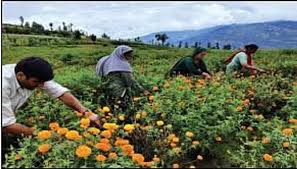
The recovery now underway is, in this context, a substantive developmental achievement. The Floriculture Development Agency records that total area under cultivation expanded from approximately 2,800 hectares in 2015 to over 4,200 hectares by 2022–23, representing a compound annual growth rate of approximately 6 per cent sustained across a period of broader economic normalisation. The registered annual value of floral produce now exceeds ₹320 crore, with informal estimates placing the effective figure considerably higher when unregistered household-level cultivation is incorporated. The Indira Gandhi Memorial Tulip Garden in Srinagar — spanning over 30 hectares, hosting over 1.5 million bulbs across approximately 68 varieties, and drawing upward of 350,000 visitors annually during the spring season — represents not merely a horticultural achievement but an index of the broader normalisation that has enabled the sector’s commercial resurgence. The Valley’s principal production districts — Srinagar, Budgam, Pulwama, and Shopian — are producing at a scale that had been structurally precluded during the conflict decades.
The Tulip Garden’s 350,000 annual visitors constitute an index not merely of horticultural achievement but of the broader normalisation that violence had structurally foreclosed.
The medicinal plant value chain: structural inheritance and corrective policy
The medicinal plant economy presents an analytically parallel but structurally more complex account of the same violence-mediated developmental suppression. J&K’s altitudinal gradient — from subtropical Shivalik foothills at approximately 300 metres to alpine terrain exceeding 5,000 metres across the Pir Panjal and Great Himalayan ranges — generates micro-ecological niches supporting a pharmaceutical flora of subcontinent-wide commercial significance. Dar et al. (2013), in a comprehensive ethnobotanical survey conducted across temperate and cold-arid zones, identified 1,093 species with pharmaceutical relevance under traditional systems, of which approximately 290 are subject to active commercial collection.
The commercially significant species profile is well-documented. Aconitum heterophyllum (Atis), harvested from high-altitude meadows above 3,500 metres, is valued in Ayurvedic cardiac and fever formulations. Saussurea lappa (Kuth), an alpine endemic, was listed under CITES Appendix I as a consequence of extraction pressures that intensified precisely during the governance-attenuated conditions of the insurgency period, when regulatory enforcement capacity in remote mountain areas was systematically degraded. Podophyllum hexandrum yields podophyllotoxin, a pharmacologically significant precursor in oncological drug synthesis. Bergenia ciliata (Pashanbhed) is extensively employed in Unani urological formulations. These species feed pharmaceutical supply chains of considerable industrial value.
The prevailing market structure — in which primary collection by Gujjar and Bakarwal pastoral communities and village-level collectors supplies intermediary traders, designated locally as arhatias, operating from district nodes in Srinagar, Jammu, Rajouri, and Ramban, who in turn supply wholesale markets in Delhi, Amritsar, and Ludhiana — reflects the structural sediment of the conflict era as much as it does endogenous market logic. As Sharma and Chadha (2019) establish through systematic value chain analysis, the economic surplus generated from J&K’s botanical supply chain accrues predominantly to downstream processing actors located in Gujarat, Maharashtra, and Uttarakhand. This configuration — in which J&K functions as a primary commodity supplier while value addition is captured externally — is a historically contingent outcome of the investment environment that violence produced, not an economically inevitable condition of the territory’s development.
The current policy framework is, for the first time, architecturally designed to reorient this configuration. The J&K Industrial Policy 2021–30 has designated floriculture and medicinal plants as priority sectors eligible for fiscal incentives, land allotment concessions, and single-window clearance — instruments calibrated to attract precisely the processing investment that violence had displaced. The National Medicinal Plants Board has sanctioned ex-situ conservation projects for endangered species, including Saussurea lappa and Podophyllum hexandrum, in partnership with the University of Kashmir’s Department of Botany, with the Medicinal Plants Introduction Centre at Chandanwari, Pahalgam, functioning as the principal germplasm conservation node. These are institutional interventions of the order that the sector’s structural reorientation requires.
Landholding structure and the residual smallholder constraint
Neither sector is analytically separable from the smallholder landholding structure that characterises both. The J&K Horticulture Department’s land-holding survey established that over 78 per cent of floriculture holdings are smaller than 0.5 hectares, operated primarily by households for whom cultivation constitutes a primary or supplementary income source. This atomised landholding pattern is not incidental to the conflict history: the systemic disincentives to large-scale agribusiness capitalisation during the insurgency decades precluded the consolidation and institutional organisation that floriculture sectors in comparator regions achieved during the same period. Individual smallholders in Budgam or Shopian lack the market leverage, cold-storage capacity, and collective institutional representation that would enable them to command remunerative prices or access premium markets.
The Central Institute of Temperate Horticulture at Srinagar, operating under the Indian Council of Agricultural Research, has maintained substantive programmes of varietal development and cultivation protocol dissemination for tulips, roses, and gladioli — the highest-value marketed categories. The Mission for Integrated Development of Horticulture, with a ₹2,200 crore outlay for the 2021–26 period, provides the financial architecture for addressing the sector’s principal structural constraints: polyhouse construction subsidies, drip irrigation, post-harvest handling support, and marketing linkages. The absence of pre-cooling facilities at Srinagar International Airport and the underdevelopment of floriculture-specific Farmer Producer Organisations remain real and consequential gaps; however, they are gaps that the current policy framework is, for the first time since the onset of violence, substantively resourced to address.
Traditional knowledge systems and institutional recognition
The traditional knowledge dimension of the medicinal plant economy intersects with the violence history in ways that resist straightforward quantification but are no less structurally significant. The Unani system — historically embedded in the Persianate intellectual milieu of the Kashmir Valley and formalised through classical medical institutions — continues to be practised by an estimated 600 to 800 registered Hakim practitioners in J&K, each drawing on Kashmiri and Himalayan botanical resources refined and transmitted across generations. The social and institutional disruptions produced by violence interrupted knowledge transmission networks and accelerated the out-migration of practitioners, attenuating the human capital base of a knowledge tradition with direct commercial and sovereign value implications.
The Biological Diversity Act of 2002 and the operationalisation of People’s Biodiversity Registers under the J&K Biodiversity Board constitute legislative recognition that traditional ecological knowledge warrants formal documentation and rights protection. Implementation has been uneven — a function, in part, of the institutional capacity constraints that are themselves a legible inheritance of the conflict period. The framework, however, is analytically sound and directionally appropriate, and its systematic implementation represents an area of demonstrable policy priority.
Ecological sustainability as a developmental precondition
Superimposed on the foregoing economic and governance challenges is an ecological sustainability dimension that the policy framework must integrate rather than defer. TRAFFIC India’s 2017 survey of the medicinal plant trade in Uttarakhand and J&K documented significant population-level stress across commercially harvested species, including Aconitum heterophyllum, Taxus baccata, and Dactylorhiza hatagirea. The over-extraction pressures documented by TRAFFIC — and which contributed to the CITES Appendix I listing of Saussurea lappa — intensified during the governance-attenuated conditions of the insurgency decades, when the enforcement of collection regulations in remote mountain terrain was systematically compromised by the security environment that violence produced. The NMPB’s conservation programmes and the Forest Department’s strengthened operational presence represent corrective institutional responses to a problem whose origins are, in part, directly traceable to the conflict period.
The climate dimension introduces a further layer of structural complexity. Khuroo et al. (2015), employing species distribution modelling across the Kashmir Himalaya, documented upward altitudinal migration of several high-value medicinal species in response to warming temperature gradients — a biogeographic shift with direct implications for collection logistics and the medium-term commercial viability of certain alpine-zone species. For the floriculture sector, the disruption of precipitation regimes associated with climatic variability introduces production uncertainty into a smallholder economy already contending with the structural legacies of violence. Conservation-compatible cultivation protocols, regulated and quota-bound wild harvesting, and sustained investment in ex-situ germplasm repositories are not supplementary policy considerations; they constitute the ecological preconditions upon which the long-run viability of both sectors depends.
Structural restoration and the logic of corrective development
The floriculture and medicinal plant sectors of Jammu & Kashmir represent a convergence of ecological endowment, living traditional knowledge, and documented commercial potential whose underlying foundations demonstrated a resilience that sustained violence was unable fully to extinguish. The developmental divergence from the national average that is now observable — between J&K’s botanical productive capacity and its realised industrial and export output — is the measurable consequence of a violence-induced developmental suppression that lasted three decades, displaced investment, degraded institutional capacity, and foreclosed the supply-chain integration that comparable ecologically endowed regions of India achieved during the same period without comparable constraint.
The current policy architecture — the MIDH’s ₹2,200 crore commitment for 2021–26, the J&K Industrial Policy 2021–30, the NMPB’s conservation and market development programmes, and ICAR-CITH’s varietal and protocol research — constitutes a structurally coherent corrective response to this historically specific developmental deficit. Its realisation at scale requires cold-chain infrastructure commensurate with export ambition, processing and extraction facilities located within J&K, floriculture-specific institutional organisation at the producer level, and the ecological governance architecture necessary to ensure that the natural resource base on which everything else depends is preserved across the generation horizon.
The Pulwama floriculturist, the Bakarwal collector above the treeline, the Hakim practitioner in Srinagar — these are the primary economic actors whose livelihoods the foregoing policy framework is designed to develop. The conditions that suppressed those livelihoods were not of their making. The institutional effort to restore and expand them is, demonstrably and at last, underway.
References
Botanical Survey of India. (2012). Flora of Jammu and Kashmir (Vol. 1). Dehra Dun: BSI.
Dar, G. H., Bhagat, R. C., & Khan, M. A. (2013). Medicinal plants of Kashmir and Ladakh: Temperate and cold arid Himalaya. Ethnobotany Research and Applications, 11, 121–141.
Department of Floriculture, Government of J&K. (2023). Annual Statistical Report 2022–23. Srinagar: Government Press.
Directorate of Horticulture (Kashmir). (2022). Horticulture at a Glance: J&K 2022. Srinagar: Government of J&K.
Floriculture Development Agency, J&K. (2023). Five Year Progress Report 2018–23 [Internal report].
Ganie, A. H., Tali, B. A., Khuroo, A. A., & Nawchoo, I. A. (2014). Traditional uses of medicinal plants of high altitude Kashmir Himalaya. Journal of Ethnopharmacology, 153(2), 520–533.
Government of J&K. (2020). Department Allocation of Business Rules 2020. Jammu: Government Press.
Horticulture Department, J&K. (2021). Land Holding Survey of Floricultural Farms 2020 [Internal survey report].
Indian Council of Agricultural Research – CITH. (2021). Annual Report 2020–21. Srinagar: CITH.
J&K Tourism Department. (2023). Bloom Season Statistical Summary 2023. Srinagar: Government of J&K.
Jalal, S. K., & Sharma, P. N. (2007). Biodiversity in the Himalayan ecosystem of Jammu and Kashmir. Himalayan Journal of Sciences, 4(6), 17–24.
Khuroo, A. A., Rashid, I., Reshi, Z., Dar, G. H., & Wafai, B. A. (2015). Predicting climate-change impacts on the distribution of medicinal plants in Kashmir Himalaya. Journal of Ethnopharmacology, 162, 229–240.
Masoodi, M. I. (2010). Unani Medicine in Kashmir: A Historical and Contemporary Account. Srinagar: Gulshan Publishers.
Ministry of Agriculture and Farmers Welfare. (2021). Revised Mission for Integrated Development of Horticulture (MIDH) Guidelines 2021. New Delhi: Government of India.
National Medicinal Plants Board. (2019). Market Survey of Medicinal Plants from J&K and Himachal Pradesh. New Delhi: Ministry of AYUSH.
National Medicinal Plants Board. (2022). Annual Report 2021–22. New Delhi: Ministry of AYUSH.
Shahabuddin, G., & Rangarajan, M. (Eds.). (2007). Making Conservation Work. Ranikhet: Permanent Black.
Sharma, A., & Chadha, K. S. (2019). Value chain analysis of medicinal plants in Himalayan states. Indian Journal of Agricultural Economics, 74(3), 415–430.
Singh, D. B., & Sharma, A. (2021). Floriculture research at CITH Srinagar: Progress and prospects. Indian Journal of Horticulture, 78(2), 110–118.
TRAFFIC India. (2017). Wild at Sale: Trade in Medicinal Plants in Uttarakhand and J&K. New Delhi: TRAFFIC South Asia.
Wescoat, J. L., Jr., & Wolschke-Bulmahn, J. (Eds.). (1996). Mughal Gardens: Sources, Places, Representations, and Prospects. Washington, DC: Dumbarton Oaks.
About the Author