Written by: Sheeraz zaman
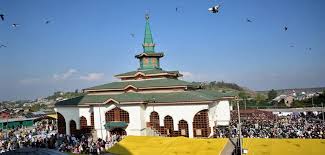
Religious sites are increasingly being discussed in a way that brings attention to their dual role as places of worship and keepers of cultural, ethical, and historical memories. Beyond their role as spaces for religious observance and spiritual contemplation, these sites embody communal identity, the preservation of historical narratives, and social cohesion, thereby positioning them at the intersection of religious conviction and social and cultural significance.The tension between doctrinal fidelity and broader cultural significance is particularly evident in regions characterized by contested boundaries, geopolitical volatility, and religious plurality. Furthermore, these places of worship function as emblems of local identity and shared memory, beyond their religious roles. Kashmir provides a valuable case study for examining this interplay, given the region’s political sensitivity, religious heterogeneity, and intricate socioeconomic dynamics.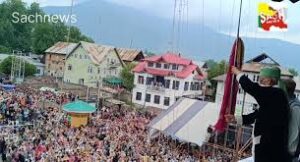 The Urs, an annual observance marking the passing of Sufi saints, serves as a prime illustration of how sacred traditions can simultaneously cultivate religious devotion and preserve a broader socio-cultural legacy. This celebration embodies the convergence of spiritual dedication, ethical tenets, historical awareness, communal solidarity, and cultural inheritance within this specific context. Urs, in its customary form, commemorates the death of a Sufi saint, observed not as a period of mourning but as a celebration of spiritual attainment, representing the saint’s union with the Divine. Within Kashmir, Urs surpasses doctrinal and theological boundaries, adopting a socio-cultural character that unites diverse communities—across religious, ethnic, and social divides—in collective acts of devotion, remembrance, and ethical conduct. This duality ritualized piety on one side, and the expression of cultural and social values on the other establishes Urs as a vital instrument for upholding pluralism, moral behavior, and communal stability.
The origin of Urs in Kashmir is fundamentally connected to the introduction and eventual entrenchment of Sufism in the region, a process that began in the fourteenth century. Pivotal figures, such as Mir Sayyid Ali Hamadani, played a crucial role in the propagation of Islamic spiritual and ethical tenets, thus emphasizing personal piety, virtuous conduct, and communal harmony. Concurrently, local spiritual leaders, such as Sheikh Noor-ud-din Noorani, Lal Ded, and Sultal ul Arefeen Sheikh Hamza Makdoomi, developed indigenous interpretations of mystical Islam, ultimately giving rise to a syncretic spiritual framework known as the Rishi tradition. The specific order combined Islamic Sufi philosophy with local ascetic and meditative practices, creating a unique social and religious structure often called Kashmiriyat. This structure was marked by its emphasis on tolerance, coexistence, ethical behavior, and spiritual reflection. Within this framework, Urs became a ritual, honoring the moral and spiritual contributions of saints while also promoting community unity and shared cultural values.
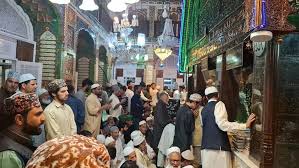
In Kashmir, Urs may be conceptualized as a form of social capital, wherein ritual gatherings cultivate dense networks of reciprocity, mutual support, and collective belonging. These commemorative practices not only sustain traditional modes of social interaction and community life, but also celebrate diversity within a shared monotheistic framework. Intellectual inquiry into Sufi traditions, especially as articulated by scholars like William Chittick, reveals the dynamic, culturally specific character of Urs. Chittick’s work highlights the significance of love, experiential understanding, and a profound awareness of the Divine within Sufi practice, portraying Sufism as a lived, transformative tradition rather than a strictly doctrinal one. His investigations elucidate how symbolic rituals—encompassing music, recitation, and spatial organization—facilitate spiritual understanding, thereby making abstract metaphysical ideas accessible to practitioners. In Kashmir, Urs acts as a prime example of this dynamic, translating esoteric teachings into locally relevant practices that resonate with various communities.
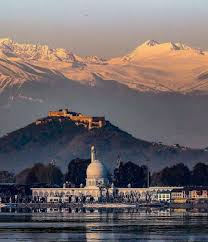
The Hazratbal Shrine, Charar-e-Sharif, Khanqah-e-Moula, and other sites associated with urs traditions are favored venues for spritual observances, owing to their deep religious, social, and cultural importance. These shrines become centers for prayer, the recitation of devotional poetry, musical performances, and acts of charity. Consequently, these events foster a multisensory ritual atmosphere, promoting both spiritual contemplation and communal harmony. The performative and symbolic aspects of Urs encompassing recitation, Sufi music, communal meals, and ritual actions serve to strengthen collective identity and promote the intergenerational transfer of cultural understanding.
A compelling instance of localized ritual adaptation is the torch-lighting ceremony observed at the Aishmuqam Shrine. Although orthodox Islamic doctrine prohibits fire-related rituals, Sufi traditions within Kashmir have, across history, exhibited a propensity for integrating and reinterpreting indigenous symbolic elements. The ascent of the hillside, accompanied by torches, visually and ritually connects with pre-Islamic practices of sacred illumination. This demonstrates how the Urs functions as a site of syncretism and cultural memory, thereby linking historical ritual forms to the spiritual frameworks of Islamic mysticism.
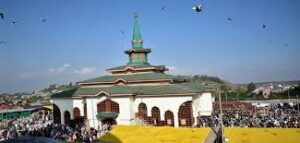 The Urs at the shrine of Sheikh Noor-ud-din Noorani in Charar-e-Sharif represents a key aspect of Rishi philosophy in Kashmir. The wide range of religious groups present at the event shows the saint’s inclusive nature. The Rishi tradition, which focuses on deep thought, emphasizes personal spiritual growth over rituals. This phenomenon can be seen in Sheikh Noor-ud-din Noorani’s saying, “Khoday chu andar manz, na zahir manz” (God is within, not in outward ceremonies). Similarly ,the Urs observances honoring other significant individuals, including Sheikh Hamza Makdoomi at Rainawari and Syed Alishah Balqi pakherpora, exemplify these principles of inclusivity and internal spirituality. This interconnected system of sacred locations, which fosters ethical, spiritual, and cultural bonds, guarantees this.
Integrating insights from Jewish philosophical thought offers a deeper understanding of the universal aspects of spiritual and cultural participation found within Kashmir’s Urs traditions. Philosophers like Moses Maimonides prioritized ethical behavior and inner spiritual growth over simple ritual adherence, a perspective that somehow is similar t the Rishi tradition in slight different ways yet carry same meaning. Maimonides’ Guide for the Perplexed underscores the importance of developing intellectual and moral virtues as the genuine means of achieving closeness to God, mirroring the Sufi emphasis on inward devotion. Likewise, Franz Rosenzweig’s reflections on the relational character of human existence highlight the inseparability of ethical living and spiritual meaning from communal involvement and the acknowledgment of the Other. This aligns with the pluralistic inclusivity of Urs, where diverse participants collaboratively engage in ethical and devotional practices, thereby fostering both spiritual understanding and social unity. The convergence of these philosophical viewpoints suggests that the ethical and contemplative principles central to Kashmiri Sufism are consistent with wider, cross-cultural traditions that emphasize internal spiritual cultivation, moral accountability, and communal solidarity.
Metaphysically, the Urs celebration embodies the Sufi concept of fana, representing the self’s annihilation within the Divine, and portraying the saint’s demise as a moment of ultimate spiritual fulfillment. Attendees participate in contemplation, recollection, and symbolic performance, thereby translating intricate theological concepts into culturally relevant expressions. Therefore, the Urs serves as a bridge, connecting religious beliefs with practical spiritual experiences, making spiritual teachings both understandable and personally significant.
The social aspect of Urs continues to be of paramount importance. Historically, Sufi shrines in Kashmir have acted as crucial points of contact, facilitating interactions that transcend religious and cultural divides. The participation of Hindus, Sikhs, and Muslims in Urs celebrations exemplifies a practical form of pluralism, wherein communal observance serves as a means of fostering mutual respect, ethical conduct, and a shared cultural identity. By foregrounding values of love, compassion, and humility, Urs provides a counterpoint to exclusivist interpretations of religion and sustains social harmony in a politically and culturally contested landscape.
The participation of women in Urs ceremonies highlights the inclusive and equal principles that these events represent. Through prayer, communal gatherings, and acts of devotion, women demonstrate how Sufi practices can navigate gender expectations while encouraging inclusive spiritual participation. These actions symbolize Urs as a social space that embraces diversity, individual agency, and communal unity.
Urs, in both economic and cultural dimensions, bolsters local economies and safeguards traditional artistic forms. The arrival of pilgrims provides financial support to local artisans, vendors, and service providers; concurrently, the rituals, musical performances, and upkeep of shrines facilitate the intergenerational transfer of cultural understanding. While contemporary digital technologies, such as live streaming and the online distribution of devotional materials, broaden the scope of Urs, they also prompt inquiries regarding the shift from communal, embodied practices to mediated experiences, thereby demonstrating the tradition’s capacity for adaptation and endurance.
The multifaceted identity of the Kashmiri Urs encompasses spiritual, ethical, social, and cultural dimensions. Functioning as a hub for religious observance and a custodian of cultural heritage, the Urs exemplifies the interplay between religious devotion and its broader societal ramifications. The inclusive, syncretic, and adaptive nature of these sites underscores their ability to cultivate pluralism, uphold ethical standards, and safeguard historical knowledge. These sites’ inclusive, syncretic, and adaptable characteristics further emphasize their potential to foster pluralism, uphold ethical principles, and preserve historical understanding. This underlines the relevance of ethical and contemplative dimensions, thereby illustrating how the introspective and socially conscious ethos of Kashmiri Sufism aligns with broader traditions of moral and spiritual contemplation. Within Kashmir’s intricate socio-political context, the persistence and strength of Urs demonstrate the lasting ability of spiritual and cultural traditions to transcend boundaries, cultivate moral and communal values, and sustain collective identity. In a global context dominated by the instrumentalization of religion for violence, Urs embodies an alternative ethos grounded in inclusivity, tolerance, and intercommunal harmony.
Reference:
Chittick, W. C. (1989). The Sufi Path of Knowledge: Ibn al-‘Arabi’s Metaphysics of Imagination. State University of New York Press.
Ernst, C. W. (1997). The Shambhala Guide to Sufism. Shambhala Publications.
Khan, M. I. (2002). Kashmir’s Transition to Islam: The Role of Muslim Rishis. Manohar Publishers.
Maimonides, M. (1963). The Guide for the Perplexed (S. Pines, Trans.). University of Chicago Press. (Original work published c. 1190)
Rai, M. R. (2004). Hindu Rulers, Muslim Subjects: Islam, Rights, and the History of Kashmir. Princeton University Press.
Ranjan, A. (2019). Sufism and syncretic culture in Kashmir: A study of the Rishi tradition. Journal of Islamic Studies, 30(2), 215–235.
Rosenzweig, F. (2005). The Star of Redemption (B. E. Galli, Trans.). University of Wisconsin Press. (Original work published 1921)
Schimmel, A. (1975). Mystical Dimensions of Islam. University of North Carolina
Digby, S. (2004). Sufi shrines and the socio-religious landscape of South Asia. In D.
Gilmartin & B. B. Lawrence (Eds.), Beyond
Turk and Hindu: Rethinking Religious Identities in Islamicate South Asia (pp. 123–145). University Press of Florida.
About the Author