Written by: Dr. Peerzada Muneer
Karbala and the Age of Noise
Muharram returns every year not merely as a season of grief, but as a mirror placed before the conscience of a community. Its centre is Karbala, where Imam Husayn ibn Ali, the grandson of the Prophet Muhammad, was martyred with a small group of family members and companions in 680 CE after refusing to submit to an unjust political order. (World History Encyclopedia) The tragedy is remembered especially on Ashura, the tenth of Muharram, and for many Muslims, particularly Shia Muslims, it has become a living language of mourning, resistance, sacrifice, loyalty, and moral courage. (Springer) But the real question is not whether we remember Karbala; the question is whether Karbala remembers itself through us.
We live in an age where truth has become fragile. A rumour travels faster than a prayer, outrage receives more attention than wisdom, and people often forward what they have not verified because it confirms what they already feel. UNESCO has warned that online disinformation and hate speech threaten informed debate, social cohesion, and public trust, especially in societies where social media platforms shape political and moral imagination. (UNESCO) Against this confusion, the Qur’anic instruction to verify news before harming others unknowingly becomes more than a private virtue; it becomes a public necessity. (Quran.com) Karbala teaches that false narratives are not harmless. The moral collapse of Kufa was not only that swords were raised against Husayn, but that fear, propaganda, silence, tribal loyalty, and worldly interest slowly defeated the inner court of conscience before the battle began.
The tragedy of Karbala is therefore not a closed historical wound. It is an ethical grammar for every age in which power demands obedience without justice, wealth buys silence, crowds replace conscience, and religion becomes decoration rather than transformation. The article in Message of Thaqalayn describes Ashura as a reflection of Qur’anic principles such as resisting oppression, rejecting humiliation, commanding right, forbidding wrong, and establishing justice. (messageofthaqalayn.com) These principles speak directly to our time. They ask whether we stand with the vulnerable when it costs us comfort, whether we question our own group when it behaves wrongly, whether we protect truth when lies are profitable, and whether we prefer the applause of the crowd to the loneliness of moral courage.
In a world of inequality, Muharram should also disturb the conscience of wealth. The World Inequality Report 2022 states that the bottom half of the world owns a very small share of global wealth, while the top segments hold a vastly disproportionate share. (World Inequality Report 2022) Karbala asks what kind of mourning is possible in a society where some people spend lavishly on symbolic displays while poor neighbours struggle for medicine, rent, food, education, or dignity. The tears of Muharram are not meant to soften only the eyes; they are meant to soften the grip of greed. If Imam Husayn stood against a system that treated power as inheritance and people as instruments, then his mourners cannot be indifferent to systems that treat workers as disposable, women as invisible, minorities as suspicious, migrants as burdens, and the poor as statistics.
Muharram also challenges modern consumerism. The market knows how to sell everything, including grief. It can turn devotion into fashion, majlis attendance into social display, and black clothing into seasonal competition. There is nothing inherently wrong with wearing black in mourning, and there is dignity in appearing respectfully in gatherings of remembrance. But when families begin to treat Muharram as an occasion for shopping, exchanging new black dresses with in-laws, comparing fabrics, repeating social rituals, and measuring respect through expense, the form begins to devour the spirit. The colour black then risks becoming less a sign of sorrow and more a uniform of habit. The tragedy is not that people wear new clothes; the tragedy is that the heart may remain old, proud, wasteful, and untouched.
Mourning as Public Responsibility
Public mourning has always had an important place in the remembrance of Karbala. Processions, elegies, gatherings, banners, and communal rituals can carry memory from private hearts into public space. Scholarship on Muharram processions notes that such public rituals can commemorate Karbala, transmit core values, and present Islam to wider society. (Springer) When done with dignity, discipline, and concern for others, a procession can become a moving classroom of sacrifice. It can remind a city that faith is not hidden in buildings alone, and that justice has a voice.
But public devotion becomes morally confused when it causes unnecessary hardship to the very public it claims to serve. Roads are not owned by any group, however sincere its devotion. They are a shared trust used by patients, workers, students, pedestrians, emergency vehicles, shopkeepers, daily wage earners, women, children, the elderly, and people of other faiths or no faith. The Prophet’s teaching that removing harm from the pathway is an act of charity gives road ethics a deeply religious meaning. (Sunnah) If removing a thorn from the road is charity, then placing avoidable obstacles on roads in the name of religion should make us pause.
This does not mean that processions must disappear, nor does it mean that communities should be ashamed of mourning publicly. It means that the mourners of Husayn must be the first to protect others from inconvenience, fear, noise, danger, and disorder. Where designated spaces exist, they should be used fully and respectfully. Where public routes are necessary, they should be planned with permissions, timings, traffic coordination, medical access, volunteer marshals, clean-up teams, and clear passage for ambulances and urgent movement. Leaders of anjuman, matami groups, imambargahs, mosques, trusts, and local committees should not wait for criticism from outside. They should establish internal discipline as an act of love for Imam Husayn.
Scholars and speakers have a special responsibility here. It is not enough to praise sacrifice from the pulpit while ignoring avoidable harm outside the gate. The pulpit of Muharram should teach that blocking a hospital road, leaving behind filth, forcing unwilling neighbours to endure excessive noise, or occupying public space beyond necessity is not azadari at its highest form. It is a failure to translate grief into adab. Real leadership is not measured by how large a procession becomes, but by how safely, humbly, cleanly, and responsibly it moves. A leader who reduces public hardship has served Karbala better than one who increases public spectacle.
The same applies to food and water distribution, one of the most beautiful features of Muharram and Arbaeen culture. To give water in the name of those who were denied water at Karbala carries immense emotional and moral power. Historical accounts describe how the Umayyad forces blocked Husayn’s access to the Euphrates before the battle, making thirst central to the memory of Karbala. (World History Encyclopedia) Therefore, sabeels, niyaz, langar, and service to wayfarers are not empty rituals. They are acts of resistance against cruelty, a way of saying that where Yazid denied water, the lovers of Husayn will offer it freely.
Yet even this noble act can lose its fragrance when it leaves behind piles of plastic cups, bottles, plates, wrappers, spoiled food, and blocked drains. A recent study on the 2023 Arbaeen pilgrimage in Karbala found substantial food and plastic waste, including thousands of tonnes of food and plastic residues generated during the event. (Sage Journals) The same study noted a moral tension identified by religious leaders, where observed excess in consumption contrasted with Islamic values of modesty and resource conservation. (Sage Journals) This should trouble every sincere mourner. How can the memory of thirsty children become the cause of polluted streets? How can food given in love be allowed to rot in heaps? How can water offered for thawab be served through plastic that remains as a burden on the earth?
The Qur’an commands people to eat and drink but not waste, because God does not love the wasteful. (Quran.com) This verse should be written not only on mosque walls, but on every sabeel table, every food stall, every volunteer badge, and every community planning document. Environmental responsibility is not a fashionable add-on to religion. It is part of amanah, the trust human beings carry before God. UNEP has warned that current patterns of plastic production and consumption threaten health and the environment, with plastic waste projected to rise sharply under business-as-usual scenarios. (UNEP – UN Environment Programme) UNEP has also emphasized that the problem is often the single-use nature of products, and that reusable systems are generally more sustainable than disposable ones. (UNEP – UN Environment Programme) If our majalis and processions continue to generate plastic without collection, segregation, recycling, or reduction, then we are allowing convenience to defeat conscience.
From Ritual to Renewal
The reform must begin from within. Mourners, committees, scholars, volunteers, and families should see responsibility not as criticism of azadari, but as its purification. To organize reusable cups, steel tumblers, water refill points, biodegradable options where reuse is impossible, separate bins, food portion control, leftover distribution systems, composting partnerships, and post-event clean-up teams is not a lesser form of mourning. It is mourning that has understood its Imam. UNEP has highlighted faith festivals as opportunities for sustainable practice, including reducing single-use plastics and integrating waste segregation into religious life. (UNEP – UN Environment Programme) A majlis that ends with a clean street may carry more spiritual truth than one that ends with emotional speeches and a trail of garbage.
Families too must ask what Muharram is doing to the home. If mothers and daughters are pressured into new clothes, if in-laws judge one another through exchanged garments, if children learn that Muharram means shopping before it means sacrifice, then the household has confused culture with remembrance. The black dress should be a sign of humility, not social competition. The money spent on unnecessary clothing could educate a child, pay a hospital bill, feed a family, support an orphan, repair a poor person’s home, or fund a clean water station with reusable systems. The question is not whether people may dress well; the question is whether grief has become another marketplace.
Leadership in Muharram must therefore be moral before it is managerial. The leader who invokes Husayn must be willing to correct his own followers. The scholar who recites the suffering of Zaynab must speak against disrespect, waste, arrogance, and public inconvenience. The organizer who serves niyaz must think of the sanitation worker who cleans after him. The volunteer who controls a procession must see the passer-by not as an interruption, but as an amanah. The family that attends majlis must ask whether it returns home more truthful, more generous, more disciplined, more environmentally conscious, and more courageous than before.
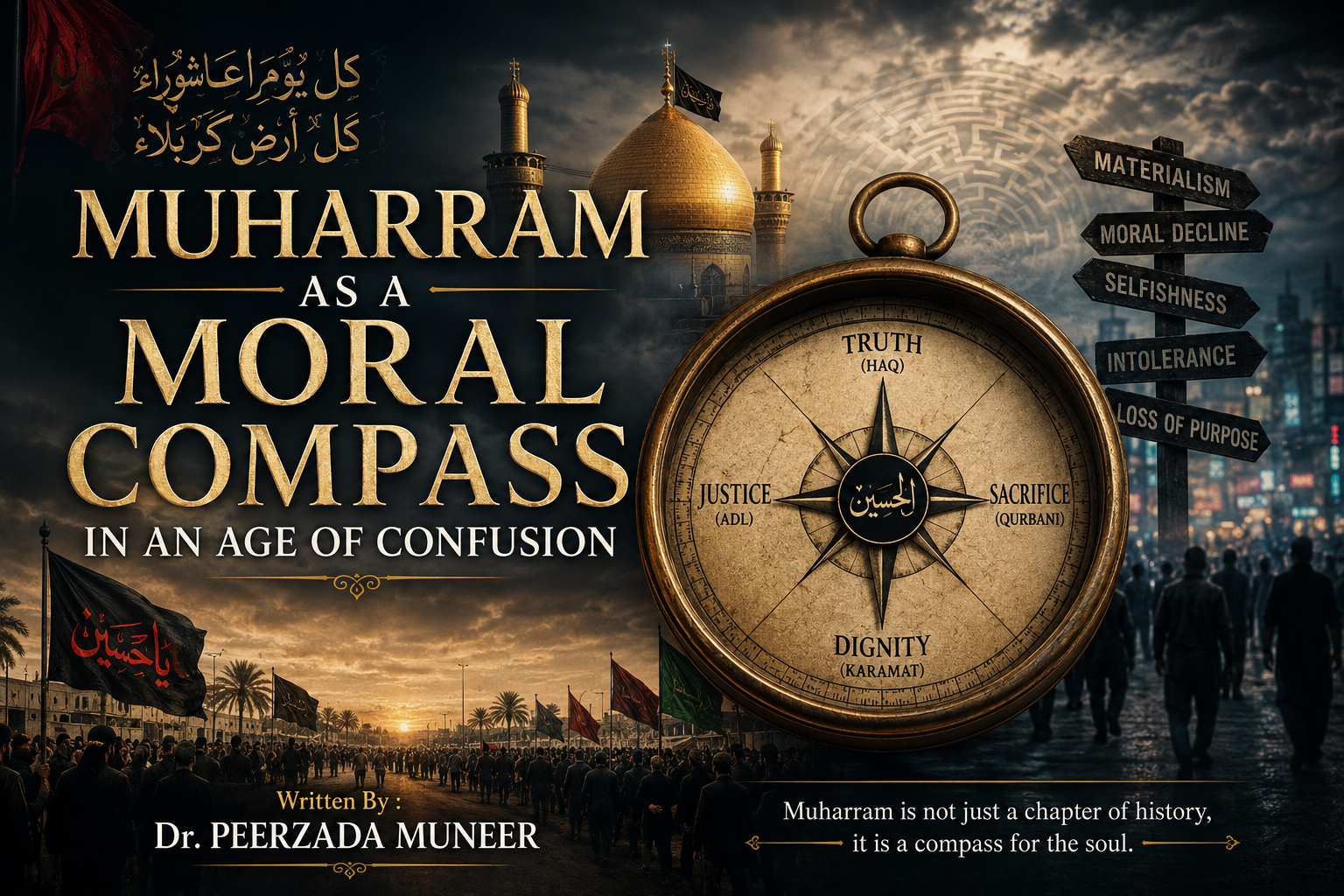
Muharram is not a museum of grief. It is a compass. In an age of misinformation, it points toward verification. In an age of consumerism, it points toward simplicity. In an age of inequality, it points toward justice. In an age of environmental crisis, it points toward restraint and stewardship. In an age of loud religion and weak ethics, it points toward the difficult unity of love and responsibility.
To mourn Imam Husayn is to refuse the Yazid within society, but also the Yazid within the self. It is to refuse the ego that says my ritual matters more than your suffering, my procession matters more than your road, my food stall matters more than public cleanliness, my social image matters more than sincerity, and my group matters more than truth. Karbala did not happen so that Muslims could repeat sorrow without reform. It happened so that every generation would ask, in its own crisis, where it stands when truth is thirsty, power is arrogant, the crowd is confused, and conscience is alone.
About the Author