Written by: Dr. Peerzada Muneer
Also called Lalleshwari, Lal Ded (c. 1320-1392 CE) was a mystical Kashmiri poet of the 14th century and saint who founded Kashmir’s awakening spiritually with her very avant-garde and philosophical poetry called the “Vakhs”. Not only are these metaphorical ‘mouthpieces’ for society, they also refer to the universal truth with verses transcending sectarianism. She is considered by both Hindus and Muslims.
Lal Ded is often seen as the mother of the Kashmari poems and the first to set the devotional expression of the Kashmir Shaivism, whose legacy inspires devotees and lovers of mystic literature worldwide.
Early Life
Around circa 1320 CE, Lal Ded was born in a Kashmiri Pandit Brahmin family in Pandrethan (near present-day Srinagar). Lalleshwari was possibly her given name, but she was fondly called Lal Ded, which meant Grandmother Lal.
She married at a young age into a very conservative environment, but her marriage was anything but happy. It is said that she suffered from mistreatment by her in-laws, who viewed her spiritual inclination to be rather misapprehended. Devoid of material life, Lal Ded moved out of her house in search of spiritual truth.
Spiritual Journey
She was a devotee of the Shaiva guru Siddha Shrikantha (Sed Boyu), by which she followed the way of Kashmir Shaivism, which emphasizes direct perception of one’s self and of the non-dual nature of the universe.
She gave up her worldly attachments, renounced religious rituals, and journeyed around naked or dressed in very little, always meditating, chanting, and reflecting in poetry.
Her spiritual path involved :
Kashmir Shaivism
Tantric mysticism
Bhakti/devotional spirit
Experiential wisdom beyond the scriptural dogma.
Poetry: The Vakhs Lal Ded’s sayings would be one’s Vakhs (meaning utterance which comes from the Sanskrit vāk, or “speech”). They are very short, powerful, and intensely spiritual verses composed in the vernacular Kashmari dialect so that they may be accessible to the common people.
Her poetry speaks of:
Realization of Self and Shiva
Critique of ritualism and caste
Praise of the inner devotion over outer form
Experiences of transcendence and union
A possible example of a Vakh (translated):
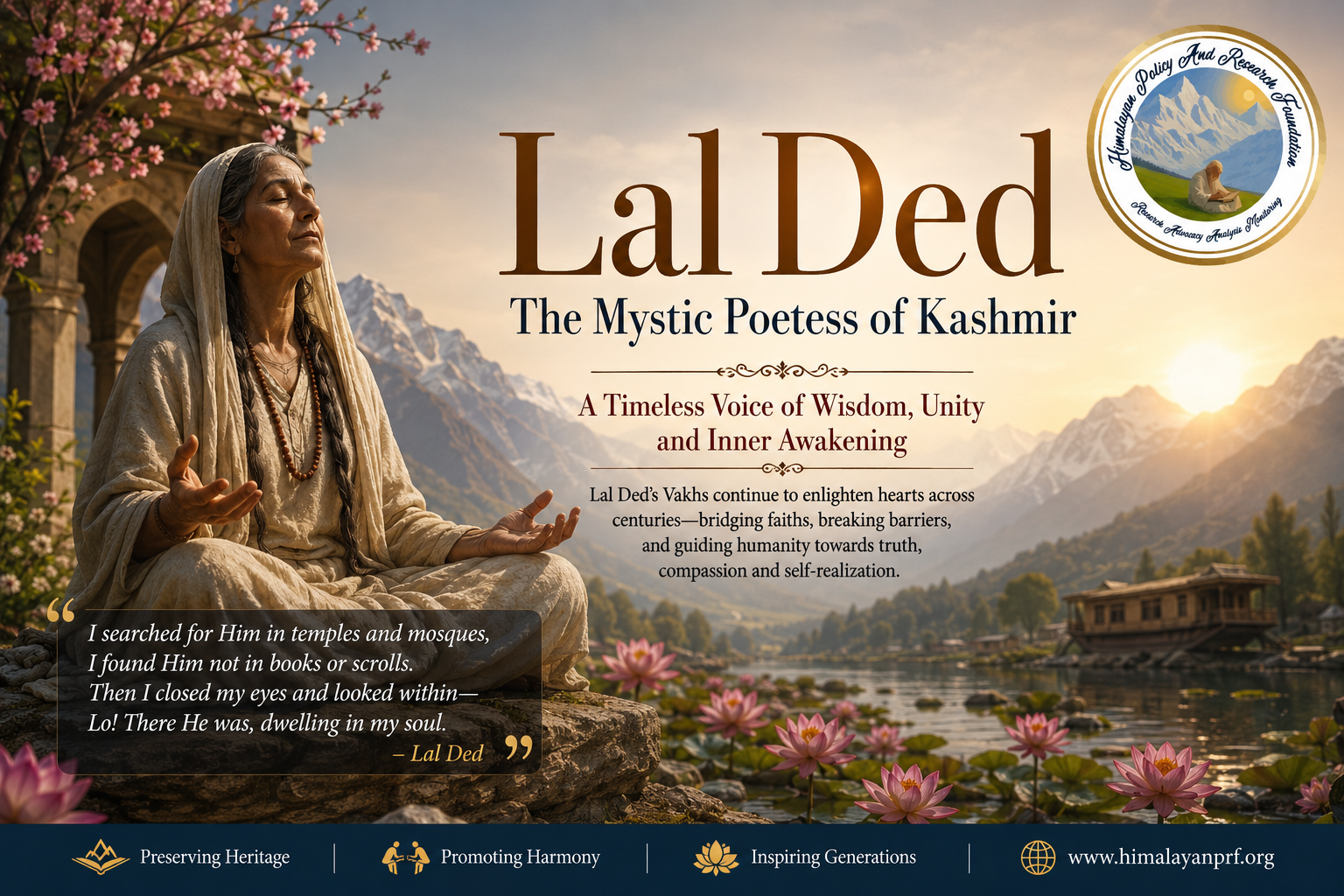
“I searched for Him in temples and mosques
I found Him not in books or scrolls
Then I closed my eyes and looked within-
Lo! There He was, dwelling in my soul.”
These Vakhs are among the oldest surviving records of Kashmari literature and are still widely quoted, sung, and meditated upon.
Faiths Bridged: Saint of All Kashmiris
One of the few figures who are considered as Christ figures by the Hindus as well as Muslims in Kashmir is Lal Ded.
Hindus see in her a Shaiva yogini with a Siddha in her and an embodiment of Shakti.
The Muslims regard her, especially among the Sufis, as a guide to the spiritual path and forerunner of Nund Rishi (Sheikh Noor-ud-Din Noorani, founder of the Rishi order in Kashmir).
In fact, it is said that even Nund Rishi was so moved by her teachings that he mentioned her in reverence.
What probably appeals to the Sufi spirit, as much as to the yogic one’s, in her works is the stress on inner realization, deep compassion, nonviolence, and devotion.
Legacy and Cultural Impact The impact of Lal Ded is tremendous:
Spiritual Mother of Kashmir: She is seen as the soul of Kashmir’s mystical tradition.
Lal Vakhs continue to be part of Kashmiri oral culture, sung in homes and spiritual gatherings.
Translation of her works into English and other languages has been done by Indian and Western scholars.
Feminist Icon: Viewed as the impressive image of female spiritual power, courage, and resistance in a patriarchal world.
Influence on:
Kashmir Shaivism
Rishi-Sufi tradition
Modern Kashmari poetic tradition
Interfaith understanding
Philosophical Essence
Lal Ded’s poetry bespeaks of the non-dualism (Advaita) of the self with the divine. She preaches that God is purely a non-foreign consciousness of the awakened within.
Empty rituals, caste hierarchies-she spoke against them, stating that love, simplicity, and the direct experience of the divine mattered the most.
Her approach: Experiential over textual Universal over sectarian Compassionate over judgmental
Modern Culture
Translations of her poetry have been done by scholars like Ranjit Hoskote, Jayalal Kaul, and G.M. Sofi.
On her life, many plays, poems, and books have been written.
She continues to stand as a significant cultural symbol of Kashmiriyat-the syncretic ethos of Kashmir.
Final Words
Lal Ded is not only a poet or saint but a living voice of Kashmir’s spiritual soul. With her fearless life, poetic genius, and boundless compassion, she broke all barriers of religion, caste, and gender and illuminated the path of self-realization.
In today’s world-troubled by division and identity politics-these Vakhs still whisper: “Don’t be trapped in names and forms, Let your heart be your shrine. Seek the Truth within- For that’s where Shiva and Allah truly reside.”
About the Author