www.himalayanprf.org
Written by: Sheeraz Zaman ( Socio Political Activist )
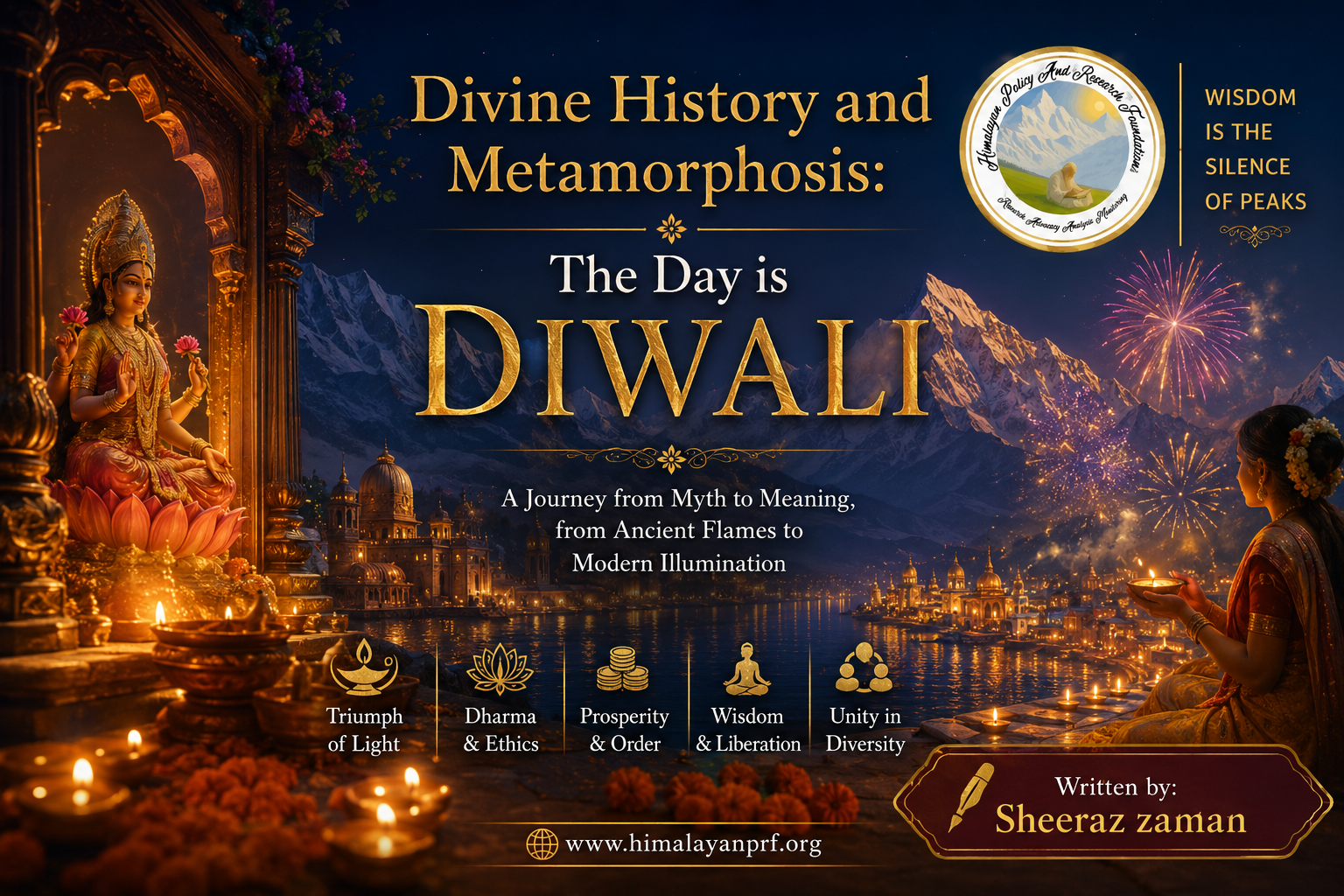
Few festivals in human civilization embody the convergence of myth, morality, and metaphysics as profoundly as Diwali. Across centuries and civilizations, the festival of lights has been celebrated not only as an occasion of joy and prosperity but as a symbolic re-enactment of the eternal struggle between darkness and illumination, ignorance and wisdom, despair and renewal. Its divine history and metamorphosis trace the journey of Indian civilization itself — from the Vedic fire altars to the electric luminescence of the modern age, from cosmic allegories to intimate household rituals.
Diwali is not merely a festival; it is a civilizational mirror reflecting how humanity evolves while holding onto its inner flame.
- The Divine Genesis: Myths that Illuminate the Eternal
Every civilization tells stories to make sense of its beginnings, and Diwali is a festival woven of such luminous tales — each version a different facet of the same jewel.
- The Return of Rama: Triumph of Dharma
In the northern heartlands of India, Diwali commemorates the homecoming of Lord Rama to Ayodhya after fourteen years of exile and his victory over the demon king Ravana. When Rama returned, the citizens lit rows of oil lamps — diyas — to illuminate his path. Symbolically, this was not just the return of a king; it was the re-entry of dharma into a world momentarily shadowed by adharma. The lamps were metaphors of conscience, affirming that even in the darkest times, the moral light endures.
Rama’s story also holds a profound psychological resonance. The human spirit, exiled in the forest of illusion, must battle its inner Ravana — the ego with ten heads of desire, pride, and greed — to return to its kingdom of peace. Thus, Diwali becomes an inner pilgrimage, a reminder that every human being must strive to restore the light within.
- 2. The Birth of Lakshmi: Prosperity and Cosmic Order
In another mythic strand, Diwali marks the appearance of Goddess Lakshmi from the cosmic ocean during the Samudra Manthan — the churning of the ocean of milk by gods and demons. From that churning arose the goddess of wealth, grace, and fertility, symbolizing the emergence of abundance through balance and effort. This narrative transcends religion; it is a cosmic principle. Prosperity is not a gift but a result of harmony — between opposites, between labor and patience, between the divine and the human.
That is why the festival’s rituals, particularly the Lakshmi Puja, are acts of purification. Homes are cleaned, debts settled, and hearts made transparent, as if preparing the world anew to welcome the goddess. Light, wealth, and cleanliness together form the triad of divine order.
3.3The Nirvana of Mahavira and the Enlightenment of the Soul
For Jains, Diwali holds a different yet equally profound meaning: it commemorates the nirvana of Lord Mahavira, the 24th Tirthankara, who attained ultimate liberation on this day in 527 BCE. When Mahavira’s soul dissolved into the infinite, the universe was said to have been illuminated with celestial brilliance. His followers lit lamps to symbolize the triumph of knowledge over ignorance — jnana deepa, the lamp of wisdom. Here, Diwali becomes a spiritual event: not a festival of external wealth but of inner freedom.
- The Coronation of Vikramaditya and the Sikh Legacy
In some traditions, Diwali also celebrates the coronation of the legendary king Vikramaditya, a symbol of just rule and cultural efflorescence. For Sikhs, the day marks the release of Guru Hargobind Ji from Mughal captivity — known as Bandi Chhor Divas — symbolizing liberation from tyranny. The Golden Temple, illuminated with lamps and fireworks, becomes an icon of faith’s resilience.
Thus, Diwali’s divine history is not singular; it is plural, inclusive, and evolving. It integrates diverse spiritual experiences into one cosmic narrative — the victory of light.
- The Civilizational Arc: From Fire to Illumination
- Vedic Fire and the Origins of Light-Worship
The earliest roots of Diwali can be traced to Vedic rituals of Agni worship. Fire, in the Vedas, was not merely a physical element but a messenger between gods and humans — the Agni devata who carried offerings to the divine realms. The lighting of lamps, then, was an act of communion — keeping the fire alive both in the hearth and in the heart.
In Rig Veda hymns, Agni is described as “the light of all lights,” the principle of cosmic order (ṛta). Diwali, in its embryonic form, continued this ancient tradition — a reaffirmation that life itself is an offering, a flame that must be tended with devotion and awareness.
- Mauryan and Gupta Eras: The Political Illumination
During the Mauryan and Gupta periods, Diwali evolved into a public celebration. Archaeological and literary sources suggest that even in Emperor Ashoka’s reign, the lighting of lamps marked civic joy and renewal. The Guptas, patrons of art and learning, transformed it into a cultural festival that symbolized intellectual illumination. It was during this time that Diwali began to acquire its artistic dimension — with poetry, music, and drama celebrating the harmony between divine and human creativity.
- The Bhakti and Sufi Age: Inner Illumination
The medieval era brought Diwali into the heart of the bhakti movement. Saints like Tulsidas, Surdas, and Mirabai reinterpreted the festival as an allegory for divine love. Lighting the lamp became a metaphor for awakening the soul to God’s presence.
“Dip jale hriday mein” — “Let the lamp burn in the heart” — became a recurring motif in devotional songs.
Interestingly, the Sufi mystics of medieval India also resonated with this symbolism. The lamp of ishq (divine love) and the annihilation of self in the flame of truth became shared imagery across Hindu and Islamic spiritual vocabularies. The chirag that burns in a Sufi shrine and the diya in a Hindu courtyard both signify the same longing for divine union. Thus, Diwali’s spirit crossed religious boundaries, embodying India’s composite ethos.
III. Metamorphosis of Meaning: The Modern Evolution of Diwali
- The Colonial Encounter and Cultural Assertion
During the colonial period, Diwali took on new meanings. For an India under foreign rule, it became a reaffirmation of indigenous identity — an assertion of continuity amidst disruption. Festivals like Diwali served as subtle resistance, keeping alive the symbols of sovereignty, morality, and self-reliance that political power sought to suppress.
Writers of the Indian Renaissance, such as Bankim Chandra Chattopadhyay and Swami Vivekananda, invoked the imagery of light as a metaphor for awakening national consciousness. The lamp, once merely a domestic ritual object, became a political symbol — of hope in times of darkness. The moral message of Diwali — that good ultimately triumphs — resonated with the freedom movement’s spiritual tone.
- The Post-Independence Transformation
After independence, Diwali metamorphosed into a national festival of unity. It transcended religious lines, becoming part of India’s cultural vocabulary. Streets glowed with electric lights; homes shimmered with modern diyas. The symbolism remained — but its canvas expanded.
Diwali now celebrated not just divine victories but human achievements: scientific progress, economic prosperity, and social togetherness.
Yet, with modernization came paradox. The festival’s meaning began to tilt towards material excess — consumerism, pollution, and noise sometimes overshadowed its spiritual core. The original fire of consciousness risked being replaced by the transient spark of spectacle. This metamorphosis poses the question: Can Diwali still serve as a moment of moral reflection in a world driven by consumption?
- The Philosophical Core: Light as Consciousness
Beyond myth and history lies the metaphysical essence of Diwali — jyoti, the light itself. In the Indian philosophical imagination, light is not merely physical but ontological. It is the essence of Brahman, the supreme reality that reveals and sustains all existence.
- The Upanishadic Lamp
- The Brihadaranyaka Upanishad speaks of the journey from darkness to light:
“Tamaso mā jyotir gamaya” — “Lead me from darkness to light.”
This is the spiritual foundation of Diwali. The lighting of lamps becomes a meditation on this journey — from ignorance (avidya) to knowledge (vidya), from ego to self-realization.
The lamp (deepa) is an archetype of consciousness. Its flame rises upward, symbolizing aspiration; its oil represents the fuel of discipline; its wick, the mind; and its light, the soul’s awareness. To light a lamp is to declare one’s readiness to know.
- The Psychological Illumination
Carl Jung, in his explorations of Eastern symbolism, noted that festivals like Diwali mirror the psyche’s archetypal processes — the reconciliation of shadow and self. The festival’s imagery of light piercing darkness mirrors the human journey toward individuation, where one must integrate the hidden and the holy within.
In this sense, Diwali is not an external ritual but an internal process of renewal. Each diya is a neuron of consciousness, each spark a moment of self-recognition. When millions of lamps burn together, they represent not just collective joy but the luminous potential of humanity itself
- The Social and Ecological Dimensions
- Light as Harmony
Traditional Diwali celebrations were deeply ecological. The use of earthen lamps (mitti ke diye), natural oils, and organic colors reflected a harmony between humans and nature. Villages glowed softly, not with electric glare but with the gentle warmth of clay and fire — a sustainable aesthetic that expressed gratitude to the earth.
However, industrial modernity has introduced dissonance — synthetic materials, chemical colors, and sound pollution. The challenge now is to rediscover Diwali’s ecological spirit: to return to simplicity without losing splendor. The true illumination must be clean — both morally and environmentally.
- Light in the Vale: Diwali among Kashmiri Pandits
In the valley of Kashmir, Diwali has long carried a distinct spiritual fragrance — serene, intimate, and deeply symbolic. For the Kashmiri Pandit community, the festival was less about grandeur and more about quiet inner light. As autumn descended upon the chinar-lined landscape, homes would be swept clean, courtyards plastered with fresh clay, and earthen lamps arranged along window ledges and temple walls, flickering against the chill October air.
The evening began with Lakshmi Puja, performed with a sacred sense of order and purity. The diya was placed upon a bronze plate beside rice grains, walnuts, and saffron — the symbols of fertility and fortune. In Srinagar and towns like Mattan, Rainawari, and Anantnag, the temples of Sharika Devi, Raghunath, and Ganpatyar would glow like constellations reflected in the Jhelum.
Children, wrapped in pherans, released small floating lamps into the river — the Jhelum Deepdan — believing that the flowing water carried their prayers to the divine. Sweets made of rice and dry fruits were shared among neighbors; in older times, even Muslim friends joined the lighting of lamps, a gesture of Kashmir’s syncretic soul.
Diwali in Kashmir, thus, was not merely a festival — it was an act of remembrance, a reaffirmation of light amid the encircling snows, a promise that no winter could extinguish the warmth of faith.
When exile came in the 1990s, and thousands of Kashmiri Pandit families were forced to leave their ancestral homes, Diwali acquired a new meaning — that of endurance and hope. In the refugee camps of Jammu, Udhampur, and Delhi, they continued to light their lamps, often using makeshift clay bowls or tin cups, turning their temporary shelters into sanctuaries of memory. The lamps burned for lost homes, silent temples, and friends left behind — but also for return, resilience, and rebirth.
Over time, these exiled Diwalis became rituals of remembrance — moments when light stood witness to survival. Even today, wherever the community has resettled, from Pune to Prague, the Kashmiri Pandit homes on Diwali evening still echo with the same invocation: “Asata niv divas, tula divas” — “Let this be not just a day of light, but of awakening.”
Their lamps, though far from the Jhelum, still seem to reflect upon its waters — carrying forward the unbroken flame of a civilization that refuses to be extinguished.
And perhaps, in this endurance lies the truest essence of Diwali — that light is not bound by geography or circumstance. It dwells wherever faith remembers, wherever memory kindles hope. For the Kashmiri Pandits, as for humanity itself, Diwali remains the soul’s homecoming — the moment when every exile ends, and the heart rediscovers its own radiant Ayodhya within.
- In recent decades, Diwali has become a global festival. From London’s Trafalgar Square to New York’s Times Square, from Dubai to Durban, millions celebrate it as a symbol of hope and harmony. It has transcended ethnicity to become a universal metaphor for human aspiration.
This global recognition reveals Diwali’s civilizational maturity. It shows how an ancient ritual can speak to modern sensibilities — the need for light amid uncertainty, for renewal amid chaos. As the world grapples with crises of meaning, Diwali’s imagery offers solace: that darkness is temporary, and light eternal.
VII. The Inner Festival: Metamorphosis of the Self
When all the lamps are lit and the night glows like a sea of stars, one realizes that Diwali’s true altar lies within. The festival’s divine history is a parable of personal metamorphosis — the transformation of the ordinary into the luminous.
To celebrate Diwali is to perform a sacred act of renewal:
To cleanse one’s mind as one cleans the home.
To settle emotional debts as one settles financial ones.
To ignite compassion as one lights lamps.
To silence inner noise as fireworks burst outside.
It is to understand that the light we seek in temples and skies already burns quietly within the human heart.
VIII. Conclusion: The Eternal Return of Light
Diwali, through its divine history and civilizational metamorphosis, tells a timeless truth — that the cosmos itself is a rhythmic alternation of light and darkness, and yet, light always returns. From Rama’s triumph in Ayodhya to Mahavira’s liberation, from the Vedic fire to modern electric brilliance, the essence remains: illumination as redemption.
The day is Diwali — but in truth, Diwali is not a day. It is a state of consciousness.
It is the realization that light is not something we kindle; it is what we are.
As long as a single lamp burns in the human soul — of faith, of truth, of love — the universe itself remains luminous.
So, when we light our diyas this year, let us remember: we are not dispelling outer darkness but awakening the inner dawn — the eternal Diwali within.
About the Author