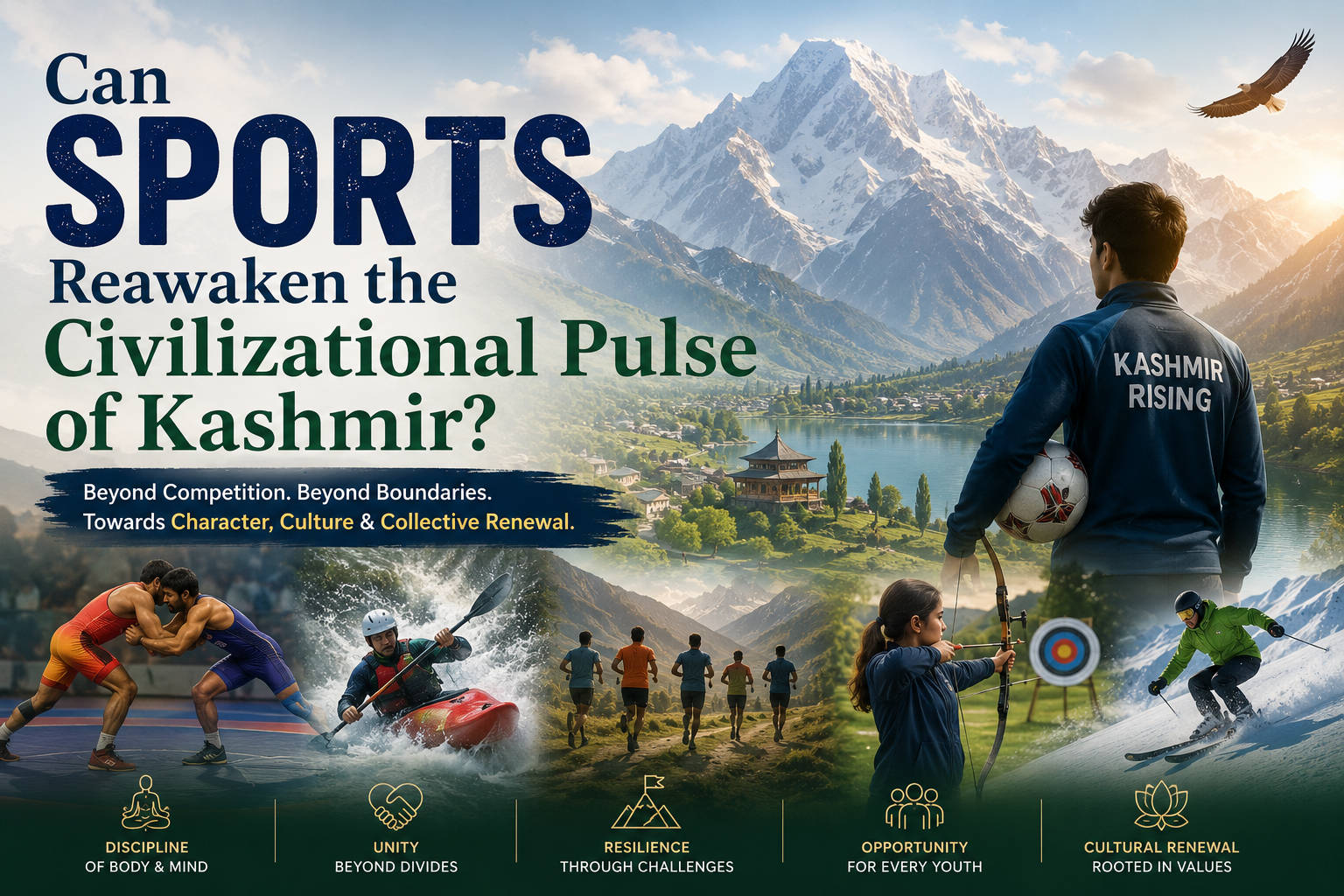
Can Sports Reawaken the Civilizational Pulse of Kashmir?
By: Fasil Ali ( Padma Shree Awardee, Sports Category, 2022)
In the tapestry of Indian civilization, the Himalayan region has always held a place of both mystique and meaning. The towering mountains, glacial rivers, and hidden valleys of Jammu and Kashmir are not merely geographical features; they form a civilisational backdrop of sacredness, endurance, and transcendence. In this context, sport emerges not as a mere recreational activity or a professional pursuit, but as a transformative force deeply aligned with the cultural, spiritual, and philosophical ethos of the region. Jammu and Kashmir, a land marked by its ethereal beauty and tumultuous history, stands today at a crossroad. Amid decades of social unrest and economic stagnation, it is sport—not politics or industry—that holds the potential to script a new narrative for its people, particularly its youth.
Sports have always been more than physical contests; they are ritualised expressions of discipline, sacrifice, and unity. The classical Indian notion of vyayam or physical exercise, as detailed in ancient texts like the Ayurveda and Hatha Yoga Pradipika, was not merely intended for bodily health but for cultivating an inner discipline that aligned the individual with the cosmos. Similarly, in the philosophical traditions of Kashmir—whether the rigorous metaphysics of Kashmiri Shaivism or the ascetic practices of Sufi mystics like Sheikh Noor-ud-din Noorani—there is an enduring emphasis on the body as a vessel for spiritual attainment. The Himalayan terrain, with its demanding altitudes and extremes of climate, necessitates a form of physical and mental conditioning that is akin to athletic training. The mountains do not yield easily; they must be ascended with discipline, perseverance, and humility. In this sense, to be fit in the Himalayas is to be attuned to the demands of nature, and to be worthy of the spiritual promise the mountains symbolise.
It is within this cultural and philosophical framework that one must understand the immense significance of promoting sports in Jammu and Kashmir. The region’s youth, having grown up in the shadow of conflict, often find themselves deprived of platforms that offer positive engagement, emotional expression, and collective identity. The consequences of this deprivation are visible in many forms—psychological trauma, substance abuse, alienation, and at times, misguided movements. However, sport offers a redemptive possibility. It channels raw energy into structured activity, transforming aggression into goal-setting, loneliness into teamwork, and frustration into resilience. More than just games, sports become a language of trust and a practice of peace.
The transformative potential of sports lies in their ability to instill values that are essential for both individual character and nation-building. Discipline, perseverance, leadership, cooperation, and ethical conduct—these are not just athletic values but civic virtues. When a young person trains in wrestling, runs a marathon, or practices martial arts, they are not merely honing their body; they are cultivating a way of being in the world that is structured, goal-oriented, and respectful of rules. This kind of moral pedagogy is invaluable in a society that seeks to rebuild its institutions, restore social cohesion, and project a vision of peace. In this respect, sports become an implicit curriculum in civic responsibility and cultural regeneration.
At a more pragmatic level, the role of sports in promoting public health cannot be overstated. Physical activity reduces the risk of chronic diseases, enhances mental health, and contributes to overall well-being. In a region like Jammu and Kashmir, where healthcare access is often uneven and where traditional community structures have been disrupted by conflict, sport offers a preventive and therapeutic framework for health. The act of running on a mountain trail, playing football on a village ground, or rowing on a glacial lake is not just exercise—it is a reclamation of space, of identity, and of hope.
The economic implications are equally significant. A thriving sports ecosystem has the potential to generate employment, attract investment, and stimulate local economies. Coaches, physiotherapists, equipment manufacturers, event organisers, and sports journalists form a network of economic opportunity that can uplift entire communities. Moreover, athletes who rise to national and international platforms become not only symbols of achievement but ambassadors of the region’s talent, culture, and resilience. They inspire pride, unite diverse communities, and offer a counter-narrative to the often one-dimensional portrayal of Jammu and Kashmir in media discourses.
In this regard, the natural endowments of the region offer immense potential. Jammu and Kashmir is uniquely positioned to become a global destination for adventure and alpine sports. The geographical diversity of the region is staggering: from Asia’s largest freshwater lake, Wular in Bandipora, to the crystalline expanse of Pangong Tso; from the dense pine forests of Patnitop to the rugged cliffs of Zanskar; from the serene meadows of Yusmarg to the snowy slopes of Gulmarg. These landscapes are not only ideal for sports like skiing, mountaineering, hiking, kayaking, and parasailing, but also offer unparalleled aesthetic experiences. The spiritual silence of the mountains, the musical flow of rivers like the Jhelum, Chenab, and Ravi, and the breathtaking grandeur of the Pir Panjal, Shivalik, and Zanskar ranges—all of this offers a backdrop that is both challenging and uplifting for athletes.
Adventure sports in particular can redefine the global perception of Jammu and Kashmir. Events that bring together international participants for mountaineering expeditions, river rafting challenges, or ski championships can do more than boost tourism. They can open up channels of cultural exchange, diplomacy, and mutual understanding. Sports tourism, unlike traditional tourism, is participatory and transformative. It invites people not only to observe the beauty of a place but to become physically and emotionally engaged with it. This fosters a form of diplomacy that is people-centric, grounded in mutual respect and shared experience.
In the broader national context, promoting sports in Jammu and Kashmir aligns with the vision of inclusive and holistic development. As India aspires to become a global power, its strength must emerge not only from its economic indicators or military capabilities, but from the health, unity, and dynamism of its people. Sports form an essential pillar of this vision. In fact, the National Sports Policy of India underscores the role of sports in nation-building, social integration, and international representation. Integrating Jammu and Kashmir into this national framework is not an act of charity but of justice—recognising the region’s unique contributions and its rightful place in the nation’s collective aspirations.
This integration must be strategic and sustained. It requires investment in infrastructure—stadiums, training centres, and playgrounds—in both urban and rural areas. It demands a robust policy for talent identification, scholarships, and coaching development. It calls for partnerships between government, civil society, educational institutions, and private stakeholders. Importantly, it also necessitates the de-stigmatisation of sports as a mere extracurricular activity. In the Himalayan context, sport is not peripheral—it is essential. It trains the body for endurance, the mind for clarity, and the soul for transcendence.
The resonance between sports and spirituality must not be underestimated. In both, there is a striving—toward excellence, toward harmony, and ultimately, toward self-realisation. The athlete, like the ascetic, submits to routine, faces pain, learns humility, and aspires toward a higher state of being. Whether climbing a peak or meditating in a cave, the goal is the same: to transcend limitations. The mountains of Jammu and Kashmir, with their rarefied air and unyielding slopes, demand this spirit. They do not merely invite us to conquer them, but to become worthy of their grace. In this sense, athletic training in the Himalayas is a form of spiritual preparation—an embodied prayer that blends motion with meaning.
To promote sports in Jammu and Kashmir, therefore, is to affirm everything that we as a society hold sacred: youth, health, discipline, unity, and purpose. It is to say that our young people are not problems to be solved, but potential to be nurtured. It is to acknowledge that peace is not merely the absence of violence but the presence of opportunity. It is to recognise that the body is not an obstacle to transcendence but a pathway to it.
Finally, the time has come to see sports not as an accessory to development, but as its very engine. In a region as symbolically and strategically important as Jammu and Kashmir, sport can be the bridge between conflict and cohesion, between marginalisation and empowerment. Let the rivers of Kashmir not only irrigate fields but race alongside rowers. Let the meadows not merely be admired but be the training grounds for runners and footballers. Let the peaks be not just gazed upon, but climbed with courage. Let sports, in all its expressions, become the hymn of a people rising again—not just in victory, but in dignity.
About the Author