By : Shakir Ahmad Mir ( Research Scholar)
Every civilisation is ultimately shaped by the geography it inhabits. Rivers create continuity, deserts cultivate endurance, and mountains teach restraint. Yet modern societies, intoxicated by technological confidence, increasingly imagine geography as something to be conquered rather than understood. Development, in our age, has become synonymous with speed, expansion, and visible infrastructure. The moral prestige of a society is measured by how rapidly it builds, how extensively it consumes, and how aggressively it transforms nature into utility. What once demanded humility is now approached with entitlement.
This developmental imagination becomes especially dangerous in mountains.
Mountains do not merely differ from plains in elevation; they differ in ecological temperament. They are living ecosystems organised around fragility, interdependence, and balance. Their stability rests on delicate rhythms- snowfall, water recharge, forests, seasonal adaptation, and ecological moderation. To impose upon mountains the same developmental logic designed for metropolitan centres is not progress; it is ecological misrecognition.
The tragedy of mountain regions across the world is not merely environmental degradation. It is an intellectual failure. We continue to ask mountains to perform functions for which they were never designed: absorb limitless tourism, sustain unregulated construction, accommodate unchecked extraction, and survive ecological neglect. We expect abundance while disregarding limits. Yet mountains possess one defining characteristic, they eventually resist excess. It is within this larger dilemma that Kashmir assumes extraordinary significance.
For generations, Kashmir has been admired for its beauty. It has occupied poetry, memory, photography, and national imagination as a site of aesthetic wonder. Yet beauty often conceals vulnerability. The landscapes that appear eternal are often the most fragile. Snow-fed ecosystems, wetlands, forests, springs, alpine meadows, and river systems function through a delicate ecological choreography. Disturb one rhythm, and consequences reverberate across the entire system.
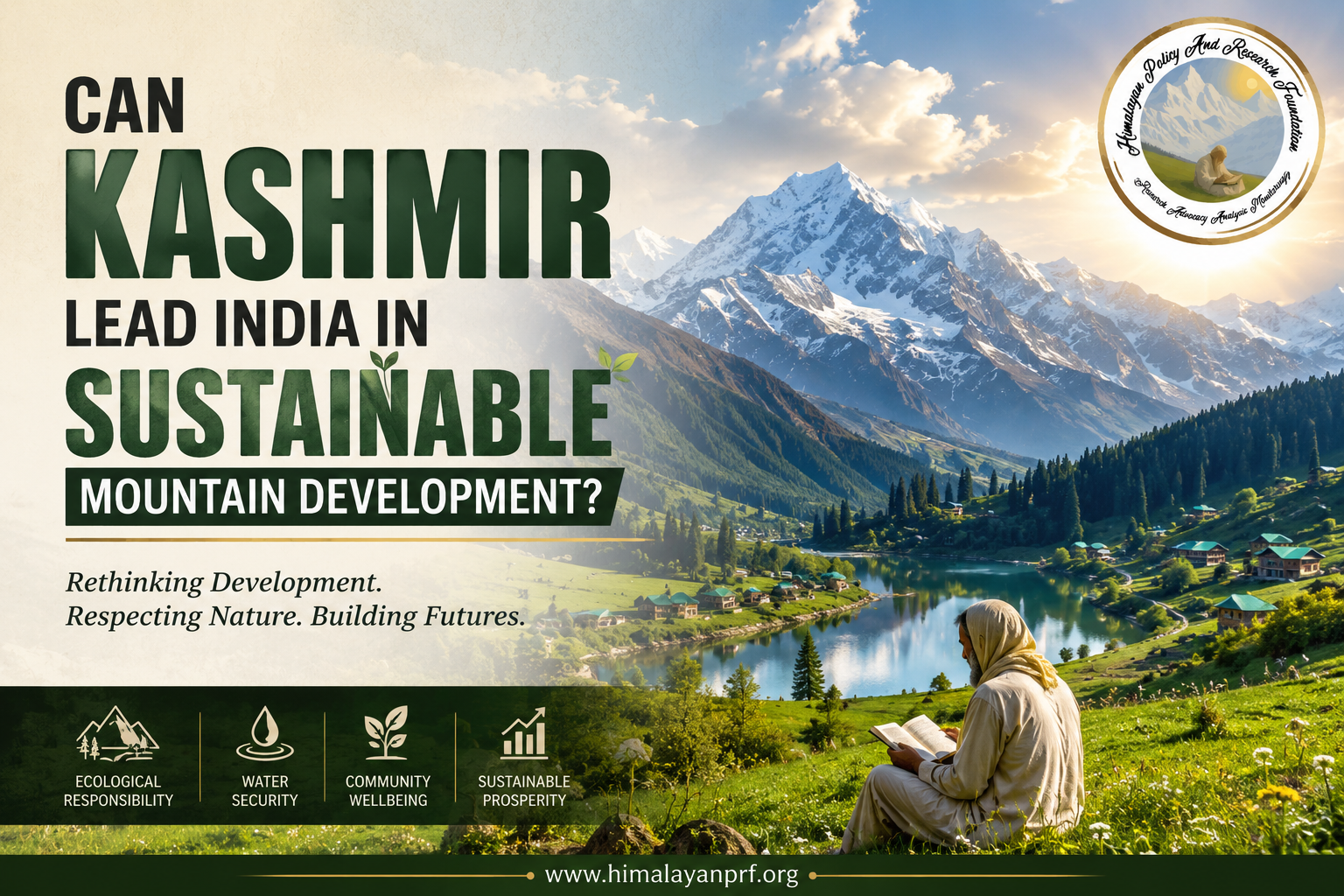
The question before Kashmir today is therefore not simply environmental; it is philosophical. Can Kashmir become more than a victim of ecological stress? Can it become a model for rethinking how mountain societies ought to develop? More importantly, can Kashmir teach India something that contemporary developmental discourse increasingly forgets, that sustainability is not the enemy of prosperity, but its precondition? The answer depends upon whether we are willing to rethink what development itself means.
Modern developmental thinking rests upon an unquestioned assumption: more is always better. More roads imply progress. More construction signals growth. More tourists indicate prosperity. More urban expansion reflects advancement. Quantitative expansion has become the language through which success is measured. Yet this obsession with scale often blinds societies to ecological consequence.
A mountain region cannot indefinitely survive a philosophy of excess. The challenge before Kashmir is therefore not whether it should develop. Such a question is intellectually unproductive. Economic opportunity, improved infrastructure, employment generation, and rising standards of living remain legitimate aspirations for any society. The more difficult and meaningful question is this: what kind of development can a fragile mountain ecosystem sustain without eroding the very ecological foundations upon which life depends?
This distinction matters because the greatest threat to sustainable mountain futures often emerges not from the absence of development, but from development without ecological intelligence. Take tourism, for instance. Tourism remains indispensable to Kashmir’s economy. It sustains livelihoods, generates employment, and supports local entrepreneurship. A prosperous tourism economy can deepen opportunity across communities. Yet tourism, if governed solely through the logic of expansion, risks undermining the very landscape upon which it depends.
The dominant imagination of tourism frequently operates through numerical triumphalism. More visitors are interpreted as automatic success. Infrastructure multiplies to accommodate demand. Roads widen. Hotels expand. Ecologically sensitive spaces increasingly transform into zones of commercial density. Yet one uncomfortable question often remains unasked: how much tourism can a mountain ecosystem meaningfully sustain? This is not an argument against tourism, but an argument against ecological impatience.
Mountains require a philosophy of carrying capacity. Sustainability demands restraint not as sacrifice, but as wisdom. A region such as Kashmir cannot afford to imagine tourism merely through quantity. The future lies in quality: ecologically responsible tourism, community-led hospitality, waste-conscious infrastructure, seasonal balance, and environmental accountability. The question cannot merely be how many people Kashmir attracts; it must also be whether Kashmir remains ecologically capable of sustaining itself.
There exists a deeper philosophical issue here. Modern societies increasingly interpret limits as obstacles. We imagine freedom as limitless expansion and prosperity as endless accumulation. Yet ecological systems teach the opposite lesson: limits are conditions of survival. Rivers survive because banks exist. Forests flourish because ecosystems regulate themselves. Mountains endure because excess remains constrained. In this sense, sustainability is not merely a technical policy concern; it is an ethical disposition. It asks societies to replace entitlement with responsibility. Kashmir possesses unique advantages in embracing such a philosophy.
Unlike heavily industrialised regions, Kashmir still retains ecological memory. Communities across mountain spaces have historically lived with an awareness of environmental rhythms. Agricultural practices, water use, seasonal adaptation, and pastoral movements often reflected ecological responsiveness rather than ecological domination. The experience of pastoral communities offers an especially important insight.
For centuries, seasonal mobility among mountain pastoral populations represented a remarkable ecological understanding of sustainability. Resource use was organised around movement, adaptation, and moderation rather than permanent extraction. Nature was not viewed as an endlessly exploitable resource, but as a partner demanding reciprocity. There is an important lesson embedded within such practices.
Contemporary development frequently mistakes permanence for success. More permanent structures, more fixed commercial spaces, and more intensive occupation are often interpreted as signs of advancement. Yet mountain ecologies often survive precisely through moderation and flexibility. Sustainable mountain development requires learning not only from technological innovation but also from accumulated ecological wisdom. At the same time, romantic nostalgia alone cannot guide policy.
Kashmir cannot afford either ecological denial or sentimentalism. Climate realities are changing. Snowfall patterns increasingly demonstrate irregularity. Water systems face pressure. Urban growth demands planning. Aspirations among younger generations require meaningful economic opportunities. Sustainability cannot mean stagnation. What Kashmir requires is not less development, but better development.
The vocabulary of development in India frequently remains trapped within binaries: either growth or conservation, economy or ecology, prosperity or sustainability. Such oppositions are intellectually inadequate. The challenge before Kashmir is not to choose between development and preservation; it is to integrate them. This requires institutional imagination.
Urban planning in Kashmir must begin recognising ecological fragility as a governing principle rather than an afterthought. Wetlands should no longer be treated as expendable land reserves awaiting commercial use. They are ecological infrastructures that regulate floods, sustain biodiversity, and support hydrological balance. Springs, rivers, and water systems require restoration not merely because they are environmentally valuable, but because they constitute the basis of long-term human survival.
Similarly, infrastructure development must increasingly adopt ecological sensitivity. Roads matter. Connectivity matters. Public services matter. But mountain infrastructure demands different principles than urban infrastructure. Environmental impact cannot remain secondary to immediate visibility. Perhaps nowhere is this more urgent than in the question of urban expansion.
The growth of mountain cities often unfolds through a dangerous assumption that ecological limits are infinitely negotiable. Yet mountain urbanism requires restraint. Density without
planning creates ecological stress. Waste accumulation intensifies environmental vulnerability. Construction detached from environmental realities risks transforming fragile geographies into zones of recurring instability. Kashmir possesses an opportunity to avoid mistakes already visible in many Himalayan regions. This opportunity becomes even more important because India increasingly confronts a mountain crisis.
Across Himalayan regions, questions of sustainability are becoming unavoidable. Glacial retreat, environmental degradation, water insecurity, ecological stress, and tourism-related pressures are reshaping mountain futures. Existing models of development increasingly reveal their limitations. India therefore requires not merely policy corrections, but conceptual alternatives. Kashmir can become one such alternative. Not because it is exceptional, but because necessity often produces wisdom. Ecological fragility can become a source of innovation if societies respond with seriousness. Kashmir’s universities, research institutions, environmental scholars, planners, and youth possess the intellectual capacity to imagine a different developmental future.
What if Kashmir became India’s foremost centre for mountain sustainability research? What if ecological planning, climate-sensitive tourism, mountain agriculture, water restoration, and environmentally conscious urbanism became the basis of a new developmental vision? What if prosperity itself were redefined through sustainability? Such possibilities are not utopian. They are increasingly necessary. The deeper challenge before Kashmir is ultimately moral.
Every society must answer a difficult question: what obligations does the present owe the future? Development pursued without ecological responsibility may generate immediate wealth, but it also transfers invisible burdens across generations. Environmental decline rarely announces itself dramatically at first. It emerges slowly in weakened rivers, declining biodiversity, shrinking wetlands, unstable weather patterns, and fragile livelihoods. By the time consequences become undeniable, reversal often becomes difficult. Kashmir therefore stands before a profound choice.
One path embraces familiar developmental impatience, the belief that prosperity requires continuous ecological compromise. The other path seeks balance: development disciplined by sustainability, growth tempered by ecological ethics, and prosperity rooted in long-term resilience. The second path is undeniably harder. It demands restraint in an age of acceleration. It requires patience in a culture of immediacy. It asks societies to think not merely about visible gains, but invisible consequences. Yet mountains reward patience. Perhaps this is the lesson Kashmir can offer India.
That development need not always be measured by concrete alone. That wisdom sometimes lies in recognising limits. That ecological care is not romantic idealism but practical necessity. And that mountains, if listened to carefully, remind us of a truth modern societies increasingly struggle to hear: the future belongs not to those who conquer nature most aggressively, but to those who learn how to live with it most intelligently.
The real question before Kashmir, therefore, is not whether it can develop. It is whether it can develop wisely enough to become a model for others. If it succeeds, Kashmir may become something more enduring than a beautiful landscape. It may become India’s most compelling argument that sustainable development is not merely possible, it is indispensable.
About the Author