Author: Peerzada Muneer
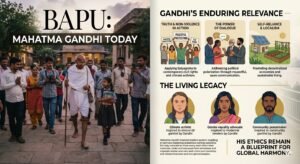
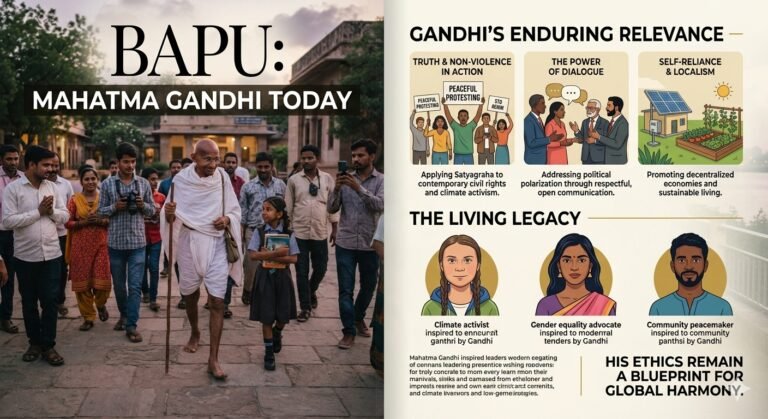
There are moments in the life of a civilisation when it becomes necessary to return to those voices that once asked not merely what a society wished to achieve, but what kind of human being it wished to become. Mahatma Gandhi belongs to that rare category of thinkers. More than seven decades after his assassination, Gandhi remains present in the Indian imagination, in public institutions, in political vocabulary, in schoolbooks, in statues and photographs, and most visibly in the familiar invocation of him as Bapu. Yet there is an irony in this continued remembrance. Gandhi is everywhere as an image and increasingly absent as a discipline of life. His spectacles remain a national symbol, but the vision through which he looked at society is progressively fading. His spinning wheel remains recognisable, but the ethic of self-restraint, dignity of labour and economic responsibility that it represented is much less visible. His name is invoked in political discourse, but the moral relationship between means and ends that lay at the heart of his politics is often forgotten.
This is precisely why Gandhi needs to be revisited today.
To revisit Gandhi is not to turn backwards. Nor is it to accept every aspect of his thought as beyond criticism. Gandhi himself resisted such treatment. His life was consciously presented as a series of experiments with truth, rather than as a finished system of doctrines. His autobiography was tellingly called The Story of My Experiments with Truth. The Gandhi Heritage Portal identifies his major writings, including Hind Swaraj and The Story of My Experiments with Truth, as key texts through which his intellectual and ethical development can be studied. To read Gandhi seriously, therefore, is to enter into an unfinished conversation about truth, violence, freedom, human dignity, religion, economics, politics and civilisation.
The urgency of that conversation has only increased.
Gandhi’s India was confronted by colonial domination, economic exploitation, racial discrimination, communal tensions and social hierarchy. Contemporary India faces a different historical configuration, but many of the underlying human problems remain. Material abundance exists alongside deprivation. Technological advancement coexists with loneliness and social alienation. Political participation is extensive, yet public discourse can become increasingly antagonistic. Religious identity, caste, region, language and other forms of social belonging can become boundaries rather than bridges. Consumption has become a measure of aspiration, while restraint is frequently interpreted as deprivation. Anger travels faster than reflection, and the ability to disagree without hatred is becoming an increasingly important democratic virtue.
Gandhi’s central question therefore returns with renewed force: how can human beings pursue legitimate aspirations without allowing desire, fear, hatred and power to destroy the social bonds that make collective life possible?
The erosion of an ethical civilisation
Indian philosophical traditions have long recognised that the greatest conflicts are not always external. They begin within the human personality. Kama, krodha, lobha, moha, mada and matsarya, the familiar catalogue of destructive passions, describe different forms of attachment, anger, greed, delusion, pride and envy. Gandhi’s vocabulary was different in emphasis but deeply concerned with the same moral problem. His project sought to transform the individual before attempting to transform society.
This is one reason his eleven vows remain remarkably suggestive for contemporary life. They included satya (truth), ahimsa (non-violence), brahmacharya, non-stealing, non-possession, bread-labour, control of the palate, fearlessness, equal respect for religions, swadeshi and the removal of untouchability. These were not merely religious observances for an ashram community. Gandhi regarded disciplined habits as the foundation of character and character as the foundation of public action.
Seen in this light, the contemporary crisis is not simply political or economic. It is also ethical.
Gandhi’s famous formulation of the “seven social sins” remains remarkably provocative: politics without principle, wealth without work, pleasure without conscience, knowledge without character, commerce without morality, science without humanity, and worship without sacrifice. These were not predictions about a particular political party or economic system. They were warnings about what happens when institutions become separated from moral purpose.
The relevance is difficult to miss. Wealth without responsibility produces inequality without social obligation. Knowledge without character can produce highly educated forms of manipulation. Commerce without morality can reduce human beings to consumers. Science without humanity can transform technological power into instruments of destruction or ecological degradation. Worship without sacrifice can reduce religion to identity and display. Politics without principle can turn public service into an exercise in power.
Gandhi’s challenge was therefore deeper than asking whether India was becoming richer, stronger or more technologically advanced. His question was whether progress was making Indians more humane.
Ahimsa: much more than the absence of violence
Perhaps no word is more closely associated with Gandhi than ahimsa. Yet translating ahimsa simply as “non-violence” can obscure the breadth of Gandhi’s meaning. For him, ahimsa was not weakness, passivity or the refusal to resist injustice. It was a disciplined refusal to allow hatred and violence to become the governing principles of resistance.
Gandhi linked ahimsa intimately with truth. In his writings, he repeatedly described truth as the end and non-violence as the means through which truth must be pursued. He insisted that the search for truth required humility because no finite human being possesses absolute truth. This idea carries enormous significance in an age of ideological certainty.
If no human being possesses the whole truth, then disagreement becomes possible without dehumanisation. The opponent is not necessarily an enemy; he or she may possess a fragment of the truth that one does not yet see. This is one of the most profound democratic implications of Gandhian thought.
Modern scholarship has also emphasised that Gandhi transformed the inherited ethical principle of ahimsa into a political method. David Hardiman notes that Gandhi gave non-violence a new political content and demonstrated that it could be practised by people of different religions rather than functioning merely as a sectarian or religious doctrine. Eijiro Hazama’s research further examines how Gandhi developed the relationship between ahimsa and satyagraha rather than simply inheriting an already complete doctrine of non-violence.
This distinction matters today. Ahimsa cannot mean silence before injustice. Gandhi’s non-violence was active. It required courage, discipline and willingness to suffer rather than inflict suffering.
That is the essence of satyagraha.
Satyagraha and the recovery of moral courage
Satyagraha, literally associated with holding firmly to truth, represented one of Gandhi’s most original contributions to political thought. It rejected the assumption that political struggle necessarily requires the destruction of one’s opponent. The Satyagrahi resisted injustice while attempting simultaneously to resist hatred.
This is fundamentally different from passive submission.
Civil disobedience, non-cooperation and boycott became powerful precisely because they converted ordinary people from subjects of power into agents of conscience. Gandhi understood that political authority depends, at least in part, upon cooperation. When citizens collectively withdraw cooperation from injustice without reproducing the violence they oppose, they create a different kind of political power.
Ramachandra Guha has emphasised this dimension of Gandhi’s continuing relevance, particularly his creation of a method through which unjust authority could be resisted without reproducing violence. Contemporary scholarship likewise continues to examine Satyagraha as a distinctive theory of political action rather than merely as a historical technique of the freedom struggle.
The lesson for today is not that every contemporary dispute can be solved through a literal repetition of the Salt March or a colonial-era boycott. The lesson is methodological: resistance need not become hatred; dissent need not become dehumanisation; political disagreement need not become social warfare.
This principle is particularly important in an age of digital communication, where outrage can be manufactured and amplified within seconds. Gandhi’s insistence on discipline before action offers an almost radical alternative: pause, examine one’s own motives, distinguish truth from assumption, refuse hatred and then act with courage.
Equality and the unfinished work of social fraternity
Gandhi’s understanding of equality was inseparable from his belief in human dignity. His campaign against untouchability, his insistence upon communal unity and his effort to bring marginalised communities into the centre of national life were integral to his constructive programme.
His Constructive Programme placed communal unity, removal of untouchability, khadi, village industries, sanitation, education, women’s welfare, economic equality, labour, farmers and Adivasis within one broad conception of national reconstruction. For Gandhi, freedom could not mean merely the departure of the British. Swaraj had to become a transformation in the everyday relations between human beings.
He explicitly described communal unity as something deeper than an administrative or political arrangement. It had to become “heart unity”, requiring friendship and respect across religious boundaries. His conception included Hindus, Muslims, Sikhs, Christians, Parsis and Jews as constituents of India.
This pluralism was not incidental to Gandhi’s nationalism. It was central to it.
Gandhi’s conception of India was civilisational rather than merely territorial. India was not to be reduced to one religion, one caste, one language, one region or one cultural expression. Its unity derived precisely from the capacity of diverse communities to inhabit a common moral and political space.
This is also where Gandhi can speak meaningfully to the Himalayan ethos.
The Himalayan civilisational imagination, particularly in the broader cultural worlds of Jammu and Kashmir and the wider Himalayan region, has historically contained multiple streams of spiritual and cultural experience. Rishi traditions, Sufi traditions, Buddhist traditions, Shaiva traditions and other local expressions have often produced forms of spirituality in which the sacred is encountered through coexistence, restraint, service and the recognition of the dignity of the other. Gandhi did not belong to the Himalayas geographically, yet the ethical vocabulary of restraint, simplicity, service, reverence for life and coexistence resonates strongly with this broader Indian civilisational inheritance.
To connect Gandhi with Himalayan wisdom is therefore not to claim that Gandhi was a product of Himalayan thought. It is to recognise an ethical affinity: the conviction that civilisation is measured not by the accumulation of power but by the quality of relationships between human beings and between humanity and nature.
Tyaga in an age of accumulation
Perhaps the most difficult Gandhian principle for the contemporary world is tyaga, or renunciation.
Modern economies are structured around aspiration, consumption and accumulation. Gandhi did not simply condemn material possessions. His more radical question was: how much do we actually need?
His doctrine of non-possession (aparigraha) challenged the assumption that happiness increases indefinitely with accumulation. Gandhi argued that civilisation should not be understood as the multiplication of wants but as their voluntary limitation. He connected excessive possession with social inequality, arguing that resources held beyond genuine need have moral consequences for those deprived of necessities.
This does not require modern India to abandon technology, industry or economic development. Rather, it asks what development is for.
Can development coexist with dignity? Can economic growth coexist with ecological responsibility? Can prosperity be measured alongside the well-being of the poorest? Can consumption be separated from status? Can technological progress be guided by human purpose?
Gandhi’s answer would begin with restraint.
His idea of trusteeship similarly attempted to transform the relationship between wealth and social responsibility. Wealth, in his moral economy, carried obligations. The wealthy were not merely owners but trustees whose prosperity had to be reconciled with the welfare of society.
This idea remains relevant to debates on inequality, corporate responsibility, philanthropy, environmental sustainability and ethical economics.
Swaraj begins with the self
One of Gandhi’s most misunderstood concepts is Swaraj. It is commonly translated as self-rule, but for Gandhi it meant more than political independence. A nation could become politically independent and remain internally unfree if its citizens were governed by greed, fear, hatred, addiction and unrestrained desire.
True Swaraj therefore begins with the individual.
This is why Gandhi’s personal practices mattered so much to his political philosophy. Food, clothing, labour, sexuality, possessions, prayer, sanitation, education and daily routine were not separate from politics. They were politics in their most fundamental form.
Anthony Parel’s scholarship similarly stresses that Gandhi’s political philosophy connected politics and economics with ethics and spiritual purpose. In this interpretation, political freedom could not be isolated from self-rule, duties, non-violence and constructive social activity.
Gandhi’s politics therefore asks an uncomfortable question of contemporary citizens: what happens when we demand freedom from others but refuse discipline upon ourselves?
A society cannot become peaceful merely by legislating peace. It must cultivate people capable of living peacefully.
Gandhi and the question of modernity
Gandhi should nevertheless not be converted into a saint beyond criticism. His views on caste, gender, industrialisation, modern medicine, technology and other questions have been contested, revised and criticised by scholars and political thinkers. Bhikhu Parekh’s Gandhi’s Political Philosophy: A Critical Examination explicitly examines both the intellectual foundations and limitations of Gandhi’s thought. His Gandhi: A Very Short Introduction similarly treats Gandhi as a thinker whose insights must be studied together with the limitations of his positions.
This critical engagement does not diminish Gandhi. It makes the engagement with him more Gandhian.
Gandhi did not ask his followers to surrender their conscience to his authority. His entire intellectual life was based on experiment, questioning and revision. The appropriate response to Gandhi today is therefore neither blind worship nor casual dismissal. It is serious engagement.
We should ask what survives his historical context.
Ahimsa survives because violence continues to destroy social trust.
Satyagraha survives because injustice continues to require resistance.
Swaraj survives because political freedom without self-mastery remains incomplete.
Sarvodaya survives because a society cannot call itself prosperous while large sections remain excluded.
Swadeshi survives as a question about local resilience, responsible consumption and economic self-reliance.
Trusteeship survives as a moral question concerning wealth and social responsibility.
Bread-labour survives as a reminder that dignity should not be separated from productive work.
Religious equality survives as a condition for a plural civilisation.
Tyaga survives as an antidote to the endless expansion of desire.
And truth survives as the indispensable foundation of public life.

Bapu today
The most important thing about Gandhi today may therefore be neither his political success nor his historical status. It may be his insistence that the quality of a civilisation depends upon the quality of its human beings.
India does not need Gandhi merely on postage stamps, government campaigns or commemorative speeches. It needs the ethical questions he posed.
What is the value of political power without principle?
What is the meaning of wealth without social responsibility?
What is the value of education without character?
What is the purpose of science without humanity?
What is the meaning of religion without sacrifice and compassion?
What becomes of freedom when citizens lose the ability to disagree without hatred?
And what becomes of India if its extraordinary plurality is converted from a source of civilisational richness into a source of permanent antagonism?
These questions make Gandhi contemporary.
The India Gandhi imagined was not an India without difference. It was an India capable of living with difference. He sought unity without uniformity, freedom without hatred, resistance without revenge, religion without exclusion, wealth without exploitation and politics without the abandonment of morality.
That is why revisiting Gandhi today is not an exercise in nostalgia. It is an exercise in civilisational self-examination.
India’s freedom was won through a remarkable mobilisation of people who differed by religion, caste, region, language, class and social background. Gandhi’s contribution was to help convert those differences into a wider moral and political fellowship. His methods were imperfect, his positions sometimes contradictory, and his legacy remains contested in important respects. Yet the central proposition remains extraordinarily powerful: the means by which a society pursues freedom shape the kind of society that freedom ultimately produces.
Perhaps that is the Gandhi India most needs to rediscover.
Not the Gandhi of statues, but the Gandhi of self-discipline.
Not the Gandhi of slogans, but the Gandhi of experiment.
Not the Gandhi of political appropriation, but the Gandhi who stood against the reduction of India to a single identity.
Not the Gandhi who is safely placed in the past, but the Gandhi who asks uncomfortable questions of the present.
In an age increasingly dominated by krodha, kama, lobha, moha and the relentless multiplication of wants, Gandhi’s vocabulary of satya, ahimsa, tyaga, seva, samabhava, swaraj and sarvodaya offers not an escape from modern India but a moral grammar with which modern India can examine itself.
The real tribute to Bapu, therefore, cannot be merely to remember the man who helped India become free.
It is to ask whether we are still capable of becoming free in the deeper sense he envisioned: free from hatred, free from fear, free from greed, free from prejudice, free from the compulsion to dominate the other, and ultimately free enough to recognise the humanity of those with whom we disagree.
Gandhi once made politics an arena of ethical experiment. The challenge before India today is to recover that experiment in its own contemporary language.
The question is not whether India can bring Gandhi back.
The question is whether India can bring back the values that made Gandhi matter.
Selected references and sources
- Gandhi Heritage Portal, Key Texts of Mahatma Gandhi, including Hind Swaraj and The Story of My Experiments with Truth. (Gandhi Heritage Portal)
- M. K. Gandhi, Constructive Programme: Its Meaning and Place, Navajivan Publishing House, 1941. (Mahatma Gandhi Website)
- M. K. Gandhi, From Yeravada Mandir / The Eleven Vows, especially the discussions of truth, ahimsa, non-possession, bread-labour, religious equality and swadeshi. (Mahatma Gandhi Website)
- M. K. Gandhi, The Gospel of Non-violence, selections on the relationship between Truth and Ahimsa. (Mahatma Gandhi Website)
- M. K. Gandhi, The Seven Social Sins, Young India, 22 October 1925. (Mahatma Gandhi Website)
- Bhikhu Parekh, Gandhi’s Political Philosophy: A Critical Examination, Palgrave/Springer. (Springer)
- Bhikhu Parekh, Gandhi: A Very Short Introduction, Oxford University Press, 2001. (OUP Academic)
- Anthony J. Parel, Pax Gandhiana: The Political Philosophy of Mahatma Gandhi, Oxford University Press, 2016. (OUP Academic)
- K. R. Rao, Gandhi’s Dharma, Oxford University Press, 2017, especially discussions of Swaraj, Swadeshi, social discrimination and communal harmony. (OUP Academic)
- David Hardiman, The Nonviolent Struggle for Indian Freedom, 1905–19, Oxford University Press, 2018. (OUP Academic)
- Eijiro Hazama, “Unravelling the Myth of Gandhian Non-violence”, Modern Intellectual History, Cambridge University Press. (Cambridge University Press)
- Bindu Puri, “The Rights of Man: A Gandhian Intervention”, Oxford University Press, 2015. (OUP Academic)
- Judith Brown, “Gandhi: A Man for our Times?”, Journal for the Study of Religion, discussing Gandhi’s responses to religious violence, inequality and the nature of religion. (UJ Press)
- Ramachandra Guha, “An Abiding Need: Why Gandhi Still Matters”, on Gandhi’s continuing relevance in the twenty-first century. (Mahatma Gandhi Website)
- UNESCO Courier, “Gandhi: The Heritage of Non-Violence”, on the international legacy of Gandhian non-violence. (UNESCO Courier)
About the Author