Author: Zahid Sultan (Independent Researcher Based in Srinagar, India)
Modern developmental thought rests upon an enduring contradiction: the conviction that nature must be made increasingly accessible, productive and amenable to human intervention, even as the ecological conditions sustaining human existence become progressively more precarious. This contradiction is particularly consequential in mountainous regions, where the material conditions of geography impose limits that technological capacity and administrative ambition cannot simply dissolve. The contemporary imagination of development, often articulated through the vocabulary of connectivity, infrastructure and economic efficiency, has a tendency to interpret geographical difficulty as an impediment awaiting engineering resolution. Yet the natural world is not an inert substrate upon which developmental projects can be indefinitely superimposed. It constitutes a complex arrangement of interdependent ecological processes whose stability is indispensable to human welfare. The controversy surrounding the recent infrastructural activity near Sheshnag Lake in Kashmir must be situated within this larger intellectual and political problem. It is not simply a dispute over excavation or the widening of a pilgrimage track; it concerns the conditions under which development acquires legitimacy, the limits of
administrative intervention and the obligations of public authority towards ecologically vulnerable territories.
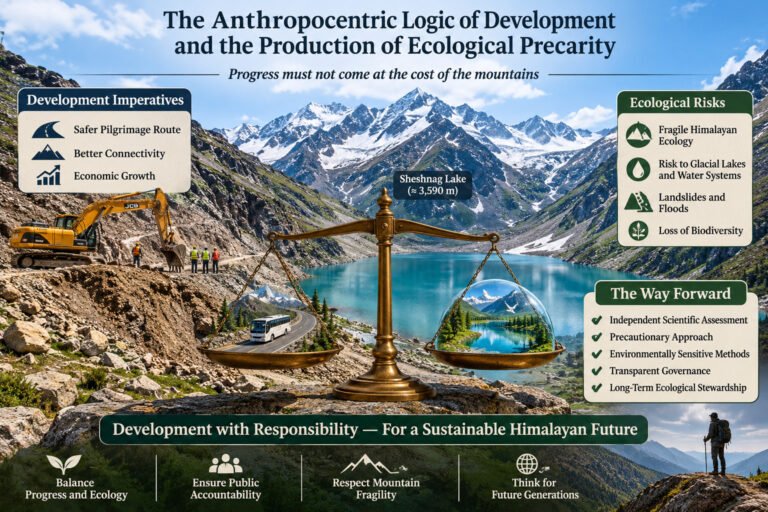
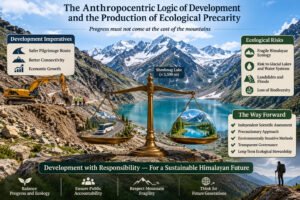
The immediate controversy emerged after footage circulated showing heavy machinery, reportedly deployed by the Border Roads Organisation (BRO), undertaking excavation and earth-moving activity in the vicinity of Sheshnag Lake. The organisation subsequently maintained that the activity was part of post-Amarnath Yatra operations, intended to improve existing tracks, facilitate pilgrim movement and stabilise vulnerable stretches. It also referred to safeguards concerning the disposal of excavated material and the preservation of natural drainage. These objectives have an evident public rationale. The state has an obligation to ensure the safety of pilgrims, particularly in a region where difficult terrain, unpredictable meteorological conditions and inadequate emergency infrastructure can produce serious
vulnerabilities. However, the legitimacy of a developmental objective cannot, by itself, establish the environmental defensibility of the means employed to achieve it. This distinction between the normative justification of a project and the ecological consequences of its execution is central to understanding the Sheshnag controversy.
Situated at approximately 3,590 metres above sea level along the traditional Pahalgam-Amarnath pilgrimage corridor, Sheshnag occupies a distinctive position within the highaltitude ecology of south Kashmir. Its significance extends beyond its visual or cultural appeal. The lake belongs to a landscape shaped by glacial processes, seasonal snowmelt, hydrological circulation, steep gradients and fragile geological formations. Its surrounding terrain includes moraine deposits, whose physical stability can be sensitive to excavation, erosion and alterations in drainage. The lake is also situated within the broader Lidder catchment, making the ecological consequences of disturbances in its vicinity relevant to a wider hydrological system. More significantly, Sheshnag figures among the fourteen glacial lakes in Jammu and Kashmir identified as high-risk in the context of glacial lake outburst flood vulnerability. This classification does not establish that the present intervention has generated an imminent threat. It does, however, establish a compelling basis for heightened precaution, rigorous scientific scrutiny and a more demanding standard of institutional responsibility.
The ecological problem must therefore be understood in terms of cumulative disturbance rather than through the narrow question of whether a particular construction activity has immediately damaged the lake. High-altitude ecosystems are characterised by intricate relationships between geological stability, sediment transport, hydrological circulation, vegetation and climatic variability. Excavation along a vulnerable slope can alter its physical configuration, expose unstable material and interfere with the natural movement of water. The disturbance of moraine formations may increase susceptibility to erosion, while the inappropriate disposal of excavated material can affect drainage channels and sediment loads. Such alterations may acquire greater significance during periods of intense precipitation, accelerated snowmelt or unusual climatic events. Their consequences are not necessarily immediate, visible or confined to the precise location of intervention. A seemingly limited engineering operation can have implications for processes extending across an entire catchment.
This is precisely why ecological vulnerability must be treated as a substantive condition of development planning rather than as an incidental consideration to be addressed after construction. It would be scientifically unwarranted to declare, without independent investigation, that the activity near Sheshnag has already produced irreversible environmental damage. But it would be equally unwarranted to presume that the intervention is harmless merely because catastrophic consequences have not been demonstrated. The appropriate response to scientific uncertainty in a fragile ecosystem is neither alarmism nor administrative reassurance. It is the systematic production of knowledge through baseline studies, independent assessment and continuous monitoring. Precaution, in this context, is not an ideological objection to infrastructure; it is a rational response to the asymmetry between the immediate benefits of intervention and the potentially enduring costs of ecological disturbance.
The BRO’s explanation must be evaluated within this framework. Improving the existing pilgrimage route and stabilising vulnerable stretches are legitimate administrative objectives. Nevertheless, the public is entitled to know the precise engineering parameters and environmental basis of the intervention. What is the proposed alignment and width of the track? What is the geographical extent of excavation? Where is the excavated material being deposited? What assessments have been undertaken concerning slope stability, moraine composition, sediment movement and natural drainage? Which statutory permissions have been obtained, and what conditions govern the execution of the project? These questions should not be construed as allegations against the organisation. They are elementary requirements of accountable public administration. Institutional credibility is strengthened when technical decisions are supported by publicly accessible evidence rather than resting exclusively upon assurances issued by the executing agency.
The judicial context also requires a careful distinction between the obligation to improve pilgrimage infrastructure and the permissibility of altering an ecologically sensitive landscape. Following concerns about pilgrim safety and fatalities, the Supreme Court intervened in 2012 and directed improvements to facilities along the Amarnath route, including the widening of tracks. However, the Court also acknowledged the ecological and climatic sensitivity of the region and cautioned against compromising its environmental integrity. Its directions were not an unrestricted authorisation for transforming traditional pedestrian routes into motorable roads. This distinction is significant because judicial recognition of a legitimate public purpose does not extinguish the obligation to observe environmental constraints. Equally, ecological sensitivity should not be invoked to render every infrastructural intervention impermissible. The task of governance is to reconcile competing public interests through proportionality, scientific assessment, statutory compliance and technically appropriate alternatives.
What is consequently required is neither an indiscriminate suspension of developmental activity nor an unquestioning acceptance of official explanations. The immediate surroundings of Sheshnag should be subjected to an independent multidisciplinary assessment involving glaciologists, geomorphologists, hydrologists, environmental scientists, civil engineers and disaster-management specialists. Such an exercise should establish an ecological baseline against which the consequences of the intervention can be evaluated. It should examine the stability of slopes, the composition of moraine deposits, the condition of natural drainage channels, sediment movement, seasonal hydrological variations and the potential implications for downstream areas. It should also determine whether the proposed engineering methods are compatible with the ecological characteristics of the site. The findings, including methodological limitations and areas of scientific uncertainty, should be made publicly available. Where unacceptable risks are identified, the alignment, scale or method of construction must be reconsidered. Where risks are demonstrably manageable, enforceable mitigation and monitoring conditions should govern subsequent work.
An ecologically informed approach must also distinguish between the legitimate requirements of infrastructure and the assumption that mechanised intervention represents the most efficient response to every geographical difficulty. Existing tracks can be maintained and improved through methods that minimise disturbance to surrounding terrain. Wherever technically feasible, smaller equipment, restricted excavation, carefully demarcated working zones and environmentally appropriate construction periods should be preferred. Excavated material must be transported to scientifically approved disposal locations rather than deposited along lake margins, unstable slopes or natural drainage channels. Disturbed surfaces should be stabilised, drainage systems restored and vulnerable stretches monitored
beyond the completion of construction. Equally important is the recognition that pilgrim safety cannot be reduced to the physical widening of a route. Crowd management, emergency communication, medical facilities, weather forecasting, evacuation arrangements and strategically located shelters are integral components of pilgrimage infrastructure. The objective must be to improve safety without making unnecessary ecological alteration the default instrument of administrative problem-solving.
Such an approach would strengthen, rather than undermine, the developmental responsibilities of the state. The Amarnath Yatra is an important religious undertaking requiring substantial administrative coordination, logistical preparedness and public investment. Ensuring the safety and dignity of pilgrims is a legitimate obligation of the government. However, the durability of pilgrimage infrastructure is inseparable from the ecological stability of the landscape through which it passes. Infrastructure that disregards geological vulnerability may generate future liabilities rather than sustainable public benefits. The quality of developmental governance must therefore be measured not merely through expenditure, physical connectivity or the speed of execution, but through the capacity of public institutions to anticipate consequences, incorporate scientific knowledge and protect the conditions upon which future development itself depends. In a fragile mountain environment, administrative restraint is not an expression of incapacity. It is an indication of institutional maturity.
The controversy, however, exposes another problem that deserves equal scrutiny: the intellectual inconsistency of Kashmir’s political class in its engagement with environmental questions. Several political figures have expressed concern over the activity near Sheshnag. Their interventions have helped bring an important question of public interest into wider discussion. Yet political seriousness cannot be established merely through the intensity of condemnation directed towards an administrative agency or an incumbent government. It must be assessed against the consistency of the principles being articulated and the willingness to institutionalise those principles beyond the immediate circumstances of political mobilisation.
Kashmir’s political class has repeatedly demonstrated a tendency to approach environmental questions through the episodic logic of political contestation. Ecological degradation becomes an urgent matter of public concern when it offers an opportunity to challenge an adversary, establish moral distinction or mobilise public sentiment. Yet comparable political urgency is seldom sustained when environmental destruction is incremental, institutionally dispersed or associated with decisions taken during different periods of political authority. Encroachment upon wetlands, unregulated construction, the degradation of water bodies, inadequate waste management and the commercialisation of ecologically sensitive spaces rarely receive the same sustained political attention. The problem, therefore, is not the absence of environmental rhetoric. It is the failure to translate that rhetoric into a coherent and continuous political commitment. Environmental responsibility is invoked as a language of opposition but insufficiently recognised as an obligation of governance.
The contradiction becomes more apparent when political actors demand accountability from public institutions without subjecting their own political histories to comparable scrutiny. Those who now invoke ecological sanctity must also account for their positions on land-use regulation, environmental clearances, wetland preservation, tourism carrying capacity and the enforcement of environmental legislation during periods when their political formations exercised governmental authority. Have they consistently advocated independent environmental audits? Have they demanded transparent inventories of encroachments and time-bound restoration of degraded ecosystems? Have they supported stronger scientific institutions and meaningful public participation in environmental decision-making? Have ecological considerations informed their legislative interventions beyond moments of public controversy? These questions are not intended to establish a simplistic equivalence between different political actors or administrations. They are intended to expose the inadequacy of a political culture in which environmental principles are applied selectively according to the identity of the institution or political formation under scrutiny. A political class that discovers ecological morality only when an excavator becomes publicly visible risks reducing environmentalism to an instrument of electoral and partisan positioning.
There is also a danger in allowing the controversy to become exclusively organised around the religious symbolism of Sheshnag. The lake occupies an important place in Hindu religious tradition and is associated with the sacred geography of the Amarnath pilgrimage. Its cultural and spiritual significance deserves recognition. Yet its preservation cannot depend exclusively upon the religious identity attached to it. Its ecological importance is independently established by its geographical location, glacial characteristics and relationship with the surrounding hydrological system. To reduce its protection to an argument about the injury of religious sentiment is to narrow the intellectual and moral basis of conservation. Equally, dismissing the cultural and spiritual significance of the landscape would be an impoverishment of the debate. Religious reverence and ecological responsibility need not occupy antagonistic moral universes. They can converge around the principle that the natural world is not simply an object of human consumption, but an inheritance carrying obligations towards those who will inhabit it after us.
The state, meanwhile, must resist the temptation to interpret environmental scrutiny as an obstructionist disposition towards development. Public criticism is not necessarily an expression of institutional hostility; it is an indispensable component of democratic accountability. The credibility of the BRO and the relevant administrative departments would be considerably strengthened through the publication of technical particulars, independent inspection and transparent communication of the safeguards governing the project. A coordinated monitoring mechanism involving scientific institutions, relevant departments and local stakeholders should be established. If the intervention has disturbed the site, a scientifically designed restoration programme should follow. If the work is found to be environmentally defensible, the assessment should be placed in the public domain. Either course would be preferable to allowing uncertainty to deepen public distrust.
More fundamentally, the Sheshnag controversy should encourage a reconsideration of the developmental paradigm governing the Himalayan region. Conventional infrastructure planning tends to privilege measurable indicators such as connectivity, expenditure, efficiency, accessibility and immediate utility. These considerations are important, but they are insufficient in territories characterised by geological instability and ecological fragility. Himalayan development requires an institutional framework attentive to cumulative environmental impacts, climate vulnerability, disaster exposure, ecological carrying capacity and long-term maintenance. Environmental assessment must become constitutive of project formulation rather than a procedural exercise undertaken after the principal decisions have already been made. The cumulative consequences of expanding pilgrimage and tourism infrastructure must be examined at the catchment and regional levels, rather than through isolated project approvals that overlook the interdependence of ecological systems.
Ultimately, the question raised by Sheshnag is not whether development should proceed, but what conception of development a responsible political and administrative order ought to defend. The capacity to transform a landscape is not synonymous with the wisdom to govern it. A capable state demonstrates its institutional strength not merely through its ability to penetrate difficult terrain with machinery, but through its capacity to distinguish necessary intervention from avoidable ecological disturbance. Similarly, a credible political opposition cannot confine itself to the vocabulary of condemnation; it must articulate environmental standards that remain binding irrespective of electoral circumstances or changes in political authority. The Himalayas require infrastructure, but infrastructure informed by scientific knowledge, ecological restraint and intergenerational responsibility. Sheshnag must not become another casualty of the assumption that every geographical constraint represents an engineering problem awaiting resolution. Its preservation is not an argument against progress. It is an argument against the intellectually impoverished assumption that progress can be measured independently of the ecological conditions that make human life possible.
About the Author