Gazal Mir (Master of Commerce)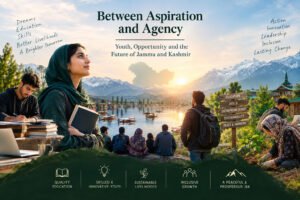
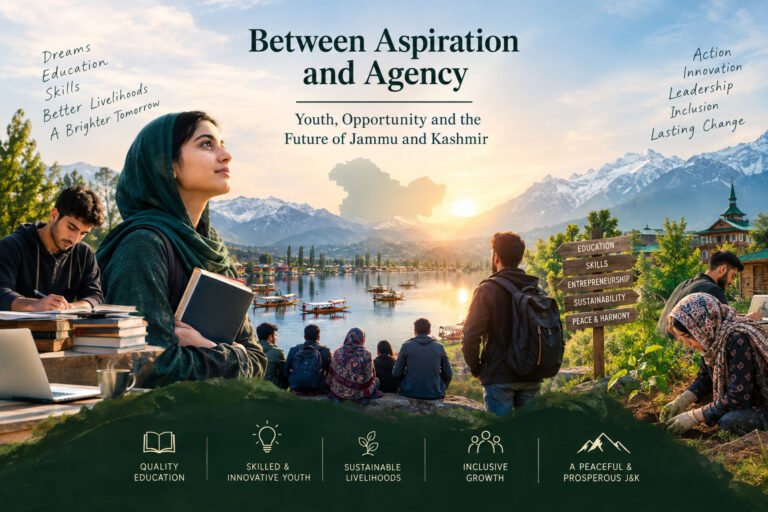
There is perhaps no more revealing way of understanding the contemporary transformation of Jammu and Kashmir than by looking at the changing aspirations of its young people. The youth of Jammu and Kashmir are no longer adequately described through the familiar vocabulary of unemployment, alienation, conflict or demographic transition. Such descriptions, though not irrelevant, remain insufficient because they reduce young people to the problems they are expected to embody rather than the futures they are attempting to construct. The more consequential question is not simply what young people in Jammu and Kashmir lack, but what they have come to expect from education, work, citizenship and the institutions that govern their lives. The emergence of an aspirational generation marks a profound sociological transition: expectations have expanded, horizons have widened, and the world of possible futures has become considerably larger than the institutional structures available to realise them.
Aspiration is therefore not merely an individual psychological phenomenon. It is a political and institutional category. A young person becomes aspirational when education, technology, mobility and social transformation enlarge the horizon of what he or she considers possible. The village is no longer the entire universe of comparison; the local economy is no longer the sole reference point; and government employment is no longer the only imaginable form of social advancement. A young person in Kashmir can now simultaneously inhabit a local social world and imagine participation in national and global professional networks. The smartphone has collapsed some of the geographical distance between Kashmir and the rest of the world, even when economic and institutional distance remains substantial. This produces a peculiar condition: the expansion of imagination without a corresponding expansion of opportunity. That contradiction lies at the heart of the contemporary youth question in Jammu and Kashmir.
For several decades, education has occupied a privileged position in the social imagination of Kashmir. It has been regarded as the principal instrument of mobility, respectability and economic security. Families have invested extraordinary resources in education because education was understood to provide a pathway out of economic vulnerability. But the social meaning of education is changing. A university degree can no longer automatically be translated into employment, social mobility or professional dignity. The expansion of higher education has produced a generation with greater educational qualifications, but the economy has not necessarily generated opportunities at the same pace. The result is an increasingly visible gap between educational aspiration and economic absorption.
This gap is not unique to Jammu and Kashmir, but its consequences acquire particular significance in a region where the public sector has historically occupied an unusually important place in the imagination of employment. Government employment has represented more than a salary. It has offered stability, social recognition, predictable career progression and a degree of protection from economic uncertainty. For many families, the government job has therefore been the institutional equivalent of security itself. Yet the state cannot indefinitely remain the principal employer of an increasingly educated population. The more educated the youth population becomes, the more unsustainable it becomes to imagine public employment as the universal destination of educational achievement.
This is where the discourse of the “aspirational youth” becomes politically significant. It forces us to ask whether the institutions of Jammu and Kashmir are organised around the aspirations of a twenty-first-century generation or around an older conception of social and economic life.
The official policy architecture increasingly acknowledges this transformation. The Jammu and Kashmir Skill Development Mission was established in 2016 with the objective of integrating skill-development efforts, training unskilled and semi-skilled youth and connecting them with labour markets. Its contemporary programmes cover sectors ranging from information technology, electronics and logistics to healthcare, tourism, green jobs, handicrafts and hospitality. The Mission is also now promoting AI-related training and international employment opportunities. JK Skill Development Mission
These developments are significant because they indicate that the official understanding of youth employment is itself moving beyond the traditional government-job paradigm. The emergence of IndiaSkills competitions, digital skills, cybersecurity, software development, robotics, renewable energy and other technologically intensive fields demonstrates that the vocabulary of employability is changing. J&K’s current skills ecosystem includes fields as diverse as cloud computing, cyber security, unmanned aerial systems, software testing, digital interactive media, renewable energy and autonomous mobile robotics. JK Skill Development Mission Yet policy vocabulary and social reality do not always move together.
The crucial question is whether the institutional ecosystem can transform training into durable livelihoods. The distinction is fundamental. Training is not employment. Certification is not employment. Employability is not employment. A certificate can testify that an individual has acquired a skill; it cannot guarantee that the economy possesses a corresponding demand for that skill. The latest J&K Skill Development Mission dashboard illustrates precisely why outcomes matter: while thousands of candidates have been trained and certified across sectors, the number recorded as placed remains considerably smaller. JK Skill Development Mission This does not invalidate skill development; rather, it demonstrates the need to judge skill policy through the entire chain from training to market demand, employment, income and career progression.
The problem, therefore, is not simply that young people need more skills. It is that the economy needs to become capable of absorbing, rewarding and retaining those skills. The distinction matters enormously. It is tempting for governments to respond to unemployment by expanding training programmes because training is administratively visible. Centres can be established, candidates enrolled, certificates distributed and targets announced. But the deeper problem is economic rather than merely pedagogical. If the productive structure does not expand, skills can become another credential accumulated by an already credential-heavy generation. The young person is then asked to become more employable without society asking whether there are enough meaningful opportunities into which that employability can be converted.
This is why the aspiration question cannot be separated from the question of economic transformation. Jammu and Kashmir needs an economy in which young people are not compelled to imagine their future exclusively through state employment or migration. Tourism, horticulture, food processing, handicrafts, information technology, education, healthcare, renewable energy, creative industries, research and knowledge-based services possess the potential to create alternative forms of economic participation. The Department of Industries and Commerce explicitly identifies entrepreneurship, human-resource development and employment generation among its objectives, while emphasising an enabling environment for industrial and entrepreneurial activity. Industries Commerce Jammu and Kashmir
But entrepreneurship itself must be treated with intellectual seriousness. There is a danger in converting entrepreneurship into a fashionable substitute for public responsibility. Telling an unemployed graduate to “become an entrepreneur” without providing access to capital, markets, infrastructure, mentoring, technology and institutional support merely transfers responsibility from the economy to the individual. Not every educated young person is required to become an entrepreneur. A mature economy must provide multiple pathways: employment, enterprise, research, professional practice, skilled trades, creative work and public service.
The question is consequently not whether every young Kashmiri should become an entrepreneur. It is whether the institutional structure permits a young person to choose. Choice is the deeper meaning of aspiration. A genuinely aspirational society is one in which a young person can choose between becoming a teacher, engineer, researcher, civil servant, entrepreneur, artist, software developer, agricultural innovator, tourism professional or skilled technician without feeling that only one route guarantees dignity. The problem with a narrow employment structure is not merely that it creates unemployment; it impoverishes the imagination of possible lives.
This brings us to education. The central challenge facing higher education in Jammu and Kashmir is not simply expansion but transformation. Universities and colleges cannot remain institutions whose principal function is the distribution of degrees. They must become spaces in which intellectual capabilities, research skills, technological competence, communication, critical reasoning and professional adaptability are cultivated. The Special Scholarship Scheme for students from Jammu and Kashmir and Ladakh reflects the continuing policy emphasis on expanding access to higher education and exposing students to educational institutions beyond the Union Territories. Education Government of India But mobility through education should ultimately be connected to a larger question: what kind of intellectual and economic ecosystem will allow young people to return, contribute and flourish?
Otherwise education risks producing a paradoxical outcome. The better educated the young person becomes, the more acutely they may perceive the limitations of the local opportunity structure. The statistics on youth unemployment reinforce the seriousness of this question. For example, the Periodic Labour Force Survey’s quarterly data for October–December 2023 recorded a youth unemployment rate for the 15–29 age group in urban Jammu and Kashmir of 19.9 percent for persons, compared with 14.6 percent for urban India in the same period. The corresponding figure for young women in urban J&K was substantially higher, at 45.5 percent. Ministry of Statistics Such figures require careful interpretation because quarterly estimates are not equivalent to long-term structural trends, and unemployment rates alone do not capture underemployment, discouraged workers or the quality of employment. Yet they illuminate the central problem: educational and social aspirations are encountering a labour market whose capacity to absorb young people remains uneven.

The gender dimension makes the problem still more complex. An aspirational youth policy that speaks about “young people” as though they constitute a homogeneous social category conceals profound differences in access to mobility, employment and economic autonomy. Young women encounter additional institutional and social constraints. Their aspirations may expand through education while opportunities for participation in paid employment remain restricted by labour-market conditions, social expectations, safety concerns, care responsibilities and inadequate institutional support. The politics of aspiration must therefore become a politics of inclusion.
The same argument applies to geography. The aspirations of a young person in Srinagar cannot simply be assumed to be identical to those of a young person in a remote village of Kupwara, Kishtwar, Rajouri, Poonch, Pulwama or Shopian. Connectivity, family income, educational infrastructure, access to coaching, exposure to technology, transport and proximity to markets create radically different opportunity structures. The language of “youth” can therefore become misleading if it conceals the inequalities within youth itself.
There is also a less visible dimension to the aspiration question: dignity. Young people do not aspire merely to earn. They aspire to live lives that they regard as meaningful. Employment matters because it provides income, but it also confers recognition, independence and social agency. A precarious job with little possibility of advancement may not satisfy an educated young person simply because it appears in an employment statistic. Similarly, migration may improve income while simultaneously producing social and emotional costs. The success of a youth policy therefore cannot be measured exclusively by the number of jobs generated. It must also ask what kinds of work are being created, what wages they provide, whether they offer security, whether they permit professional growth and whether they enable young people to exercise meaningful autonomy.
This is where the idea of agency becomes more important than the idea of employability. A young person should not be understood merely as an object of policy intervention- someone to be trained, counselled, financed, placed or regulated. The aspirational youth is a political subject. Young people possess preferences, ambitions, grievances, creativity and the capacity to define their own conception of the good life. Public policy should therefore create conditions within which young people can exercise agency rather than prescribing the form that their aspiration should take.
There is an important political consequence here. The relationship between youth and institutions is increasingly mediated by expectations. When young people believe that effort can generate opportunity, institutions acquire legitimacy. When they repeatedly experience a disconnect between qualification and opportunity, merit and outcome, or aspiration and institutional response, distrust can deepen. The issue is not reducible to any particular government or political party. It is a structural question about the credibility of institutions.
A society cannot indefinitely tell its young people that education is the pathway to advancement while providing too few pathways through which education can become advancement. Nor can it repeatedly celebrate “youth potential” without building institutions capable of converting potential into capability and capability into opportunity.
This is why the language of aspiration should be treated with caution. Governments often celebrate aspirational youth because aspiration sounds optimistic, productive and politically reassuring. But aspiration is not inherently optimistic. It can contain frustration within it. The greater the distance between what people believe is possible and what institutions allow them to achieve, the more politically consequential that frustration becomes. The aspirational youth of Jammu and Kashmir therefore represent both an opportunity and a test for institutions.
They are an opportunity because they possess educational exposure, technological familiarity, professional ambition and increasing connections with wider India and the global economy. J&K’s participation in national skills competitions already demonstrates that young people from the region are capable of competing across a wide range of technical and professional domains. The official Skill Development Mission records achievements by J&K youth in areas including fashion technology, robotics, software testing, cybersecurity, graphic design, web technologies, healthcare and other skills. JK Skill Development Mission
But they are also a test because their aspirations expose the inadequacies of institutions more clearly than previous generations could. A young person who has seen alternative possibilities is less likely to accept inherited limitations as inevitable. The future of Jammu and Kashmir will therefore depend, in no small measure, on whether its institutions can move from managing youth to enabling youth.
This requires a shift from fragmented schemes to an integrated political economy of opportunity. Education must communicate with industry. Universities must communicate with research institutions. Skill programmes must be connected to actual labour-market demand. Entrepreneurship must be linked to finance and markets. Tourism must generate skilled and dignified employment rather than merely seasonal work. Horticulture must move further up the value chain. Digital infrastructure must become an instrument of economic mobility. Local enterprises must be given access to wider markets. And young people must be treated not simply as beneficiaries of schemes but as participants in designing the institutions that affect their future.
Ultimately, the question of aspirational youth is a question about the relationship between expectation and possibility. Jammu and Kashmir is witnessing a generation that has inherited a much wider horizon than its predecessors. Its young people can imagine careers, identities and forms of mobility that were difficult to conceive a generation ago. The challenge before institutions is to ensure that this expansion of imagination is accompanied by an expansion of opportunity.
For the deepest failure would not be that young people have become too ambitious. It would be that society has encouraged them to imagine a larger future without building the institutional architecture through which that future can become attainable. The measure of a genuinely modern Jammu and Kashmir, therefore, will not be found merely in roads constructed, buildings inaugurated, schemes announced or certificates distributed. It will be found in something more difficult to measure: whether an educated young person can look towards the future without having to choose between aspiration and belonging, between dignity and livelihood, or between opportunity and departure.
The real task is to transform aspiration from an individual burden into a public capability. A young person should not have to apologise for wanting more from life. The responsibility of institutions is not to lower that expectation, but to create the economic, educational and civic conditions in which aspiration can become agency, agency can become achievement, and achievement can become a source of collective renewal. That is ultimately the politics of aspirational youth in Jammu and Kashmir: not a politics of promises, but a politics of possibility.
About the Author