Written by: Peerzada Muneer
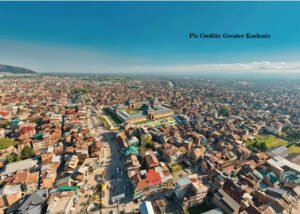
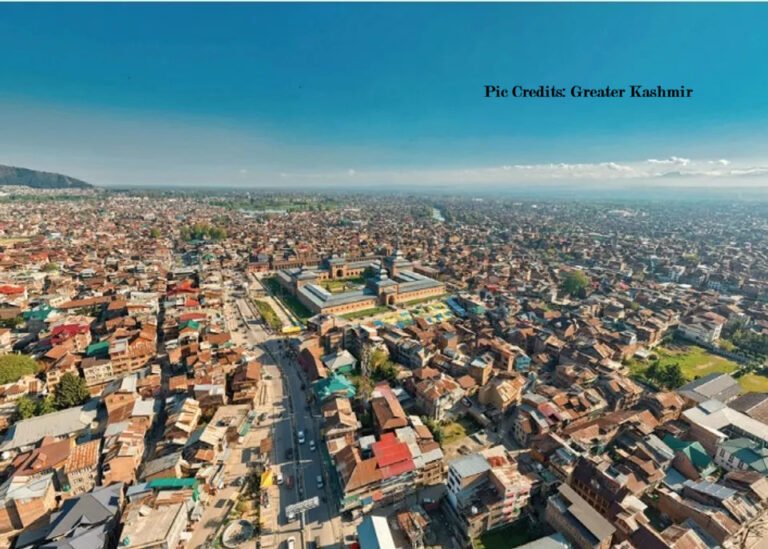
Srinagar is no longer merely expanding; it is being transformed at a speed and in a direction that raises fundamental questions about the future of urban life in Kashmir. What is visible on the surface is a familiar catalogue of urban difficulties: traffic congestion, inadequate drainage, waterlogging, shrinking open spaces, deteriorating water quality, air pollution, mounting waste, unregulated construction, disappearing agricultural land and increasing pressure on public infrastructure. Yet to understand Srinagar merely through these symptoms would be to miss the deeper crisis. The city is experiencing a fundamental mismatch between the scale of human activity that it attracts and the ecological, infrastructural and institutional systems that sustain it. Recent research shows that Srinagar’s built-up area expanded from approximately 7,930 hectares in 1985 to nearly 19,956 hectares in 2025, while the pattern of growth shifted from a relatively compact urban core towards dispersed, corridor-oriented expansion.
This transformation is particularly consequential because Srinagar is not an ordinary plains city. It is a Himalayan city embedded within a complex system of rivers, lakes, wetlands, marshes, agricultural fields, orchards, flood channels and mountain slopes. The city’s geographical identity is inseparable from the Jhelum, Dal Lake, Nigeen, Khushalsar, Brari Nambal, Hokersar and numerous smaller waterways and wetlands that historically performed ecological functions far beyond their aesthetic value. The official district profile itself describes Hokersar as a 13.75-square-kilometre wetland supporting migratory birds and functioning as part of Kashmir’s wider wetland system. The Srinagar Master Plan 2035 likewise recognises that rapid population growth and unplanned urbanisation are depleting and degrading ecological resources and explicitly states that urban sustainability cannot be separated from the protection of rivers, lakes, wetlands, forests, hills and other ecological systems.
The first problem, therefore, is not simply that Srinagar has become crowded. It is that the city has become the principal destination for an ever-expanding range of activities that were once distributed across the region. Srinagar is simultaneously Kashmir’s administrative capital, principal commercial centre, educational hub, medical centre, transport node, tourism gateway and increasingly the preferred location for housing, investment and private enterprise. A recent assessment notes that people from virtually every district travel to Srinagar for employment, education, healthcare, business and government services, while millions of tourists enter the city and its surrounding region annually. The result is a phenomenon that conventional population statistics do not fully capture: the city’s effective daily population is substantially larger than the population formally residing within its administrative boundaries.
This distinction is essential because urban pressure is not generated by residents alone. It is generated by commuters, students, patients, traders, government employees, tourists, construction workers, delivery networks, commercial vehicles and visitors from surrounding districts. Srinagar has consequently become not merely a city but a regional magnet. The Census of India maintains dedicated migration datasets for Srinagar Urban Agglomeration that distinguish migration for employment, business, education, marriage, household movement and other reasons, demonstrating that population mobility into urban centres is a structurally measurable phenomenon rather than an anecdotal one. Earlier demographic research had already identified rural-to-urban movement as an important component of Srinagar’s growth, while spatial studies have specifically attributed urban expansion to natural population growth and in-migration from adjoining districts.
The contemporary rural-to-urban movement, however, deserves to be understood in broader terms than conventional economic migration. People move towards Srinagar not only because of employment but because the city has acquired symbolic value. It represents education, modern healthcare, administrative access, social mobility, consumer choice, connectivity and, increasingly, status. The city has become an aspiration in itself. A family may move from a village not because its agricultural livelihood has completely disappeared, but because remaining in the village is increasingly perceived as limiting the educational, professional and social prospects of its children. The result is an urbanisation of aspiration before it is an urbanisation of employment. In this sense, Srinagar is absorbing not only people but expectations.
This phenomenon creates a vicious circle. As people migrate or commute towards the city, demand for housing, schools, hospitals, shops, offices, parking spaces and transport increases. New construction follows demand; construction creates land-value escalation; rising land values encourage the conversion of agricultural and open land; the loss of open land increases ecological pressure; ecological deterioration reduces the quality of urban life; and deteriorating quality of life then stimulates further outward expansion in search of cheaper land and larger houses. Srinagar’s urbanisation thus becomes simultaneously centrifugal and centripetal: it pulls people towards the city while pushing the built environment further into the rural landscape.
Satellite-based research demonstrates the magnitude of this transformation. Between 1971 and 2011, Srinagar’s built-up area increased by 585.08 percent while population increased by 214.75 percent, indicating that land consumption was proceeding substantially faster than demographic growth. Another study found that built-up land expanded from 12 percent of the city’s area in 1992 to approximately 40 percent in 2020, while water bodies declined from 6 percent to 4 percent and plantations and forests also contracted. Research covering 1980 to 2012 similarly documented the conversion of rural open land into urban and suburban built-up areas and identified extension, infill and leapfrog development as major patterns of expansion.
The significance of these numbers is often underestimated. Land is not merely a commodity upon which buildings are placed. In Srinagar, land is part of a hydrological system. Agricultural fields, marshes, ponds, gardens and open spaces absorb, retain, filter or redirect water. Once these surfaces are covered by concrete, the hydrological behaviour of the city changes. Rainwater that once infiltrated or accumulated gradually must instead move rapidly across impermeable surfaces and enter drainage channels that were not designed for the resulting volume. Urban flooding is consequently not simply a consequence of excessive rainfall. It is also a consequence of eliminating the landscape’s capacity to receive rainfall.
The consequences are visible in Srinagar’s drainage crisis. In September 2026, the Srinagar Municipal Corporation reported that the city had approximately 680 kilometres of storm-water deep drainage against about 2,500 kilometres envisaged under Master Plan 2035. The CAG has additionally identified serious implementation deficiencies in drainage infrastructure. In the Nadroo-Hyderpora storm-water project, pipes intended for storm water were found to be receiving sewage, and between 20 and 30 October 2023 a dewatering station discharged approximately 1.72 crore litres of wastewater into a flood channel despite there being no rainfall during that period. This is not merely a technical failure. It demonstrates the consequences of designing infrastructure in isolation from the ecological and sanitary systems of the city.
The irony is that the city has not been without plans. Srinagar has had successive planning exercises, mobility studies, drainage projects, sewerage schemes, the Smart City programme and Master Plan 2035. Yet the persistence of precisely those problems that planners have identified decades earlier suggests that the crisis is not principally one of knowledge. It is a crisis of implementation, enforcement, institutional coordination and political economy. A 2024 assessment of urban planning in Jammu and Kashmir observed that many towns possess master plans that remain largely unimplemented because the necessary zonal plans and mechanisms of execution are absent, and it highlighted a severe shortage of qualified urban planners relative to the number of urban centres requiring professional planning. Earlier commentary on Srinagar’s planning history similarly observed that environmental problems, including water, air, land and noise pollution, were aggravated by the absence or non-implementation of effective planning frameworks.
The problem is therefore better described as a gap between the planned city and the lived city. On paper, Srinagar may have a Master Plan extending to 2035; on the ground, however, the city is being produced every day through individual construction decisions, road widening, commercial conversions, informal parking, land transactions, institutional relocations, tourism demand and incremental encroachments. Planning documents describe the city that authorities intend to have, whereas thousands of small decisions continuously produce another city. The latter ultimately becomes stronger than the former.
Mobility provides an especially clear illustration of this contradiction. Srinagar’s Comprehensive Mobility Plan found that approximately 91 percent of the surveyed road network had peak-hour speeds of no more than 20 kilometres per hour, while only about 6 percent recorded speeds above 30 kilometres per hour; only around 15 percent of the surveyed road network had footpaths. A separate study of major corridors documented significant delays for private vehicles and substantial commuter loads on routes converging upon Lal Chowk. Meanwhile, the registered vehicle fleet of Jammu and Kashmir has continued to expand rapidly, crossing 27 lakh vehicles by 2026, with more than 1.69 lakh vehicles added during 2024-25 alone. The problem is consequently not simply “traffic”; it is a transport model in which the regional economy continues to concentrate destinations in Srinagar while mobility remains heavily dependent on road-based movement.
Tourism adds another layer to this pressure. Jammu and Kashmir recorded more than 2.35 crore domestic tourist visits and 65,452 foreign tourist visits in 2024, according to the Ministry of Tourism, while 2025 had already recorded more than 95 lakh domestic and nearly 20,000 foreign visits in the first six months. Tourism brings employment, income and investment, but tourist numbers cannot be treated as an unqualified measure of development. Every additional visitor requires water, transport, accommodation, food, energy, waste collection, sanitation and public space. The ecological cost of tourism is therefore not captured merely by counting hotel rooms or visitor expenditure. A destination can become economically successful precisely while becoming ecologically poorer.
The commercialisation of Srinagar has consequently begun to alter not only its environment but its spatial character. Residential areas become commercial corridors; traditional markets become increasingly vehicle-dependent; heritage spaces become retail fronts; agricultural land becomes housing; open areas become parking; and landscapes that once had cultural or ecological functions acquire monetary values. The danger is that the city begins to evaluate every space according to its immediate commercial utility. A wetland becomes “vacant land”, a traditional house becomes “redevelopment potential”, a riverfront becomes “commercial frontage”, and a public open space becomes “underutilised land”. Such vocabulary is not innocent. It changes the conceptual status of land before it changes the physical landscape.
The consequences are particularly serious for water. Srinagar’s Master Plan acknowledged that the city’s historical development around the Jhelum and its lakes had progressively resulted in domestic waste entering nearby water bodies and noted the absence of comprehensive modern sewerage facilities, with septic systems and open drains historically carrying wastewater towards natural water bodies. Recent official activity around water-quality surveillance also illustrates the continuing concern. More than 3.07 lakh drinking-water samples were reportedly tested across Jammu and Kashmir during 2025-26, alongside continuing monitoring under the Jal Jeevan Mission. At the level of lakes and wetlands, a CAG audit has examined untreated effluent discharge, encroachment, land-use changes, waste disposal and water-quality issues in Kashmir’s major lakes. The issue, therefore, is not simply whether water is available. It is whether the hydrological system that provides water can continue to remain ecologically healthy under increasing urban loads.
Waste presents another contradiction. Srinagar now generates roughly 525 to 600 tonnes of municipal solid waste per day according to recent official-linked assessments, while the city has accumulated a major legacy-waste burden at the Achan site. The Government has consequently approved an 800-tonne-per-day integrated solid-waste facility at Saidpora-Achan at an estimated cost of Rs 361 crore. Yet the very scale of such projects should provoke a more fundamental question: why does the solution to an expanding waste crisis so often begin with a larger waste-processing machine rather than with a different urban metabolism? If a city continuously produces more waste because its consumption model continuously intensifies, technological treatment can manage the symptom without questioning the system generating it.
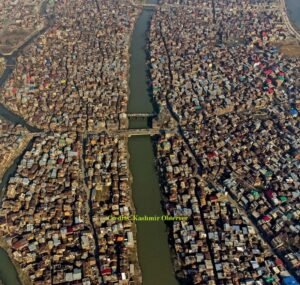
Air quality is another emerging dimension of Srinagar’s urban transformation. A 2026 study in GeoJournal found that between 2001 and 2021 Srinagar experienced increases in land-surface temperature of up to 4 degrees Celsius, declining vegetation cover and increases in PM2.5 concentrations of up to 3.9 micrograms per cubic metre, with more than half of the city falling into moderate-to-poor environmental-quality categories. Earlier research found that the city’s maximum land-surface temperature increased by 11 degrees Celsius between 1992 and 2020 and linked the transformation of marshes and water bodies into built-up land with substantial thermal increases. Another study specifically identified urban sprawl, degradation of cropland and vegetation, encroachment and increased built-up area as contributors to urban heat-island intensity. These findings complicate the popular image of Srinagar as a naturally cool Himalayan city. A city can retain a mountain climate while simultaneously creating its own local heat environment.
The deeper crisis, therefore, is one of carrying capacity. Srinagar’s ecological systems evolved over centuries to support a particular relationship between settlement, agriculture, water, vegetation and seasonal change. Contemporary urbanisation assumes that technological infrastructure can compensate indefinitely for the removal of those natural functions. A drain can replace a wetland; a pumping station can replace natural drainage; an air-conditioner can replace shade; a water-treatment plant can compensate for pollution; a road can compensate for spatial concentration; a retaining wall can compensate for the loss of natural buffers. Each intervention may solve a specific problem, but collectively they produce an increasingly artificial city whose survival depends upon ever greater quantities of energy, concrete, machinery and administrative intervention.
This is perhaps the most important perspective from which Srinagar’s urban crisis should now be reconsidered. Development should not be measured merely by the amount of infrastructure constructed, the number of roads widened, buildings approved, tourists accommodated or investments attracted. The more meaningful question is whether each intervention increases or diminishes the city’s capacity to sustain human life. A road that saves ten minutes but removes a wetland, a commercial complex that generates revenue but increases flood exposure, a housing colony that accommodates families but eliminates agricultural land, or a technological project that increases convenience while increasing energy consumption may produce measurable economic value while simultaneously creating an unmeasured ecological liability.
The cost is ultimately borne by human beings. Poor air quality becomes a health burden; contaminated water becomes a public-health risk; traffic congestion becomes lost productive time and psychological stress; disappearing open spaces reduce children’s opportunities for recreation; flooding destroys property; waste affects workers and surrounding communities; heat affects vulnerable populations; and the loss of traditional landscapes weakens the cultural and psychological rootedness of the inhabitants. Development that ignores these costs can become a process in which human beings are reduced to statistical units, consumers, commuters, tourists, taxpayers, customers or economic numbers. The city then ceases to be a habitat for human flourishing and becomes an apparatus for commercial circulation.
There is also a cultural and civilisational cost that conventional urban economics finds difficult to quantify. Srinagar was historically not simply a settlement placed upon nature; it was a city that developed in a continuous conversation with water, mountains, gardens, agriculture, crafts, shrines, temples, mosques, neighbourhoods and seasonal rhythms. The recent reflection on Srinagar’s liveability by Amitabh Mattoo is significant precisely because it distinguishes between a city’s measurable functions and its deeper “register” of rootedness, memory and belonging. When sacred spaces, historic neighbourhoods, gardens, waterways and traditional streetscapes are transformed into commercial commodities, something more than architectural heritage is lost. The sanctity of place is diminished.
This is why the answer cannot simply be another Master Plan. Srinagar certainly requires a revised and enforceable spatial plan, but it also requires a different philosophy of development. The first requirement should be to stop treating the ecological infrastructure of the city as residual land. Wetlands, floodplains, water channels, agricultural belts, orchards, forests, open spaces and natural drainage routes must be recognised as infrastructure in their own right. New construction should be permitted only after its cumulative effects on water, traffic, waste, energy, landscape and public health are assessed. The principle should move from “Can this land be built upon?” to “Can this ecosystem safely accommodate this intervention?”
The second requirement is decentralisation. Srinagar cannot indefinitely remain the sole metropolitan centre for the Valley. The development of carefully planned secondary urban nodes around Budgam, Ganderbal, Pampore, Magam, Narbal, Awantipora, Sopore, Anantnag and Baramulla has already been proposed as a means of distributing population, institutions and economic activity. But decentralisation must not mean reproducing Srinagar’s mistakes in smaller towns. These centres must be designed around carrying capacity, public transport, local employment, water security, agricultural protection and ecological buffers from their inception.
Most importantly, Jammu and Kashmir requires a return to a Himalayan conception of development in which human settlement is understood as part of nature rather than as an external force acting upon it. Kashmir’s older ethos offers intellectual resources for such a transition. The traditions of living with rivers, cultivating gardens, protecting springs, maintaining orchards, respecting sacred landscapes and adapting architecture to climate embody an ecological intelligence that modern planning has too often dismissed as antiquated. The Himalayan wisdom required today is not a rejection of science or technology but a reordering of their purpose. Technology should assist ecological systems rather than replace them; infrastructure should work with natural processes rather than attempt to overpower them; and development should enhance the conditions of life rather than merely accelerate consumption.
Srinagar therefore needs not simply a smarter city but a wiser city. Its future cannot be secured by concrete alone, nor by technology alone, nor by tourism alone, nor by commercial growth alone. Every infrastructural and technological intervention carries an ecological and human cost, and those costs must be included in the definition of development itself. When construction destroys a wetland, when commercialisation removes a public space, when pollution enters water, when congestion consumes human time, and when concrete replaces the living landscape, the loss is not merely environmental. It is a loss of health, time, memory, belonging and ultimately of the purity and dignity of human life.
The fundamental question before Srinagar is consequently not whether it should develop. It must develop. The question is what kind of development is compatible with the life of a Himalayan city. A city becomes liveable not when nature has been conquered by infrastructure, but when infrastructure has learned to live within the limits of nature. Srinagar’s greatest opportunity may therefore lie not in becoming another rapidly expanding Indian metropolis, but in becoming an example of a different urban imagination: one in which rivers remain rivers, wetlands remain wetlands, orchards remain productive landscapes, sacred places remain sacred, villages remain viable, urban centres remain human in scale, and technological advancement serves life rather than reducing life to a unit of commercial value. The real measure of Srinagar’s future will not be how much of the Valley we are able to build upon, but how much of the Valley we are wise enough to leave alive.
References
- Government of Jammu & Kashmir, Housing and Urban Development Department. Srinagar Master Plan 2035: Srinagar Metropolitan Region – Planning for Sustainable Growth and Change. Government of Jammu & Kashmir. Master Plan 2035 — Government of J&K
- Comptroller and Auditor General of India. Conservation and Management of Lakes in Jammu and Kashmir. Government of India, Report No. 4 of 2025. CAG Report — Conservation and Management of Lakes in J&K
- Census of India. Migration Tables: Srinagar Urban Agglomeration. Office of the Registrar General & Census Commissioner, India. Census of India — Migration Data
- Ministry of Tourism, Government of India. Tourist Inflow in Jammu & Kashmir. Press Information Bureau, Government of India. Ministry of Tourism — Tourist Inflow in J&K
- Hussain, A. Urban Transformation in a Himalayan Metropolitan City: Socio-Spatial Dynamics and Planning Implications from Srinagar, India. City and Environment Interactions, 2026. ScienceDirect — Urban Transformation in Srinagar
- Illuminating Urban Land Transformation of Srinagar City, India, through Nightlight Remote Sensing. City and Built Environment, Springer Nature, 2026. Springer Nature — Urban Land Transformation of Srinagar
- Land Use/Land Cover Change and Urban Expansion of Srinagar City, India. Journal of Geographic Information System. Research article — Srinagar Urban Expansion
- Urban Land Transformation of Srinagar City, India. ISPRS Archives. ISPRS Archives — Srinagar Urban Expansion Study
- Urban Sprawl and Its Impact on Land Surface Temperature and Vegetation in Srinagar City. Discover Cities / Springer Nature. Springer — Srinagar Urban Sprawl and Heat-Island Effects
- Urbanisation, Land Use/Land Cover Change and Land Surface Temperature in Srinagar City. Environmental/Remote Sensing Research. PubMed — Srinagar Urbanisation and Environmental Change
- Environmental Quality Assessment of Srinagar City: Land Surface Temperature, Vegetation and PM2.5. GeoJournal, 2026. GeoJournal — Srinagar Environmental Quality Research
- RITES Ltd. / Srinagar Smart City. Comprehensive Mobility Plan for Srinagar. Comprehensive Mobility Plan for Srinagar
- Greater Kashmir. “Srinagar Cannot Breathe Forever.” Greater Kashmir. Srinagar Cannot Breathe Forever
- Greater Kashmir. “Srinagar Planned for 2035, Struggling Today.” Greater Kashmir. Srinagar Planned for 2035, Struggling Today
- Greater Kashmir. “A Much Awaited Document: Srinagar Master Plan is Yet to be Finalized.” Greater Kashmir. Srinagar Master Plan — Greater Kashmir
- Greater Kashmir. “Part 1: Srinagar Master Plan in Retrospect and Prospect.” Greater Kashmir. Srinagar Master Plan in Retrospect and Prospect
- Srinagar-Born Man Decodes What Makes a City Liveable. The Telegraph India. What Makes a City Liveable — The Telegraph India
- Rising Kashmir. “Kashmir’s Development Dilemma: Cities, Commerce and a Changing Climate.” Rising Kashmir. Kashmir’s Development Dilemma
- Rising Kashmir. “The Lasjan Exclusion and the Crisis of Srinagar’s Master Plan.” Rising Kashmir. The Lasjan Exclusion and the Crisis of Srinagar’s Master Plan
- Brighter Kashmir. “Urban Planning Conclave and Intrinsic Realities.” Brighter Kashmir. Urban Planning Conclave and Intrinsic Realities
- Tribune India. “Haphazard Growth in Srinagar Blamed on Faulty Master Plans.” The Tribune. Haphazard Growth in Srinagar
- Kashmir Life. “Unmaking Srinagar.” Kashmir Life. Unmaking Srinagar
- Institute for Policy Research and Governance (IMPRI). “Article 370, Urban Planning and the Unravelling of Srinagar’s Traditional Economy.” IMPRI. Urban Planning and Srinagar’s Traditional Economy
- Kashmir Despatch. “Revisit Srinagar Master Plan 2035.” Kashmir Despatch. Revisit Srinagar Master Plan 2035
- Government of Jammu & Kashmir. Srinagar Municipal Corporation and Urban Sanitation/Drainage Infrastructure Documents. Government of Jammu & Kashmir. J&K Urban Development Department
About the Author