www.himalayanprf.org
By: Irshad Ahmad Bhat ( Research Scholar )
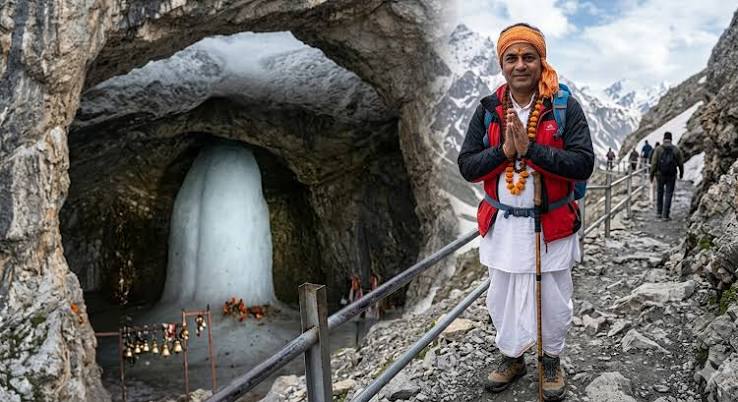
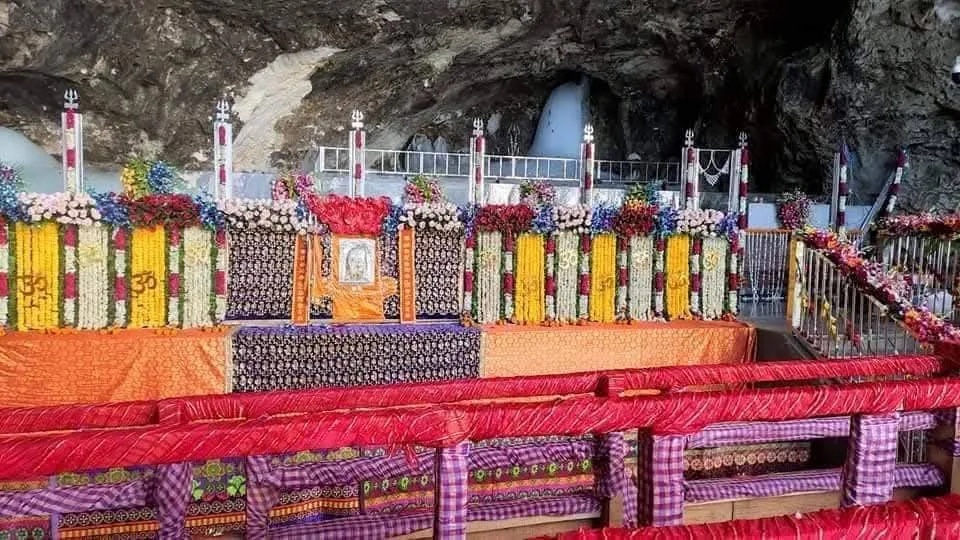
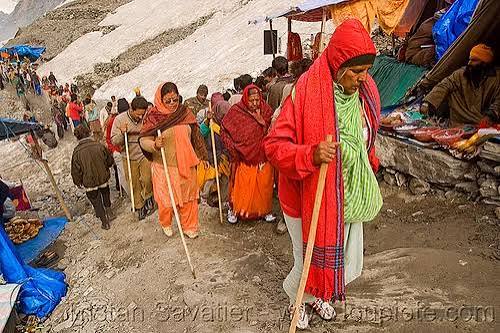
Every summer, the snow melts off the upper Himalaya, the Lidder and the Sindh swell with glacial water, and tens of thousands of pilgrims set out on a climb that is at once geographic, theological and psychological: the Amarnath Yatra. Through the steep defiles of Pahalgam and Baltal, the route climbs to an ice-formed lingam in a cave shrine more than 3,800 metres up. Officials tends to describe it in numbers – registrations, security deployments, medical camps, langars. That vocabulary is necessary for running the Yatra. It tells us almost nothing about what the Yatra is.
This is not simply an annual mass movement of devotees. It is a sustained metaphysical event, belief enacted upon terrain, and it says something enduring about Kashmir itself. To treat it only as religious tourism, or only as a security parameter to be managed each July, is to mistake the container for what it carries. What does it mean for ordinary people to put themselves, year after year, through a punishing high-altitude climb to a site whose sanctity is renewed rather than fixed? Why does a natural ice formation, melting within weeks of being formed, command more devotional weight than any permanent shrine could? These are not rhetorical flourishes; they are the actual questions a serious reading of the Yatra has to answer, and they are best approached through three threads – mountain, self, pilgrimage and composite culture: the Yatra as a metaphysics of sacred space and inner journey; as a rare resonance of faith, nature and soul against a fractured contemporary world; and as a philosophical testimony to Kashmir’s composite culture.
The Mountain as Axis Mundi: Reading the Yatra through Mircea Eliade
The Romanian historian of religion Mircea Eliade remains the clearest lens for understanding pilgrimage. He drew a line between profane space – ordinary, navigated by everyday coordinates and sacred space, which breaks suddenly into the ordinary and reorders the believer’s world around itself (Eliade, 1959, pp. 20–24). Eliade called this break a hierophany: a manifestation of the sacred that fixes, at the point it occurs, a centre – an axis mundi from which the world takes its bearings (Eliade, 1959, pp. 36–40).
The Amarnath cave works exactly this way. It is not just a cavern at altitude; for the pilgrim it is the point where the axis between earth and the transcendent becomes briefly visible, made real through the seasonal ice lingam – a hierophany that renews itself but never repeats, since its shape, size and timing shift from year to year. That variability resists the fixed permanence of a built temple and ties the sacred instead to climate, geology and cosmic rhythm. The mountain becomes what Eliade called an imago mundi, a miniature model of the universe (Eliade, 1959, pp. 42–44), where the climb is as spiritual as it is physical.
This is why the terrain cannot be dismissed as scenery before the “real” religious moment at the cave. The narrow tracks above Pissu Top, the hush of the Sheshnag lake, the gruelling final climb from Panchtarni – together these form a graduated liturgy, each stage a threshold.
Liminality, Communitas, and the Dissolution of the Social Self
If Eliade gives us the cosmology of sacred space, the anthropologist Victor Turner gives us the social psychology of the journey itself. Turner saw pilgrimage as the clearest example of liminality: ordinary hierarchy and role suspended, producing communitas – an unmediated fellow-feeling among people who exist, for the rite’s duration, “betwixt and between” their usual social positions (Turner, 1969, pp. 94–97; Turner & Turner, 1978, pp. 1–18).
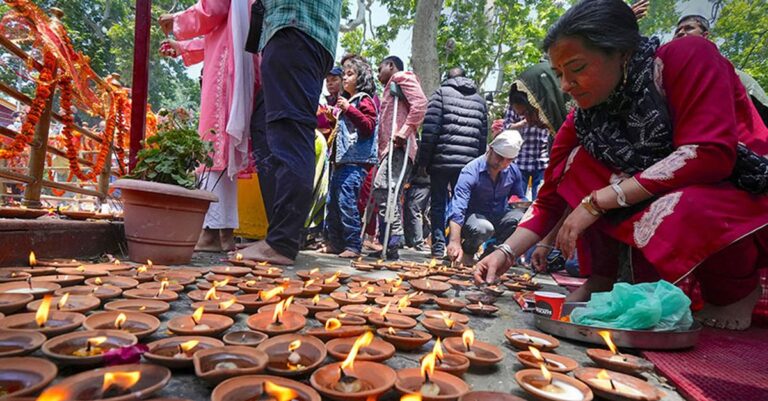
The Yatra shows this with unusual clarity. The pilgrim gives up domestic comfort and professional identity for the indistinguishable garb of the trail, the shared cold, and a radical dependence that mountain terrain forces upon strangers. A bureaucrat and a labourer from another state may find themselves on the same exposed ridge, trusting the same icy footing, the same rope-assisted crossing held together by porters and local guides. This is communitas not as an idea in a seminar room but as something the body is forced into. No designation, no salary slip, no caste certificate survives the climb intact; the mountain is, briefly, the great leveller that the plains rarely allow.
Turner separated the liminal – temporary, transitional – from the liminoid: comparable experiences in modern leisure that lack the structure of a genuine rite of passage (Turner, 1982, pp. 20–27). The Yatra resists slipping into the liminoid because it stays bound to cosmological markers – lunar dates, a fixed destination, the Amareshwara legend – and because its pilgrims take on real risk and real hardship. The terrain is not a backdrop. It is the mechanism of liminality itself. Breathlessness, vertigo, cold and fatigue strip away the pilgrim’s habitual sense of self and open the space through which transcendence is allowed in.
It is worth noting, carefully, a resonance – not a lineage with an idea familiar to Persianate and Kashmiri mysticism: the spiritual path as a stripping away (takhliyah) before the soul can be adorned (tahliyah) (Chittick, 1989, pp. 159–162). The logic of ascent-as-purification recurs across traditions, and the Yatra’s ordeal performs, in its own idiom, an inner emptying not unlike what other contemplative paths describe.
The Inner Journey: Terrain as Text of the Soul
If Eliade explains why the mountain is sacred and Turner how the journey dissolves the social self, neither alone explains what pilgrims themselves keep saying: that the Yatra is an inner journey, distinct from but inseparable from the outer one. Call this a theology of exertion – the belief, common to many ascetic traditions, that physical hardship is not incidental to spiritual attainment but central to it.
Kashmir’s own philosophy offers a sharper vocabulary than the borrowed language of effort and reward. In the non-dual Shaiva metaphysics native to the valley, Shiva names consciousness at rest – awareness in silence, still and undifferentiated – while Shakti names that same consciousness in motion, the dynamic energy through which the still ground becomes active and knowable (Abhinavagupta, trans. Singh, 1989, pp. 45–52; Dyczkowski, 1987, pp. 60–66). The two are not opposites awaiting reconciliation but a single reality seen from its two inseparable faces: Prakasha, the light of bare awareness, and Vimarsha, that light’s own grasp of itself – the moment stillness becomes aware that it is still (Abhinavagupta, trans. Singh, 1989, pp. 88–91). Seen this way, the cave and the climb stop looking like two different things. The frozen lingam is Prakasha rendered in ice; the toiling ascent, the breath, the chant are Shakti, Vimarsha moving through the pilgrim’s own limbs. Destination and journey are separably inseparable – two faces of one awareness, each complete only in the other’s presence.
The terrain – the switchbacks, the altitude sickness, the sudden weather – works as a kind of moral schooling within this same frame. Difficulty is not an obstacle to devotion; it is its medium, the Shakti-side labour by which a pilgrim approaches a Shiva-side stillness already waiting at the summit. Fighting breathlessness on the climb from Chandanwari is, in the devotional imagination, also a fight against accumulated ego and doubt. The mountain becomes a text: each switchback a line, each rest point a pause, the first sight of the cave a revelation that completes the sentence. This is a journey of the soul and not merely of the body – because the body’s exhaustion is exactly what makes the soul’s inward turn, Vimarsha folding back into Prakasha, visible to the pilgrim.
None of this is solitary withdrawal. The pilgrim’s inner change happens through the collective: the chants of “Bholey Baba,” the langars run by volunteers of every background, the porters and pony-handlers drawn overwhelmingly from the valley’s own villages. The inner journey is carried by an outer social fabric that the Yatra calls into being every year – assembled, taken apart, reassembled across decades.
Faith, Nature, and Soul amid Global Discord
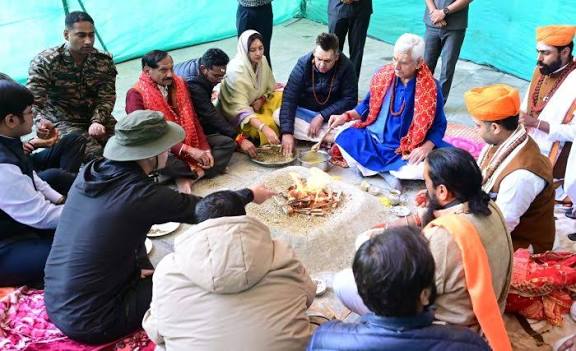
The contemporary world has no shortage of fractures. Economic inequality widens. Political polarisation hollows out shared civic language. Ethnic and ideological conflict recur with grim regularity across continents, and digital life, for all its connectivity, leaves most people lonelier and more anxious than before. Against this, the Yatra’s survival deserves to be read not as a leftover from another age but as a counter-argument.
What it offers, structurally, is a three-way resonance between faith, nature and the human soul that much of the modern world has lost. Today’s fractures are, at root, often a crisis of resonance: faith gets privatised and politicised rather than communally lived; nature is treated as a resource rather than a sacred presence; and the soul – the inner life of the person is pulled apart by productivity, consumption and grievance. The Yatra reverses each. Faith is performed openly and collectively, needing no doctrinal defence, in a landscape that imposes its own discipline. Nature is not backdrop but co-participant – glacier, cave and river all act upon the pilgrim. And the soul, instead of fragmenting under hardship, is put back together through it, exactly as communitas and hierophany would predict.
Continuity Under Duress: Silence, Stillness, and the Yatra’s Endurance
The Yatra’s persistence across three turbulent decades is usually told as a story of resilience – a ritual surviving despite hardship. That telling is not wrong, but it borrows its categories from politics, and it risks missing what is philosophically most interesting: the pilgrimage endures not only because communities choose, year on year, to keep it alive, but because of what kind of event it is. An axis mundi, in Eliade’s sense, is by definition the still point around which a disordered world is reordered (Eliade, 1959, pp. 36–40). Its claim on continuity rests not on the absence of disturbance but on its capacity to remain a centre regardless of what circulates at its edges.
Kashmir’s non-dual Shaiva thought gives this a sharper description than the language of survival can. If Shiva is consciousness as silence and Shakti consciousness as movement, then duress – any disturbance – belongs entirely to the register of Shakti: movement within a field whose ground is never itself in motion (Dyczkowski, 1987, pp. 88–93). The Yatra’s unbroken recurrence each season is, on this reading, not a triumph over circumstance requiring an adversary, but the simple visibility, year after year, of a stillness never actually contingent on the surrounding weather of events. The mountain need not overcome disturbance to remain an axis; it only has to remain what it already is. Continuity here is not resistance dressed in ritual clothing – it is Prakasha, showing through.
This matters because it shifts the weight of the Yatra’s endurance toward a question proper to pilgrimage studies itself: what does it mean for a sacred centre to be, in Eliade’s phrase, a fixed point in a moving world (Eliade, 1959, pp. 20–24)? Each season can be read as a renewed Vimarsha – consciousness’s self-recognition performed collectively on the mountain’s terrain, thousands of selves arriving again at a centre that does not move even as everything around it does. Kashmir’s composite culture, on this account, is less a fragile arrangement requiring constant defence than a lived expression of the same Shiva–Shakti dynamic at community scale: stillness, a shared sense of place, and movement, the plural hands that carry the ritual forward each year, working as one inseparable process rather than as two things held together by sheer effort.
Understood this way, the Yatra’s continuity is less a claim about politics than a claim about the structure of sacred space itself – that an axis mundi, once established, organises the disturbances around it rather than being organised by them. The pilgrim’s own ascent enacts this in miniature: every uncomfortable step is Shakti; every moment of arrival, however brief, is Shiva. The mountain simply repeats, season after season, a fact about consciousness that Kashmir’s own philosophers worked out long before any modern vocabulary of conflict and resilience existed – that stillness and movement were never two separate things needing reconciliation, only one thing, recognising itself.
The Yatra as the Essence of Kashmir, Not Only of Hindu Devotion
It follows that the Amarnath Yatra cannot be properly understood as a Hindu pilgrimage that merely happens to occur on Kashmiri soil. That framing, common in administrative shorthand, gets the relationship backwards. The Yatra is Kashmiri before it is, in any narrow sociological sense, transplanted devotion. Its route, its seasonal rhythm, its dependence on local ecological knowledge, its place in the region’s mixed economy of hospitality – all mean that the pilgrimage’s very possibility has always been co-authored across the valley’s communities.
This co-authorship is a structural feature of how the region has always understood itself, where devotional geography and religious identity were never as neatly separable as later narratives have sometimes insisted. The porter carrying an elderly pilgrim’s belongings across Pissu Top, the shopkeeper who has supplied the same families for generations, the local administration that keeps the Yatra running each season – none of these are external support to an essentially Hindu ritual. They are internal to a pilgrimage that is, properly understood, a shared Kashmiri institution, a living instance of composite culture rather than a metaphor for it. To separate the Yatra from Kashmiriyat is to misdescribe both.
Conclusion
Read through Eliade’s sacred space and Turner’s liminal process, the Amarnath Yatra is a dense event: an axis mundi that reorders the pilgrim’s world, a liminal ordeal that dissolves ordinary identity into communitas and, through exertion, into felt inner change. Set against today’s global discord, it stands as a rare case of restored resonance between faith, nature and the human soul. And read through the valley’s own non-dual Shaiva philosophy, its unbroken continuation looks less like a story of resistance than the patient, recurring visibility of a stillness – Shiva, Prakasha – that the moving world’s disturbances have never actually displaced. The mountain does not merely receive the pilgrim’s devotion. By permitting the journey, season after season, it remains what an axis mundi has always been: the still point at which the self, the sacred and a composite culture recognise themselves as one inseparable movement.
References
Abhinavagupta. (1989). A trident of wisdom: Translation of Para-trīsikâ-Vivaraṇa (J. Singh, Trans.). State University of New York Press.
Chittick, W. C. (1989). The Sufi path of knowledge: Ibn al-‘Arabī’s metaphysics of imagination. State University of New York Press.
Dyczkowski, M. S. G. (1987). The doctrine of vibration: An analysis of the doctrines and practices of Kashmir Shaivism. State University of New York Press.
Eliade, M. (1959). The sacred and the profane: The nature of religion (W. R. Trask, Trans.). Harcourt, Brace & World.
Turner, V. (1969). The ritual process: Structure and anti-structure. Aldine Publishing.
Turner, V. (1982). From ritual to theatre: The human seriousness of play. Performing Arts Journal Publications.
Turner, V., & Turner, E. (1978). Image and pilgrimage in Christian culture: Anthropological perspectives. Columbia University Press.
About the Author