
www.himalayanprf.org
Written by: Dr. Peerzada Muneer
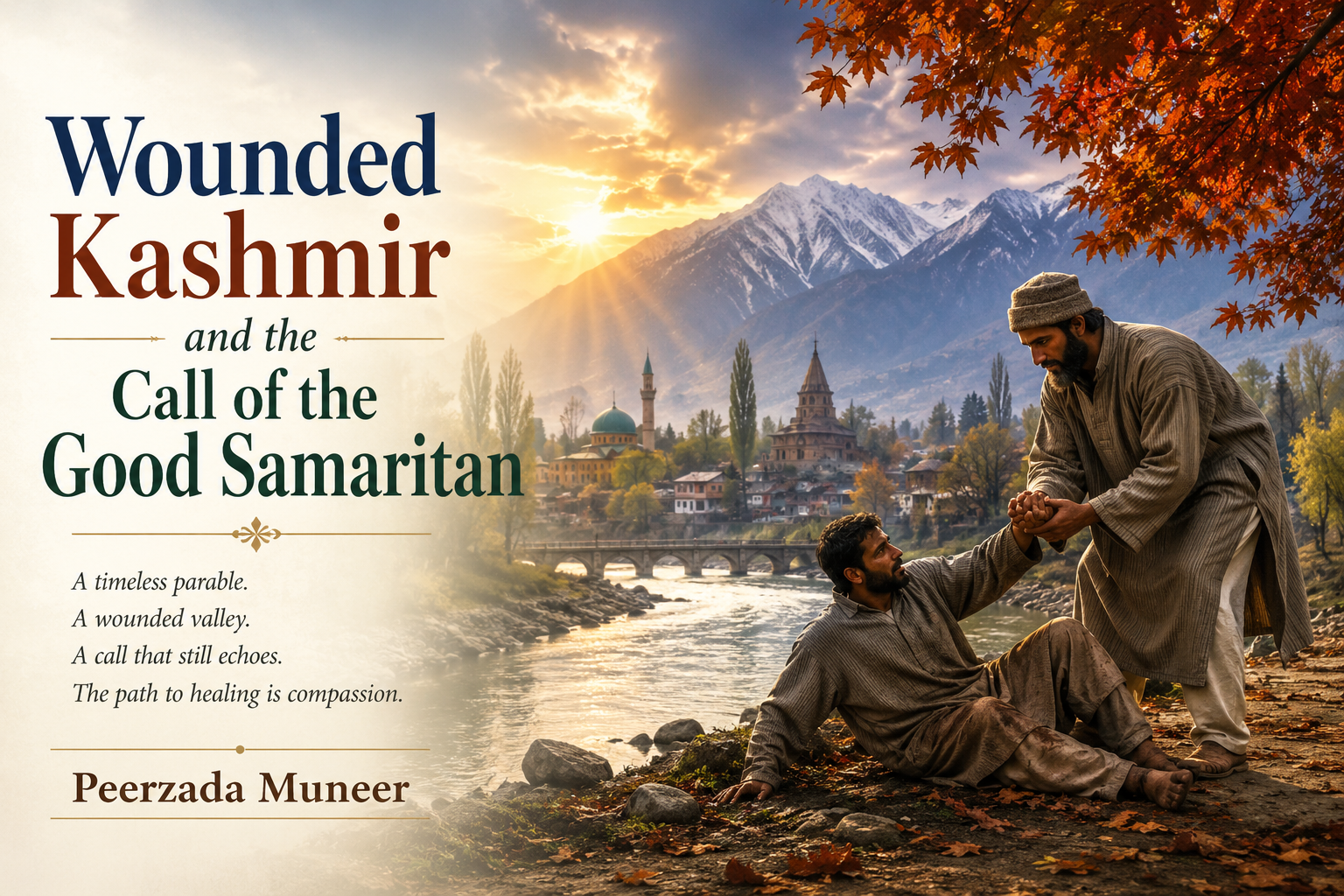
The “Parable of the Good Samaritan” is a significant narrative from the Bible, located in the book of Luke, chapter 10, verses 25-37. In this parable, a man is savagely assaulted, robbed, and abandoned, left in a state of near death on the roadway. A priest and a Levite, among others, bypass the injured guy without providing aid. Nevertheless, it is a Samaritan, an individual from a community scorned by the Jews, who exhibits compassion and tends to the wounded man. He attends to the man’s injuries, transports him to an inn, and caters to his requirements. Jesus employs this parable to convey a vital lesson regarding the significance of extending charity and love to one’s neighbour, irrespective of their background or differences.
This eternal lesson in compassion and love profoundly reflects the intricate and persistent concerns and viewpoints of Kashmir. Kashmir, situated in a scenic yet tumultuous valley, has experienced the departure and return of the Kashmiri Pandits, reflecting the ethical quandaries and problems illustrated in this biblical narrative. Similar to the Samaritan’s deeds that surpassed religious and ethnic divisions, the Kashmiri Pandits’ longing for home and reconciliation epitomizes the pursuit of harmonious coexistence in a region characterized by conflict.
The core of the parable, articulated through the lawyer’s inquiry regarding the achievement of eternal life via love for God and neighbor, is profoundly pertinent to the situation in Kashmir. This region possesses a profound history of religious and cultural variety, marked by a distinctive amalgamation of Sufi and Shaivite traditions. This synthesis, commonly termed “Kashmiriyat,” embodies the concept of love and compassion that surpasses religious and cultural divides.
In the parable of the Good Samaritan, the wounded man lying defenseless and unclothed on the road represents vulnerability. Likewise, the Kashmiri Pandits, compelled to abandon their motherland, became casualties of violence and insecurity. Their departure was characterized by trepidation, bereavement, and a deep sense of dislocation. They were deprived not only of their possessions but also of their ancestral heritage, akin to the man who was assaulted and left in a state of near death.
The characters in the parable – the priest, the Levite, and the Samaritan – metaphorically represent the varied responses to the suffering of the Kashmiri Pandits. The priest and the Levite, who disregarded the wounded man, symbolize the apathy and silence exhibited by many people who could have done a thing to prevent the exodus. The two groups, familiar with the region’s social dynamics, opted not to intervene in the issue.
In contrast, the Samaritan who assisted the wounded man parallels the individuals and organizations, both inside and beyond Kashmir, that offered support to the displaced Kashmiri Pandits. The Samaritans provided assistance, refuge, and support to the Pandit community during their most challenging times. Their deeds surpassed religious and ethnic divisions, exemplifying love and compassion for their neighbors in need.
Kashmir’s tradition as a fertile environment for various religious and cultural identities is fundamentally anchored in the synergy between Sufism and Shaivism. Sufism, characterized by its focus on mysticism, spirituality, and a direct personal relationship with the divine, aligned with the Shaivite philosophy dominant in the region. This merger produced a distinctive amalgamation of practices, beliefs, and cultural expressions that defined Kashmiri identity.
The accession of Jammu and Kashmir to India initiated a prolonged struggle centered on political and territorial conflicts. Over the years, this region transformed into a battleground for conflicting narratives, exacerbating tensions and frustrations among its varied people. One of the most terrible and poignant events in Kashmir’s history was the exodus of the Kashmiri Pandits in the late 1980s and early 1990s, a time characterized by rising militancy and violence. The forceful departure of the Pandit minority highlighted the significant issue of maintaining the heterogeneous fabric of Kashmir.
The migration of the Kashmiri Pandits, a deeply terrible episode in Kashmir’s history, serves as a painful parallel to the injured individual in the parable of the Good Samaritan. The Pandit community, once a vital component of Kashmir’s complex social fabric, suffered violence, persecution, and displacement throughout the turbulent late 20th century. Their coerced exodus from their original territory has resulted in enduring scars that persist to the present day.
Recent years have witnessed initiatives and a semblance of optimism over the repatriation of the Pandits to Kashmir. This return indicates the Samaritan’s dedication in the narrative to cure and restore the injured. It signifies a lasting affection for the land and a steadfast pursuit of reconciliation, despite apparent insurmountable challenges. It exemplifies the extraordinary tenacity of a people endeavoring to reconstruct and reintegrate into the intricate fabric of Kashmiri society.
The homecoming of the Kashmiri Pandits should not be perceived just as a gesture of hospitality or the relocation of individuals to distinct enclaves. It should represent the reconciliation of a divided family, wherein the Pandits are welcomed as an essential component of the same social fabric, endowed with all the rights, security, and dignity that this involves.
Their homecoming hinges on the assurance of security and the preservation of their dignity. Prioritizing their protection is essential, necessitating the implementation of extensive security measures to ensure a life devoid of fear and persecution.
Inclusion is essential for effective reintegration. It is imperative to avoid the segregation of Pandits into distinct colonies, allowing them to blend harmoniously into existing communities to cultivate a deep feeling of belonging and oneness. Furthermore, they must to have the ability to actively engage in local administration, partake in decision-making processes, and articulate their concerns to guarantee that their distinct perspectives are acknowledged.
The repatriation of the Pandits must include the restitution of their ancestral lands and properties, enabling them to reconstruct their lives and livelihoods. Assistance for the restoration of their residences, many of which have deteriorated during their absence, is vital.
Sacred freedom must be ensured, enabling the Pandits to restore their sacred places and practices unimpeded, thereby safeguarding their valued cultural and spiritual heritage. Furthermore, granting access to local schools for the education of Pandit children without discrimination is essential for their seamless assimilation into the educational system.
Economic prospects, skill enhancement initiatives, and job possibilities must be established to aid the Pandits in reconstructing their lives and livelihoods. Active support for cultural preservation initiatives is essential to protect and promote the distinctive customs and languages of the Kashmiri Pandits, ensuring their transmission to future generations.
A thorough process of reconciliation and healing must be commenced to confront the profound scars of the past and cultivate a revitalized feeling of togetherness and forgiveness among all communities in Kashmir. By doing so, the area may progress towards a more promising future, whereby the diversity of its cultural legacy continues to serve as a source of strength and resilience.
The cultural legacy of Kashmir is a complex amalgamation that transcends simplistic religious classification. This reflects the region’s syncretic, spiritual, pluralistic, and devotional characteristics. This affluent and varied history has developed over centuries, molded by the interaction of several religious, artistic, and philosophical influences.
Syncretism in Kashmir is manifest in the coexistence and interaction of several religious traditions, including Hinduism, Islam, Buddhism, and Sikhism. This connection has resulted in a synthesis of ideas and practices that influence the art, music, folklore, and lifestyle of the region. Kashmiri cultural expressions are profoundly anchored in spirituality and mysticism, transcending religious confines and highlighting the quest for inner enlightenment and a profound relationship with the divine.
A hallmark of Kashmiri cultural legacy is its dedication to pluralism and religious tolerance. Kashmir’s history has been characterized by a confluence of several faiths, with its ethos honoring diversity and fostering unity among disparate populations. The ethos of tolerance is ingrained in the region’s culture, music, and art, promoting an atmosphere of cohabitation and reverence for diverse belief systems.
The cultural expressions of Kashmir are marked by a celebration of existence, nature, and spirituality. Festivals like Navroz, Shivratri, Eid, and others serve as occasions for communal celebrations that surpass denominational barriers. These festivals exemplify the inclusive essence of Kashmiri culture, uniting individuals from varied origins in shared rituals and celebrations.
Kashmir is renowned for its unique and intricate artistic traditions. The region’s handicrafts, woodwork, textiles, and pashmina shawls exemplify a confluence of artistic influences and illustrate the cross-cultural exchanges that have molded Kashmiri art.
The folklore and storytelling traditions of Kashmir comprise a rich collection of narratives that frequently transcend religious borders. These narratives provide ethical teachings, insight, and a sense of communal belonging that resonates with individuals from diverse backgrounds. They encompass universal themes of love, compassion, and human values.
Music, encompassing classical, folk, and devotional genres, serves as a unifying influence in Kashmir. Sufi music, highlighting the spiritual path and divine love, resonates with audiences of various religions. The amalgamation of traditional instruments and tunes illustrates the interaction of diverse cultural influences.
The tale of the Good Samaritan profoundly influences the cultural, spiritual, and political landscape of Kashmir. The Sufi-Shaivite concord, commonly known as “Kashmiriyat,” encapsulates the principle of kindness that surpasses religious divisions. Kashmir’s legacy as a crucible for varied identities, both religious and cultural, highlights the significance of pluralism and tolerance.
The adversities encountered by the Kashmiri Pandits, their displacement, and their ongoing repatriation serve as a poignant reminder of the necessity for empathy, reconciliation, and restoration in the region. Kashmir, in its pursuit of restoring unity and cultivating a unified identity, may find inspiration in its profound history of syncretism and the enduring lesson of the Good Samaritan.
The route to enduring peace in Kashmir necessitates the adoption of the Good Samaritan ethos and the pursuit of a future wherein all communities coexist harmoniously, irrespective of their religious, cultural, or political disparities. The fable illustrates that love, compassion, and mercy ought to direct our interactions to foster unity amidst variety and guarantee that Kashmir remains a nursing mother to all its varied identities.
About the Author