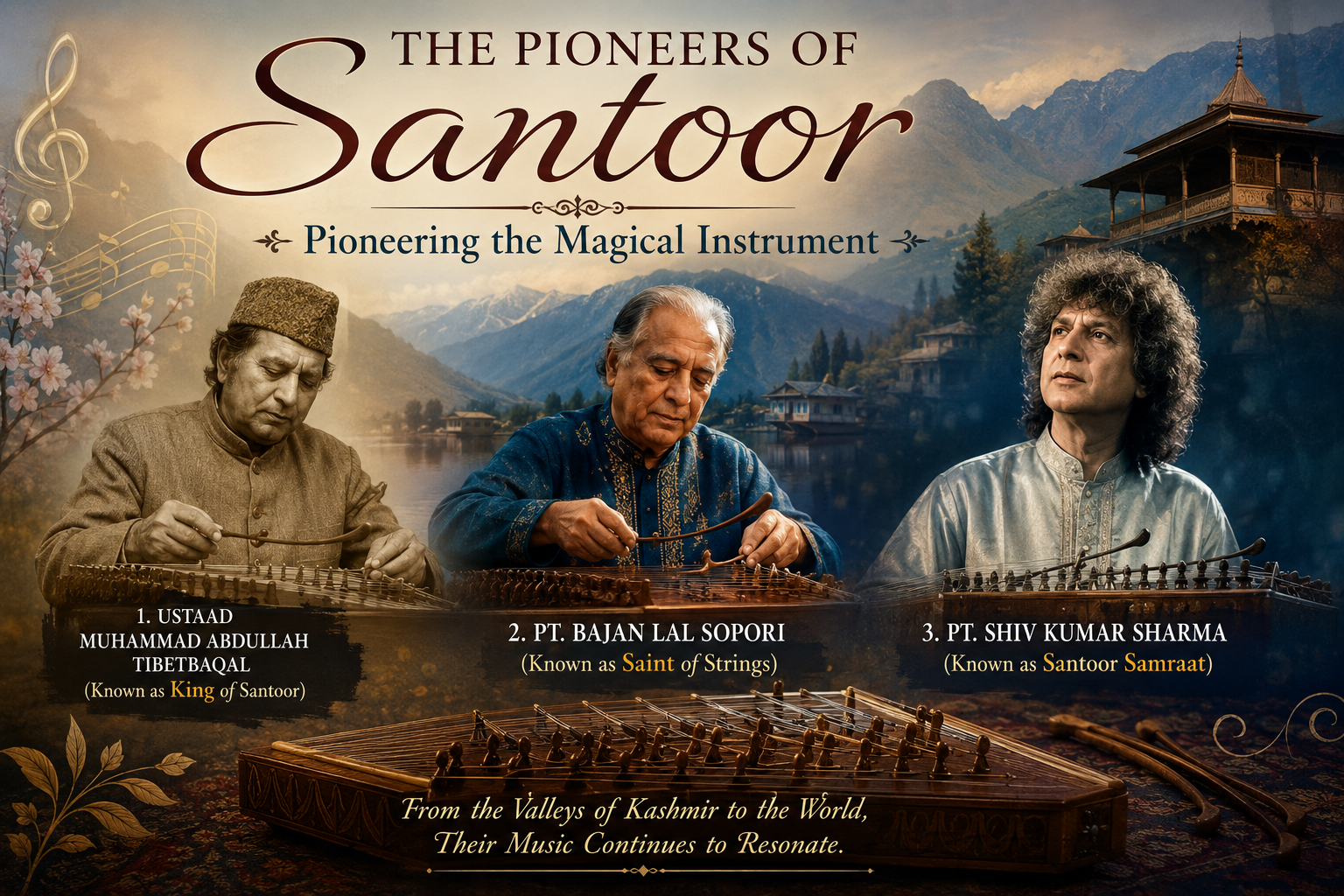
Pioneering Santoor The Magical instrument
Written by: Adil Tibatbakal
- Ustaad Muhammad Abdullah Tibetbaqal (Known as King of Santoor)
- Pt. Bajan Lal Sopori (Known as Saint of Strings)
- Pt. Shiv Kumar Sharma (Known as Santoor Samraat)
Ustaad Muhammad Abdullah, known as Tibet Baqal, was not just a master musician—he was the heartbeat of Santoor in Kashmir. His journey defined an era, where music became a sacred path, and the Santoor, a divine companion.
Born in the spiritual heart of Kashmir, Ustaad Muhammad Abdullah was drawn to the Santoor as if it were a part of him. He spent years mastering the instrument, eventually becoming its most revered exponent.
This powerful declaration wasn’t arrogance—it was truth. He lived, breathed, and spoke through the Santoor, making it sing with love, devotion, and divine ecstasy.
Title: “Tibet Baqal”
The title “Tibet Baqal” was a mark of deep respect, bestowed upon him by admirers during his time at Radio Kashmir, where his music touched hearts across generations. It reflected both his mystical aura and unmatched musical grace.
Radio Kashmir and Recognition
At Radio Kashmir, Ustaad Tibetbaqal shaped the cultural soul of the region. His live performances and recordings introduced the magic Santoor Recitals & Sufiana Kalam to the wider world.
Achievements
Sangeet Natak Akademi Award (1972): First recipient from Jammu & Kashmir, this national award was a landmark moment in Kashmiri music history.
Master of Sufiana Kalam: His Santoor carried the essence of Sufi poetry and mysticism.
Beloved Performer: His concerts were spiritual journeys that lifted listeners into a state of calm and reflection.Ustaad Tibetbaqal’s legacy is timeless. He transformed the Santoor from a folk instrument into a symbol of Kashmiri identity and spiritual pride. His lineage would continue to carry this sacred responsibility forward.
Pt. Bajan Lal Sopori was born in Srinagar into a Kashmiri Pandit family to Shambhu Nath Sopori on 22 June 1948.Pt Bajan Lal Sopori hailed from Sopore in the Baramulla district of the Kashmir Valley and traced his lineage to ancient Santoor experts. He belonged to the Sufiana gharana of Indian classical music. His family has played santoor for over six generations.[6] His first public performance was at a conference organised by Prayag Sangeet Samiti & the University of Allahabad when he was 10 years old.Pt. Bajan Lal Sopori gave his first public performance in 1953, at the age of five. He learned western classical music from Washington University & Hindustani from his grandfather S.C. Sopori and father Shambhoo Nath.Pt. Bajan Lal Sopori has taught music at Washington University, US. His performances have been broadcast in India and seen by both cultural associations there and by audiences in countries such as Belgium, Egypt, England, Germany, Norway, Syria and the USA. Sopori stated that “he worked with All India Radio in 1990, when he was transferred to Delhi,” and that “no music was produced from the valley. There was not even a tabla player to accompany him” when he returned.
—A result of decades of experimentation and innovation, Sopori’s Santoor and its playing style now known as ‘Sopori Baaj through its novel construction, further adoption of Dhrupad aesthetics, and its variety of kalam (wooden mallets).
Originating from the Santoor used in Sufiana Mausiqi, the Sopori Santoor is essentially an expanded version, covering more than 5 1/2 octaves, adorned with certain classical innovations including an attached tumba (goard) to enhance the posture and bass of the instrument (also used for Sitar and other Hindustani Classical instruments), sympathetic strings (or ‘tarab’, also found on many instruments in the Hindustani tradition), and thick strings that produce a singing glide when pressure is applied, an emulation of a technique that is essential in Indian music called Meend. Like Dhrupad, the Sopori Baaj places much emphasis on the Raag Alaap (the elaboration of a Raga without percussion), using a heavier pair of kalam to enhance the sustain of a single note. The Sopori Baaj is also unique in its consistent use of the Pakhawaj along with Tabla for accompaniment. In recent years, the Ghatam has also been added to the percussion ensemble.
Pandit Shivkumar Sharma (Santoor Samraat)(1938-2022) was an Indian classical musician and composer, renowned for popularizing the santoor, a Kashmiri folk instrument, in Hindustani classical music. He was born in Jammu and began learning Tabla at a young age from his father, Uma Dutt Sharma, and Santoor Instrumental from Ustaad Muhammad Abdullah Tibetbaqal who was Legendary Santoor and Suffiyana Maestro of that time Sharma’s innovative approach to the santoor, including expanding its range and developing a new playing technique, helped establish it as a solo instrument in the classical music scene. At the age of 14 , Pt. Shiv Kumar Sharma started learning the santoor, a 100-stringed instrument, from Ustaad Muhammad Abdullah Tibetbaqal which was traditionally used in Sufi music of Kashmir
About the Author