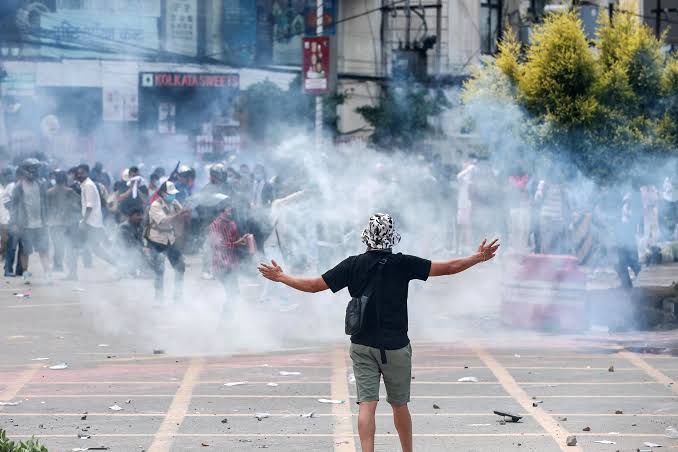
What the rise of Balendra Shah reveals about democratic disillusionment – and the brutal institutional logic that awaits those who promise transformation.
Written by: Durdana Samoon ( Research Scholar )
There is a particular grammar to anti-incumbency in South Asian democracies. Public dissatisfaction is no longer directed solely at specific leaders or policy failures; rather, it increasingly reflects a deeper repudiation of the structural conditions that have historically constituted and sustained political authority. This is the only meaningful lens through which the contemporary political moment in Nepal can be understood, where Balendra Shah has rapidly emerged within Kathmandu’s municipal governance structure. His rise cannot be reduced to the trajectory of an idiosyncratic individual. Instead, it signals a broader reconfiguration of representational authority, as a disillusioned youth-frustrated with entrenched patronage networks, elite capture, and the procedural rigidity of conventional party structures- actively expands the normative bases of political legitimacy.
This phenomenon is neither unprecedented nor geographically isolated. From the authoritarian-adjacent populism of Nayib Bukele to the early governance experiment of the Aam Aadmi Party in Delhi, generational displacement of incumbent elites has repeatedly been mobilised as a vehicle for systemic reform. What distinguishes these transitions analytically is not their surface novelty but the structural tension they invariably produce: the collision between reform-oriented political agency and the path-dependent institutional architectures within which governance must ultimately be operationalised. It is this tension-rather than the symbolic appeal of youth-that constitutes the central problematic of generational political transition.
Youth-led governance derives its initial legitimacy not primarily from demonstrable output performance but from what political theorists designate as input legitimacy: legitimacy constituted through perceived representativeness and responsiveness. Among younger electorates inheriting governance systems marked by chronic bureaucratic inertia, systemic opacity, and the normalisation of elite impunity, such leadership functions as a symbolic rupture from the patrimonial networks that have historically mediated access to state resources. In Bourdieusian terms, this constitutes a form of political capital-accumulated not through institutional positioning but through the embodied representation of generational aspiration-that can be strategically deployed to reconfigure both institutional relationships and public expectations of what governance is fundamentally for (Pierre Bourdieu).
The symbolic dimension is further reinforced by the modalities of youth leadership. Shah, for instance, has consistently privileged direct engagement over traditional party-mediated channels, cultivating digitally mediated public spheres that bypass established intermediary structures such as patronage brokers, factional hierarchies, and elite gatekeepers. This is not merely tactical innovation. It represents a qualitative transformation in the normative
relationship between executive authority and civic constituencies, reconstituting expectations of administrative accessibility and deliberative accountability in ways that legacy governance structures are structurally ill-equipped to replicate.
And yet, the institutional environment within which such governance must be enacted introduces constraints of considerable analytical weight. Governance does not operate upon a blank canvas; it is exercised within historically sedimented configurations-legal-bureaucratic regimes, administrative hierarchies, inter-agency coordination mechanisms, and regulatory frameworks-whose evolutionary trajectories are characterised, within historical institutionalism, by deep path dependency. As theorised by Douglass North and Paul Pierson, institutional arrangements embody accumulated investments in particular procedural logics. Departures from established trajectories are structurally costly, organisationally disruptive, and frequently subject to juridical contestation. Institutional persistence, in this sense, is not reducible to mere conservatism or elite obstruction; it reflects the functional embeddedness of procedural configurations within governance ecosystems that have adapted-however imperfectly-to the recurrent demands of administrative complexity.
This produces a structural paradox that is often undertheorized in popular accounts of political transition. The very institutional arrangements that youth-led administrations identify as primary objects of reform simultaneously constitute the principal mechanisms of systemic stability, policy continuity, and juridical predictability. Their procedural density is not purely symptomatic of dysfunction; it is also a sedimentary record of iterative institutional adaptation. Reform initiatives, consequently, cannot be enacted through simple circumvention. They must be mediated through these configurations-negotiated across procedural protocols, inter-agency hierarchies, and regulatory constraints that are inherently resistant to rapid reconfiguration. This dynamic must be recognised as structural constraint rather than misread as executive underperformance.
It is precisely here that the expectation–performance disequilibrium-arguably the most consequential challenge confronting youth-led governance-emerges with particular acuity. Political transitions driven by popular mobilisation generate inflated expectations of transformation. Youth leaders, by virtue of their symbolic differentiation from entrenched elites, are often perceived as possessing qualitatively distinct reformist capacity. While this perception constitutes a powerful electoral asset, it simultaneously becomes a governance liability of the first order. Empirically, governance outcomes are incremental and temporally lagged. Structural reform requires prolonged institutional engagement, sustained coalition-building, and careful navigation of juridical constraints.
Policy effects materialise through cumulative, often non-linear processes that resist the immediacy of political narratives. The divergence between anticipated and actual outcomes is therefore not a reflection of executive inadequacy but is rooted in the institutional logic of transformation itself. However, sustained misalignment between expectation and performance generates a gradual erosion of the very legitimacy upon which youth-led administrations depend. Incremental gains are normatively discounted when they fail to match the promised scale of change. Affective political support is transformed into public
disillusionment- a dynamic particularly corrosive where legitimacy is founded on mobilisational expectation rather than demonstrated competence. More critically, the communicative strategies that initially generate resonance- digital responsiveness, anti-establishment rhetoric, and the language of rupture- can intensify this disequilibrium by compressing feedback loops and leaving little discursive space for the slow, unglamorous work that meaningful institutional reform demands.
The long-term sustainability of youth-led governance is therefore contingent not upon the indefinite extension of mobilisational energy but upon what may be termed momentum management: the strategic alignment of public expectations with the temporal realities of institutional transformation. This requires a delicate discursive shift- from disruption-centric narratives that derive legitimacy from contrast with incumbent failures to process-oriented frameworks that foreground gradualism, negotiation, and cumulative reform. Failure to execute this recalibration risks entrapping leadership within a logic of perpetual mobilisation, a posture structurally incompatible with the demands of sustained governance.
Institutionally, meaningful transformation is unlikely to emerge from wholesale displacement- an approach that is both politically impracticable and systemically destabilising. More viable pathways lie in incremental internal reform: leveraging existing institutional capacities, cultivating alliances within administrative hierarchies, and progressively reconfiguring operational logics from within. This is not an accommodation to dysfunction; it is a recognition that durable transformation is more effectively achieved through sustained endogenous reconfiguration than through externally imposed rupture.
A related and underappreciated risk confronting youth-led regimes is entrapment within the domain of symbolic representation, wherein political capital generated through generational turnover is consumed by performative governance rather than translated into substantive institutional output. Symbolic legitimacy, while compelling, lacks durability in the absence of measurable policy outcomes. The critical transition- analytically and practically- is from representation to institutionalisation: from embodying change to embedding it.
Ultimately, the evaluative benchmark for youth-led governance- whether in Nepal or elsewhere- lies in its capacity to institutionalise reform: to embed change within durable configurations that persist beyond individual leadership cycles and remain resilient across political transitions. For figures such as Shah, the movement from symbolic expectation to operational governance is not merely a personal challenge; it is the constitutive test of youth-led politics itself. Democratic renewal, in its deepest sense, will be judged not by the intensity of disruption, but by the durability of transformation.
About the Author