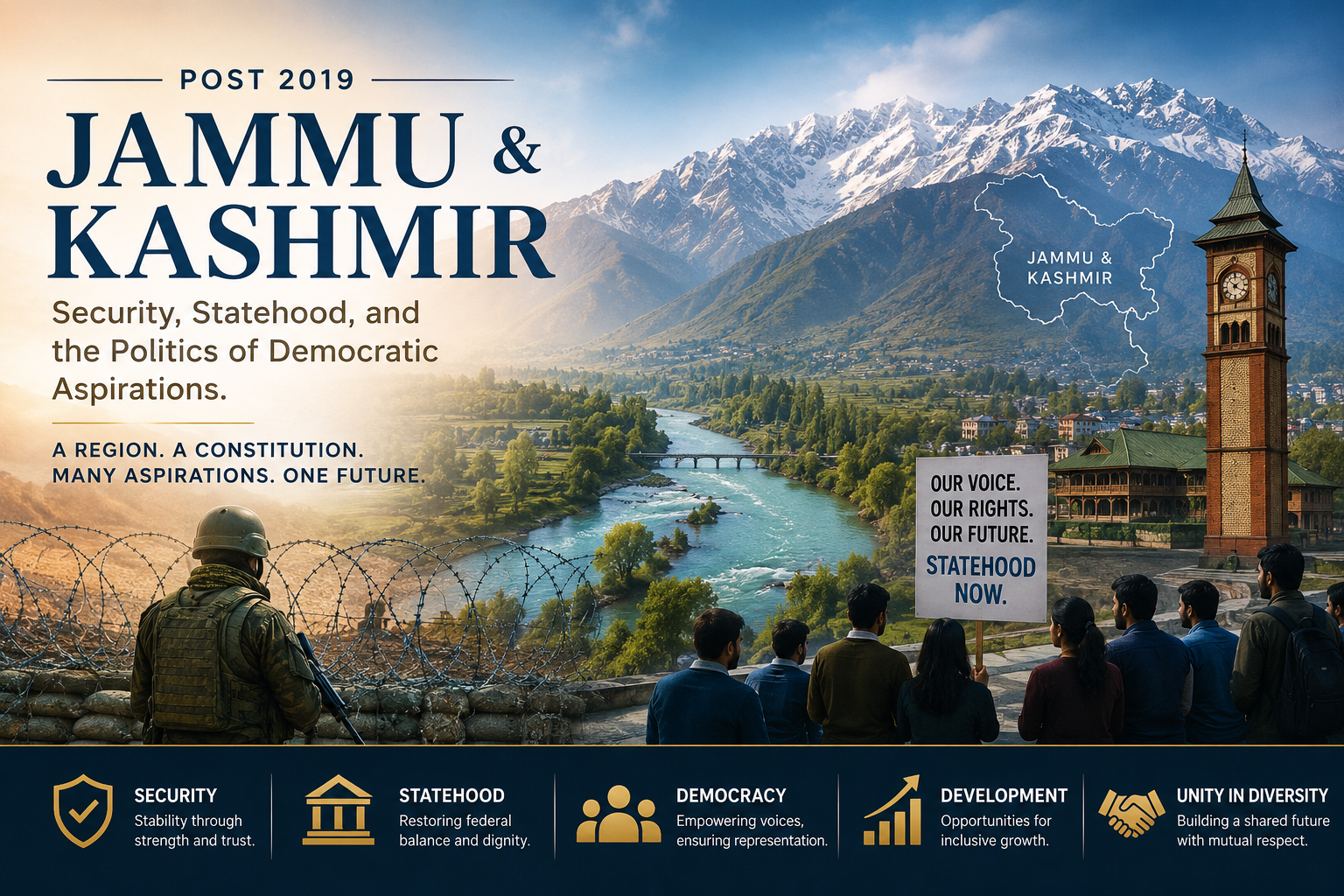
Post 2019 Jammu and Kashmir
Durdana Samoon, Research Scholar, ( Public Policy And Public Administration )
Jammu and Kashmir, flanked by the snow-covered Pir Panjal mountains and the vast Himalayan foothills to the north, along with the Shivalik foothills to the south, with the Jhelum River marking its fertile valley, is a vital component of India’s constitutional framework and geopolitical landscape.The region’s geography has historically shaped settlement patterns, agricultural productivity, and political arrangements, making it both essential and unique.The current political dialogue over Jammu and Kashmir is characterised by three principal tensions: national security issues, the unresolved desire for statehood, and the diverse political desires of its inhabitants.The previous Article 370 provided a framework of asymmetric federalism intended to reconcile local autonomy with national integration; nevertheless, the 2019 reorganisation into Union Territories has intensified debates concerning governance, democratic legitimacy, and popular sovereignty. Mainstream political parties underscore statehood as vital for democracy; yet, the general people articulate aspirations that extend beyond constitutional recognition, encompassing economic opportunity, political agency, and socio-cultural validation. Jammu and Kashmir, more than a mere geographical entity, represents a convergence of constitutional frameworks, strategic imperatives, and societal heterogeneity, thereby demanding intricate policy interventions that reconcile security concerns, administrative practices, and democratic ideals.
Almost five years after the constitutional amendment of Article 370 in August 2019, Jammu and Kashmir stands at a pivotal institutional and political crossroads within India’s federal structure. While security data suggests a degree of stability, discussions concerning the reinstatement of statehood persist, shaping political culture, public aspirations, and perceptions of institutional credibility. The constitutional amendment of Article 370, coupled with the enactment of the Jammu and Kashmir Reorganisation Act, 2019, precipitated a substantial constitutional shift, fundamentally altering the region’s legal, administrative, and governmental frameworks. These structural changes led to different political paths, sparking debate about their alignment with public political goals: the consolidation of Union Territory status, which aimed to strengthen governance and security, and the restoration of statehood, seen as essential for federal equality, institutional diversity, and democratic principles. At the same time, the ongoing discussions highlight the difficulty of balancing effective governance with the security needs of a border area, a region shaped by geopolitical tensions and conflict.The statehood discussion extends beyond legal aspects, involving a thorough analysis of governance legitimacy, social stability, and the expected integration of democratic power among the citizenry.Consequently ,this underscore the interaction between constitutional design and societal expectations.
Since 2019, Jammu and Kashmir has experienced a pronounced reduction in disruptive collective action, a development closely linked to the structural and administrative measures introduced during the post-reorganisation phase. Large-scale street mobilisations, coordinated shutdowns, and prolonged internet restrictions- constitutive of cyclical unrest substantially declined, illustrating the effectiveness of both security interventions and administrative oversight. The data supports this change: in 2018, there were 52 organized shutdowns and 1,221 stone-pelting incidents. By 2023, organized incidents had stopped completely, and terror-related events had decreased from 228 to 44.Civilian deaths diminished by 81%, terrorist incidents by 66%, and security-force fatalities by 48%, thereby suggesting both operational success and improved community compliance. This observed stabilization primarily stems from a reduction in local insurgent recruitment. This decrease has resulted from the combined effects of intensified counter-insurgency efforts, enhanced intelligence sharing, the financial weakening of militant organizations, and the curtailment of political channels that previously facilitated insurgent mobilization. The resurgence of tourism and economic activity, as evidenced by an increase from 3.4 million visitors in 2020 to over 20 million in 2023, reflects a rise in public confidence and a wider socio-economic return to normalcy, thus underscoring the relationship between security, economic management, and public approval. These developments collectively illustrate the interplay of state capacity, operational effectiveness, and socio-political dynamics in fostering stability and bolstering institutional confidence, consequently establishing an environment conducive to developmental governance.
The consolidation of institutions following reorganisation exemplifies Max Weber’s claim that the state holds a legal monopoly on coercive power, underscoring the essential function of administrative rationality in calming conflict-affected areas.The centralised coordination of security services, along with advanced monitoring capabilities and unified command structures, has enhanced operational coherence, enabling a systematic response to internal and external threats.Cross-border infiltration efforts are now facing significantly stronger barriers, a shift that showcases advanced technical capabilities, improved coordination between agencies, and strategic operational planning. Infrastructure initiatives, economic expansion, and the subsequent electoral processes constituted the primary concerns of this period. These transformations are observable within security as per various official and other independent data,a phenomenon referred to as “normalisation.” This balance of governmental power and authority is a key indicator in how well institutions work and how much the public trusts them.
The 2024 legislative assembly elections, the first since the region’s reorganization, saw a significant voter turnout. The outcome was a government led by Omar Abdullah, with the Jammu and Kashmir National Conference at the helm. This marked the return of a representative government, even if it operated within a unified administrative framework. The significant voter turnout underscores the gradual, yet persistent, adoption of constitutionally mandated democratic norms.Thus, the devolution of executive authority manifest a significant alteration in the governance framework of the Union Territory. The electoral exercise, while reaffirming established principles of political responsibility, also served as a symbolic endorsement of political participation in an area traditionally characterised by structural instability due to violence and frequent disturbances. The effective execution of these elections highlights the robustness of local government structures, linking central monitoring with representative democracy and enhancing public trust in political and administrative processes.In spite of the fact that there has been a discernible stabilisation, the phase that follows 2019 need to be understood as one of stability induced with necessary policy measures rather than the complete resolution of political objectives.Drawing upon Michel Foucault’s concept of governmentality, which posits that modern governance extends beyond simple coercion, this analysis considers demographics management, the oversight of administrative processes, and the planning of economic development. In Jammu and Kashmir, efforts are underway to digitize land records, streamline direct benefit transfers, bolster anti-corruption strategies, and broaden welfare programs. These initiatives align with existing security protocols, which are in place to monitor and protect the region’s social and political environment.
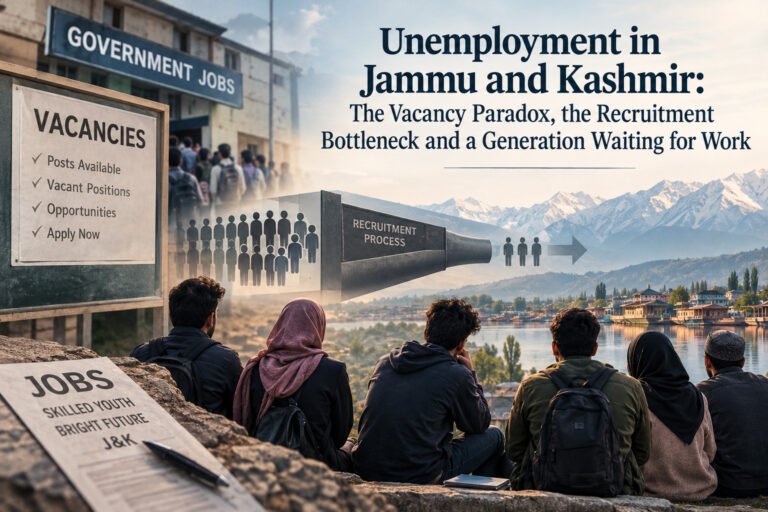
Although full statehood is not yet achieved, participatory governance is firmly established at the local level through sub-state democratic frameworks, such as empowered Panchayati Raj institutions and District Development Councils. These actions demonstrate the role of administrative efficiency and procedural governance in fostering political stability. Consequently, this cultivates public trust and encourages adherence to regulations, thereby illustrating a complex interplay among security, development, and the establishment of democratic institutions, which ultimately leads to sustained stability. Post elections, political parties’ demands for statehood have increased. The newly elected government is emphasizing its return as essential for both comprehensive legislative authority and equality within the federal structure. However, the residents of Jammu and Kashmir aspire more than just formal recognition of statehood.They expect a robust rule of law, reliable security, a restoration of routine everyday activities, and the continuous functioning of educational institutions. The expansion of institutional accountability, the mitigation of administrative malfeasance, and the proliferation of sustainable employment opportunities—especially for youth—are fundamental elements of the populace’s political ambitions. Democratic representation, therefore, requires addressing a multidimensional governance agenda, where statehood constitutes only one component within a broader constellation of societal expectations oriented toward socio-economic stability, institutional integrity, and civic normalisation. In effect, statehood restoration should be understood as a normative and symbolic anchor rather than the singular determinant of political fulfilment, reflecting its role within a wider framework of governance, public expectation, and institutional consolidation.
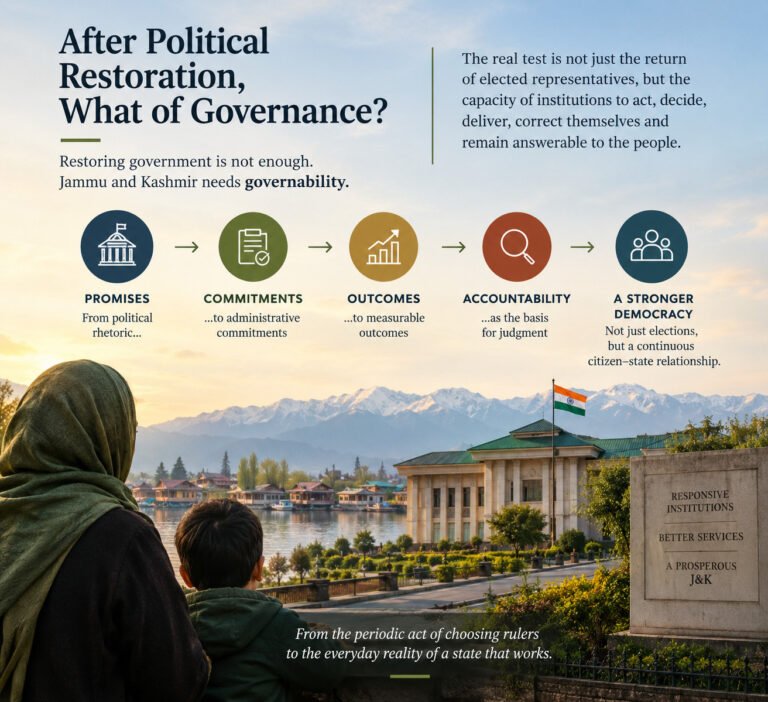
The analytical essence of Jammu and Kashmir’s post-2019 course is in the dynamic interaction between governance and security challenges and the broader political aspirations of the populace over low politics matters.A decrease in insurgency and systemic instability promotes developmental governance, infrastructure investment, and institutional improvement.Concurrently, improvements in public service delivery, job availability, and democratic governance foster security stability by alleviating the structural elements that incite insurgency mobilisation.Francis Fukuyama’s differentiation between the capacity of the state and legitimacy offers a crucial analytical perspective: enduring order arises when coercive authority is integrated within accountable governance frameworks and bolstered by societal agreement. Thus, the normative stability of the region relies on the institutionalisation of legitimacy in conjunction with coercive capacity, highlighting the interrelation of state capacity, governance efficacy, and social consent.Furthermore, the reciprocal dynamics between security operations and public trust underscore the mutually constitutive nature of legitimacy and coercive capacity, rather than their functional independence, thus demonstrating how hybrid governance models can strategically incorporate coercive, administrative, and participatory elements.
Due to Jammu & Kashmir’s geopolitical proximity to contested international boundaries, a robust and well-coordinated security apparatus is needed.The Union government maintains centralised authority over policing, intelligence, and counter-terrorism; meanwhile ,elected government with a horizontal procedural framework ensure deliberative governance and accountability procedures.The challenge lies in harmonising these institutional domains so that security consolidation does not compromise democratic development, and devolved authority does not weaken strategic coherence. The sustained stability hinges on the concurrent establishment of representative democracy, the fostering of normative legitimacy, and the deployment of a robust security framework. The intricate interplay between federal authority and subnational representation serves as a practical illustration of federal asymmetry, thereby showcasing the adaptability of Indian federalism in response to both security imperatives and political demands.These interactions underscore how effective governance is co-created through the interplay of central authority, local political structures, and societal approval, thus connecting the normative and practical aspects of statecraft.
The constitutional future of Jammu and Kashmir—whether it remains a Union Territory or transitions to statehood—will hinge more on the efficacy of governance institutions in sustaining political stability, fostering inclusive participation, and implementing security measures that uphold rights, rather than on its official administrative designation. National security and the functioning of democratic institutions represent interconnected facets of the Indian federal system, rather than inherently conflicting objectives. To provide enduring legitimacy and stability, democratic governance discourse must integrate democratic representation, socioeconomic advancement, equitable federalism, and security elements within a robust and adaptable institutional architecture. This design must be capable of addressing the region’s diverse political requirements, thereby fostering institutional resilience and creating a sustainable equilibrium between coercive authority and normative legitimacy.Ultimately, the enduring stability and legitimacy of any constitutional or administrative structure in Jammu and Kashmir will depend on the ability of institutions to sustain participatory democracy, maintain law and order, and ensure strategic coherence in a region consistently influenced by geopolitical factors. This will include incorporating democratic governance into a system of normative legitimacy and legitimate state authority.
About the Author