By: Sheeraz Zaman ( Socio Political Activist )
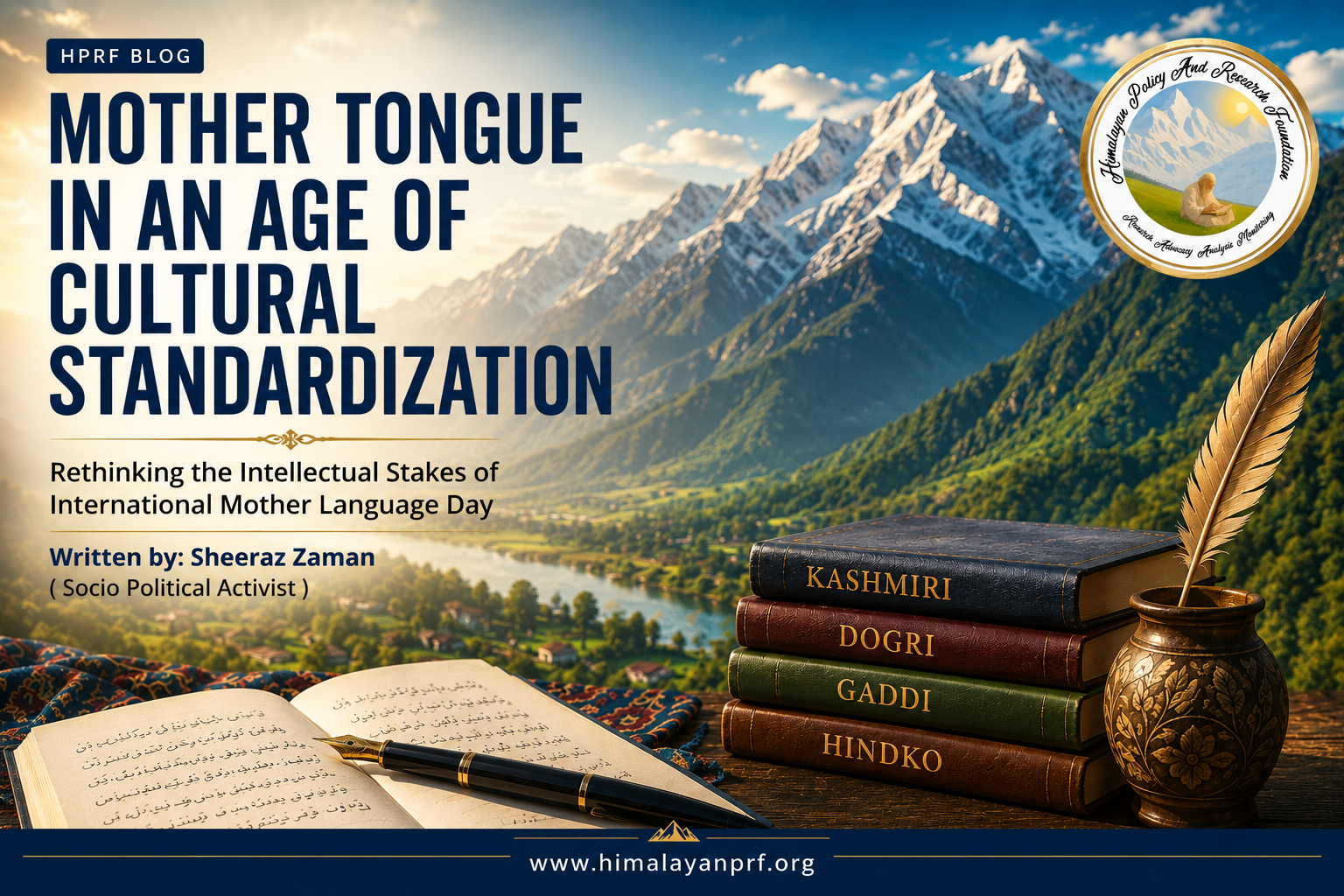
International Mother Language Day, observed every year on 21 February under the recognition of UNESCO, is frequently presented as a celebration of linguistic diversity. Yet the language of celebration obscures the gravity of what is involved. Languages across the world are not merely diverse; many are endangered. Some disappear quietly each decade. When a language vanishes, it does not simply reduce the number of available words. It narrows the range of memory, compresses experience, and alters the ways in which a community understands itself.
A mother tongue is not just the first language spoken. It is the structure within which consciousness first arranges reality. Before formal schooling, before legal identity, before civic belonging, a child inhabits the grammar of the home. That grammar teaches distinctions: between respect and familiarity, between elder and younger, between obligation and choice. Vocabulary shapes emotional intelligence. The terms available for sorrow or affection influence how those emotions are recognized and expressed. Language does not sit outside experience; it organizes it.
For this reason, the decline of a mother tongue is not a sentimental matter. It is structural. Every language carries a distinct intellectual architecture. Some encode relational hierarchy within verbs. Others emphasize spatial orientation over abstract direction. Many preserve ecological knowledge through specific classifications of land, seasons, plants, and animals. Such classifications are not ornamental. They emerge from sustained interaction with particular environments. When a language erodes, this embedded knowledge risks erosion as well.
Modern societies often assume that linguistic consolidation is necessary for efficiency. A shared language simplifies governance, legal procedure, and national administration. In multilingual states, policymakers frequently defend linguistic standardization as a tool of integration. There is logic in this claim. Communication across large populations requires coordination. Yet coordination need not imply uniformity. The problem arises when standardization becomes synonymous with superiority. A dominant language accrues institutional authority. It becomes the medium of examinations, professional advancement, and public discourse. Other languages, though not banned, become peripheral.
The consequences unfold gradually. Parents encourage children to prioritize the language associated with opportunity. Schools reinforce the hierarchy by structuring assessment around it. The media amplifies its prestige. Over time, the mother tongue retreats into domestic space. It survives in conversation with grandparents but disappears from formal writing. A language confined to intimacy eventually loses intergenerational continuity. Children may understand but not speak it fluently. The shift seems harmless at first, even practical. Yet within two generations, fluency can dissolve.
Education lies at the center of this transformation. When children begin schooling in a language unfamiliar at home, they must decode both content and medium simultaneously. The cognitive load increases. More importantly, an implicit message forms: knowledge belongs to another language. The home language becomes secondary, insufficient for intellectual seriousness. Research in pedagogy has repeatedly shown that early instruction in the mother tongue strengthens comprehension and literacy. Once foundational skills are secured, additional languages can be acquired more efficiently. Multilingualism built upon a stable base produces stronger learners than multilingualism constructed through displacement.
The argument for mother-tongue preservation, therefore, is not isolationist. It does not reject global languages or economic mobility. Rather, it insists that engagement with wider worlds should not require abandonment of the first one. The binary between rootedness and progress is false. A person can inhabit multiple linguistic worlds without surrendering the primary one. In fact, those grounded in their mother tongue often approach new languages with greater confidence and structural awareness.
Globalization complicates this balance. Migration disperses speech communities. Urbanization mixes dialects. Digital platforms privilege languages with extensive user bases. Algorithms amplify what is already dominant. Smaller languages struggle for visibility. The market rarely rewards linguistic particularity unless it can be commodified. As a result, linguistic attrition accelerates not through prohibition but through preference.
Yet preference is shaped by policy and prestige. When governments invest in literary production, translation, and regional media, they expand the functional scope of minority languages. When universities allow scholarship in diverse tongues, they challenge the assumption that intellectual rigor requires a single linguistic medium. When public administration accommodates multilingual interaction, it affirms that citizenship is not contingent upon linguistic conformity.
International Mother Language Day should prompt reflection on these structural choices. It should not be reduced to ceremonial statements about heritage. The survival of languages depends upon daily usage reinforced by institutional legitimacy. Families transmit speech, but institutions determine its public value. Without recognition in education and governance, even vibrant home usage may decline.
There is also an ethical dimension. Languages are inherited. They carry centuries of adaptation, conflict, migration, and creativity. Each generation receives a linguistic world shaped by those who came before. To relinquish that world casually is to interrupt continuity. Preservation is therefore not merely cultural policy; it is intergenerational responsibility.
The disappearance of a language is rarely dramatic. It is incremental. Words fall out of use. Idioms lose relevance. Children reply in another tongue. Eventually, fluency survives only among elders. When those elders pass, so does a portion of history. International Mother Language Day reminds us that such loss is neither inevitable nor trivial. It is the result of choices, and it can be addressed by choices.
To understand why mother languages decline, one must examine not only sentiment but structure. Languages do not fade because speakers suddenly cease to love them. They recede when systems reward alternative choices. The relationship between language and power is therefore central. Every society distributes authority through institutions, and institutions operate in particular languages. Courts deliberate, universities examine, corporations transact, and bureaucracies record in selected tongues. Those selections create hierarchies of participation.
When access to professional advancement depends upon fluency in a dominant language, rational actors adapt. Families, anxious about mobility, adjust domestic priorities. They may continue to value the mother tongue symbolically while investing materially in another language. The shift is understandable. Yet over time, repeated adaptation alters communal equilibrium. A language not reinforced in formal domains loses functional depth. Technical vocabulary ceases to expand. New concepts are borrowed rather than generated internally. Gradually, the language becomes confined to familiar topics. Its expressive range contracts.
This contraction is rarely visible in a single generation. It accumulates quietly. Grandparents speak with full fluency; parents become bilingual but increasingly selective; children comprehend but respond in another language. Each stage appears manageable. The rupture becomes evident only when fluency can no longer be restored without deliberate intervention. By then, a community may find that it retains memory but lacks articulation.
The notion of articulation is crucial. A language is not merely a tool for exchange; it is a medium for shaping thought. Linguists have long debated the extent to which language influences cognition, yet few deny that linguistic categories guide attention. Words available for particular experiences affect how those experiences are processed. In some languages, kinship terminology maps relationships with intricate precision. In others, environmental vocabulary distinguishes subtle variations in terrain or climate. When these lexical distinctions disappear, patterns of awareness may shift.
Moral reasoning is similarly embedded. Concepts of duty, reciprocity, honor, or communal obligation often derive from linguistic frameworks that do not translate seamlessly. Translation can approximate meaning, but it may alter emphasis. A term that carries communal weight in one language might appear merely descriptive in another. Such
differences influence how social responsibility is imagined. A reduction in linguistic diversity may therefore narrow the spectrum of ethical articulation available within a society.
Urbanization intensifies these pressures. Cities gather individuals from diverse linguistic backgrounds into shared spaces where practical communication favors dominant languages. Informal multilingualism may flourish temporarily, yet institutional life tends to converge around fewer linguistic norms. Over time, urban-born generations may feel detached from ancestral speech patterns. Dialects flatten; regional accents soften. What remains is intelligible but diluted.
Technology further accelerates consolidation. Digital communication platforms operate through standardized coding systems and predictive algorithms trained predominantly on major languages. While translation tools expand access, they often privilege uniform grammar and vocabulary. Minority languages with limited digital representation struggle to gain algorithmic visibility. Without proactive digital archiving and software support, technological progress can inadvertently marginalize linguistic plurality.
However, technological transformation also offers opportunity. Audio recording, online repositories, and collaborative dictionaries enable communities to document speech with unprecedented ease. Educational applications can teach literacy in scripts once considered endangered. Social media, though dominated by global languages, also provides space for revival movements. The decisive factor is intentionality. Communities and institutions must recognize technology as an arena for preservation rather than surrender.
Policy frameworks can either accelerate or counteract attrition. Multilingual education programs grounded in the mother tongue during foundational years demonstrate measurable benefits in literacy and comprehension. Such programs do not isolate students from national languages; rather, they establish cognitive stability before expansion. Teacher training institutions must therefore cultivate bilingual competence. Curriculum designers should produce contemporary textbooks in regional languages, ensuring that scientific and technological discourse remains accessible.
Cultural production reinforces this effort. Literature, journalism, theatre, and cinema conducted in mother tongues expand their relevance beyond domestic conversation. When writers address modern dilemmas in local languages, they demonstrate expressive capacity equal to any global medium. Intellectual seriousness must not be tethered to linguistic dominance. Universities play a pivotal role here. Allowing research and scholarly publication in regional languages affirms their analytical legitimacy.
Economic design also matters. Public services offered in multiple languages signal institutional respect. Media broadcasting in regional languages creates professional pathways for speakers. Tourism industries can foreground linguistic heritage as cultural value rather than relic. When a language acquires visible economic utility, its prestige strengthens organically.
About the Author