Surinder Ambardar (Political Analyst)
There is something profoundly paradoxical about the condition of democracy in Jammu and Kashmir today. The vocabulary of grassroots democracy has become increasingly elaborate, even as the institutions through which that democracy is supposed to acquire meaning have fallen into abeyance. Panchayats have been elected, Block Development Councils constituted, and District Development Councils established; yet, at the very moment when decentralisation ought to have become an everyday political practice, the institutional architecture of rural self-government stands without elected representatives.
The problem is not merely that elections have been delayed. Elections are important, but the deeper issue is what their absence does to the distribution of political power. Democracy is not sustained merely by constitutional declarations or administrative schemes. It requires institutions through which citizens can exercise judgment, articulate preferences, scrutinise public expenditure, and hold those exercising public authority answerable. When these institutions become vacant for prolonged periods, power does not disappear. It migrates. It returns to administrative hierarchies, departmental offices, and political executives. The more unsettling question before Jammu and Kashmir, therefore, is this: when grassroots institutions cease to function, who occupies the space that democracy leaves behind?
The history of local self-government in India makes this question particularly significant. The village has never been merely an administrative category. From the Sabha and Samiti of ancient political thought to the village institutions described in Kautilya’s Arthashastra, from the local institutions of the Chola period to the muqaddam, patwari, and chowkidar of medieval rural administration, governance in India has always depended upon some form of local mediation between the state and society. These institutions were certainly not democratic in the modern egalitarian sense. Their social structures were hierarchical, exclusionary, and often deeply unequal. Yet they reveal an enduring political fact: the state could not govern the village without institutions and persons rooted in the village.
Colonial rule transformed this relationship. The British state increasingly substituted bureaucratic penetration for autonomous local authority. The resolutions associated with Lord Mayo in 1870 and Lord Ripon in 1882 introduced a vocabulary of decentralisation, but colonial local government remained circumscribed by the imperatives of imperial administration. The paradox of colonial decentralisation was therefore already visible: authority could be devolved administratively without sovereignty being democratised politically.
Indian nationalism altered the meaning of this question. Dadabhai Naoroji’s advocacy of self-government and the subsequent nationalist discourse of Swaraj gradually shifted the issue from administrative participation to political autonomy. Gandhi radicalised this idea. For him, Swaraj could not mean simply replacing British rulers with Indian rulers. A society remained politically dependent if ordinary citizens were excluded from decisions concerning their own lives. His conception of Gram Swaraj consequently placed the village at the centre of democratic self-rule.
The constitutional order eventually gave this aspiration a formal foundation. Article 40 of the Constitution directs the state to organise village panchayats and endow them with the powers necessary to function as units of self-government. The 73rd Constitutional Amendment subsequently transformed this aspiration into a constitutional framework for Panchayati Raj, creating Part IX of the Constitution and recognising Panchayats as an institutional component of democratic governance. The language matters. The Constitution does not describe Panchayats merely as agencies for implementing government programmes. It calls them units of self-government. That distinction is frequently lost in administrative practice.
The application of the 73rd and 74th Constitutional Amendments, and more specifically the three-tier Panchayati Raj system, was anchored by the Honourable Prime Minister of India from the Red Fort, with the recognition that a Panchayat is meaningful not simply because it receives funds, implements a government scheme, or constructs a local road. Its democratic significance lies in whether citizens possess institutional authority to determine priorities, deliberate over competing claims, and hold representatives accountable. Decentralisation is therefore not simply the geographical movement of government offices. It is the political movement of authority. This is precisely where the present situation in Jammu and Kashmir becomes troubling.
The constitutional location of the electoral process makes the present impasse all the more revealing. Panchayat elections in Jammu and Kashmir are conducted under the superintendence, direction, and control of the State Election Commission; they are not, in a formal constitutional sense, elections that the executive government can simply schedule or cancel according to its political convenience. But constitutional responsibility cannot be reduced to the question of who puts the ballot paper before the voter. An Election Commission can conduct elections; it cannot, by itself, create every legal, administrative, and institutional precondition necessary for them. The preparation and revision of electoral rolls, reservation and rotation, delimitation where required, notification of constituencies, and the deployment of the administrative machinery necessarily involve the executive apparatus. The meaningful constitutional question, therefore, is not merely who conducts the election, but who creates the conditions under which the election can be conducted in a timely manner. To invoke the independence of the Election Commission as a reason for executive inaction would be to mistake institutional autonomy for institutional isolation.
This distinction assumes particular significance in Jammu and Kashmir because the issue can no longer plausibly be presented as a momentary administrative inconvenience. The Panchayats and Block Development Councils completed their terms in January 2024, while the District Development Councils completed their five-year terms in February 2026. The consequence is not the disappearance of the government from rural Jammu and Kashmir. Departments continue to function, schemes continue to be implemented, and public expenditure continues to be incurred. What has disappeared is something more difficult to replace: the elected political agency through which rural citizens can collectively question, prioritise, and hold local authority accountable.
There is an uncomfortable irony here. The Government of Jammu and Kashmir derives its own authority from an electoral mandate, yet the institutions that carry electoral democracy into the village have remained in suspension for an extended period. One need not impute motives to recognise the contradiction. Governments are not merely elected to administer; they are also entrusted with sustaining the institutional conditions of democratic life. If an elected government does not demonstrate sufficient urgency in restoring elected local bodies, it becomes difficult to persuade the bureaucracy, whose institutional logic is administrative rather than representative, that Panchayats should be treated as genuine centres of political authority rather than as subordinate implementing agencies. Democracy cannot credibly demand from the bureaucracy a respect for grassroots representation that the political executive itself appears unwilling to prioritise.
The deeper danger, therefore, is not simply bureaucratic substitution. It is the gradual normalisation of a peculiar political hierarchy in which electoral legitimacy is considered indispensable at the national and territorial levels but dispensable at the grassroots. Such a hierarchy would invert the very logic of decentralisation. The 73rd Constitutional Amendment was conceived not to make villages better administered by distant authorities, but to make citizens more capable of governing the affairs closest to them. When elected local institutions remain absent, the state may continue to function; but self-government begins to recede. This is where the problem of administrative centralism becomes important.
Administrative centralism is not necessarily hostile to democracy. A functioning democracy requires a professional bureaucracy. The problem begins when administrative institutions start occupying spaces constitutionally intended for representative institutions. A bureaucracy can maintain continuity without representation. A department can administer a programme without deliberation. A government can spend money without citizens possessing meaningful institutional control over priorities.
Administration answers the question of how the government operates. Democratic self-government asks the more fundamental question of who possesses the authority to decide what the government ought to do. When elected Panchayats disappear, this second question becomes increasingly vulnerable.
The danger is not necessarily tyranny in its classical sense. There is no need for an overtly coercive regime before democratic institutions become hollow. There is a subtler form of political concentration in which decisions gradually accumulate within administrative structures while citizens become recipients rather than participants. It is this condition that requires conceptual scrutiny.
Is it oligarchy? In the classical sense, oligarchy denotes government by the few. The contemporary danger in a decentralised administrative system is more institutional than personal: the concentration of decision-making among a relatively narrow circle of officials, departments, and political authorities who possess access to information, resources, and discretionary power unavailable to ordinary citizens.
Or is it a tyrannical order? Again, the term should be used cautiously. Tyranny traditionally implies arbitrary and coercive rule. The present concern is different. It is the possibility of democratic government becoming increasingly administrative and increasingly remote from those whom it governs. Perhaps the more accurate term is administrative centralism. This becomes particularly important in rural development.
A village does not experience governance through departmental compartments. Its inhabitants do not experience water, roads, sanitation, agriculture, education, horticulture, employment, and social welfare as separate bureaucratic files. They experience them as interconnected dimensions of everyday life. Yet governmental responses are frequently fragmented among numerous departments and schemes.
Panchayati Raj was intended, at least in principle, to provide a political mechanism for integrating these fragmented interventions around local priorities. Without elected Panchayats, that integrative political function weakens. The result can be a peculiar form of decentralisation in which programmes move downward but power remains upward. This is perhaps the most important contradiction in the current moment.
The language of grassroots development is everywhere. Government schemes speak of participation, inclusion, community development, and local implementation. But participation without institutional authority risks becoming ceremonial. Consultation without decision-making power becomes procedural. And decentralisation without fiscal and administrative autonomy can become little more than the delegation of responsibility without the transfer of power. The financial dimension is therefore crucial.
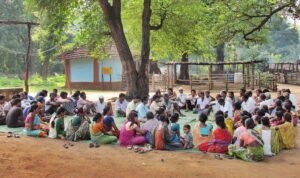
Panchayati Raj cannot function merely on symbolic authority. It requires what may be called the threefold architecture of decentralisation: functions, functionaries, and finances. A Panchayat expected to solve local problems without adequate financial resources is not empowered; it is merely burdened. Similarly, allocating funds without giving local representatives meaningful authority over priorities does not constitute genuine self-government.
The problem of unutilised funds consequently cannot be reduced to bureaucratic inefficiency. Every unutilised public allocation represents a possible failure to translate collective resources into public goods. But there is an additional democratic cost. When local institutions cannot convert resources into visible outcomes, citizens may begin to regard democratic institutions as irrelevant to their material lives. That produces a dangerous political psychology.
Citizens cease asking their elected representatives to explain development failures because there are no elected representatives to whom such questions can be directed. They instead approach officials, political intermediaries, or higher administrative authorities. Accountability consequently travels upward rather than downward. This is the inverse of democratic decentralisation. And it creates a double loss for Jammu and Kashmir.
The first is an economic loss: delayed projects, underutilised allocations, and unrealised development outcomes. The second is a democratic loss: the weakening of institutions through which citizens can demand explanations for that very underperformance. The second loss may ultimately prove more consequential than the first. Roads can eventually be constructed and funds reallocated. Institutional habits of democratic accountability are harder to rebuild once citizens become accustomed to approaching power through informal channels rather than representative institutions.
The significance of the District Development Councils is particularly important here. Their creation was presented as an important step towards strengthening democratic decentralisation in Jammu and Kashmir. Yet their subsequent completion of term without immediate replacement raises a larger question about democratic continuity. A democracy cannot be understood only as a sequence of elections. It must also be understood as a continuity of institutions. This is why prolonged electoral interregnums deserve greater scrutiny than they ordinarily receive.
There will, of course, be legitimate reasons for electoral preparation: delimitation, reservation, rotation, revision of electoral rolls, and other statutory requirements. These are not trivial matters. But procedural complexity cannot become a permanent substitute for political accountability. The legitimacy of delay depends upon whether the delay is demonstrably necessary, transparently explained, and followed by a credible institutional timetable. Otherwise, constitutional democracy begins to acquire a peculiar temporality: elections are promised in the future while administration governs in the present. That gap matters.
It matters because local democracy performs a function that higher levels of government cannot easily reproduce. The Panchayat creates political proximity between citizens and representatives. The Gram Sabha, at least in principle, makes public expenditure and development priorities visible within the community itself. It creates the possibility of disagreement without alienation, contestation without institutional rupture, and accountability without waiting for a distant election.
The absence of this institutional proximity produces a democratic void. And democratic voids are rarely empty. They are occupied by informal power. Political brokers, bureaucratic discretion, departmental hierarchies, and local elites can acquire greater influence when formal representative mechanisms weaken. This is why the question of Panchayati Raj is ultimately also a question of oligarchy. The absence of democratic institutions can empower those who already possess resources, information, networks, and proximity to authority.
The irony is striking: an institution designed to democratise power may become most necessary precisely when the concentration of power begins to grow. This is where the intervention of the Union government must also be assessed carefully. There is a legitimate argument for Union intervention in strengthening democratic institutions in Jammu and Kashmir, particularly where institutional capacity, finances, and administrative coordination require support. But there is a constitutional and political limit to such intervention.
The purpose of decentralisation cannot be to create a more efficient system through which higher authorities govern the village. It must be to enable the village to participate more meaningfully in governing itself. Otherwise, decentralisation becomes paradoxical: the centre creates institutions of local government while simultaneously retaining the substantive architecture of decision-making. The real measure of democratic deepening, therefore, is not how many schemes reach a Panchayat. It is how much discretion, deliberation, and accountability accompany those schemes.
The challenge before Jammu and Kashmir is consequently larger than the scheduling of another round of Panchayat elections. Elections are the immediate necessity, but institutional reconstruction is the larger task. The Panchayats need not merely elected representatives but meaningful functions. They need not merely allocations but predictable finances. They need not merely responsibilities but administrative capacity. And they need not merely meetings but genuine Gram Sabha participation.
The objective should be to transform the Panchayat from an implementing appendage of government into a political institution capable of articulating the priorities of the people it represents. This is ultimately the unfinished promise of Swaraj.
Gandhi’s insight remains relevant because he understood that political freedom becomes fragile when citizens are spectators to the exercise of power. The village was important to him not because rural life was inherently virtuous, but because democratic citizenship had to be cultivated somewhere. It had to acquire habits of deliberation, disagreement, responsibility, and collective judgment. The question confronting Jammu and Kashmir today is therefore deceptively simple: Are we decentralising power, or merely decentralising administration?
If Panchayat elections remain in abeyance while development continues through administrative channels, the distinction will become increasingly difficult to ignore. A government may continue to function efficiently in the absence of elected local institutions. But efficiency cannot substitute for representation, and administration cannot permanently substitute for self-government. The real danger is not that democracy suddenly disappears. It is that democracy survives as vocabulary while its institutional substance gradually recedes.
That is why the three-tier Panchayati Raj system must not be treated as another administrative cycle awaiting completion. It is part of the constitutional architecture of Indian democracy. Its suspension, even when legally explained, carries political consequences. The question is therefore not whether Jammu and Kashmir has Panchayati Raj on paper. The question is whether power has actually reached the people for whom Panchayati Raj was created.
Until that question is answered affirmatively, the language of grassroots democracy will remain ahead of its institutional reality. And when the institutions of self-government fall silent, the political space they leave behind does not remain vacant. It is occupied by the few who have the authority to decide. That is the point at which decentralisation risks becoming oligarchy, not because democracy has formally been abolished, but because the distance between the citizen and the exercise of power has once again begun to widen.
About the Author