Written by: Dr. Peerzada Muneer
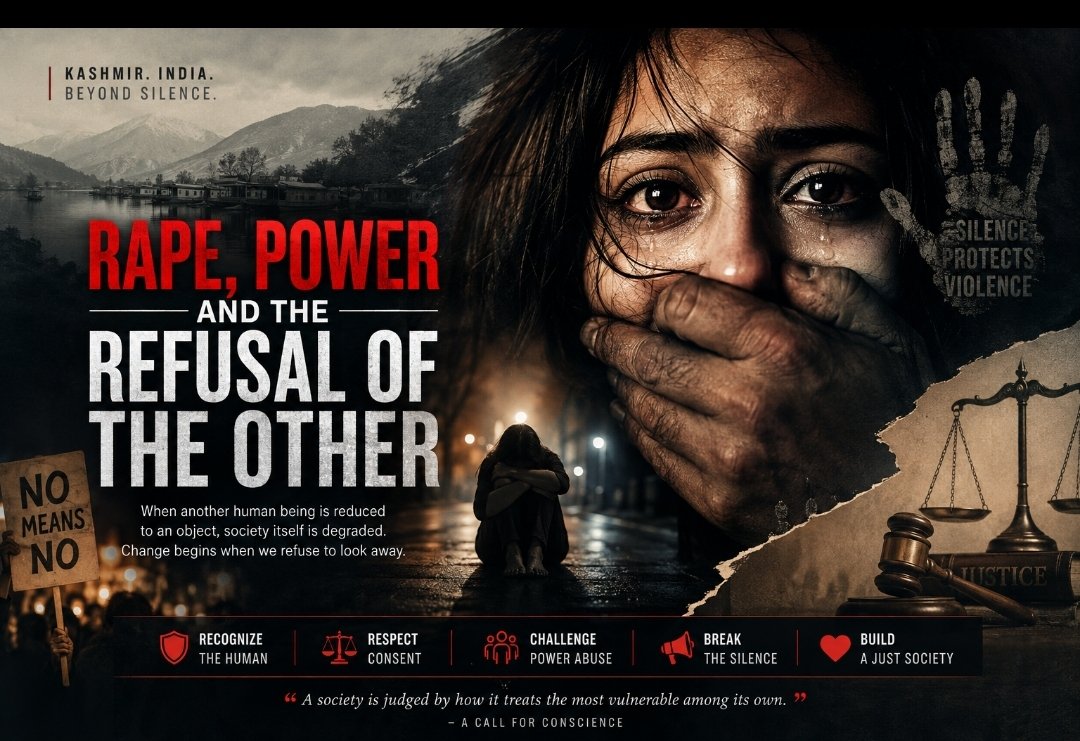
The recurrence of sexual violence in Kashmir and across India confronts society with a question far deeper than criminality alone. It compels us to ask what happens when another human being ceases to be encountered as a person and is instead reduced to an object to be possessed, humiliated, punished or consumed.
The alleged gang rape recently reported in Baramulla is particularly disturbing because, according to the police account, two men allegedly assaulted a 21-year-old woman, recorded the crime on a mobile phone and later threatened her. The survivor approached the police on July 25 regarding an incident that allegedly occurred on July 3. Two suspects have since been arrested, and the phone allegedly used in recording the assault has been seized. The investigation remains underway, and any discussion must therefore respect the presumption of innocence while acknowledging the gravity of the allegations (Greater Kashmir).
Only weeks earlier, the recovery of the body of a 12-year-old girl in Budgam shocked Kashmir. Police described it, prima facie, as a case of rape and murder, constituted a Special Investigation Team and reminded the public that the identity of a child victim must never be disclosed (The New Indian Express). Such incidents are not isolated tragedies. They reveal how sexual violence flourishes when physical power, technological capability, social silence and unequal relationships converge.
At the same time, intellectual honesty requires caution against the simplistic claim that rape is simply “increasing every year.” Recorded crime does not perfectly reflect actual crime. The latest available data show that India registered 29,536 rape cases and 441,534 crimes against women in 2024. While the total number of crimes against women remained staggering, it was marginally lower than the previous year. Jammu and Kashmir recorded 3,366 crimes against women in 2024 compared with 3,653 in 2023, the lowest annual figure in five years (Centre for Economic Data and Analysis). These numbers provide no comfort. They merely remind us that particularly horrific incidents should not be confused with a uniform statistical trend. Sexual violence remains deeply entrenched irrespective of annual fluctuations.
Statistics themselves tell only part of the story. Many survivors never report sexual violence because the accused is often someone they know, including a relative, neighbour, employer, teacher or intimate partner. Fear of retaliation, economic dependence, family pressure, social stigma and the threat of public humiliation frequently silence victims. Moreover, legal classification practices can conceal the full extent of sexual violence. Cases involving rape and murder may be statistically recorded under murder alone because it carries the greater punishment. Changes in reporting practices and the transition to India’s new criminal laws have further complicated year to year comparisons (Centre for Economic Data and Analysis).
Perhaps the most revealing national finding is that strangers are not the principal perpetrators. According to official data, 96.8 percent of registered rape cases in 2024 involved accused persons already known to the survivor. Friends or intimate partners constituted 47 percent, neighbours and other acquaintances 42.6 percent, while family members accounted for 7.2 percent. Only 3.2 percent involved an unknown offender (Centre for Economic Data and Analysis). This overturns the popular image of rape as an attack by a dangerous stranger lurking in an isolated place. More often, the threat arises within ordinary relationships built on familiarity and trust.
This explains why allegations emerge across professions, educational backgrounds and social classes. Occupations do not produce rape, but they often provide access, authority and opportunities for abuse. Teachers possess educational authority, employers economic control, police officers coercive power, doctors professional access and religious figures moral credibility. Indian law recognises this reality by prescribing enhanced punishment where offenders occupy positions of trust, authority or dominance (Bharatiya Nyaya Sanhita, 2023). Respectability and education, therefore, cannot substitute for institutional safeguards.
Historically, rape was not primarily understood as a violation of a woman’s autonomy. In many patriarchal legal traditions, it was treated as an offence against the property, honour or lineage of the men who claimed authority over her. Feminist struggles and legal reform gradually transformed this understanding by placing consent, bodily integrity and individual autonomy at the centre of the law. India’s legal evolution reflects this difficult journey. Public outrage over the Mathura custodial rape case exposed the dangerous assumption that the absence of physical resistance necessarily implied consent and eventually contributed to legal reforms enacted in 1983 (Manupatra).
The 2012 Delhi gang rape marked another turning point. The Justice Verma Committee recognised rape not as an uncontrollable act of passion but as an exercise of power. It recommended broader legal definitions, institutional reform, protection for complainants, educational changes and the removal of the marital rape exception while warning that punishment alone could never eliminate the social roots of sexual violence (PRS Legislative Research).
The Bharatiya Nyaya Sanhita defines consent as an unequivocal and voluntary agreement communicated through words, gestures or other forms of expression. It specifically recognises that the absence of physical resistance cannot by itself be interpreted as consent because victims confronted with overwhelming fear may freeze, dissociate or submit simply to survive ((Bharatiya Nyaya Sanhita, 2023).
Gang rape carries some of the harshest punishments available under Indian law. Section 70 of the Bharatiya Nyaya Sanhita prescribes a minimum sentence of twenty years extending to imprisonment for the remainder of natural life, while offences involving children may attract life imprisonment or even the death penalty (Bharatiya Nyaya Sanhita, 2023). India therefore does not primarily suffer from weak punishment. Its greater failures lie in prevention, investigation, delayed trials, witness intimidation, social prejudice and inadequate long term support for survivors.
Rape must therefore be understood not as ordinary sexual desire pursued unlawfully but as violence expressed through sexuality. Genuine desire recognises the possibility of refusal. Rape abolishes refusal altogether. It transforms another person’s body into the site where dominance, humiliation, anger and entitlement are violently asserted.
There is no single psychological profile of a rapist. Many offenders appear outwardly ordinary, maintain families, hold respected jobs and function normally within society. This is precisely why describing perpetrators simply as monsters can become intellectually misleading. Such language places them outside society and allows society to avoid examining the cultural beliefs, peer groups, institutions and silences that enable apparently ordinary individuals to disregard another person’s autonomy.
Contemporary research increasingly supports a social ecological explanation. Sexual violence emerges through the interaction of personal experiences, family relationships, peer influences, institutional environments and broader gender norms. Childhood exposure to violence, harmful alcohol use, controlling behaviour, unequal power relations, attitudes that normalise coercion and environments where male privilege remains unquestioned all contribute to elevated risk without mechanically producing offenders (World Health Organization).
One influential explanation, known as the Confluence Model, identifies two recurring patterns. The first is hostile masculinity, characterised by resentment towards women, sexual entitlement and acceptance of coercion. The second is an impersonal orientation towards sexuality in which intimacy becomes detached from affection, mutual respect and responsibility, reducing sex to conquest or status. Contemporary research continues to find strong associations between these patterns and male sexual aggression (PubMed Central).
Hostile masculinity should never be confused with masculinity itself. Courage, strength, discipline and protectiveness are not causes of rape. The danger lies in distorted notions of manhood that equate domination with strength, interpret rejection as humiliation and regard women as responsible for managing male desire. Within such a worldview, refusal is experienced not as an autonomous decision but as an insult demanding retaliation.
Gang rape introduces an additional social psychology. Responsibility becomes diffused, aggression is rewarded by peers and violence itself becomes a performance through which participants affirm group identity. Leaders encourage followers, followers reinforce leaders and the group collectively normalises escalating cruelty. Research examining multiple perpetrator rape has shown that severe violence is closely associated with this reciprocal reinforcement while finding no evidence that victim resistance causes greater brutality (University of Twente).
The alleged recording of the Baramulla assault illustrates another disturbing development. Modern technology enables perpetrators not merely to commit violence but to prolong it through digital blackmail, image-based abuse and the constant threat of public humiliation. The camera becomes another weapon, extending coercion long after the physical assault has ended (Greater Kashmir).
The fact that some offenders may themselves have experienced abuse requires careful handling. Childhood trauma, neglect or exposure to domestic violence can affect emotional development and increase vulnerability to later antisocial behaviour. Yet the belief that sexually abused children inevitably become sexual offenders is both empirically false and morally harmful. Research has found no evidence that childhood sexual abuse alone predicts later sexual offending (National Institute of Justice). Most survivors never become perpetrators. Trauma may explain certain vulnerabilities, but it never removes moral agency or personal responsibility.
Nor should rape be reduced to mental illness. While psychiatric disorders may coexist with offending in some individuals, the overwhelming evidence points towards entitlement, coercive attitudes, learned behaviour and unequal power rather than psychosis or loss of contact with reality. To describe every perpetrator as mentally ill not only stigmatizes people living with psychiatric conditions but also diverts attention from the ordinary social beliefs that make sexual violence possible.
Psychoanalytic thought offers another way of understanding rape. It suggests that some offenders attempt to overcome feelings of shame, vulnerability or inadequacy by forcing another person into complete helplessness. Control over another’s body creates the illusion of personal power. Object relations theory similarly explains rape as the reduction of a complete human being into a mere “part object,” a body detached from history, voice, emotion and subjectivity. The offender no longer encounters another consciousness but merely appropriates a body imagined to exist for his gratification or domination (American Journal of Psychoanalysis).
This reduction is sustained by rape myths that continue to circulate within society. These include beliefs that women frequently fabricate allegations, that genuine victims must physically resist, that certain clothes imply consent, that previous intimacy grants permanent sexual access or that marriage eliminates the possibility of rape. Such myths subtly shift responsibility away from the person who ignored consent and onto the person whose consent was violated.
Culture undoubtedly shapes attitudes, but it must never be transformed into ethnic, religious or regional determinism. No religion, caste, profession or geographical community possesses a natural inclination towards rape. Geography may influence policing, isolation or institutional capacity, while conflict can weaken accountability and increase impunity, but neither mountains nor plains create sexual entitlement. Sexual violence is a product of human choices operating within particular social and institutional conditions rather than an inevitable characteristic of any culture or landscape (World Health Organization).
The same caution applies when discussing religion. Religious belief itself cannot reasonably be blamed for sexual violence. In fact, studies generally associate higher levels of genuine religiosity with lower levels of physical and sexual aggression (Revista Brasileira de Psiquiatria). The danger arises not from religion but from ethically impoverished religiosity that substitutes ritual for morality. Such religiosity may emphasise female modesty while neglecting male accountability, defend family honour rather than the injured person or treat silence as virtue. Research has found that rigid authoritarian forms of religious commitment are more likely to correlate with rape myth acceptance, whereas reflective and ethically engaged religious orientations may have the opposite effect (Journal of Interpersonal Violence).
Kashmir’s own civilisational heritage provides an important moral resource. The shared traditions of Kashmir Shaivism, Sufism and the Rishi movement, symbolised by Lal Ded and Nund Rishi, have long represented spiritual coexistence, compassion and human dignity ((University of Kashmir)). These traditions cannot guarantee moral conduct, nor should they be romanticised. Their value lies in offering a language through which society can reaffirm that if springs, shrines, trees and sacred landscapes deserve reverence, the human body deserves even greater inviolability.
The philosophy of Emmanuel Levinas deepens this moral insight. Levinas argues that ethics begins in the encounter with the face of the Other. The face signifies not merely physical appearance but the irreducible humanity, vulnerability and moral authority of another person (Internet Encyclopedia of Philosophy). The presence of the Other interrupts the illusion that the world exists solely for one’s own purposes. Rape therefore becomes the radical refusal of the face. It attempts to erase another person’s autonomy and transform her into an extension of the offender’s will.
Seen through Levinas, rape is an act of totalisation. A unique human being is reduced to the sameness of another person’s desire. Her memories, relationships, future and freedom become irrelevant because she is no longer recognised as “someone” but treated merely as “something.”
Jacques Derrida extends this analysis by describing the gravest violence as the complete appropriation of the Other through the elimination of difference (Stanford Encyclopedia of Philosophy). His distinction between law and justice is equally significant. Law necessarily applies general rules, whereas justice demands attention to the singularity of each person and each circumstance. This does not weaken due process. Rather, it requires institutions capable of combining rigorous evidentiary standards with a humane and non humiliating response to survivors.
Public outrage following particularly brutal cases is understandable, but outrage alone cannot prevent future violence. India already prescribes severe punishments, especially for gang rape and offences against children. Yet more than 250,000 rape and POCSO cases remained pending before fast-track special courts at the end of 2025 despite the operation of hundreds of dedicated courts (The Economic Times). The challenge therefore lies less in increasing penalties than in improving investigations, strengthening judicial capacity, ensuring timely trials and making accountability more certain.
Prevention must begin long before any criminal act occurs. Children and adolescents require age appropriate education about bodily autonomy, consent, respectful relationships, digital responsibility and the right to seek help. Consent must be understood not simply as the absence of a spoken “no” but as an active, voluntary and revocable agreement. Marriage, previous intimacy, silence, fear or intoxication never transfer ownership over another person’s body.
Boys and young men must become central participants in this educational effort rather than being viewed merely as potential offenders. They should learn emotional regulation, respect for rejection, healthy masculinity and the courage to challenge abusive behaviour within peer groups. Bystander intervention, respectful friendships across genders and collective responsibility can become powerful safeguards against sexual violence.
International frameworks similarly emphasise that policing alone cannot eliminate rape. The World Health Organization’s RESPECT framework advocates relationship education, women’s empowerment, survivor services, poverty reduction, safe environments and the transformation of harmful gender norms (World Health Organization). The Centers for Disease Control and Prevention likewise recommends coordinated action across schools, healthcare, workplaces, justice systems and communities to create environments that reduce risk while supporting survivors (Centers for Disease Control and Prevention).
Every institution that exercises authority over women or children must adopt effective safeguarding mechanisms. Schools, colleges, hospitals, religious institutions, sports organisations, workplaces, hostels and welfare homes require clear reporting procedures, protection against retaliation, trained complaint mechanisms and independent oversight. Safeguarding should never depend solely upon the presumed integrity of respected individuals.
Equally important is a survivor centred response. Delayed reporting should never automatically be interpreted as evidence of fabrication because fear, threats, trauma and social pressure often prevent immediate disclosure. Investigators require training in trauma informed interviewing, preservation of biological and digital evidence and the lawful handling of electronic devices. Medical care must prioritise confidentiality, dignity, physical recovery and long term psychological support rather than reducing survivors to sources of forensic evidence alone (World Health Organization).
Society must also reject the language of permanent destruction. Rape is among the gravest violations of bodily autonomy, but the survivor is neither dishonoured nor morally diminished by another person’s crime. Recovery remains possible. The loss belongs to the offender and to every institution that fails to protect or support the survivor.
Supporting survivors does not require abandoning due process. It requires listening without prejudice, ensuring safety, protecting privacy and allowing a fair investigation to proceed. Equally, due process must never become a weapon for intimidating complainants or demanding that every genuine survivor conform to a predetermined emotional script. Human responses to trauma are profoundly diverse.
Communalising rape is equally destructive. The religion, caste, region or profession of an accused person should never become grounds for condemning an entire community, just as community reputation should never suppress legitimate allegations. Responsibility belongs to individual offenders, those who assist them and any institutions that enable or conceal their actions.
Religious and community leaders bear a particular responsibility. They must consistently teach consent, bodily inviolability, compassion and accountability while rejecting victim blaming, forced compromise and the notion that family honour resides in a woman’s silence. Genuine morality disciplines power rather than concealing it.
Kashmir’s syncretic traditions can contribute meaningfully only when they become living ethical practices rather than nostalgic symbols. The reverence historically extended to shrines, neighbours, guests and sacred landscapes must ultimately be extended to the embodied human person. The body is not territory over which family, husband or community possesses sovereignty. It is the first boundary of personhood.
The ultimate challenge is not merely to make men fear punishment. It is to cultivate individuals who experience another person’s refusal as morally final. Laws may prohibit rape, but lasting prevention requires institutions that detect predatory behaviour early, communities that withdraw approval from coercion, peer groups that reject abuse and a culture in which survivors can speak without social death.
Levinas reminds us that ethics begins in responsibility to the Other, while Derrida reminds us that justice can never reduce a singular human being to an administrative category or political symbol. A society that truly encounters the Other cannot first ask whether she was respectable enough, modest enough or careful enough to deserve protection. Her humanity was already sufficient.
Rape begins where the Other disappears. Its prevention begins where the Other is restored as a face, a voice, a will and an inviolable human world.
About the Author