Written By Dr. Peerzada Muneer
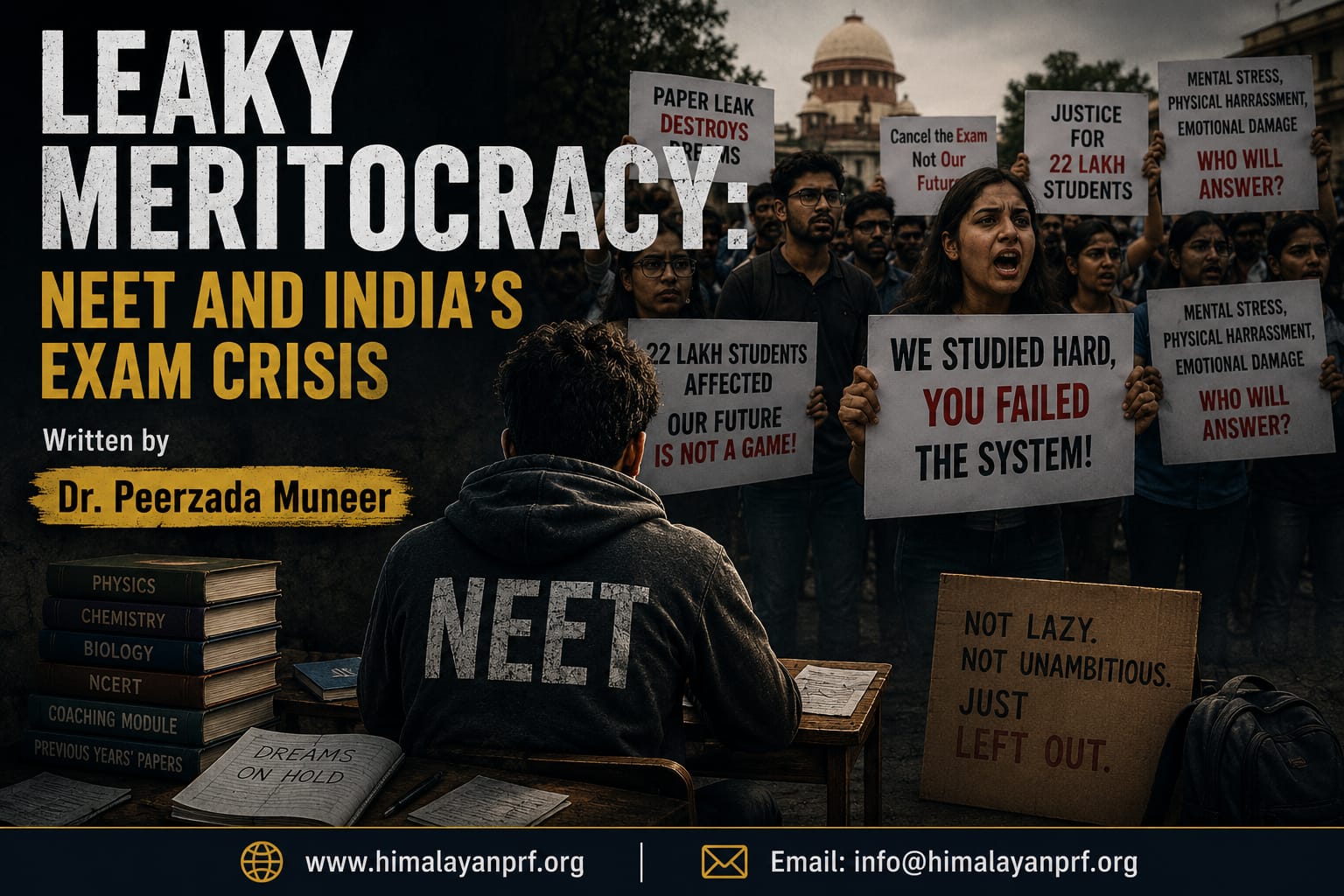
NEET-UG 2026 has turned India’s examination integrity crisis from a recurring scandal into a test of state capacity. The examination was scheduled for 3 May 2026 in pen-and-paper mode for about 22.79 lakh registered candidates across 551 Indian cities, 14 cities abroad and more than 5,432 centres, making it one of the largest single-gateway tests in the world for medical education. The National Testing Agency said before and after the examination that papers were moved through GPS-tracked vehicles, monitored by CCTV and protected through biometric verification, AI-assisted surveillance, jammers, police escorts and other security protocols. Yet on 12 May 2026, the NTA cancelled the 3 May examination and announced a re-conduct after inputs from law-enforcement and central agencies indicated that the process could not stand, while the Union government referred the case to the CBI for a comprehensive inquiry. (Hindustan Times)
The reported facts of the NEET-UG 2026 leak show how the modern paper-leak economy has moved beyond a simple theft of printed papers into a hybrid criminal market using coaching networks, encrypted applications, digital forwarding and inter-state brokers. NDTV reported allegations that a Nashik student, Shubham Khairnar, bought a digital copy of the paper for Rs 10 lakh and sold it for Rs 15 lakh, and that a copy circulated about 45 hours before the examination. (www.ndtv.com) The same reporting said that a “guess paper” forwarded from Kerala to Rajasthan allegedly contained large overlaps with the actual chemistry and biology questions, after which the Rajasthan Special Operations Group traced the network to Haryana and Nashik. (www.ndtv.com) NewsOnAir reported that Rajasthan Police and the CBI intensified the investigation, that 15 people were detained by Rajasthan SOG, that CBI took custody of Khairnar, and that multiple people were questioned in connection with the alleged leak network. (News On Air) Times of India reported that the CBI arrested five accused from Jaipur, Gurugram and Nashik and searched multiple locations in the case. (Medical Dialogues) Publicly available reporting at this stage establishes an organised inter-state network, but claims about political protection or high-profile complicity require proof through chargesheets, financial trails, call records and judicial findings rather than assumption.
The 2026 case is not an aberration. It is the latest expression of a deeper pattern in which examinations have become high-value public contracts, social ladders and criminal opportunities at the same time. An Indian Express investigation found 41 documented paper leaks over five years across 15 states in recruitment examinations, affecting about 1.4 crore applicants competing for just over 1.04 lakh posts. (The Indian Express) India Today reported that 70 examination leaks in seven years affected about 1.7 crore applicants across 15 states, while Newslaundry’s ten-year count identified 89 suspected cases and 48 retests affecting at least 6.5 crore candidates. (India Today) (Newslaundry) The Tribune reported more than 50 public recruitment paper-leak cases since 2015, with Rajasthan, Gujarat, Uttar Pradesh, Bihar, Telangana and Uttarakhand among the repeatedly affected states. (The Tribune) These numbers differ because each investigation defines “leak” and “affected candidate” differently, but their convergence is unmistakable: paper leaks are now a structural feature of competitive testing, not a series of isolated local crimes.
The methods are revealing because they expose weak links across the examination chain. Indian Express documented cases in which answers were circulated on WhatsApp within minutes, papers were stolen from government offices, servers of private vendors were allegedly hacked, and leaked material moved across social media before or during tests. (The Indian Express) In at least 15 of the 41 cases examined by Indian Express, candidates waited nearly a year for a re-examination, in four cases the wait crossed two years, and in seven cases candidates were still waiting at the time of reporting. (The Indian Express) Such delays convert a security breach into a social injury: honest candidates lose money, age eligibility, mental health, trust and sometimes the only employment window available to them.
The failure is especially striking because India has already experienced a national medical-exam crisis. In NEET-UG 2024, the Supreme Court recorded that the examination had over 23 lakh candidates at 4,750 centres in 571 cities and 14 overseas locations, and that illegal circulation of papers was established in Hazaribagh and Patna. The Court ultimately declined to order a nationwide retest because it found no sufficient material to show a systemic leak or widespread malpractice, while still directing stringent action against every detected beneficiary. By November 2024, the government told Parliament that the CBI had filed five chargesheets in the NEET-UG 2024 paper-theft case against 45 accused, including candidates and MBBS students accused of solving stolen papers or impersonation. The lesson from 2024 should have been that even a geographically contained leak can damage the legitimacy of a national examination. The recurrence in 2026 suggests that legal deterrence, technological surveillance and administrative assurances have not yet closed the operational gaps.
The government has not been inactive, but action has been uneven. The Public Examinations (Prevention of Unfair Means) Act, 2024 came into force on 21 June 2024 and brought within its scope examinations conducted by bodies such as UPSC, SSC, Railway Recruitment Boards, IBPS, ministries, departments, NTA and other notified authorities. (India Code) The law defines unfair means broadly to include leakage of question papers or answer keys, unauthorised possession, collusion, solving assistance, tampering with documents, computer-network manipulation and violation of security procedures. It makes offences cognizable, non-bailable and non-compoundable, and provides imprisonment and heavy fines for individuals, service providers and organised-crime actors involved in public-examination fraud. Parliament was also told that a high-level committee set up in June 2024 recommended reforms in entrance testing, NTA structure, use of technology, SOPs for pen-and-paper and computer-based tests, and stronger institutional linkages with state and district authorities. The same government reply, however, admitted that examination-specific leak data is not maintained centrally by the Ministry of Education. This is a fundamental governance weakness because a state that cannot maintain a unified incident registry cannot reliably measure risk, identify repeat offenders, compare state performance or learn from patterns.
The pressure that produces demand for leaked papers is also structural. In 2026, about 22.79 lakh candidates registered for NEET-UG, while the Supreme Court’s 2024 judgment recorded only about 1.08 lakh MBBS seats, split roughly between government and private institutions. Even allowing for changes in seats, the ratio shows a brutally narrow funnel in which one examination can decide access to a profession associated with income, status, social respect and intergenerational mobility. The wider labour market intensifies this pressure: the official Periodic Labour Force Survey reported a 9.9 percent unemployment rate among youth aged 15 to 29 in 2025, with urban youth unemployment at 13.6 percent, and also reported that 25 percent of people aged 15 to 29 were not in employment, education or training. (Press Information Bureau) When secure jobs and professional degrees become scarce tickets to dignity, families may treat entrance examinations not as educational assessments but as existential gambles. This does not excuse corruption, but it explains why a market exists for it.
The social cost of such fraud is far greater than the cancellation of one examination. A candidate who buys a medical seat through a leaked paper is not merely stealing a rank; he or she is entering a profession where incompetence can harm patients, distort diagnosis, endanger public health and corrode hospital ethics. A candidate who enters public service through a purchased paper may carry into administration the same moral grammar that secured the post: influence over merit, payment over procedure, concealment over accountability. The problem is therefore not only that deserving students are displaced. It is that the state may unknowingly recruit future doctors, teachers, police personnel, engineers and clerks whose first professional act was fraud. Once inside the system, such entrants are more likely to normalise bribery, favouritism, absenteeism, malpractice and public indifference because their own appointment or admission already rests on a breach of public trust.
This makes paper leaks a governance issue, a policy issue and a security issue simultaneously. They are a governance issue because responsibility is fragmented across exam bodies, vendors, state police, district officials, coaching hubs, transport chains and courts. They are a policy issue because India has built life-defining bottlenecks around single high-stakes tests while underinvesting in broad-based capacity, vocational dignity, continuous assessment and multiple pathways to professional success. They are a security issue because question papers now behave like high-value data assets, vulnerable to insider compromise, courier theft, server intrusion, photographic capture, encrypted forwarding and coordinated resale. The state has treated exam security partly as a policing problem and partly as a technology problem; it must now treat it as a critical public-infrastructure problem.
The remedies must therefore be institutional rather than cosmetic. India needs a permanent national examination integrity authority or a statutory examination security board that maintains a real-time registry of leaks, vendor blacklists, breach typologies, prosecution outcomes, retest delays and compensation records. Every national and state testing body should be required to publish a post-exam integrity audit within a fixed time, including anonymised data on suspicious centres, abnormal score clusters, biometric mismatches, cyber incidents and law-enforcement referrals. The paper life cycle should move toward a zero-trust model in which no single official, vendor or local centre can access a complete paper without traceable authorisation. Large question banks, algorithmic randomisation, multiple equivalent forms, last-mile encrypted delivery, tamper-evident printing, digital watermarking, independent cyber audits and psychometric anomaly detection should become standard, not emergency reforms. Human controls matter as much as technology: officials and vendors must face conflict-of-interest disclosure, rotation, background checks, asset scrutiny, whistleblower channels and swift financial investigation. Candidate protection must also be automatic: if a test is cancelled, the re-exam calendar, fee refund, travel assistance, grievance portal and mental-health support should be announced immediately.
At the same time, India must reduce the desperation that makes paper leaks profitable. Expanding public medical seats, strengthening district hospitals as teaching institutions, improving nursing, allied-health and vocational pathways, publishing reliable recruitment calendars and protecting age relaxations after cancelled exams would reduce the monopoly power of a few tests. Coaching-centre regulation is also necessary because several leak networks grow around information asymmetry, aspirant anxiety and informal broker cultures. None of this means lowering standards. It means designing standards that are fair, resilient and educationally meaningful.
The deeper critique concerns the nature of education itself. Competitive examinations in India increasingly reward endurance, coaching access, memorisation speed and risk-taking under scarcity. They often detach learning from curiosity, ethics, craft, local knowledge, community responsibility and the teacher-student relationship that older Indian educational traditions valued. The answer is not to romanticise the past or abandon modern science. The answer is to bridge the two: combine rigorous national standards with continuous school assessment, practical aptitude, ethical reasoning, supervised portfolios, community service, oral explanation, clinical or vocational simulation, and multiple chances across the year. A future doctor should be tested not only on recall but also on judgment, integrity and care. A future officer should be judged not only by rank but also by competence, public reasoning and ethical temperament. Examinations must remain sacred because they allocate public trust. The NEET-UG 2026 leak shows that when that sanctity is sold, the victim is not only the honest candidate; the victim is the republic itself.
About the Author