Written by Dr. Peerzada Muneer
Introduction
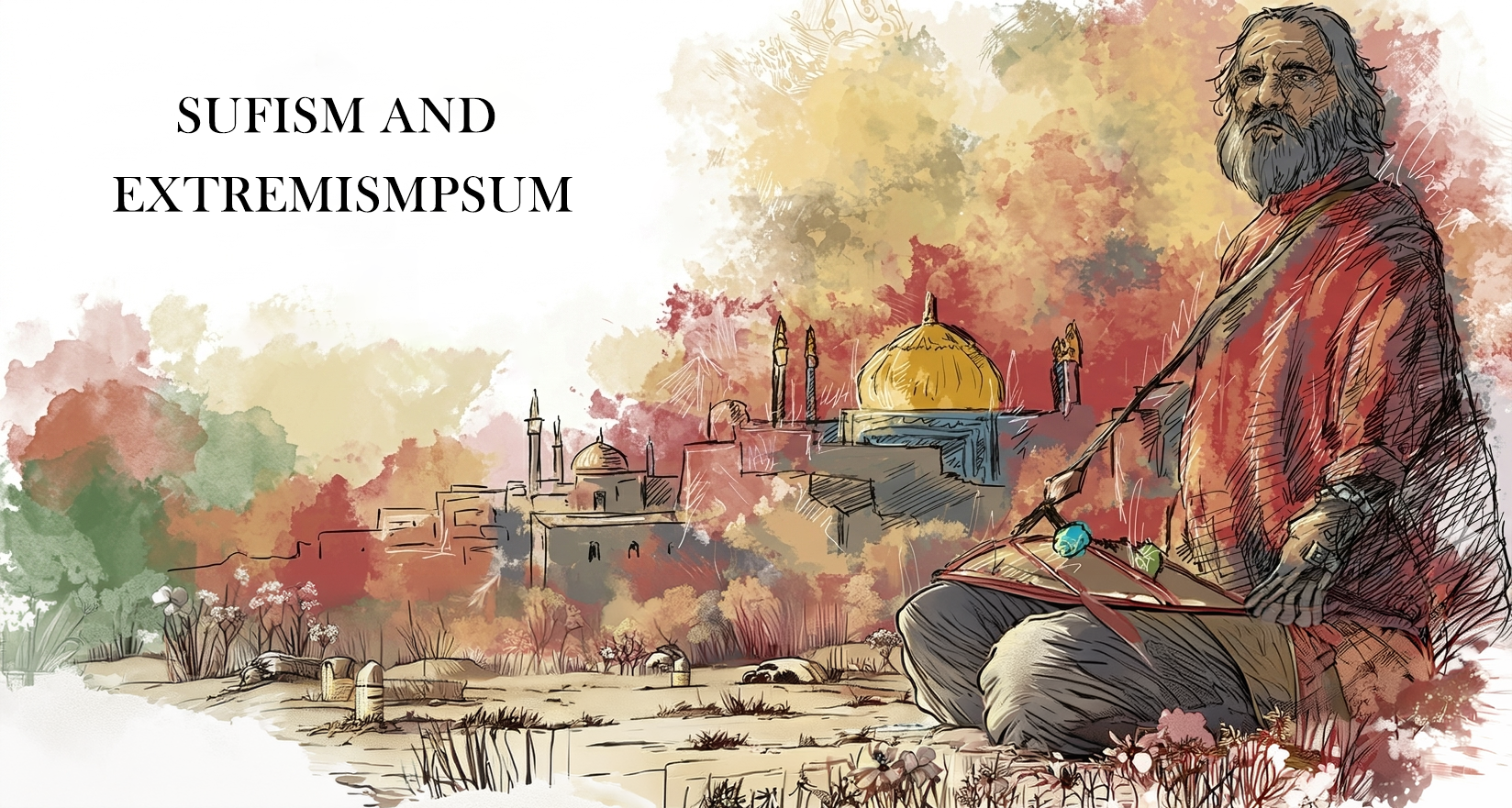
The contemporary global landscape has witnessed an intensification of debates around religion, violence, and extremism. In this context, Sufism, commonly understood as the mystical dimension of Islam, has frequently been positioned as a counter-narrative to terrorism and religious radicalism. Policymakers, scholars, and public intellectuals often portray Sufism as inherently peaceful, pluralistic, and inclusive, in contrast to what is described as rigid, dogmatic, or fundamentalist interpretations of Islam. This framing has gained traction particularly in the aftermath of global conflicts associated with extremist groups that claim religious legitimacy. Reports and analyses have noted how Sufism is being promoted as part of broader ideological responses to terrorism and radicalization (https://www.brookings.edu/articles/positive-branding-and-soft-power-the-promotion-of-sufism-in-the-war-on-terror/). However, while Sufism undoubtedly offers ethical and spiritual resources that challenge violence, the broader discourse that elevates it as a singular antidote to extremism raises significant conceptual and analytical concerns.
Mysticism has historically been a driving force within all major religious traditions. It has appeared under different names and forms, including Kabbalah and Hasidism within Judaism, Bhakti traditions within Hinduism, contemplative practices in Christianity, extreme non-violence in Buddhism and Jainism, and forms of seva and devotion in Sikhism. These traditions emphasize inward transformation, experiential knowledge of the divine, and ethical refinement. Sufism fits squarely within this broader phenomenon, functioning not as an external addition to Islam but as one of its core dimensions. Comparative reflections on mysticism across traditions further reinforce this shared spiritual orientation and its ethical implications in responding to violence (https://gompel-svacina.eu/product/responses-of-mysticism-to-religious-terrorism-sufism-and-beyond/).
Over the past several decades, there has been a growing inclination to separate religion from spirituality or mysticism. This separation is often framed in terms of a dichotomy between institutional religion, which is associated with dogma, authority, and rigidity, and spirituality, which is presented as personal, compassionate, and transformative. Such a dichotomy has influenced both popular and academic discourses, leading to the perception that mysticism operates independently of, or even in opposition to, organized religion. This trend is visible across religious traditions and has contributed to the portrayal of Sufism as something distinct from Islam itself.
At the same time, the rise of conflicts that are framed in religious terms has led to efforts to distinguish between what is described as fundamentalist or extremist religion and what is seen as authentic, peaceful spirituality. In this context, Sufism has been promoted as a form of Islam that embodies tolerance, coexistence, and humility. Governments and international organizations have actively supported Sufi institutions, festivals, and educational initiatives as part of broader strategies aimed at countering violent extremism, including initiatives such as international Sufi forums and cultural diplomacy efforts (https://indembassy-amman.gov.in/world-sufi-forum.html). Policy discussions have also explored how Sufi traditions can be mobilized within counter extremism frameworks, particularly in regions affected by conflict (https://kujenga-amani.ssrc.org/2021/04/21/sponsoring-sufism-as-a-framework-for-countering-violent-extremism-in-the-horn-of-africa-the-ethiopia-us-alliance/).
While these efforts may be well intentioned, they risk reinforcing a problematic binary that divides Islam into opposing camps. On one side stands Sufism, depicted as peaceful and inclusive, and on the other side stand various non-Sufi traditions that are implicitly or explicitly associated with violence. Such a binary not only oversimplifies the complexity of Islamic thought but also contributes to the marginalization of large segments of Muslim communities. It further creates the impression that the problem of extremism lies within Islam itself, rather than in the ways in which the religion is interpreted, manipulated, and sometimes weaponized. Scholars have also cautioned that this framing risks “airbrushing” the diversity of Muslim experiences and simplifying Islam into digestible categories (https://www.theatlantic.com/international/archive/2017/11/airbrushing-sufi-muslims-out-of-modern-islam/546794/).
Sufism, Islam, and the Question of Misinterpretation
The positioning of Sufism as a counter narrative to extremism often rests on the assumption that there is something inherently problematic within Islam that requires correction through its mystical dimension. This assumption does not hold when Islam is read comprehensively and contextually. The Qur’anic emphasis on justice, compassion, and the sanctity of human life provides a clear ethical framework that stands in opposition to violence and terrorism. Acts of extremism carried out in the name of Islam must therefore be understood as distortions that arise from selective readings, misinterpretations, and ideological agendas rather than from the religion itself. Discussions on the relationship between Sufism and terrorism also highlight how misreadings of Islamic teachings contribute to the problem rather than the tradition itself (https://www.journalijdr.com/islamic-illusionism-sufism-and-terrorism).
This insight is not limited to Islam. Across religious traditions, instances of violence have often been linked to particular interpretations that extract specific elements from sacred texts while ignoring their broader ethical and theological contexts. Mystical traditions, including Sufism, often emerge as responses to such rigid or literalist readings, emphasizing instead the deeper meanings and ethical implications of religious teachings. However, this does not mean that mysticism exists outside or above religion. Rather, it represents one interpretive approach among many within a given tradition.
In the case of Islam, Sufism has historically coexisted with other theological, legal, and philosophical schools. It has contributed significantly to the development of Islamic thought, culture, and society. Sufi scholars have engaged deeply with the Qur’an and the Hadith, offering interpretations that highlight the inner dimensions of faith. Their teachings on self-purification, humility, and divine love have shaped Muslim spirituality across regions and centuries. Contemporary analyses continue to describe Sufism as an integral expression of Islam rather than an alternative to it. (https://www.nytimes.com/2017/11/24/world/middleeast/sufi-muslim-explainer.html).
The contemporary portrayal of Sufism as antithetical to Islamic fundamentalism or ritualism therefore reflects a selective reading of both Sufism and Islam. It overlooks the fact that many Sufi practitioners adhere to the same ritual practices and legal frameworks as other Muslims. It also ignores the internal diversity within Sufism itself, which encompasses a wide range of beliefs, practices, and orientations. Some Sufi orders have historically been involved in political movements and even armed resistance, demonstrating that Sufism is not inherently detached from worldly concerns.
Moreover, the narrative that positions Sufism as a counter to extremism can inadvertently create a different kind of Islam that appears more accessible or appealing to external audiences. This so-called marketable Islam is often characterized by its aesthetic elements, such as music, poetry, and cultural expressions, which are highlighted as symbols of peace and harmony. While these elements are indeed important aspects of Sufi traditions, their selective promotion can lead to the marginalization of other forms of Islamic expression. It can also reinforce stereotypes that associate non-Sufi Islam with rigidity or violence. Critical scholarship has also pointed out how framing Sufism as an answer to terrorism may unintentionally simplify complex religious realities (Sufism_An_answer_to_global_terrorism).
There is also a geopolitical dimension to the promotion of Sufism as a counter narrative. Various states have supported Sufi institutions as part of their soft power strategies, presenting them as embodiments of moderate Islam. Discussions within policy circles have explicitly linked Sufism to countering ideological extremism and responding to the rise of more rigid interpretations (https://www.heritage.org/terrorism/event/the-power-counter-narratives-sufi-islam-and-the-rise-wahhabism). While these initiatives may contribute to intercultural dialogue, they also raise questions about the instrumentalisation of religion for political purposes. When Sufism is promoted primarily as a tool for countering extremism, its spiritual and intellectual richness risks being reduced to a functional role within policy frameworks.
Beyond the Binary: Religion as a Whole Against Extremism
A more nuanced approach to the relationship between Sufism and extremism requires moving beyond the binary that separates mysticism from religion. Instead of viewing Sufism as an external corrective to Islam, it is more accurate to understand it as one of the many ways in which Islamic teachings can be interpreted and lived. This perspective allows for a broader engagement with the ethical and spiritual resources within Islam as a whole.
The claim that Islam, when read comprehensively, stands opposed to terrorism is supported by its foundational texts and principles. The emphasis on justice, mercy, and the preservation of human dignity provides a strong basis for rejecting violence. The misuse of Islamic concepts by extremist groups does not reflect the essence of the religion but rather its distortion. This applies equally to other religions, where similar patterns of misinterpretation and manipulation have been observed. Discussions in academic and policy contexts have similarly emphasized that extremism arises from ideological distortions rather than from the core teachings of Islam (https://shs.cairn.info/journal-politique-etrangere-2021-3-page-161?lang=en).
Recognizing this broader context shifts the focus from identifying a particular strand of religion as the solution to extremism to addressing the underlying processes that enable such distortions. These processes include the selective interpretation of texts, the politicization of religious identity, and the exploitation of grievances for ideological purposes. Countering extremism therefore requires a comprehensive engagement with religious traditions that emphasizes contextual interpretation, ethical reflection, and intellectual pluralism. Observations in policy discussions and media narratives have also highlighted the appeal of promoting Sufism as a softer and more accessible face of Islam, while cautioning against oversimplification (https://time.com/archive/6947416/can-sufism-defuse-terrorism/).
Sufism can play a valuable role within this framework. Its emphasis on inner transformation and self-discipline addresses the psychological and emotional dimensions of radicalization. By cultivating humility, compassion, and a sense of interconnectedness, Sufi teachings can counter the alienation and resentment that often underpin extremist ideologies. Public discourse in countries like India has also emphasized the role of Sufism in promoting peace and countering extremist tendencies (Sufism can act as an antidote to terrorism, Spread Sufism, check terror). However, these values are not exclusive to Sufism. They are present within the broader Islamic tradition and can be found in other religious and philosophical systems as well.
It is also important to acknowledge that certain groups have propagated violence in the name of Islam while claiming exclusive authority over its interpretation. These groups often adopt doctrinally rigid and exclusionary positions, presenting themselves as the sole representatives of authentic Islam. However, their claims do not find support within the broader Islamic tradition, which is characterized by diversity and debate.
The challenge, therefore, lies not in identifying a single correct form of Islam but in fostering a culture of critical engagement with religious texts and traditions. This involves encouraging scholars, educators, and community leaders to promote interpretations that align with the ethical principles of justice, compassion, and coexistence. It also requires addressing the social and political conditions that contribute to the appeal of extremist ideologies.
In this context, the emphasis on Sufism as a counter narrative should be understood as part of a broader effort to highlight the ethical and spiritual dimensions of religion. However, this emphasis must be accompanied by a recognition of the limitations of such an approach. Elevating Sufism as the primary antidote to extremism risks obscuring the complexity of both religion and violence. It may also lead to the marginalization of other important voices within the Islamic tradition.
Ultimately, a more effective response to extremism involves reclaiming the holistic nature of religion itself. This means recognizing that Islam, like other major religions, contains within it the resources to oppose violence and promote peace. It also means acknowledging that mysticism, while significant, is only one aspect of a much larger and more diverse tradition. By moving beyond simplistic narratives and engaging with the full richness of religious thought, it becomes possible to develop more nuanced and sustainable approaches to countering extremism. Broader reflections on the role of Sufism in peacebuilding also reinforce the importance of integrating spiritual traditions within wider societal frameworks rather than isolating them (terrorism-defused-by-sufism).
Conclusion
The portrayal of Sufism as a counter narrative to extremism reflects both the ethical depth of mystical traditions and the contemporary urgency to respond to religiously framed violence. Its emphasis on love, humility, and inner transformation undeniably offers important resources for challenging ideologies rooted in exclusion, hatred, and absolutism. Yet, the tendency to position Sufism as inherently opposed to the rest of Islam remains analytically insufficient and politically problematic, as it reduces the complexity of Islamic tradition to an artificial and misleading binary.
Mysticism has historically been an integral dimension of all religious traditions rather than a separate or superior alternative. The modern inclination to divide spirituality from religion has contributed significantly to the misrepresentation of both. In the Islamic context, this has led to the construction of a dichotomy between Sufism and so called fundamentalism, a division that neither reflects historical realities nor does justice to the diversity of Islamic thought. Such a framing has also enabled the instrumentalisation of Sufism within policy and geopolitical frameworks, often reducing it to a functional tool deployed in the service of counter extremism strategies rather than recognizing it as a living and evolving spiritual tradition.
A more grounded understanding points instead to the role of misinterpretation, selective reading, and ideological manipulation in the emergence of extremism. Islam, when approached in its textual and contextual entirety, stands firmly opposed to violence and terrorism. The same holds true for other major religious traditions, where ethical teachings consistently foreground compassion, justice, and the sanctity of life. Sufism contributes meaningfully to this ethical vision, but it does not monopolize it, nor should it be seen as the sole bearer of Islam’s peaceful dimensions.
In the Indian context, this discussion acquires an added layer of historical and cultural significance. The devotional and Sufi strands of Islam have played a central role in shaping the subcontinent’s religious and cultural landscape. These traditions have long been intertwined with the broader ethos of diversity that defines India, fostering spaces of shared spirituality, coexistence, and mutual enrichment. A renewed engagement with this legacy does not imply a departure from Islam but rather a rearticulation of its lived expressions in harmony with the pluralistic fabric of the region.
Kashmir, in particular, offers a compelling example of this synthesis through its indigenous mystical tradition known as Reshism. This tradition, deeply rooted in the Himalayan cultural milieu, developed through intricate interactions between Islamic Sufi thought and the philosophical currents of Kashmiri Shaivism. Within this shared space, spiritual and cultural expressions evolved in ways that transcended rigid religious boundaries while remaining grounded in their respective traditions. The legacy of saints, poets, and sages continues to define the cultural and spiritual identity of the region, shaping a sense of belonging that operates simultaneously at psychological, ontological, and spiritual levels.
It is significant that no rigid ideological framework has been able to fully displace this deeply embedded mystical ethos. The continued resonance of this heritage suggests that efforts to counter violence and extremism in such contexts must engage with these indigenous spiritual traditions. A call for renewal in Kashmir, therefore, is not a call to import external models of counter extremism but to reconnect with its own historical and spiritual resources. This involves a return to the teachings of revered saints, the poetic traditions that articulate shared human experiences, and the landscape itself, which has long been a source of spiritual reflection and connection.
Such a revival is not about separating spirituality from Islam but about recognizing how Islam has historically been lived, experienced, and expressed within a particular cultural and geographical setting. The spiritual strand is not external to religion but is one of its most profound articulations, manifested through the lives, practices, and expressions of the people who inhabit that tradition. In this sense, the reengagement with Sufi and related mystical traditions in Kashmir and India more broadly offers a pathway toward reinforcing a sense of belonging and continuity, which is essential in addressing the alienation that often underlies violent ideologies.
Moving forward, efforts to counter extremism must therefore prioritize a comprehensive engagement with religion that avoids simplistic categorizations. This includes fostering critical and contextual interpretations of religious texts, encouraging intellectual diversity within traditions, and addressing the broader socio political conditions that enable radicalization. Within such a framework, Sufism retains its importance, not as an isolated counter to Islam or extremism, but as one among many expressions through which the ethical and spiritual core of religion can be realized.
In this light, Sufism should be understood not as a counter to Islam but as an integral part of it, and not as the sole response to extremism but as one of several pathways that illuminate the deeper values of faith, humanity, and coexistence.
About the Author