Zahid Sultan (Independent Researcher Based in Srinagar, India)
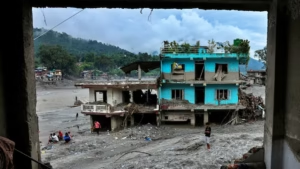
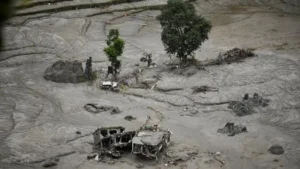
There is something profoundly unsettling about the recent devastation in Nepal. On 26
August, a catastrophic flood swept through the Bhote Koshi-Trishuli river system, carrying
with it water, rock, ice, mud and the accumulated violence of a destabilising Himalayan
landscape. By 4 September, Nepal’s Ministry of Foreign Affairs reported 1,287 bodies
recovered, around 5,083 people still missing, and more than 13,000 rescued. The preliminary
estimate of physical and economic losses had reached NPR 387.54 billion. The disaster
destroyed homes, roads, bridges, hydropower infrastructure and entire stretches of
settlements.
The immediate temptation is to describe this as another Himalayan “natural disaster”. That
description is accurate only in the most superficial sense. It is also intellectually inadequate.
A disaster may have a natural trigger without being entirely natural in its consequences. A
glacier may collapse, a river may swell, a mountain may slide, but the scale of destruction is
mediated by where human beings build, how they alter watersheds, what they remove from
floodplains, how they regulate rivers, whether they maintain wetlands, and whether
institutions understand the ecological systems they claim to govern.
Nepal therefore ought not to be regarded merely as a distant tragedy. For Jammu and
Kashmir, it should be read as a warning. The warning acquires particular significance when
placed alongside the findings of the Comptroller and Auditor General of India on the
conservation and management of lakes in Jammu and Kashmir. The CAG’s Report No. 4 of
2025, covering the period ending March 2022, presents a disturbing picture of ecological
deterioration, fragmented institutional responsibility, inadequate scientific assessment,
encroachment and land-use transformation. Of the 63 lakes sampled by the audit, seven were
found to be either not visible or almost dried up when their geographical coordinates were
examined through satellite imagery. The seven included Rakh-i-Arth, Sether Gund Numbal,
Marhama, Devpursar, Mahtan, Chandargar Numbal and Galwal Talao.
The juxtaposition is difficult to ignore. Nepal has shown us what happens when Himalayan
waters become violently excessive. Kashmir is showing us what happens when Himalayan
waters are progressively deprived of the ecological spaces through which they are supposed
to circulate. One is an eruption of water; the other is the slow erasure of water. Both are
failures of imagination.
The dominant understanding of water governance in Jammu and Kashmir has been
remarkably anthropocentric. Lakes are treated as tourist attractions, wetlands as vacant land,
rivers as channels to be engineered, springs as local conveniences and floodplains as potential
sites for construction. The ecological system is divided administratively into departments,
authorities and jurisdictions, as though nature itself recognised bureaucratic boundaries.
The CAG report exposes precisely this institutional fragmentation. The administration of
lakes is distributed among several departments, while the Forest Department has been
entrusted with the conservation and management of 697 lakes. Yet the audit found that the
necessary detailed survey of these lakes had not been conducted, partly because of inadequate
technical manpower. Of the 697 lakes, only a small number were subject to specific
conservation and management programmes.
A state that does not know the condition of its water bodies cannot plausibly claim to govern
its ecological future. What is not mapped becomes invisible; what becomes invisible becomes
politically expendable. The disappearance of a lake is therefore more than the disappearance
of water. It is the disappearance of institutional memory.
The CAG found that in the 63 sampled lakes there had been inadequate assessment of
changes in catchment areas, water-carrying capacity and water budgets. Scientific assessment
of biodiversity, pollution sources, dredging, de-weeding and the expected life of lakes was
either absent or inadequate. Lake areas had also experienced encroachment and conversion
into built-up areas, agricultural fields, plantations and other land uses. In some instances,
government land was transferred for construction in contravention of wetland conservation
rules.
The significance of these findings extends far beyond environmental administration.
For decades, modern development has been premised upon a peculiar idea: that nature is
essentially a passive background to human activity. Mountains are scenery, rivers are
resources, wetlands are obstacles, forests are timber, and land is valuable primarily when it
can be converted into something else. The climate crisis has exposed the bankruptcy of that
ontology.
Nature is not a backdrop. It is an active condition of social existence. A wetland is not simply
a wetland. It is a hydraulic institution without a ministry. A floodplain is not merely unused
land. It is a natural mechanism for absorbing and distributing excess water. A lake is not
simply an aesthetic object. It is part of a hydrological metabolism. A forested catchment is
not merely an expanse of trees. It regulates runoff, sedimentation, groundwater and river
behaviour. When these systems are degraded, society does not eliminate risk. It merely
transfers ecological risk into social space. This is why the tragedy in Nepal deserves to be
read alongside Kashmir’s disappearing water bodies.
The August 26 disaster appears to have been triggered by a glacial collapse that sent rock, ice
and meltwater into the valleys below, generating destructive floods and debris flows. The
United Nations Development Programme estimated more than 2.2 million tonnes of debris
within the areas analysed shortly after the disaster. But the deeper lesson is not that glaciers
can collapse. Himalayan geology has always been dynamic. Mountains have always moved;
rivers have always flooded; glaciers have always advanced and retreated.
The question is whether human civilisation has retained the institutional capacity to live with
a landscape whose volatility is increasing. That question is especially pertinent because
climate change does not produce only one kind of water crisis. It produces extremes: too
much water in one place, too little in another; intense precipitation followed by prolonged
dryness; glacial instability alongside shrinking local water sources; floods alongside
groundwater stress. This makes the conservation of ordinary water bodies an issue of climate
adaptation, not merely environmental beautification.
And here Kashmir’s predicament becomes particularly serious. Consider the interconnected
system of Anchar, Gilsar and Khushal Sar. The CAG observed that Anchar and Gilsar
function as exit channels for outflow from Dal Lake and are therefore important to the
ecological functioning of the broader lake system. Yet both have experienced reduction in
their extent and deterioration in water quality through encroachment and earth filling. This is
precisely where conventional development thinking becomes dangerous. The water body is
considered in isolation from the system of which it is a part. But water does not understand
administrative compartments.
If one lake is narrowed, another is polluted, a channel is obstructed, a wetland is filled and a
floodplain is built upon, the consequences do not remain confined to the parcel where the
intervention occurred. Hydrological systems are relational. The destruction of one component
can alter the behaviour of the entire system. This is why Anchar is not merely an “Anchar
problem”. Khushal Sar is not merely a Khushal Sar problem. Dal is not merely a Dal
problem. They are parts of a hydrological architecture. When that architecture is dismantled
piecemeal, disaster does not necessarily arrive dramatically. Sometimes it arrives as an
imperceptible reduction in resilience.
That distinction is crucial. Vulnerability often precedes catastrophe by decades. The
catastrophe is merely the moment when accumulated vulnerability becomes visible. The
CAG’s finding that seven sampled lakes were either invisible or almost dried up should
therefore disturb us precisely because there was no dramatic moment of disappearance. There
was no single morning when society woke up to discover that seven water bodies had ceased
to exist. Their disappearance was incremental. Encroachment occurred. Land use changed.
Vegetation expanded. Roads appeared. Catchments deteriorated. The water shrank.
Institutional responsibility became dispersed.
The lake did not disappear overnight. It was administratively forgotten before it became
physically invisible. This is perhaps the most disturbing dimension of the CAG report. We
tend to imagine ecological destruction as an event. In reality, it is often a process of
normalisation. A little encroachment is tolerated. A channel is narrowed. A sewage outlet is
ignored. A wetland is treated as wasteland. A construction proposal is justified in the
language of public necessity. A technical report is delayed. A management authority lacks a
clear mandate. A conservation plan remains on paper. Each individual act appears
manageable. Together they produce ecological collapse.
The politics of environmental destruction is therefore rarely the politics of spectacular
decisions. It is the politics of incremental permissiveness. This is why the CAG’s criticism of
institutional fragmentation matters. Governance becomes ineffective when everyone
possesses a partial mandate and nobody possesses comprehensive responsibility. The audit
found that multiple departments and authorities were involved in lake administration, while
development authorities often lacked clear directions and specific mandates for conservation.
The result is a familiar pathology of modern government: responsibility is dispersed faster
than accountability.
When a lake deteriorates, there is always an administrative explanation. The department says
it was not responsible for encroachment. The development authority says conservation was
outside its principal mandate. The municipality points towards another agency. The revenue
machinery invokes land records. The pollution-control institution identifies sewage. The
planning authority speaks of development. And the lake continues to disappear. This is not
governance but institutional diffusion masquerading as administration.
The Nepal disaster should compel Himalayan regions to reconsider this model. The
Himalayas cannot be governed as isolated territorial units. The ecological system transcends
borders. Glaciers do not stop at political boundaries. Rivers do not respect administrative
jurisdictions. Sediment moves across valleys. Atmospheric systems ignore borders. A flood
generated upstream becomes somebody else’s catastrophe downstream. Nepal’s recent
disaster has already revived concerns about early warning systems and cross-border
information sharing. Reporting has noted that Nepali and Chinese officials had discussed
flood, weather and glacier-related hazards months before the catastrophe.
The lesson for Kashmir and the wider Himalayan region is unmistakable: ecological
governance must become anticipatory rather than merely reactive. Our present model is
heavily biased towards response. We wait for the flood, then discuss relief. We wait for
landslides, then discuss slope stabilisation. We wait for water scarcity, then discuss
conservation. We wait for a lake to shrink, then announce restoration. This is an expensive
form of political procrastination. The central question should instead be: what ecological
systems must remain intact so that disasters do not become catastrophes?
That requires a radical shift in the meaning of infrastructure. The difference is that
conventional infrastructure is built by engineers, while ecological infrastructure is inherited
from geological and biological processes. Yet the latter can be far more difficult and
sometimes impossible to reconstruct once destroyed. We cannot simply manufacture a lost
wetland by passing a government order. We cannot recreate an ancient hydrological system
through cosmetic lakefront development. We cannot compensate for ecological memory with
concrete.
This is where the language of “development” requires intellectual scrutiny. Development that
destroys the ecological conditions upon which human settlement depends is not development
in any meaningful long-term sense. It is the liquidation of natural capital disguised as
progress. The CAG report’s observation that approximately one per cent of Jammu and
Kashmir’s capital expenditure budget during 2017-22 was allocated to six major lakes is
revealing in this context.
The question is not simply whether governments should spend more money on lakes.
The deeper question is why conservation is treated as expenditure while ecological
destruction is treated as development. We spend enormous resources after disasters because
disaster is politically visible. Prevention is politically invisible. A restored wetland does not
produce a ribbon-cutting ceremony. A lake that successfully absorbs floodwater does not
make for dramatic headlines. A forest that prevents sedimentation does not appear in a
government’s achievement brochure.
But when these invisible services disappear, the costs become brutally visible. This is the
paradox of ecological governance: the better the ecosystem functions, the less visible its
contribution becomes. A healthy wetland looks like unused land. A functioning floodplain
looks like emptiness. A protected catchment looks like undeveloped territory. Only when
these spaces are destroyed do we understand what they were doing for us. Nepal has just
offered the Himalayas another devastating reminder.
The lesson should not be reduced to climate change alone. Climate change matters
enormously, but invoking it as a universal explanation can become another form of political
evasion. If every disaster is attributed to climate change, governments can escape
responsibility for the development choices that turn hazards into catastrophes. Climate
change may alter the probability and intensity of hazards. Governance determines much of
the vulnerability. That distinction matters.
A glacier collapse is a hazard. Building vulnerable infrastructure in the path of potential
debris flows is a governance decision. Heavy rainfall is a hazard. Destroying wetlands that
could absorb excess water is a governance decision. River flooding is a hazard. Encroaching
upon floodplains is a governance decision. A changing climate is a planetary reality. Failing
to prepare for it is a political choice.
For Jammu and Kashmir, therefore, the CAG report should not be treated merely as another
audit document to be tabled, discussed and archived. It should be read as an indictment of a
particular developmental sensibility. The seven lakes that became invisible are not merely
seven environmental statistics. They are seven warnings. The shrinking Anchar is a warning.
The degradation of Khushal Sar is a warning. The fragmentation of institutional
responsibility is a warning. The absence of comprehensive scientific assessment is a warning.
And Nepal is the warning amplified to Himalayan scale.
There is still a tendency to imagine that environmental conservation represents a conflict
between nature and development. That is a false binary. The real conflict is between
short-term extraction and long-term habitation. The choice is not between people and lakes. It
is between a civilisation that understands ecological limits and one that discovers those limits
only through catastrophe. The Himalayas do not require our pity. They require a different
politics.
A politics that understands that mountains are not merely scenic frontiers; that rivers are not
merely conduits; that wetlands are not empty spaces; that lakes are not ornamental objects;
and that ecological systems are not infinitely substitutable. Most importantly, they require a
politics capable of thinking beyond the electoral and bureaucratic time horizon. The most
consequential ecological decisions are often made long before their consequences become
politically visible. A lake can be encroached upon today and flood risk can emerge years
later. A catchment can be degraded gradually and sedimentation can become catastrophic
later. A wetland can be filled in increments and its absence becomes apparent only during an
extreme rainfall event.
For Jammu and Kashmir, the question is painfully simple: how many more water bodies must
disappear before we understand that their disappearance is itself a form of disaster? The
answer cannot be another committee, another management plan or another ceremonial
restoration programme. What is required is ecological accounting, legally protected
boundaries, scientific monitoring, integrated catchment management, transparent land-use
regulation and a single-point institutional architecture capable of assigning responsibility. The
CAG itself has recommended time-bound management, proper delineation and demarcation
of lakes, enforcement of wetland rules, removal of encroachments, public awareness and
greater budgetary emphasis on conservation. But even these measures will remain
insufficient if the underlying political imagination does not change.
The real task is to make the invisible visible. To understand that the lake that appears empty
is performing a function. That the wetland that appears useless is storing water. That the
floodplain that appears vacant is protecting a settlement. That the forest that appears
economically unproductive is regulating a watershed. And that the mountain ecosystem we
treat as an inexhaustible inheritance is, in fact, a fragile inheritance being consumed in real
time. Nepal’s rivers have carried the Himalayan warning downstream in the most brutal
language imaginable: death, debris, displacement and ruin. Kashmir has received a quieter
warning. Its lakes are disappearing. Perhaps that is the more frightening warning of the two.
Because catastrophe commands attention.
Disappearance rarely does. And by the time we notice what has disappeared, we may
discover that we were not merely losing water bodies. We were losing the ecological
conditions that made habitation possible in the first place.
About the Author