



Institutional Fragility, Distributive Justice, and Ecological Sustainability in a Conflict-Affected Union Territory.
Irshad Ahmad Bhat (Research Scholar, Politics and Governance)
The contemporary contestation over land in Jammu and Kashmir is most productively analysed within a historically embedded and institutionally contingent framework marked by protracted political instability, episodic administrative disruption, and conflict-induced governance deficits. Current public discourse has foregrounded the juridical status of state-owned land subject to heterogeneous forms of occupation, including residential construction, agrarian utilisation, and commercial appropriation. However, a reductionist legal-positivist framing premised exclusively on statutory violation or encroachment -obscures the deeper structural, political-economic, and historical processes that have generated and normalised irregular landholding regimes over successive decades.
Extended conflict dynamics have diminished regulatory enforcement capacity, disrupted bureaucratic coherence, and weakened institutional responsibility. Within such a Political cum governance vacuum, public land became vulnerable to informal settlement,selective regularisation, and discretionary administrative practices. For economically marginalised communities, possession of state land served more as a survival strategy in the lack of adequate welfare provisions, stable tenure systems.Conversely, political intermediaries and economically powerful actors have, in certain instances, allegedly leveraged institutional fragility and patronage networks to facilitate accumulative land capture. The contemporary land question, therefore, must be conceptualised as a dysfunction as well as nexus of legality, distributive inequity, socio-economic precarity, and clientelist political structures.
This underlying normative contradiction between formal legality and substantive justice manifest the jurisprudential perspective of Martin Luther King Jr., who contended that law and order gain legitimacy by their alignment with justice rather than mere procedural formalism. Enforcement strategies in land governance systems must be assessed based on distributive effects and social equality, rather than solely on legislative compliance.In the absence of transparent and rule-bound procedures, corrective land policies risk reproducing rather than remedying entrenched inequalities.The disagreement is about governance difficulties relating to shared resources including pastures, grazing grounds and village commons.These resources have always been integral to rural livelihoods and socio-ecological systems, as well as problems with ownership and tenure regularisation.The destruction or transformation of such commons signifies not only a property conflict but also a systematic diminishment of shared ecological resources. This outlook aligns with the environmental philosophy advanced by Aldo Leopold in his articulation of a “land ethic,” wherein land is conceived as a biotic community rather than a commodifiable asset.
In an ecologically vulnerable mountainous region characterised by climate sensitivity, unregulated land-use alterations exacerbate ecological imbalance, intensify resource scarcity, and undermine long-term resilience.
The accelerated proliferation of built-up infrastructure across ecologically sensitive zones has amplified anthropogenic stress, diminished vegetative cover, and heightened exposure to hydro-meteorological hazards. Situated within the overarching global climate problem, these developments elucidate the imperative of integrating sustainability concepts into land administration systems.The sustainable development framework proposed by Gro Harlem Brundtland, especially the idea of intergenerational equality, clearly establishes the ethical duty to ensure that current land-use patterns do not inflict irreparable ecological harm on future generations. The attrition of commons and grazing ecosystems in Jammu and Kashmir thus constitutes not only a localised governance failure but also a violation of intergenerational justice norms.
Land in India carries economic, cultural, and political significance; in a region such as J&K characterized by historical land reforms, layered tenure systems, and post-2019 administrative transformation—the governance of land assumes even greater sensitivity. Empirical data revealed from official disclosures placed before the Jammu and Kashmir Legislative Assembly express the magnitude of the issue and frames the contours of the ongoing institutional response.
As per the official replies staged in the Assembly by the Revenue Department during 2025, nearly about 17.22 lakh kanals and 15 marlas of land across various categories—state land, kahcharai (grazing) land,forest land, custodian land,and land belonging to development authorities were identified as being under encroachment in the Union Territory (Government of J&K,Assembly Reply 2025;Kashmir Life,2025). Of this total amount,approximately 14.27 lakh kanals and 7.5 marlas have reportedly been retrieved through multiple anti encroachment measures conducted across Union Territory -leaving roughly 2.99 lakh kanals still under unauthorized control. Interestingly,Jammu division accounts for a disproportionately large share of the encroached land relative to the Kashmir division, although both regions display significant levels of this level of land occupation. These numerical numbers substantiate both the historical accumulation of encroachments over decades and the magnitude of recent recovery drives. Government disclosures further estimate that the market value of encroached state land exceeds ₹18,000 crore, underscoring the substantial fiscal implications of the problem (Kashmir Reader, 2025).
Forest land encroachment is a significant environmental crisis of the current situation. Official statistics reveal that roughly 19,501.87 hectares of forest area are currently subject to unlawful occupation in J&K (2025, Kashmir News Observer). These encroachments adversely affect biodiversity conservation,destabilise watershed systems, depleting ground water tables ,and intensifying vulnerability to horrific landslides and flooding. Proceedings under the Indian Forest Act, 1927, have been initiated in numerous cases, including eviction notices, boundary demarcation, fencing, and post-retrieval reforestation. Utilisation of technological tools such as GPS mapping, satellite imagery, and drone-based surveys reflects an effort to modernize monitoring mechanisms and reduce reliance on manual verification. Ecological governance discourse emphasizes upon that tenure insecurity and improper enforcement capacity often lead to forest land conversion and degradation (Shahariar et al.,2023). This overlap between rural livelihood claims and conservation initiatives further complicate enforcement, as forest-edge communities often assert customary or longstanding occupancy rights.
Custodian land is a distinct and legally intricate form of encroachment. Governed by statutes relating to evacuee property following the partition of 1947, custodian land is intended to remain under state supervision unless lawfully transferred. Government numbers reveal that more than 166,000 kanals of custodian land are now under unlawful occupation in J&k (2025,Kashmir Life). Retrieval rates in this region have been notably low, primarily due to protracted litigation, documentary ambiguities,and contested historical assertions. Investigations by the Anti-Corruption Bureau have allegedly shown instances of fraudulent mutations and distortion of revenue entries in certain cases, exposing weaknesses in the land record management system (ACB Reports, 2024–25). These findings highlight that intrusion is not solely an issue of unofficial settlement; in some instances, it indicates collusion and deficiencies within governmental structures.
Urban and peri-urban encroachments further validate the convergence of land governance with rapid development pressures. Land under the jurisdiction of agencies such as the Jammu Development Authority and the Jammu Municipal Corporation has been identified as encroached in expanding urban belts (Assembly Proceedings, 2025).
Unauthorised occupation in certain places undermines master plans, confuses zoning restrictions,and escalates infrastructure costs.Urban planning literature constantly indicates that peri-urban expansion is propelled by escalating land values,speculative markets,and insufficient affordable housing availability. In Jammu and Kashmir, the growth of metropolitan centers like Jammu city has heightened rivalry for land and thereby amplifying the motivation for unlawful occupation of government properties. The opportunity cost of encroached urban land is substantial, as it limits the state’s capacity to designate areas for public utilities, industrial zones, housing developments, and transit routes.The structural drivers of land encroachment in J&K are multi-layered and historically embedded.Initially, discrepancies in land classification- shamilat and kacharai land,generated uncertainties vulnerable to informal appropriation. These categories frequently demonstrate ambiguous boundaries and outdated cadastral mapping, thereby, resulting in administrative ambiguity.Simultaneously,coexistence of manual records coexisting with digitised systems like HALRIS and Aapki Zameen has resulted in discrepancies between textual records and spatial data. Inadequate synchronization between legacy records and digital databases limits transparency and facilitates manipulation. Third,demographic pressures and urbanization increased demand for residential and commercial land, particularly in peri-urban districts witnessing infrastructural growth. Fourthly, prolonged adjudication of land conflicts,particularly those pertaining to custodian or forest land,engenders legal stagnation that encroachers capitalize on. These variables correspond with extensive land governance research in India, exemplifying record opaqueness, tenure insecurity, and inadequate enforcement as key causes of invasion (Land Governance Review, 2023).
Institutionally, the response to encroachment in J&K has involved large-scale anti-encroachment measures coordinated by the Revenue Department in collaboration with district administrations, forest authorities, and law enforcement agencies. The retrieval of almost 1.4 million kanals of land within a brief timeframe exemplifies administrative determination and operational efficacy. Eviction measures involve the demolition of unauthorised structures,the sealing of illegally occupied commercial properties,and the restoration of land to authorities. Technological interventions such as geospatial mapping and digital mutation tracking have been introduced to enhance accuracy and accountability.
Governance researchers warn that temporary enforcement initiatives, albeit effective in the short term, cannot replace thorough institutional reform. The sustainable avoidance of invasion necessitates systematic enhancements in land record management,clear mutation processes,and prompt dispute resolution mechanism systems.The financial consequences of encroachment are significant. The estimated cost of encroached land incurs significant potential expenses for the state due to delayed infrastructure projects,diminished revenue,and restricted public investment. Moreover,prolonged interference results in legal expenses and administrative obstacles that intensify institutional capacity limitations.Unauthorised occupation adversely impacts land markets by creating informal transactions that operate beyond regulatory oversight
Environmentally, encroachment into forest and ecologically sensitive areas compromises biodiversity and weakens climate resilience strategies. Socially, eviction drives can generate tensions, particularly when long-standing occupants claim livelihood dependence or administrative neglect.
Deliberations within the ongoing Legislative Assembly reflect divergent normative political positions on how the encroachment issue should be addressed. Some legislative members advocate a welfare oriented approach,arguing that economically marginalised occupants who have resided on public land for decades should be prioritized for conditional regularization or entitlement rights under transparent schemes. They contend that in some instances, occupancy signifies historical administrative negligence rather than intentional illegality, and that systematic legalisation could mitigate societal dissatisfaction and prolonged litigation.Others,however, emphasize on strict adherence to statutory frameworks, stressing that public land constitutes a collective asset that must be protected from unauthorized appropriation. Certain legislators asserted that indiscriminate regularisation may institutionalise criminality, encourage greater invasion, and undermine the credibility of governance institutions.The underlying conflict between distributive fairness and rule-based enforcement remains important to legislative discourse.
Ultimately, the future trajectory of land policy in J&K is contingent on the political and administrative authorities directing governance discourse in the Union Territory. Decisions regarding whether to prioritize strict enforcement and conditional regularization, or hybrid framework mechanism integrating both approaches will be shaped by legislative consensus, executive commitment, and bureaucratic capacity. Land encroachment is, therefore, not just a technical matter of cadastral correction but a deeply larger political question concerning equity, legality,and state authority. Sustainability as per national environmental action plan requires profound institutional reforms, technological upgradation of land records,strengthened accountability mechanisms, and a balanced approach that aligns current socioeconomic realities with the requirements of legal governance.The policy challenge confronting the state is consequently multidimensional and normatively complex. It entails harmonising rule-of-law imperatives with social protection obligations while simultaneously safeguarding ecological integrity. A coercive eviction-centric paradigm risks exacerbating socio-economic vulnerability and delegitimising state authority, whereas indiscriminate regularisation may entrench illegality, incentivise speculative encroachment, and accelerate environmental degradation. A calibrated, empirically informed, and institutionally protected policy framework is required to distinguish between types of occupation and to align corrective actions with principles of equality and sustainability.
A viable institutional mechanism would be the establishment of an independent and quasi-judicial commission potentially chaired by a retired High Court or Supreme Court jurist and consisting of representatives from revenue administration, environmental regulatory authorities,urban and regional planning institutions,and social policy experts. Such a body should undertake a granular, category-specific audit distinguishing subsistence-based occupation, long-duration agrarian use, commercial encroachment, and organised land capture facilitated through political patronage. Simultaneously, it stressed to prioritise the legal protection and ecological restoration of commons, integrate rigorous environmental impact assessments into land-use conversion decisions, and accelerate the digitisation, cadastral verification, and public auditing of land records to reduce discretionary ambiguity.Ultimately,resolution of the land question necessitates a paradigmatic shift toward integrative governance—one that harmonises legal rationality, distributive justice, ecological stewardship, and institutional accountability. The objective extends beyond the mechanical reclamation of public land; it encompasses the reconstruction of bureaucratic legitimacy,the preservation of collective environmental assets,and the institutionalisation of sustainable land governance in a violence-affected and climatically vulnerable region.
The contemporary contestation over land in Jammu and Kashmir is most productively analysed within a historically embedded and institutionally contingent framework marked by protracted political instability, episodic administrative disruption, and conflict-induced governance deficits. Current public discourse has foregrounded the juridical status of state-owned land subject to heterogeneous forms of occupation, including residential construction, agrarian utilisation, and commercial appropriation. However, a reductionist legal-positivist framing premised exclusively on statutory violation or encroachment -obscures the deeper structural, political-economic, and historical processes that have generated and normalised irregular landholding regimes over successive decades.
Extended conflict dynamics have diminished regulatory enforcement capacity, disrupted bureaucratic coherence, and weakened institutional responsibility. Within such a Political cum governance vacuum, public land became vulnerable to informal settlement,selective regularisation, and discretionary administrative practices. For economically marginalised communities, possession of state land served more as a survival strategy in the lack of adequate welfare provisions, stable tenure systems.Conversely, political intermediaries and economically powerful actors have, in certain instances, allegedly leveraged institutional fragility and patronage networks to facilitate accumulative land capture. The contemporary land question, therefore, must be conceptualised as a dysfunction as well as nexus of legality, distributive inequity, socio-economic precarity, and clientelist political structures.
This underlying normative contradiction between formal legality and substantive justice manifest the jurisprudential perspective of Martin Luther King Jr., who contended that law and order gain legitimacy by their alignment with justice rather than mere procedural formalism. Enforcement strategies in land governance systems must be assessed based on distributive effects and social equality, rather than solely on legislative compliance.In the absence of transparent and rule-bound procedures, corrective land policies risk reproducing rather than remedying entrenched inequalities.The disagreement is about governance difficulties relating to shared resources including pastures, grazing grounds and village commons.These resources have always been integral to rural livelihoods and socio-ecological systems, as well as problems with ownership and tenure regularisation.The destruction or transformation of such commons signifies not only a property conflict but also a systematic diminishment of shared ecological resources. This outlook aligns with the environmental philosophy advanced by Aldo Leopold in his articulation of a “land ethic,” wherein land is conceived as a biotic community rather than a commodifiable asset.
In an ecologically vulnerable mountainous region characterised by climate sensitivity, unregulated land-use alterations exacerbate ecological imbalance, intensify resource scarcity, and undermine long-term resilience.
The accelerated proliferation of built-up infrastructure across ecologically sensitive zones has amplified anthropogenic stress, diminished vegetative cover, and heightened exposure to hydro-meteorological hazards. Situated within the overarching global climate problem, these developments elucidate the imperative of integrating sustainability concepts into land administration systems.The sustainable development framework proposed by Gro Harlem Brundtland, especially the idea of intergenerational equality, clearly establishes the ethical duty to ensure that current land-use patterns do not inflict irreparable ecological harm on future generations. The attrition of commons and grazing ecosystems in Jammu and Kashmir thus constitutes not only a localised governance failure but also a violation of intergenerational justice norms.
Land in India carries economic, cultural, and political significance; in a region such as J&K characterized by historical land reforms, layered tenure systems, and post-2019 administrative transformation—the governance of land assumes even greater sensitivity. Empirical data revealed from official disclosures placed before the Jammu and Kashmir Legislative Assembly express the magnitude of the issue and frames the contours of the ongoing institutional response.
As per the official replies staged in the Assembly by the Revenue Department during 2025, nearly about 17.22 lakh kanals and 15 marlas of land across various categories—state land, kahcharai (grazing) land,forest land, custodian land,and land belonging to development authorities were identified as being under encroachment in the Union Territory (Government of J&K,Assembly Reply 2025;Kashmir Life,2025). Of this total amount,approximately 14.27 lakh kanals and 7.5 marlas have reportedly been retrieved through multiple anti encroachment measures conducted across Union Territory -leaving roughly 2.99 lakh kanals still under unauthorized control. Interestingly,Jammu division accounts for a disproportionately large share of the encroached land relative to the Kashmir division, although both regions display significant levels of this level of land occupation. These numerical numbers substantiate both the historical accumulation of encroachments over decades and the magnitude of recent recovery drives. Government disclosures further estimate that the market value of encroached state land exceeds ₹18,000 crore, underscoring the substantial fiscal implications of the problem (Kashmir Reader, 2025).
Forest land encroachment is a significant environmental crisis of the current situation. Official statistics reveal that roughly 19,501.87 hectares of forest area are currently subject to unlawful occupation in J&K (2025, Kashmir News Observer). These encroachments adversely affect biodiversity conservation,destabilise watershed systems, depleting ground water tables ,and intensifying vulnerability to horrific landslides and flooding. Proceedings under the Indian Forest Act, 1927, have been initiated in numerous cases, including eviction notices, boundary demarcation, fencing, and post-retrieval reforestation. Utilisation of technological tools such as GPS mapping, satellite imagery, and drone-based surveys reflects an effort to modernize monitoring mechanisms and reduce reliance on manual verification. Ecological governance discourse emphasizes upon that tenure insecurity and improper enforcement capacity often lead to forest land conversion and degradation (Shahariar et al.,2023). This overlap between rural livelihood claims and conservation initiatives further complicate enforcement, as forest-edge communities often assert customary or longstanding occupancy rights.
Custodian land is a distinct and legally intricate form of encroachment. Governed by statutes relating to evacuee property following the partition of 1947, custodian land is intended to remain under state supervision unless lawfully transferred. Government numbers reveal that more than 166,000 kanals of custodian land are now under unlawful occupation in J&k (2025,Kashmir Life). Retrieval rates in this region have been notably low, primarily due to protracted litigation, documentary ambiguities,and contested historical assertions. Investigations by the Anti-Corruption Bureau have allegedly shown instances of fraudulent mutations and distortion of revenue entries in certain cases, exposing weaknesses in the land record management system (ACB Reports, 2024–25). These findings highlight that intrusion is not solely an issue of unofficial settlement; in some instances, it indicates collusion and deficiencies within governmental structures.
Urban and peri-urban encroachments further validate the convergence of land governance with rapid development pressures. Land under the jurisdiction of agencies such as the Jammu Development Authority and the Jammu Municipal Corporation has been identified as encroached in expanding urban belts (Assembly Proceedings, 2025).
Unauthorised occupation in certain places undermines master plans, confuses zoning restrictions,and escalates infrastructure costs.Urban planning literature constantly indicates that peri-urban expansion is propelled by escalating land values,speculative markets,and insufficient affordable housing availability. In Jammu and Kashmir, the growth of metropolitan centers like Jammu city has heightened rivalry for land and thereby amplifying the motivation for unlawful occupation of government properties. The opportunity cost of encroached urban land is substantial, as it limits the state’s capacity to designate areas for public utilities, industrial zones, housing developments, and transit routes.The structural drivers of land encroachment in J&K are multi-layered and historically embedded.Initially, discrepancies in land classification- shamilat and kacharai land,generated uncertainties vulnerable to informal appropriation. These categories frequently demonstrate ambiguous boundaries and outdated cadastral mapping, thereby, resulting in administrative ambiguity.Simultaneously,coexistence of manual records coexisting with digitised systems like HALRIS and Aapki Zameen has resulted in discrepancies between textual records and spatial data. Inadequate synchronization between legacy records and digital databases limits transparency and facilitates manipulation. Third,demographic pressures and urbanization increased demand for residential and commercial land, particularly in peri-urban districts witnessing infrastructural growth. Fourthly, prolonged adjudication of land conflicts,particularly those pertaining to custodian or forest land,engenders legal stagnation that encroachers capitalize on. These variables correspond with extensive land governance research in India, exemplifying record opaqueness, tenure insecurity, and inadequate enforcement as key causes of invasion (Land Governance Review, 2023).
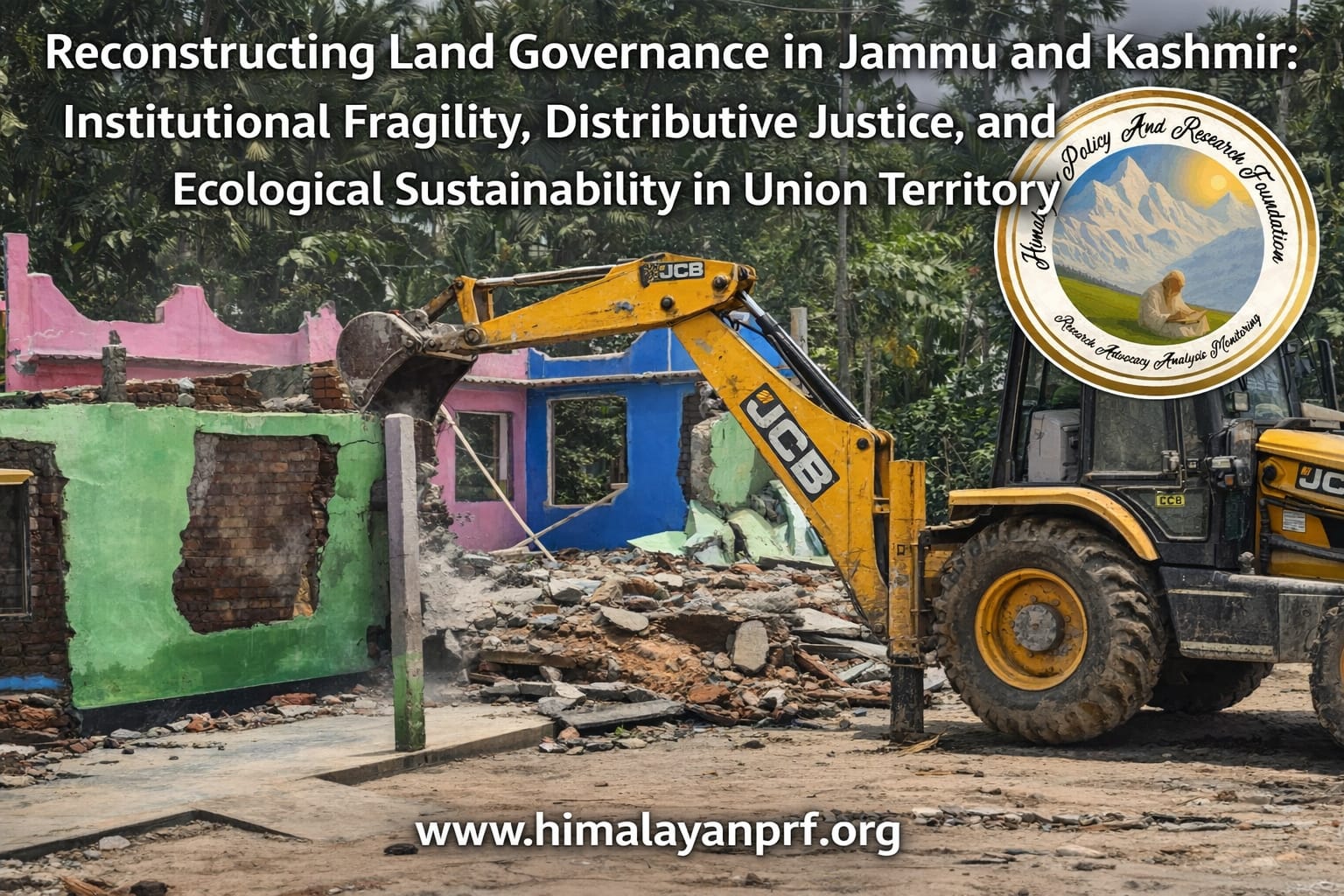
Institutionally, the response to encroachment in J&K has involved large-scale anti-encroachment measures coordinated by the Revenue Department in collaboration with district administrations, forest authorities, and law enforcement agencies. The retrieval of almost 1.4 million kanals of land within a brief timeframe exemplifies administrative determination and operational efficacy. Eviction measures involve the demolition of unauthorised structures,the sealing of illegally occupied commercial properties,and the restoration of land to authorities. Technological interventions such as geospatial mapping and digital mutation tracking have been introduced to enhance accuracy and accountability.
Governance researchers warn that temporary enforcement initiatives, albeit effective in the short term, cannot replace thorough institutional reform. The sustainable avoidance of invasion necessitates systematic enhancements in land record management,clear mutation processes,and prompt dispute resolution mechanism systems.The financial consequences of encroachment are significant. The estimated cost of encroached land incurs significant potential expenses for the state due to delayed infrastructure projects,diminished revenue,and restricted public investment. Moreover,prolonged interference results in legal expenses and administrative obstacles that intensify institutional capacity limitations.Unauthorised occupation adversely impacts land markets by creating informal transactions that operate beyond regulatory oversight
Environmentally, encroachment into forest and ecologically sensitive areas compromises biodiversity and weakens climate resilience strategies. Socially, eviction drives can generate tensions, particularly when long-standing occupants claim livelihood dependence or administrative neglect.
Deliberations within the ongoing Legislative Assembly reflect divergent normative political positions on how the encroachment issue should be addressed. Some legislative members advocate a welfare oriented approach,arguing that economically marginalised occupants who have resided on public land for decades should be prioritized for conditional regularization or entitlement rights under transparent schemes. They contend that in some instances, occupancy signifies historical administrative negligence rather than intentional illegality, and that systematic legalisation could mitigate societal dissatisfaction and prolonged litigation.Others,however, emphasize on strict adherence to statutory frameworks, stressing that public land constitutes a collective asset that must be protected from unauthorized appropriation. Certain legislators asserted that indiscriminate regularisation may institutionalise criminality, encourage greater invasion, and undermine the credibility of governance institutions.The underlying conflict between distributive fairness and rule-based enforcement remains important to legislative discourse.
Ultimately, the future trajectory of land policy in J&K is contingent on the political and administrative authorities directing governance discourse in the Union Territory. Decisions regarding whether to prioritize strict enforcement and conditional regularization, or hybrid framework mechanism integrating both approaches will be shaped by legislative consensus, executive commitment, and bureaucratic capacity. Land encroachment is, therefore, not just a technical matter of cadastral correction but a deeply larger political question concerning equity, legality,and state authority. Sustainability as per national environmental action plan requires profound institutional reforms, technological upgradation of land records,strengthened accountability mechanisms, and a balanced approach that aligns current socioeconomic realities with the requirements of legal governance.The policy challenge confronting the state is consequently multidimensional and normatively complex. It entails harmonising rule-of-law imperatives with social protection obligations while simultaneously safeguarding ecological integrity. A coercive eviction-centric paradigm risks exacerbating socio-economic vulnerability and delegitimising state authority, whereas indiscriminate regularisation may entrench illegality, incentivise speculative encroachment, and accelerate environmental degradation. A calibrated, empirically informed, and institutionally protected policy framework is required to distinguish between types of occupation and to align corrective actions with principles of equality and sustainability.
A viable institutional mechanism would be the establishment of an independent and quasi-judicial commission potentially chaired by a retired High Court or Supreme Court jurist and consisting of representatives from revenue administration, environmental regulatory authorities,urban and regional planning institutions,and social policy experts. Such a body should undertake a granular, category-specific audit distinguishing subsistence-based occupation, long-duration agrarian use, commercial encroachment, and organised land capture facilitated through political patronage. Simultaneously, it stressed to prioritise the legal protection and ecological restoration of commons, integrate rigorous environmental impact assessments into land-use conversion decisions, and accelerate the digitisation, cadastral verification, and public auditing of land records to reduce discretionary ambiguity.Ultimately,resolution of the land question necessitates a paradigmatic shift toward integrative governance—one that harmonises legal rationality, distributive justice, ecological stewardship, and institutional accountability. The objective extends beyond the mechanical reclamation of public land; it encompasses the reconstruction of bureaucratic legitimacy,the preservation of collective environmental assets,and the institutionalisation of sustainable land governance in a violence-affected and climatically vulnerable region.
Reference :
- Anti-Corruption Bureau, Jammu & Kashmir. (2024–2025). Annual investigation and vigilance report. Government of Jammu & Kashmir.
- Brundtland, G. D.(1987).Our common future: Report of the World Commission on Environment and Development. Oxford University Press.
- Government of Jammu & Kashmir, Revenue Department. (2025). Reply to starred and unstarred questions in the Jammu and Kashmir Legislative Assembly regarding land encroachment. Jammu and Kashmir Legislative Assembly Secretariat.
- Indian Forest Act, 1927, No. 16, Acts of Parliament, 1927 (India).
- Jammu & Kashmir Legislative Assembly. (2025). Assembly proceedings and official debates on land retrieval and encroachment. Legislative Assembly Secretariat.
- Kashmir Life. (2025). Government discloses extent of encroached state and custodian land in J&K. Kashmir Life.
- Kashmir News Observer. (2025). Nearly 19,500 hectares of forest land under encroachment in J&K: Official data. Kashmir News Observer.
- Kashmir Reader. (2025). Market value of encroached state land exceeds ₹18,000 crore: Government figures. Kashmir Reader.
- King, M. L., Jr. (1963). Letter from Birmingham Jail. In J. M. Washington (Ed.), A testament of hope: The essential writings and speeches of Martin Luther King, Jr. (1986 ed.). HarperCollins.
- Land Governance Review. (2023). Land tenure insecurity, record opacity, and enforcement deficits in Indian states: A policy review. Ministry of Rural Development, Government of India.
- Leopold, A. (1949). A sand county almanac: And sketches here and there. Oxford University Press.
- Shahariar, M. S., Rahman, M. M., & Hossain, M. S. (2023). Forest tenure insecurity and land conversion dynamics in South Asia.
- Journal of Environmental Policy & Governance, 33(2), 145–162. https://doi.org/xxxxx
- World Commission on Environment and Development. (1987). Our common future,United Nations.