From Gas to Grain: The Geopolitics of Nutrient Security
Written by: Durdana Samoon ( Research Scholar )
The contemporary global system has, over the past half-century, invested heavily in institutional, financial, and strategic mechanisms designed to mitigate energy insecurity. Strategic Petroleum Reserves were constructed at immense fiscal cost to ensure that no geopolitical rupture could fully sever modern civilization from its primary energy inputs. The United States possesses around 400 million barrels of crude oil stored in subsurface salt caverns along the Gulf Coast. On March 11, 2026, the International Energy Agency sanctioned a coordinated release of 400 million barrels, marking the greatest drawdown in its history and highlighting the maturity and operational preparedness of this institutional framework. Energy insecurity, therefore, is governed by stockpiles, doctrine, and coordinated multilateral response mechanisms. Fertiliser insecurity, by contrast, lacks any comparable framework. No major economy maintains strategic reserves of nitrogen, phosphate, or potash at scale, nor does any institutional mechanism exist to coordinate emergency nutrient releases. This asymmetry highlights not just a policy deficiency but an intrinsic vulnerability within the global food system.
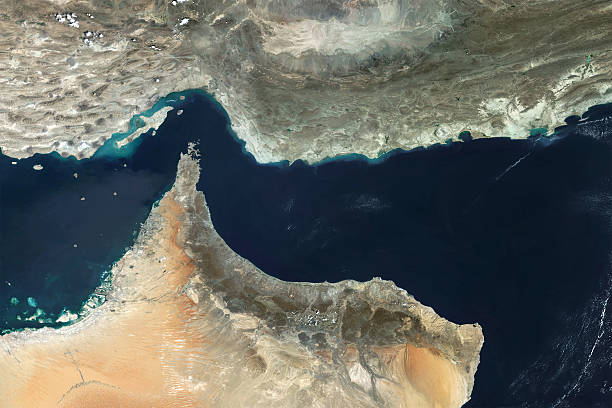
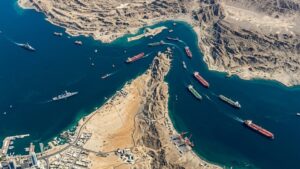
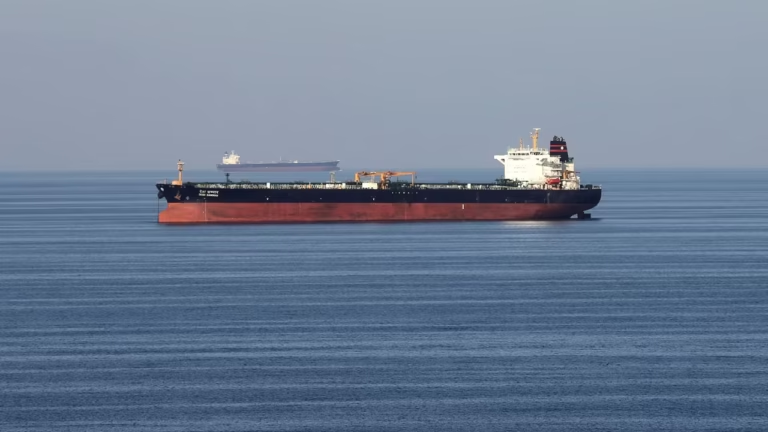
The Strait of Hormuz exemplifies the consequences of this oversight. Widely recognised as a critical energy chokepoints through which approximately one-fifth of global oil flows, it is simultaneously a central artery in the global fertiliser trade. Roughly one-third of seaborne fertilizer shipments transit this narrow corridor, while exporters exposed directly or indirectly to the conflict account for nearly 49 percent of global urea exports, approximately 30 percent of ammonia exports, and close to half of global sulfur trade. This convergence changes Hormuz from an energy chokepoint into a highly concentrated nutrient chokepoint, with nutrients vital for the global agricultural system. Since late February 2026, commercial traffic in this corridor has virtually ceased, with daily ship movements plummeting by roughly 97 per cent. Diplomatic efforts are still hampered, and both parties appear unwilling to back down. Compounding the situation, the fixed nature of agricultural cycles presents an unyielding problem. Planting seasons are relentless; they cannot be deferred. Soil chemistry remains unaffected by geopolitical fluctuations, and crops do not defer to postponed fertiliser application. This temporal mismatch between diplomacy and biology defines the urgency of the unfolding crisis.
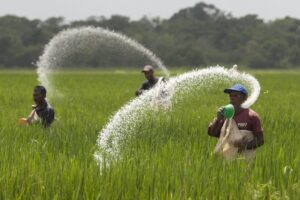
This condition may be conceptualised as the “Nitrogen Trap”, a systemic phenomenon in which global agriculture becomes critically dependent on concentrated, non-substitutable inputs that are neither stockpiled nor geographically diversified. Over decades, agricultural systems have been optimised for cost efficiency, resulting in the concentration of production, distribution, and logistics in a limited number of nodes. These nodes include geographic chokepoints such as Hormuz, energy inputs such as natural gas, and financial infrastructures such as maritime insurance markets. Under conditions of stability, such optimisation maximises output and minimises cost. Under conditions of disruption, however, it generates systemic fragility. The current crisis shows that these systems are not just repricing under strains but also collapsing, as physical constraints override price signals and disrupt the flow of essential inputs.
The Haber-Bosch process, an industrial method for converting atmospheric nitrogen into ammonia, is the foundation of this system. This process, which came into existence in the early 1900s, solved a major problem for human population growth: the limited availability of nitrogen that plants could use. Although nitrogen makes up about 78 percent of the Earth’s atmosphere, it’s mostly in the form of N₂. This molecule has a strong triple bond, which makes it chemically inactive and unavailable to plants. Before industrial fixation, reactive nitrogen came from biological processes, lightning, and mineral deposits like guano. In theory, these resources might sustain between 3.5 and 4 billion people worldwide. This capacity was greatly boosted by the Haber-Bosch process, which has made it possible to support the current nearly 8 billion people on the planet.
Synthetic nitrogen fertilisers now underpin nearly half of global food production, with estimations manifesting that approximately 48 per cent of the world’s population is fed by crops grown using such inputs. The process utilises between 1% and 2% of the world’s total energy, revealing its deep connection to the global energy-food system. Essentially, it is the metabolic engine of modern society. The Persian Gulf is strategically key in this system, mainly because it has a lot of inexpensive natural gas. This gas is used as both the hydrogen source and the energy for making ammonia. As a result, this cost advantage has made the region a leading centre for producing nitrogen fertilisers. Major facilities in Qatar, Saudi Arabia, the United Arab Emirates, Oman, and Iran collectively account for a substantial share of global urea and ammonia exports. These molecules, however, are geographically constrained; they must transit the Strait of Hormuz to reach global markets. There exists no viable alternative route, pipeline, or overland corridor capable of substituting for maritime transport through this chokepoint. The result is a structural vulnerability is concentrated in a narrow maritime passage only 21 nautical miles wide.
The vulnerability extends beyond nitrogen to include sulphur, a crucial but often overlooked component of the global fertiliser system. Sulphur, a byproduct of hydrocarbon refining, is mainly produced in the Persian Gulf, where large amounts of sour crude oil and natural gas are processed. It’s a necessary precursor for sulphuric acid, which is needed to convert phosphate rock into fertiliser that plants can use. About half of the world’s sulphur trade involves countries affected by the Hormuz crisis. Major phosphate producers, with Morocco leading the pack, depend significantly on imported sulphur to keep their operations running. Any disruption in sulphur supplies, however, has repercussions that extend well beyond the Gulf region. Even countries rich in phosphate reserves find themselves unable to maintain production without sulphuric acid, highlighting the interconnectedness of global food systems.
The intricate web of global interdependence grows ever more complicated, particularly when we factor in policy choices made in other major producing regions. China’s recent move to slash phosphate fertiliser exports until August 2026, a measure designed to keep domestic prices under control and maintaining agricultural stability, has effectively taken millions of tonnes off the world stage. This situation then feeds on itself, as the physical cap on nitrogen and sulphur is further exacerbated by the regulatory constraints placed on phosphate exports. For the first time since the industrialisation of fertiliser production, all three primary nutrient systems—nitrogen, phosphate, and sulphur—are simultaneously constrained. Farmers worldwide thus face an unprecedented convergence of shortages that cannot be easily mitigated through substitution or market adjustment.
The closure of the Strait of Hormuz, however, cannot be understood entirely in terms of physical blockades. While military actions have rendered the corridor hazardous, the decisive factor has been the collapse of maritime insurance capacity. Protection and Indemnity clubs, which are insuring a staggering 90 per cent of the world’s shipping, collectively announced war-risk coverage cancellations in early March 2026. This geopolitical change displays the inherent limitations of the insurance industry, particularly those flowing from regulations like the European Union’s Solvency II Directive. Insurers are required to maintain capital reserves to cover significant losses, and the ongoing risks in the Red Sea had already reduced these reserves. The geopolitical situation in the Persian Gulf created a complex web of interconnected risks, which ultimately reduced the capacity for underwriting.
The economic consequences of this contraction are severe. War-risk premiums surged from approximately 0.1–0.25 per cent of vessel value to as high as 5 per cent per transit. For a commercial vessel valued at $50 million, this translates into insurance costs of up to $2 million for a single voyage. Such costs are incompatible with the economics of fertiliser shipping, where margins are relatively thin. As a result, trade has effectively ceased, not because shipping is physically impossible, but because it is economically unviable. Attempts to restore insurance capacity through sovereign-backed reinsurance schemes have thus far proven insufficient. Financial assurances may mitigate monetary losses, but they do not alleviate the physical hazards associated with working in a war zone. The reinstatement of shipping hinges on the restoration of physical safety, which is still uncertain.
The consequences of this disruption extend widely. Within agriculture sector, limited fertiliser availability reduces crop yields, especially for nitrogen-reliant cereals like wheat, rice, and maize. Therefore ,a downward trend in production escalate food prices, exacerbating food insecurity in places depending on imports. Furthermore, the effects extend to industrial sectors, given that ammonia and its derivatives are employed in diverse applications, encompassing pharmaceuticals, chemicals, and energy infrastructures. The interwoven architecture of contemporary supply chains exacerbates these disturbances, creating loops of feedback that can destabilise economic systems.
Moreover, the crisis triggers significant geopolitical implications. Historically, food price inflation has been linked to social discontent and political instability, particularly in areas with low fiscal resources to subsidise food imports. Simultaneously, fertiliser insecurity transcends economic concerns, becoming a significant issue of national and international security. The lack of institutional arrangements to manage such crises further heightens the risk factor and thereby forces states to react in an improvised and chaotic order. In essence, the Hormuz crisis reveals a deeper and fundamental imbalance in the global approach to resource security. While energy systems are buffered by strategic reserves and coordinated institutional responses, fertiliser systems are sensitively susceptible to concentrated and largely unmitigated risks. This disparity highlights a broader failure to recognize the essential function of nutrients in supporting human existence. The Nitrogen Trap exemplifies how systems engineered for peak efficiency can unintentionally cultivate systemic vulnerabilities when confronted with instability. Mitigating this susceptibility requires a strategic realignment, including the creation of fertilizer reserves, the diversification of supply chains, and the integration of nutrient security into broader economic and national security frameworks. Absent the execution of these measures, the global food system will persist in its precarious dependence on a restricted array of inputs and processes, susceptible to disruptions that can rapidly propagate throughout an interconnected and fragile global landscape.
References:
International Energy Agency. (2026, March 11). The IEA coordinates the largest-ever oil stock release. https://www.iea.org
U.S. Department of Energy. (2024). Strategic petroleum reserve: Annual report.
Food and Agriculture Organization of the United Nations. (2022). The state of the world’s land and water resources for food and agriculture.
Food and Agriculture Organization of the United Nations. (2023). Fertiliser market developments and outlook.
International Fertiliser Association. (2024). World Fertiliser Outlook 2024–2028. IFA.
United Nations Conference on Trade and Development. (2023). Global trade update: Fertiliser and food security. UNCTAD.
World Bank. (2023). Commodity markets outlook: Fertilisers and food prices. World Bank.
Smil, V. (2001). Enriching the earth: Fritz Haber, Carl Bosch, and the
Smil, V. (2001). Enriching the earth: Fritz Haber, Carl Bosch, and the transformation of world food production. MIT Press.
Erisman, J. W., Sutton, M. A., Galloway, J., Klimont, Z., & Winiwarter, W. (2008). How a century of ammonia synthesis changed the world. Nature Geoscience, 1(10), 636–639.
Galloway, J. N., & Townsend, A. R. (2003). The global nitrogen cycle: Past, present, and future.
U.S. Geological Survey. (2024). Mineral commodity summaries: Phosphate rock and sulfur.sulphur.
About the Author


This article is very insightful… v need such articles as this is rare analysis of its kind where we get to know more about this multifront areas of energy security.