

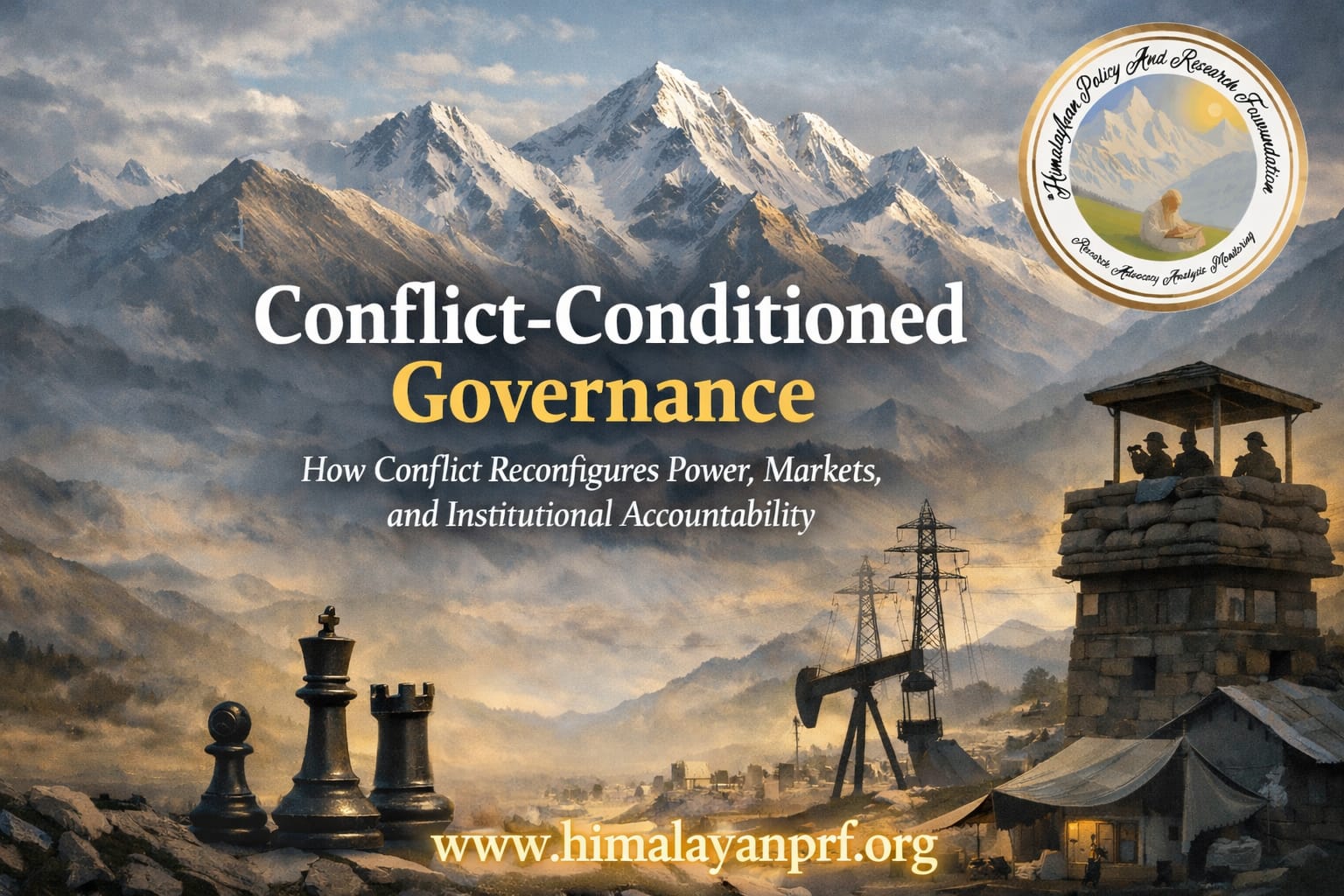
How Conflict Reconfigures Power, Markets, and Institutional Accountability
By: Dr Fida Hussain ( Senior Research Fellow)
Conflict is often narrated in the language of loss- lives extinguished, homes reduced to rubble, institutions corroded, and futures deferred. Yet there exists another dimension that is less visible but no less devastating: the political economy that grows in the shadow of violence. Every prolonged conflict generates not merely casualties and ceasefires but a parallel structure of incentives, interests, dependencies, and distortions. This structure hardens over time. It feeds on insecurity, rationalizes emergency, monetizes fear, and redistributes opportunity in ways that reward proximity to power and punish vulnerability. These are the scars of a conflict economy- not accidental wounds, but structural imprints that outlast the gunfire.
A conflict economy is not simply an economy disrupted by war. It is an economy reorganized around war. When insecurity becomes permanent rather than episodic, the allocation of resources, the design of institutions, and even the imagination of development shift accordingly. Public expenditure tilts disproportionately toward security apparatuses; bureaucratic discretion expands under the pretext of urgency; procurement becomes opaque; surveillance infrastructures proliferate; and extraordinary measures normalize themselves as routine governance. What begins as an emergency gradually becomes equilibrium. The state, rather than transitioning back to ordinary legality and transparent administration, internalizes the grammar of exception. In such an environment, conflict is no longer merely endured; it is administered.
This administrative normalization has profound distributive consequences. Conflict economies produce asymmetries. They generate beneficiaries- contractors, intermediaries, politically connected elites, segments of bureaucracy, and private actors who thrive on state patronage tied to security and reconstruction. At the same time, they produce the permanently precarious- small traders whose supply chains collapse at every shutdown, students whose educational trajectories fracture under repeated disruptions, laborers whose mobility is restricted by curfews and checkpoints, families whose savings evaporate under uncertainty. The tragedy is not only that violence destroys wealth; it is that the mechanisms erected in response to violence reallocate whatever remains in ways that entrench inequality.
The moral vocabulary of conflict frequently invokes sacrifice, resilience, and patriotism. Yet beneath this rhetoric lies a more unsettling reality: prolonged instability generates vested interests in its own continuation. This does not imply that actors consciously desire bloodshed; rather, it recognizes that certain structures become financially and politically
dependent on the persistence of emergency. Budget lines tied to security rarely shrink voluntarily. Special funds designated for “reconstruction” are extended year after year. Regulatory relaxations introduced as temporary measures become permanent exemptions. In such contexts, the cessation of conflict threatens not only militants or insurgents but also those embedded in the ecosystem of control and reconstruction. Peace, paradoxically, becomes economically disruptive.
One of the most corrosive features of a conflict economy is its impact on institutional trust. Markets function on predictability; societies function on credibility. When emergency powers override procedural safeguards, when contracts are awarded without transparency under the guise of urgency, and when citizens perceive that access to opportunity depends less on merit than on political proximity, trust erodes. Over time, individuals adapt rationally to irrational systems. Informality expands. Tax compliance weakens. Corruption ceases to shock; it becomes a strategy. The informal payment, the middleman, the recommendation letter, the discretionary clearance-all become survival mechanisms in a system where formal rules are unstable.
Education, too, is reshaped by conflict’s economic logic. Recurrent disruptions diminish instructional continuity, but the damage extends further. A generation socialized in uncertainty recalibrates its aspirations. Risk aversion intensifies; migration becomes both aspiration and necessity; public sector employment is prized not for innovation but for stability. Entrepreneurial energy- essential for economic diversification- is dampened by unpredictability. Investors, domestic and foreign alike, discount regions marked by volatility. Insurance premiums rise. Credit becomes expensive. Infrastructure projects stall or inflate in cost due to security contingencies. The opportunity cost of instability accumulates invisibly, year after year.
The rhetoric of reconstruction often promises transformative development once “normalcy” is restored. Yet reconstruction within a conflict economy frequently replicates the same distortions that conflict produced. Large-scale infrastructure contracts concentrate in the hands of a few; oversight remains weak; timelines extend indefinitely; cost overruns are justified by security considerations. Reconstruction thus becomes less a bridge to equitable growth and more an extension of the emergency apparatus. The language changes- from counterinsurgency to connectivity, from stabilization to smart cities- but the underlying patterns of concentrated benefit and diffused cost persist.
There is also a psychological dimension to the scars of a conflict economy. When livelihoods depend on patronage networks mediated through security structures, citizenship is reframed as dependency. The relationship between state and citizen shifts from rights to favors. Welfare schemes are not experienced as entitlements grounded in constitutional principles but as discretionary benevolence. This recalibration diminishes civic agency. Demands for accountability are muted by fear of reprisal or exclusion. Silence becomes prudence. In such an environment, democratic participation risks being hollowed out- not by formal suspension but by informal intimidation and economic vulnerability.
A particularly insidious scar lies in the distortion of labor markets. Skilled professionals often exit conflict zones, seeking stability elsewhere. This brain drain is not merely demographic; it is developmental. Universities struggle to retain faculty; hospitals lose specialists; private enterprises hesitate to expand. The resulting vacuum is filled either by underqualified substitutes or by centralized deployments disconnected from local contexts. The region’s capacity to generate endogenous growth declines. Over time, dependency on external transfers deepens, reinforcing the very fragility that necessitated intervention in the first place.
The fiscal dimension deserves equal scrutiny. Conflict regions frequently rely on extraordinary fiscal transfers from central authorities. While such transfers may be necessary to offset revenue deficits caused by instability, they can inadvertently entrench a rentier dynamic. When local revenue generation is weak and public expenditure is externally financed, accountability mechanisms weaken. Citizens, disconnected from taxation, have limited leverage over budgetary priorities. Political elites, insulated by transfers, face diminished pressure to cultivate sustainable economic bases. The result is a cycle of dependence that masks structural stagnation beneath the veneer of fiscal largesse.
It would be simplistic to suggest that security expenditure is inherently illegitimate in conflict settings. States have a responsibility to protect citizens and uphold order. The problem arises when security becomes the organizing principle of economic life rather than its necessary safeguard. When the exceptional displaces the ordinary, when oversight is perpetually deferred in the name of urgency, and when developmental discourse is subordinated to securitized metrics, the economy ceases to serve society; it begins to discipline it.
Moreover, conflict economies often recalibrate the very meaning of productivity. In stable contexts, productivity is measured through innovation, diversification, and value addition. In conflict contexts, productivity may be redefined through the capacity to manage unrest, to procure equipment, to secure contracts tied to surveillance or reconstruction. This shift alters the incentive structure for human capital formation. Young people, observing which sectors yield returns, adjust accordingly. Careers aligned with administrative power or security infrastructure appear rational; ventures dependent on open markets appear perilous. The cumulative effect is an economy that orients itself toward containment rather than creativity.
Another scar manifests in spatial segregation. Conflict reshapes urban geographies: fortified enclaves, restricted zones, and differential access to infrastructure become normalized. Real estate values fluctuate not according to market fundamentals but according to proximity to perceived safety or patronage networks. Entire neighborhoods may stagnate due to recurring cordons or reputational stigma. These spatial inequalities embed themselves into generational trajectories, influencing schooling, employment access, and social mobility. Geography becomes destiny in ways that perpetuate division long after overt violence subsides.
The discourse of “normalcy” often obscures these structural distortions. Official pronouncements may highlight increased tourist footfall, infrastructure inaugurations, or investment summits as evidence of recovery. Yet macro indicators can conceal micro
realities. A surge in short-term capital inflows does not necessarily translate into broad-based employment. Ribbon-cutting ceremonies do not automatically restore institutional trust. Without addressing the underlying architecture of the conflict economy- the opaque procurement systems, the emergency legal frameworks, the patronage networks- development remains cosmetic.
An argumentative stance is necessary here because complacency thrives on selective optimism. It is tempting to interpret incremental improvements as definitive turning points. But unless the incentive structures that reward emergencies are dismantled, unless fiscal transparency replaces discretionary allocation, unless citizens are treated as rights-bearing stakeholders rather than security subjects, the scars will not fade; they will calcify.
Critics may argue that such analysis underestimates the complexity of governing volatile regions. Indeed, governance in conflict settings is fraught with dilemmas. Yet complexity cannot justify opacity. Nor can insecurity legitimize indefinite exception. The measure of a resilient state lies not in the expansion of its coercive apparatus but in its capacity to transition from emergency to ordinary legality without forfeiting stability. When that transition is delayed indefinitely, conflict ceases to be an event and becomes an economic system.
The scars of a conflict economy are therefore multidimensional: fiscal dependence, distorted labor markets, spatial segregation, patronage entrenchment, eroded trust, and attenuated civic agency. These are not ephemeral consequences; they shape generations. Children who grow up in environments where opportunity is mediated by discretion internalize a politics of caution. Entrepreneurs who repeatedly encounter arbitrary shutdowns recalibrate ambition. Citizens who experience welfare as favor rather than right temper their demands. The cumulative effect is a society disciplined by uncertainty.
To confront these scars requires more than rhetorical commitments to peace or development. It demands structural recalibration: transparent procurement, time-bound emergency measures subject to judicial oversight, genuine decentralization that empowers local accountability, investment in human capital insulated from political patronage, and fiscal reforms that incentivize local revenue generation. Without such measures, conflict’s economic architecture will persist even in the absence of open hostilities.
The true tragedy of a conflict economy is that it transforms abnormality into routine. It habituates society to lower expectations. It narrows the horizon of possibility. And once expectations are diminished, the threshold for acceptable governance declines accordingly. The scar, in this sense, is not merely economic; it is normative. It redefines what citizens believe they deserve.
If conflict wounds the body politic, the conflict economy reshapes its skeleton. It determines how resources flow, how institutions behave, and how citizens relate to power. Healing, therefore, cannot be confined to ceasefires or investment announcements. It must involve the
dismantling of the economic structures that have learned to thrive on instability. Until that occurs, the guns may fall silent, but the scars will continue to govern.
To understand the endurance of a conflict economy, one must interrogate the political incentives that sustain it. Violence may ebb, insurgencies may fragment, and formal hostilities may recede, yet the architecture erected during years of instability rarely dissolves of its own accord. Institutions adapt to crisis, and in adapting, they generate routines, hierarchies, and revenue streams that develop constituencies. Those constituencies, in turn, acquire influence. What was once justified as extraordinary hardens into administrative habit. Thus, even when the intensity of conflict diminishes, the economic logic that grew around it remains intact, functioning with remarkable autonomy.
At the heart of this persistence lies a paradox: the rhetoric of stabilization coexists with the preservation of exceptionalism. Governments announce phases of “post-conflict recovery,” yet emergency regulations continue to structure decision-making. Investment summits are organized, yet procurement processes remain opaque. Official narratives speak of integration and development, yet oversight mechanisms remain weakened in the name of security. This contradiction is not merely rhetorical; it is material. It reflects the difficulty- and often the unwillingness- of dismantling systems that have become financially and politically profitable.
The political class, too, is shaped by the incentives of a conflict economy. In environments marked by chronic insecurity, electoral competition often pivots less on policy differentiation and more on proximity to authority. Candidates emphasize their ability to “manage” the state apparatus, to secure projects, to mediate with security institutions, to expedite clearances. Representation becomes transactional rather than transformative. Constituents seek access; politicians promise access. The structural questions- about transparency, fiscal sustainability, diversification are overshadowed by the immediate calculus of patronage. In such a system, politics narrows to brokerage.
This narrowing has consequences for democratic imagination. When public debate revolves around the distribution of state largesse rather than the architecture of governance, the horizon of reform contracts. Citizens may demand roads, employment packages, or compensation schemes, but seldom are they invited into conversations about institutional redesign. The very language of reform becomes technocratic, confined to administrative circles. A conflict economy, in this sense, disciplines political discourse. It renders structural critique marginal and privileges managerial competence over normative transformation.
Dependency deepens as external fiscal transfers compensate for depressed local revenues. While such transfers may be justified to mitigate instability, they also create a structural asymmetry. Local administrations become reliant on central allocations; long-term planning is shaped by the anticipation of grants rather than the cultivation of endogenous growth. When revenue generation is weak, taxation reforms are politically sensitive and economically risky. Consequently, fiscal accountability attenuates. Citizens, unaccustomed to a robust tax-state relationship, perceive public expenditure as detached from their own contributions.
The reciprocal bond that underpins fiscal citizenship weakens, and with it, the leverage required to demand transparency.
Moreover, the private sector in conflict settings often evolves within constrained horizons. Enterprises align themselves with state-driven projects-construction, logistics, services linked to public contracts-because such sectors offer relative security. Diversification into export-oriented or innovation-driven domains appears precarious amid unpredictability. Banks, wary of risk, tighten credit. Insurance costs escalate. Informal networks substitute for formal guarantees. The result is an economy that circulates within a narrow bandwidth, recycling state funds rather than generating new value. Growth, when it occurs, is shallow.
The social consequences are equally profound. Prolonged exposure to emergency governance reshapes civic culture. Self-censorship becomes habitual; dissent is recalibrated; public assemblies are weighed against perceived risk. Economic vulnerability compounds political caution. Individuals employed in sectors dependent on state patronage may hesitate to articulate critique, fearing exclusion. Over time, a tacit social contract emerges: stability in exchange for silence, access in exchange for acquiescence. This contract is rarely articulated but widely understood. It is one of the most enduring scars of a conflict economy because it internalizes restraint within society itself.
Generational effects further complicate recovery. Youth who mature in environments characterized by recurrent disruptions encounter truncated educational trajectories and limited professional exposure. Their aspirations oscillate between migration and public sector employment. Innovation ecosystems struggle to take root where uncertainty dominates. Even when security metrics improve, reputational stigma lingers. Investors, evaluating risk, rely on historical data; regions once marked by conflict carry a premium long after violence declines. Thus, the past continues to tax the future.
Advocates of incrementalism may argue that gradual improvements-better infrastructure, rising tourism, periodic investment announcements-signal organic transition away from a conflict economy. Yet without institutional recalibration, such improvements risk entrenching the very patterns they purport to transcend. Infrastructure projects, for instance, may generate employment during construction but fail to catalyze sustainable industries if regulatory unpredictability persists. Tourism may surge seasonally but remain vulnerable to political tremors. The appearance of vibrancy can coexist with structural fragility.
What, then, would a genuine departure from a conflict economy entail? It would begin with the reassertion of ordinary legality. Emergency measures must be time-bound, subject to legislative review and judicial scrutiny. Procurement processes must be transparent, competitive, and audited rigorously. Public expenditure should be published in accessible formats to enable civic oversight. Such reforms are not merely procedural; they are normative. They signal that governance is returning to rule-bound accountability rather than discretionary management.
Second, fiscal restructuring is imperative. Encouraging local revenue generation through calibrated taxation reforms, incentivizing small and medium enterprises, and diversifying the economic base reduces dependency on external transfers. This does not imply abrupt withdrawal of support; rather, it requires a phased strategy that couples transfers with capacity-building. When local administrations cultivate their own revenue streams, accountability deepens. Citizens, contributing through taxation, acquire legitimate leverage to scrutinize expenditure.
Third, investment in human capital must be insulated from patronage. Universities, vocational institutes, and research centers require autonomy and stable funding mechanisms shielded from political volatility. Scholarships and recruitment processes must adhere to meritocratic standards to restore faith in fairness. Education is not merely a sector; it is the foundation upon which diversification rests. Without credible educational institutions, efforts to transcend a conflict economy will falter.
Fourth, spatial integration demands attention. Urban planning that dismantles segregated enclaves and expands equitable access to infrastructure fosters social cohesion. Mixed-use development, accessible public transport, and inclusive housing policies counteract the geography of division. Economic revival cannot occur in pockets; it must diffuse across communities.
Fifth, civic empowerment is indispensable. Civil society organizations, independent media, and community forums provide platforms for accountability. Encouraging participatory budgeting, public hearings, and open data initiatives reinvigorates democratic agency. A conflict economy thrives on opacity; its antidote is transparency coupled with citizen engagement.
Critically, these reforms must be accompanied by a narrative shift. Stability should not be framed solely as the absence of violence but as the presence of justice, transparency, and opportunity. When public discourse equates peace with silence or development with spectacle, structural reform recedes. A society emerging from conflict requires a more demanding vocabulary-one that measures success not merely by reduced incidents but by restored institutional trust.
It is tempting to believe that economic growth alone can dissolve the scars of conflict. Growth, however, is not self-correcting. Without deliberate structural transformation, growth may reinforce inequalities embedded during years of instability. Those who accumulated capital through patronage networks may consolidate their dominance. Those marginalized during conflict may remain peripheral. Equity, therefore, must be central to any recovery strategy.
There is also a need for moral clarity. Recognizing the existence of a conflict economy is not an indictment of any single institution or actor; it is an acknowledgment of structural dynamics that arise in prolonged crises. Yet denial perpetuates distortion. Only by
confronting the uncomfortable truth-that instability has generated beneficiaries as well as victims-can reform begin. Silence protects interests; candor challenges them.
Ultimately, the scars of a conflict economy are neither inevitable nor irreversible. They persist because dismantling them demands political courage. It requires those who benefit from opacity to relinquish privilege, those who wield emergency powers to accept constraint, and those who depend on patronage to embrace meritocratic uncertainty. Such transitions are fraught, but they are indispensable.
If conflict reconfigures an economy around fear, recovery must reconfigure it around trust. Trust in institutions, trust in procedures, trust in fairness. This trust cannot be legislated into existence; it must be cultivated through consistent, transparent practice. The shift from emergency governance to accountable administration is not merely technical-it is transformative.
The enduring danger of a conflict economy is that it teaches society to survive rather than to aspire. It compresses ambition into the narrow corridor of security and access. Healing requires expanding that corridor-restoring the belief that opportunity is not contingent on proximity to power but on capability and initiative. When citizens begin to expect more than stability-when they demand justice, transparency, and equitable growth-the architecture of conflict begins to loosen its grip.
Peace, in its deepest sense, is not the silence of guns but the restoration of ordinary life governed by predictable rules. An economy scarred by conflict can recover only when its organizing principle shifts from containment to creativity, from discretion to due process, from patronage to productivity. Until then, the scars remain embedded-not as visible wounds, but as invisible constraints shaping choices, expectations, and destinies.
The question, therefore, is not whether conflict leaves economic scars; it inevitably does. The question is whether societies possess the resolve to prevent those scars from ossifying into permanent structures. Where that resolve exists-anchored in transparency, accountability, and inclusive growth-the architecture of conflict can be dismantled. Where it falters, instability may recede, but its economic shadow will continue to govern long after the headlines move on.