Author: Hilal Ahmad Lone ( Research Scholar)

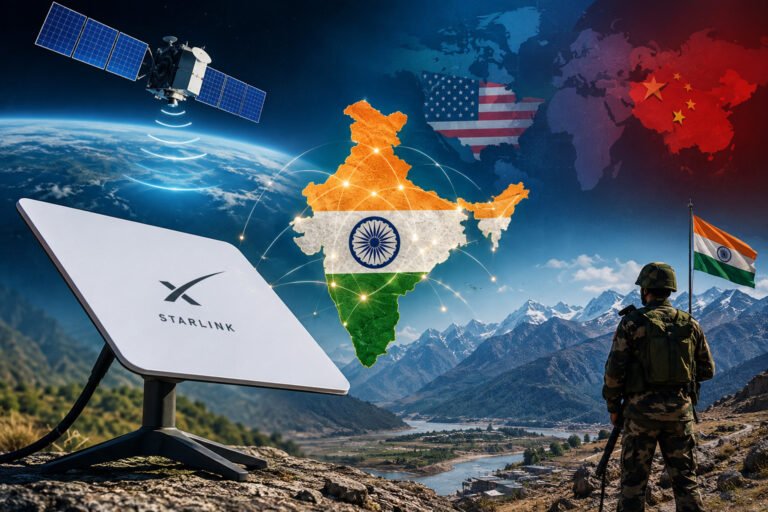
The recent debate surrounding Starlink’s proposed entry into India presents a problem that conventional understandings of national security are increasingly ill-equipped to address. The territorial state continues to exercise juridical sovereignty over its population, but the infrastructures through which authority is exercised, information circulates and security is organised are becoming progressively detached from territorial boundaries. The state’s capacity to regulate communication can no longer be inferred simply from its control over physical territory. It must also be understood in relation to the ownership, architecture and operational jurisdiction of the technological systems upon which contemporary societies depend. Starlink is significant in this respect not merely because it offers an alternative mode of internet connectivity, but because it exemplifies a wider transformation in the relationship between technological capital and sovereign authority. The question confronting India is therefore not reducible to whether a foreign corporation should be permitted to enter its telecommunications market. It concerns the conditions under which a state can preserve substantive sovereignty when essential communications infrastructure is increasingly controlled by transnational private actors.
This question acquires particular urgency in the Indian context. The country’s strategic environment is characterised by military competition with China, a protracted confrontation with Pakistan, the threat of cross-border militancy and the expanding significance of cyber operations. These challenges are not interchangeable, nor can they be subsumed under an undifferentiated category of external threat. Nevertheless, they collectively demonstrate that contemporary security is constituted through a complex relationship between territorial defence, information control, technological capacity and the management of vulnerabilities within civilian infrastructure. The strategic significance of communications networks lies precisely in their dual character: they are indispensable to ordinary social and economic activity, yet they can also become instruments through which coercive power is exercised, intelligence is transmitted and adversarial capabilities are coordinated. Satellite internet consequently inhabits an ambiguous space between civilian infrastructure and strategic capability. Its security implications cannot be established by reference to its commercial character alone.
The conceptual difficulty is that sovereignty has historically been associated with the state’s capacity to exercise supreme authority within a defined territorial jurisdiction. Yet the material conditions of that authority are undergoing a profound transformation. Communications increasingly depend upon infrastructures whose physical components, corporate ownership, data-processing arrangements and operational jurisdictions are distributed across multiple territories. The state may retain the legal authority to regulate a service without possessing equivalent control over the technical systems through which that service operates. This disjunction between juridical authority and infrastructural capacity constitutes one of the central dilemmas of contemporary sovereignty. In the case of satellite communications, the difficulty is especially pronounced because the transmission of information can occur through orbital systems that do not correspond neatly to the territorial boundaries within which regulatory authority is ordinarily exercised.
Starlink brings this contradiction into particularly sharp relief. Its low-Earth-orbit satellite constellation can provide connectivity to locations where terrestrial broadband infrastructure is either inadequate or prohibitively expensive. Such a capability has evident developmental and humanitarian significance, particularly in geographically inaccessible regions. Yet the very technological characteristics that facilitate connectivity across difficult terrain also complicate conventional mechanisms of regulatory oversight. The question is not whether satellite communications are inherently beyond the reach of the state. Such a proposition would be technologically and legally simplistic. Rather, the question is whether the state possesses the institutional and technical capacity to translate its formal regulatory authority into effective operational control. A government may prescribe conditions concerning subscriber identification, lawful interception, traffic routing and geographical restrictions; the effectiveness of those conditions, however, depends upon the architecture of the network and the enforceability of the obligations imposed upon its operator.
India’s security concerns must be situated within this distinction between formal sovereignty and effective capacity. In a conventional telecommunications system, the relationship between subscribers, domestic operators and terrestrial infrastructure provides established points of regulatory intervention. Satellite networks alter the configuration of that relationship. Their users may connect through specialised terminals rather than conventional mobile towers, and their communications depend upon a system whose ownership and management extend beyond the territorial jurisdiction of the state in which the service is consumed. This does not render such communications intrinsically anonymous, nor does it establish that lawful monitoring is impossible. It does, however, require a more demanding assessment of whether existing regulatory mechanisms remain adequate under conditions of geopolitical confrontation and internal insecurity. The relevant issue is not technological novelty as such, but the possibility that the state’s capacity to identify, investigate and interrupt unlawful communications may become contingent upon the cooperation of a private operator.
The implications are particularly consequential for a state confronting forms of indirect warfare. India’s security predicament cannot be understood exclusively through the conventional model of interstate conflict, in which military capabilities are concentrated within identifiable state institutions and exercised through relatively visible chains of command. Cross-border militancy, covert assistance to non-state actors and the strategic exploitation of political vulnerabilities complicate this model. Proxy warfare seeks, among other things, to create an asymmetry between the capacity to inflict harm and the capacity to attribute responsibility. Communications technologies may facilitate this asymmetry by enabling coordination across geographical distances and by reducing dependence upon established communications infrastructure. Nevertheless, it would be analytically indefensible to infer that Starlink is being used by Pakistan-sponsored militant organisations in India merely because satellite connectivity could theoretically facilitate such activity. The distinction between an identifiable vulnerability and an established instance of exploitation must remain central to any serious security analysis.
The significance of this distinction extends beyond evidentiary caution. If every technology that could potentially be appropriated for hostile purposes were treated as an exceptional security threat, the category of national security would become so expansive that it could justify almost any restriction. Digital networks, encrypted messaging, mobile telecommunications and cloud infrastructure all possess dual-use characteristics. Their potential exploitation does not eliminate their civilian utility, nor does it establish that prohibition is necessarily the most effective regulatory response. The state’s task is to identify the specific vulnerabilities generated by a particular technological architecture and determine whether they can be mitigated through enforceable safeguards. Security policy becomes analytically inadequate when the possibility of misuse is treated as sufficient evidence for exclusion. The relevant standard must be whether the risks are sufficiently material, whether they can be demonstrated and whether the proposed restrictions are proportionate to the threat.
China introduces a different, although related, dimension to this problem. The strategic competition between India and China concerns not merely territorial disputes but also technological capacity, critical infrastructure and the distribution of power within the international system. Communications infrastructure has acquired strategic significance because it mediates the coordination of state institutions, the functioning of essential services and the resilience of societies under conditions of conflict. A state that depends upon a foreign corporation for an important communications capability must therefore consider the possibility that commercial decisions, regulatory interventions in another jurisdiction or geopolitical pressures could affect the availability of that capability. The problem is not that every foreign corporation necessarily acts as an instrument of its home state. Such an assumption would obscure the distinction between corporate agency and governmental control. The problem is that dependence upon privately controlled infrastructure may create vulnerabilities even in the absence of hostile intent.
The experience of satellite connectivity during the Russia-Ukraine war illustrates this broader predicament. Starlink’s importance to communications in a conflict environment has demonstrated that decisions taken by a private operator can acquire consequences extending beyond the ordinary sphere of commercial activity. Where military or civilian capabilities become dependent upon a privately controlled network, the provider’s decisions concerning access, continuity and geographical availability can acquire strategic significance. This observation does not establish that Starlink poses a specific threat to India, nor does it imply that the company would necessarily act against Indian interests. It establishes a more general proposition: the strategic consequences of technological dependence cannot be assessed exclusively through the declared intentions of the provider. They must also be evaluated in relation to the institutional arrangements governing access, continuity, accountability and the distribution of decision-making authority.
For India, this problem intersects with the doctrine of strategic autonomy. Strategic autonomy is often understood as the preservation of freedom of action in foreign policy, but its contemporary significance extends to the material conditions that sustain such freedom. A state cannot exercise meaningful autonomy if essential capabilities depend upon infrastructure that it cannot adequately regulate, replace or maintain during a crisis. Yet autonomy should not be conflated with technological autarky. The exclusion of foreign technology may protect against certain dependencies while simultaneously depriving the state of capabilities that could strengthen its resilience. The strategic question is therefore one of calibrated interdependence: how can India benefit from globally developed technologies without allowing the provision of essential services to become contingent upon arrangements over which it exercises insufficient control? The answer requires institutional capacity, diversified infrastructure and enforceable regulatory obligations rather than an indiscriminate preference for either domestic ownership or foreign participation.
The debate over Starlink also reveals a tension between national security and the political economy of technological competition. The allegation that powerful domestic business interests may be obstructing a foreign competitor raises the possibility that regulatory authority can become entangled with the commercial interests of established firms. Such allegations, however, must not be mistaken for demonstrated facts. The existence of a competitive conflict does not establish regulatory capture, just as the invocation of national security does not establish that restrictions are necessarily protectionist. Both possibilities require scrutiny. The legitimacy of the regulatory process depends upon whether the conditions imposed upon competing operators can be justified by identifiable differences in their technical and operational circumstances. Where restrictions are imposed, the government should be able to explain their rationale and demonstrate their consistency, subject to the legitimate confidentiality of sensitive security information. Otherwise, the boundary between prudent regulation and discretionary exclusion becomes increasingly difficult to sustain.
This is where the problem of democratic accountability becomes inseparable from the problem of sovereignty. The state must retain the capacity to impose security obligations upon private operators, but its exercise of that capacity must itself remain subject to institutional scrutiny. National security cannot be reduced to a rhetorical justification that suspends the demand for reasons. Nor can market competition be elevated into an absolute principle that overrides the state’s responsibility to protect critical infrastructure. The relevant distinction is between restrictions that respond to demonstrable vulnerabilities and restrictions whose relationship to the stated security objective remains obscure. A credible regulatory framework must establish this distinction through transparent standards, independent technical assessment and procedures through which decisions can be reviewed. Such arrangements are not concessions to commercial interests; they are conditions of legitimate public authority.
India’s response should consequently be neither an unconditional acceptance of Starlink nor an automatic prohibition of the service. It should be a system of conditional authorisation based upon verifiable technical and legal requirements. Subscriber identification, terminal registration, cybersecurity audits, lawful interception and compliance with domestic data-handling obligations are essential elements of such a framework. Equally important is the capacity to enforce geographically specific restrictions when legally justified by an emergency or a credible security threat. These arrangements must be assessed in operational terms rather than accepted merely because they appear in regulatory documents. The state must establish whether the provider can comply with its requirements in practice, what mechanisms are available when compliance fails and whether essential communications capabilities can be maintained if the service becomes unavailable. Such obligations should apply consistently across the satellite communications sector, including operators associated with domestic corporations. The nationality of ownership is relevant to the assessment of jurisdiction and strategic dependence, but it cannot substitute for a substantive evaluation of security risk.
The developmental implications of satellite connectivity should not be marginalised within this discussion. In remote Himalayan settlements, geographically isolated border communities and areas vulnerable to natural disasters, satellite internet could expand access to education, healthcare, research and emergency services. For Jammu and Kashmir, where geography and security considerations intersect in distinctive ways, reliable communications can have considerable public value. Yet the benefits of connectivity should not be assumed to arise automatically. Affordability, network reliability, regulatory conditions and the distribution of access will determine whether the technology reduces existing inequalities or remains concentrated among institutions and households with greater resources. A security framework that ignores these considerations would be incomplete, just as a developmental argument that disregards the strategic consequences of communications infrastructure would be insufficient.
The deeper issue is that the contemporary state increasingly exercises authority over systems that it neither owns nor directly operates. The expansion of private technological infrastructure has not rendered sovereignty obsolete; it has altered the material conditions under which sovereignty must be exercised. Authority is no longer secured exclusively through territorial control but also through the capacity to regulate networks, impose obligations upon private actors and preserve essential functions under conditions of uncertainty. Starlink is therefore emblematic of a broader transformation in which technological capital acquires strategic significance without necessarily becoming an instrument of the state in which it originates. The resulting relationship is neither one of complete state control nor of unrestricted corporate autonomy. It is a contested relationship in which public authority must continuously establish the conditions under which private technological capacity can be reconciled with collective security.
India’s challenge is to recognise that sovereignty in the digital age is neither preserved through the indiscriminate exclusion of foreign technology nor strengthened through uncritical technological dependence. It requires the capacity to distinguish between risks that can be mitigated and dependencies that may become strategically unacceptable; between legitimate commercial competition and the exercise of disproportionate private power; and between necessary security restrictions and the arbitrary extension of executive discretion. These distinctions are institutionally demanding precisely because they resist simple solutions. They require the state to demonstrate not merely its willingness to regulate, but its capacity to regulate intelligently, consistently and accountably.
The ultimate question raised by Starlink is therefore not whether a foreign billionaire should be permitted to challenge the interests of an established Indian corporation. It is whether the Indian state can maintain effective public authority over communications infrastructure whose operation increasingly transcends territorial boundaries. In an international environment shaped by strategic competition with China, the threat of cross-border militancy associated with Pakistan and the growing significance of privately controlled digital systems, this question is integral to the future of national security. Sovereignty cannot be reduced to the capacity to prohibit; nor can technological openness be treated as an unconditional good. The substantive test of sovereign capacity lies in the ability to govern the conditions of technological interdependence without surrendering either security or accountability. A state demonstrates its autonomy not simply by determining which technologies may enter its territory, but by ensuring that their operation remains compatible with the public purposes for which authority is exercised.
About the Author