Author: Peerzada Muneer
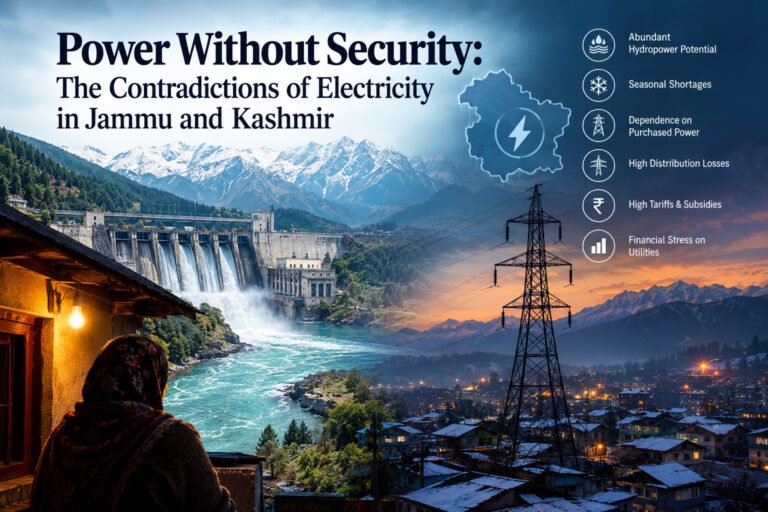
Jammu and Kashmir occupies a paradoxical position in India’s energy landscape. Endowed with substantial hydropower potential, traversed by major river systems and home to strategically significant hydroelectric projects, the region possesses the natural foundations of an energy-rich economy. Yet electricity insecurity remains a persistent concern for households, commercial establishments, small industries and public institutions, particularly during the winter months. The contradiction raises a fundamental question of political economy: why does the availability of an abundant natural resource not translate automatically into reliable, affordable and universally accessible electricity?
The answer lies in the distinction between energy potential, installed generation capacity, actual electricity production and the institutional capacity to deliver power to consumers. These are related but fundamentally different dimensions of the electricity system. Hydropower potential describes what geography might permit; installed capacity indicates what infrastructure has been constructed; generation depends on hydrological and operational conditions; and consumer access ultimately depends on procurement, transmission, distribution, financial viability and administrative management. Jammu and Kashmir’s electricity challenge must therefore be understood not merely as a problem of insufficient generation, but as a structural question concerning the organisation and governance of its energy economy.
The Paradox of Hydropower Abundance
The scale of Jammu and Kashmir’s hydropower potential provides an appropriate starting point. A Government of India parliamentary annexure published in December 2019 identified approximately 13,543 MW of potential for large hydropower projects and 1,707.45 MW for small hydropower projects in the combined erstwhile Jammu and Kashmir and Ladakh region. These figures should be understood as identified potential, rather than operational capacity, and they refer to the administrative geography used at the time of publication. Source: Ministry of Power, Government of India, parliamentary annexure on identified hydropower potential.
The distinction matters because potential cannot be treated as electricity already available to consumers. Projects require investment, environmental clearances, construction, transmission infrastructure and years of implementation. Even commissioned plants do not necessarily operate at their rated capacity throughout the year. River flows vary seasonally, reservoir conditions affect generation, and maintenance can reduce output. Hydropower is therefore a major strategic asset, but it is not an unlimited or seasonally uniform source of electricity.
The Central Electricity Authority’s continuing publication of hydroelectric potential development reports reflects the importance of assessing potential, project development and commissioned capacity separately. Source: Central Electricity Authority, Hydro Electric Potential Development reports.
The deeper issue is that natural resource abundance does not necessarily establish local energy autonomy. Electricity generated at a hydroelectric station may enter a wider interconnected grid, be allocated under contractual arrangements, or be associated with ownership and power-purchase agreements that determine who receives its output and on what terms. Consequently, the presence of major power projects within a territory does not, by itself, guarantee that the territory’s own demand will be met at the required time or at an affordable cost.
This distinction is especially important in Jammu and Kashmir, where the political significance of hydropower frequently exceeds public understanding of its commercial and regulatory arrangements. The relevant question is not simply how much electricity can be generated from the region’s rivers, but how generation, ownership, power allocation, procurement costs and local consumption are connected.
The Winter Deficit: When Demand and Supply Move in Opposite Directions
Seasonality constitutes one of the most important structural challenges in Jammu and Kashmir’s electricity economy. Winter brings a sharp increase in household demand for heating and lighting, while commercial establishments, educational institutions, healthcare facilities and public infrastructure also require dependable electricity. Shorter daylight hours further increase the importance of artificial lighting. At the same time, reduced river flows in some periods can constrain hydropower generation, although the extent varies across projects and depends on operating conditions.
This creates a seasonal mismatch between the availability of particular generation resources and the timing of consumer demand. The result is that a region may possess substantial annual hydropower potential while still requiring electricity purchases from the wider power market during periods of high demand or inadequate local generation.
The distinction between annual energy adequacy and dependable peak supply is central here. Annual energy requirement measures the total electricity needed over a period, generally expressed in million units (MU), whereas peak demand measures the maximum power required at a particular moment, generally expressed in megawatts (MW). A system may procure sufficient energy over a year yet experience constraints during particular hours, days or local distribution peaks. An annual supply figure therefore cannot, on its own, establish that every consumer receives uninterrupted electricity.
Official figures illustrate why these distinctions matter. According to the Ministry of Power’s reported supply position, Jammu and Kashmir’s energy requirement during 2024–25 was 20,374 MU, against an energy supply of 20,283 MU, leaving 90 MU of officially recorded unmet energy requirement, equivalent to approximately 0.4 per cent. Source: Ministry of Power, Government of India, state-wise power supply position for 2024–25.
At first glance, this relatively small annual energy gap might suggest that the system is broadly adequate. However, aggregate annual statistics do not necessarily capture the distribution of interruptions across districts, the duration and frequency of outages, local transformer constraints, scheduled curtailment or the unequal consequences of electricity shortages for different consumers. Nor do they reveal whether the supply available during the coldest periods corresponds to the hours when households need it most.
The policy implication is that electricity planning must move beyond aggregate energy balances. Jammu and Kashmir requires transparent seasonal assessments of peak demand, available generation, contracted supply, purchased electricity and the actual duration of outages. Without these indicators, official claims of adequacy and public experiences of insecurity can appear contradictory while referring to different dimensions of the same system.
Dependence on Purchased Power and the Cost of Security
Where local generation cannot meet demand at a particular time, electricity procurement from external sources becomes an essential component of system management. Such purchases are not inherently undesirable. Interconnected electricity markets allow regions to diversify supply, balance fluctuations and obtain power from generating stations that may be more economical or more readily available at a given time.
The problem arises when dependence on purchased power becomes expensive, unpredictable or financially difficult to sustain. Winter procurement requirements can place pressure on distribution utilities, particularly when market prices rise during periods of widespread demand. Long-term power-purchase agreements can provide greater certainty, but they also create financial commitments and may not always correspond perfectly to changing demand patterns.
Consequently, energy security cannot be measured exclusively by the proportion of electricity generated within Jammu and Kashmir. It must also be assessed through the affordability and reliability of procurement arrangements, the availability of contracted capacity during peak periods, and the ability of utilities to pay generators and maintain supply infrastructure.
The region’s hydropower resources should therefore be understood as part of a wider portfolio rather than as a substitute for all other sources of electricity. Better forecasting, appropriate long-term contracting, demand management, storage and diversified procurement can reduce exposure to seasonal volatility. However, these measures must be assessed against their costs, technical feasibility and implementation timelines rather than treated as automatic solutions.
Distribution Losses: The Missing Link Between Generation and Consumption
Even when electricity has been generated or procured, its availability to consumers depends on the efficiency of the distribution system. This is where Jammu and Kashmir’s electricity challenge becomes particularly significant. Technical losses occur naturally when electricity travels through networks, but commercial losses arise from problems such as inaccurate metering, unbilled consumption, theft and weak revenue collection. Aggregate technical and commercial (AT&C) losses combine technical losses with commercial and collection inefficiencies, making them an important indicator of distribution performance.
The Government of India’s published data reported AT&C losses of 59.28 per cent for Jammu and Kashmir in 2020–21. The same published table did not provide a corresponding figure for 2021–22, so the 59.28 per cent figure should not be presented as a current estimate. It nevertheless illustrates the historical scale of the distribution challenge. Source: Ministry of Power, Government of India, state-wise AT&C losses under the Revamped Distribution Sector Scheme.
High AT&C losses can weaken a utility’s finances through a straightforward mechanism. Electricity must be purchased or generated, transmitted and distributed before revenue can be collected from consumers. When a substantial share of the energy supplied does not translate into realised revenue, the utility’s ability to cover procurement costs, maintain infrastructure and invest in network improvements is undermined. The resulting financial pressure can reinforce operational weaknesses, creating a cycle in which inadequate revenue contributes to poor service, while poor service weakens the perceived legitimacy of billing and payment arrangements.
The Revamped Distribution Sector Scheme was designed to improve the quality, reliability and affordability of electricity through financially sustainable and operationally efficient distribution utilities. Its objectives include reducing AT&C losses and closing the gap between the average cost of supply and average revenue realised. Source: Ministry of Power, Revamped Distribution Sector Scheme overview.
For Jammu and Kashmir, the central question is whether distribution reforms are producing sustained, independently verifiable improvements in metering, billing, collections, feeder performance and outage duration. Aggregate loss-reduction claims should be supported by year-wise utility data and should distinguish technical losses from commercial losses. Smart meters may improve visibility and billing, but technology alone cannot resolve inadequate maintenance, weak accountability, poor consumer communication or financial mismanagement.
The Financial Contradiction: Affordable Tariffs, Expensive Electricity
Electricity affordability is another essential dimension of the region’s energy paradox. The cost of supplying electricity is not necessarily the same as the price charged to a consumer. Retail tariffs must account for power procurement, transmission and distribution costs, operational expenditure and other approved components. Where the government wishes to protect households or particular economic sectors from the full cost of supply, subsidies can bridge the difference between the approved tariff and the amount paid by consumers.
Jammu and Kashmir’s official electricity distribution corporation website illustrates the scale of this arrangement. For financial year 2025–26, the Kashmir Power Distribution Corporation Limited reported government support of ₹4,136 crore towards covering the revenue gap associated with subsidised electricity tariffs. The same official page lists a subsidised energy rate of ₹2.30 per unit for domestic metered consumption up to 200 units per month, against a stated full-cost tariff of ₹7 per unit. Source: Kashmir Power Distribution Corporation Limited, government subsidy and FY 2025–26 tariff information.
These figures demonstrate that consumer affordability is supported by a substantial fiscal commitment. They also reveal why the distinction between the price paid by a household and the economic cost of supplying electricity matters. Subsidies can protect household budgets, support vulnerable consumers and reduce the immediate burden of heating and essential services. At the same time, the financial viability of distribution utilities depends on whether the difference between the cost of supply and the revenue collected is funded predictably and transparently.
The appropriate policy question is therefore not whether electricity subsidies should exist, but whether they are sufficiently targeted, fiscally sustainable and accompanied by improvements in service delivery. Subsidies that protect low-income households can advance social welfare; subsidies that are poorly targeted or inadequately funded can weaken utility finances without guaranteeing better reliability. A durable electricity policy must reconcile affordability with the financial resources required to maintain and modernise the distribution network.
This also raises questions about the allocation of public expenditure. Subsidy commitments must be examined alongside capital investment in transformers, substations, transmission capacity, metering, maintenance and system automation. Financial support that preserves low tariffs but leaves distribution infrastructure under-maintained may offer immediate relief while failing to address the underlying causes of insecurity.
Hydropower Benefits, Free Power and Local Energy Security
The political economy of hydropower extends beyond the quantity of electricity generated. It also concerns who owns the projects, who bears their environmental and social costs, how benefits are distributed and what share of the value created by local natural resources returns to the region.
Hydroelectric projects can generate revenue, provide electricity under contractual arrangements and create opportunities for infrastructure development. Yet these benefits do not automatically translate into cheaper retail electricity or uninterrupted local supply. The financial and contractual structure of each project matters, including ownership, power-purchase agreements, royalty or free-power provisions where applicable, and the allocation of generation among beneficiaries.
A serious assessment must therefore distinguish the existence of free-power entitlements from the availability of electricity at a consumer’s premises. Even where a project provides a share of generation or revenue to the regional administration, the ultimate effect on household bills depends on how those benefits are accounted for, allocated and used within the broader electricity system.
The government should publish accessible, consolidated information on hydropower projects associated with Jammu and Kashmir, identifying their ownership, installed capacity, actual annual generation, allocated power, free-power entitlements where applicable, revenues received and outstanding project commitments. The Central Electricity Authority’s hydroelectric potential and project-development reports provide a starting point for understanding the distinction between potential and development status. Such disclosure would allow citizens to evaluate whether the region’s natural-resource endowment is generating commensurate public benefits.
The argument is not that every unit generated in Jammu and Kashmir must necessarily be reserved for local consumption. Electricity is traded through interconnected systems, and regional cooperation can be economically rational. Rather, resource-producing regions should be able to assess transparently whether their arrangements deliver fair economic returns, reliable access and long-term developmental benefits.
Towards a More Reliable Electricity System
Addressing Jammu and Kashmir’s electricity insecurity requires a coordinated reform agenda rather than a singular emphasis on constructing additional generating capacity. New hydropower projects can strengthen the system over time, but they cannot substitute for improvements in forecasting, procurement, distribution and financial governance.
First, the administration should publish a seasonal electricity balance sheet showing forecast demand, peak requirements, available generation, contracted supply, expected purchases and actual supply. Such a framework would distinguish genuine generation shortages from procurement constraints and distribution failures. It would also permit a more rigorous assessment of winter preparedness.
Second, distribution utilities should publish comparable monthly indicators of AT&C losses, feeder-level reliability, outage frequency, outage duration, metering coverage, billing efficiency and revenue collection. These indicators should be independently audited and presented in a manner that allows consumers to compare performance across districts and over time.
Third, procurement planning should account explicitly for seasonal volatility. A balanced portfolio of dependable contracted power, appropriately designed market purchases, improved forecasting and feasible storage solutions can reduce exposure to periods of constrained supply. Demand-side measures, including building efficiency, efficient heating technologies and targeted support for vulnerable consumers, can also reduce the pressure associated with winter peaks.
Fourth, subsidy policy should be integrated with utility reform. The government should disclose the amount budgeted, released and actually paid against approved subsidies, alongside the cost of supply and revenue realised by each distribution utility. This would help establish whether consumer protection is being delivered without creating unsustainable payment obligations or diverting attention from the need to improve operational performance.
Finally, hydropower governance should be treated as a question of public accountability. Project-level information about capacity, generation, ownership, contractual allocations and financial returns should be accessible to the public. Such disclosure would allow policy debates to move beyond broad claims about resource abundance towards a measurable assessment of economic and social benefits.
Conclusion: From Resource Potential to Energy Security
Jammu and Kashmir’s electricity paradox is ultimately a problem of conversion: the conversion of natural-resource potential into dependable generation, of generation into affordable procurement, of procurement into reliable distribution, and of public expenditure into measurable consumer outcomes. Each stage requires different institutional capacities, and weaknesses in any one of them can undermine the performance of the entire system.
The available evidence demonstrates both the scale of the challenge and the need for analytical precision. The identified hydropower potential of the combined erstwhile Jammu and Kashmir and Ladakh region establishes the importance of the resource, but not the quantity of electricity presently available to local consumers. The reported 0.4 per cent annual energy deficit in 2024–25 indicates that aggregate unmet energy requirement was relatively small, but does not independently establish uninterrupted service across seasons and districts. The historical AT&C loss figure highlights a serious distribution concern, while the reported ₹4,136 crore subsidy commitment illustrates the fiscal effort required to support affordable tariffs.
Taken together, these indicators point towards a more comprehensive understanding of energy security. The objective should not merely be to generate more electricity, nor should affordability be pursued independently of financial sustainability. Jammu and Kashmir needs an electricity system in which reliable supply, reasonable consumer costs, commercially viable utilities and transparent management of hydropower benefits reinforce one another.
The decisive question is therefore not whether Jammu and Kashmir possesses enough rivers to generate electricity. It is whether the institutions responsible for planning, procuring, distributing and financing electricity can transform that natural advantage into a dependable public service. Until that transformation becomes measurable in the everyday experience of households and businesses, hydropower abundance will remain an economic promise only partially realised.
About the Author