Author: Peerzada Muneer
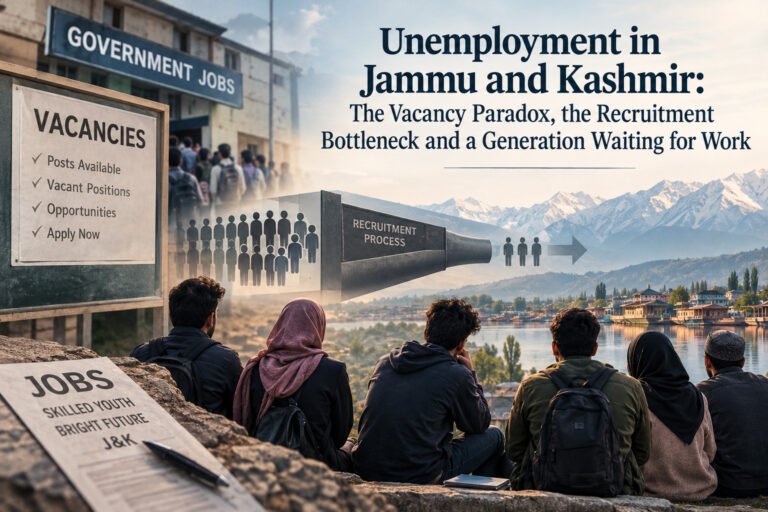
Jammu and Kashmir’s unemployment crisis presents a paradox that deserves closer scrutiny. Government departments report tens of thousands of vacant posts, recruitment agencies receive applications in the millions, and official economic surveys record improvements in labour-force participation and employment. Yet, for a substantial section of educated youth, securing a stable livelihood remains an increasingly distant prospect. The contradiction is not simply between the number of people seeking work and the number of jobs available. It concerns the structure of the regional economy, the dominance of government employment in career aspirations, the pace of recruitment, the quality of private-sector jobs, the mismatch between education and market demand, and the absence of a credible transition from education to productive employment.
The most revealing evidence comes from the figures placed before the Jammu and Kashmir Legislative Assembly in September and October 2026. According to government information reported by PTI, 40,672 government posts were vacant across departments, including 3,318 gazetted posts, 24,427 non-gazetted posts and 12,927 multi-tasking staff positions. Separately, recruitment figures reported in October indicate that the Jammu and Kashmir Public Service Commission (JKPSC) and the Jammu and Kashmir Services Selection Board (JKSSB) received 21,12,121 applications against 15,964 advertised posts over the reporting period. The two figures reveal different dimensions of the crisis: a substantial stock of unfilled sanctioned positions and an exceptionally large number of applicants competing for a comparatively small number of advertised opportunities. (PTI report on government vacancies; Kashmir Life, October 2026, on recruitment applications and selections)
These figures should not be treated as a complete census of unemployment or as proof that every vacant position can immediately be filled. They nevertheless establish a central policy question: why has the public recruitment system failed to convert a substantial number of identified vacancies into timely appointments, while the wider economy has not generated enough attractive alternatives to absorb the surplus of qualified jobseekers?
Measuring the scale of unemployment
A rigorous assessment must begin by distinguishing between the unemployment rate, the number of unemployed people, the youth unemployment rate, the number of registered jobseekers and the number of government vacancies. These indicators measure different phenomena and cannot be used interchangeably.
The Periodic Labour Force Survey (PLFS), conducted by the Ministry of Statistics and Programme Implementation, provides the principal official basis for measuring unemployment in India. According to the Government of India’s response in the Rajya Sabha on 12 March 2026, Jammu and Kashmir’s unemployment rate among people aged 15–29 declined from 18.3 per cent in 2019–20 to 17.4 per cent in 2023–24. The youth worker-population ratio increased from 34.7 per cent to 40.2 per cent over the same period. These figures indicate some improvement, but they also mean that unemployment remained a serious problem among young people participating in the labour market. (Ministry of Labour and Employment, Government of India, Rajya Sabha reply, 12 March 2026)
The distinction between youth unemployment and overall unemployment is particularly important. The Jammu and Kashmir Economic Survey 2024–25 reported that the overall unemployment rate, measured under the usual-status approach for people aged 15 and above, declined from 6.7 per cent in 2019–20 to 6.1 per cent in 2023–24. The subsequent Economic Survey 2025–26 reported improvements in labour-force participation and the worker-population ratio over the same period. These indicators suggest that employment conditions have improved in aggregate, but they do not establish that enough well-paid, secure or appropriately skilled jobs are being generated for educated young people. (J&K Economic Survey 2024–25; J&K Economic Survey 2025–26)
There is no contradiction in an overall unemployment rate of 6.1 per cent coexisting with youth unemployment of 17.4 per cent. The two estimates refer to different age groups, and young people often experience a more difficult transition from education to employment. Nor does a declining unemployment rate necessarily mean that the economy is creating sufficient jobs for every new graduate. Some people may stop looking for work, accept employment below their qualifications, enter low-productivity self-employment or migrate in search of opportunities. The headline unemployment rate must therefore be examined alongside participation rates, employment quality, wages, working hours and the number of educated people unable to find suitable work.
The more recent quarterly data also illustrate the importance of methodology. In the PLFS quarterly bulletin for July–September 2024, Jammu and Kashmir recorded a youth unemployment rate of 13.5 per cent under the current-weekly-status measure for the relevant reporting category, while the corresponding all-India figure was 8.1 per cent. Quarterly estimates and annual usual-status estimates should not be directly compared as if they were identical measures; their value lies in showing that unemployment among young people can remain substantially above the national level even when different statistical approaches produce different headline figures. (MoSPI, PLFS Quarterly Bulletin, July–September 2024)
The frequently reported figure of 17.4 per cent is therefore significant, but it should not be confused with the total number of unemployed youth. A percentage measures the share of the labour force that is unemployed, whereas the absolute number depends on the size of the population and the proportion participating in the labour market. A comprehensive district-level assessment would require consistent age-wise data on population, labour-force participation, educational qualifications and employment status. (Government of India, youth employment indicators for Jammu and Kashmir)
The vacancy paradox: 40,672 posts, but how many are actually available for recruitment?
The government vacancy figures provide a more immediate measure of the administrative challenge. The September 2026 figures reported by PTI offer the following breakdown:
| Category | Vacant posts | Share of total |
| Non-gazetted | 24,427 | 60.1% |
| Multi-tasking staff (MTS) | 12,927 | 31.8% |
| Gazetted | 3,318 | 8.2% |
| Total | 40,672 | 100.0% |
Source: PTI report on vacancies in Jammu and Kashmir, 22 September 2026. Percentages are calculated from the reported figures.
The departmental distribution is equally revealing. Health and Medical Education accounted for 12,797 vacancies, comprising 2,125 gazetted posts, 8,064 non-gazetted posts and 2,608 MTS posts. Agriculture Production had 4,939 vacant posts, Finance had 1,829, and School Education had 1,364. These four departments together accounted for 20,929 vacancies, or approximately 51.5 per cent of the reported total. The concentration is significant because these are departments with direct consequences for healthcare delivery, agricultural productivity, financial administration and the quality of education. (Economic Times Education, reporting government figures placed before the Assembly)
The health sector illustrates why vacancy figures are not merely a recruitment statistic. A vacant medical, nursing, technical or administrative position can affect patient loads, waiting times, diagnostic services and the functioning of public health facilities. In education, vacancies can contribute to uneven teacher deployment, particularly in remote and difficult-to-reach areas. In Agriculture Production, understaffing may constrain extension services, disease surveillance, technical advice and the dissemination of improved cultivation practices. In Finance, vacancies can affect accounting, audit, expenditure monitoring and the timely processing of administrative work. The precise consequences depend on the post, location and existing staffing levels, but the potential costs extend well beyond the individual salary not being paid.
A crucial qualification is necessary, however. A vacant post is not automatically a recruitable post. Some vacancies may be subject to promotion quotas, court cases, changes in recruitment rules, cadre restructuring, reservation rosters or the requirement to obtain formal approval before a requisition can be sent to a recruitment agency. Some may not be financially sanctioned for immediate filling, while others may be essential posts awaiting administrative processing. The government must therefore publish the number of vacancies that are sanctioned, financially available, referred to recruiting agencies, advertised, under examination, selected and awaiting appointment. Without these distinctions, a large vacancy figure can generate public expectations that the administrative system may not be equipped to fulfil immediately.
There is also a discrepancy in the wider public reporting of vacancies. News reports during 2026 have referred to totals of approximately 38,872, 40,672, 53,972, 59,000, 64,439 and more than 77,000 posts, depending on the date, source and apparent scope of the count. The September 2026 Assembly figure of 40,672 is a specific reported government count. Higher figures, such as those discussed by Rising Kashmir and Kashmir Life, should not simply be added to it or presented as directly comparable. They may reflect different reporting dates, departmental coverage, vacancy identification exercises or categories of posts. Until the government reconciles these totals through a department-wise statement with a common cut-off date and definition, it would be methodologically unsound to claim that all these figures describe the same vacancy pool.
This uncertainty itself has policy significance. A government seeking to address unemployment should maintain a public, periodically updated vacancy dashboard, with each position traceable from departmental identification to final appointment. Such transparency would allow candidates, legislators and researchers to distinguish genuine recruitment delays from posts that cannot presently be filled.
Recruitment: advertisements, selections and the cost of waiting
The number of posts advertised by JKPSC and JKSSB over recent financial years offers one of the clearest measures of how recruitment activity has changed. Government figures reported by The Indian Express in October 2026 show that JKPSC advertised 2,586 posts in 2023–24, 1,400 in 2024–25 and 357 in 2025–26. JKSSB advertised 4,228 posts in 2023–24, 5,044 in 2024–25 and 1,731 in 2025–26. The combined totals were therefore 6,814, 6,444 and 2,088 posts, respectively. (The Indian Express, 5 October 2026)
| Financial year | JKPSC posts | JKSSB posts | Combined total |
| 2023–24 | 2,586 | 4,228 | 6,814 |
| 2024–25 | 1,400 | 5,044 | 6,444 |
| 2025–26 | 357 | 1,731 | 2,088 |
Source: The Indian Express, recruitment data presented in the Assembly.
The contraction is substantial. The combined number of advertised posts in 2025–26 was approximately 69.4 per cent lower than in 2023–24. The decline was particularly sharp in JKPSC advertisements, which fell by approximately 86.2 per cent between those two years. JKSSB advertisements fell by approximately 59.1 per cent over the same period. These calculations are based on the reported annual figures, not on the total number of posts filled or the number of vacancies that existed in each year. (The Indian Express, recruitment data presented in the Assembly)
This decline requires careful interpretation. It does not, by itself, prove that recruitment stopped altogether. JKSSB’s official advertisement archive records notifications throughout 2025 and 2026, and its official updates include examination notices, answer keys, document verification and selection lists for several posts. These include police recruitment, accounts assistants, health-sector posts and technical positions. (Official JKSSB advertisement archive; official JKSSB notices and selection updates)
The more defensible conclusion is that recruitment has continued, but the number of posts advertised has varied sharply and the pace has not been commensurate with the scale of reported vacancies and applicant demand. Recruitment must be evaluated through the entire sequence of requisition, advertisement, examination, result, verification, selection and appointment. An advertisement is not an appointment; a selection list is not necessarily a completed joining process; and a vacancy identified by a department may never reach the advertisement stage if the requisition remains pending.
The recruitment agencies’ own records also show that delays can extend across several years. The JKSSB selection archive includes results for some posts originally advertised in 2020 and 2021, alongside more recent notifications. That does not mean every old recruitment has remained pending, since some processes have concluded and others may have been delayed for specific reasons. It does, however, demonstrate why recruitment performance must be assessed by notification year and the time taken to complete each stage rather than by the volume of advertisements alone. (JKSSB selection archive)
A separate concern is the financial burden imposed on candidates. According to information reported from the Assembly, JKPSC collected approximately ₹24.43 crore in application fees against 4,961 advertised posts over the three financial years 2023–24 to 2025–26, while JKSSB collected approximately ₹89.50 crore against 11,003 non-gazetted posts. Together, the agencies collected about ₹113.93 crore, conventionally reported as ₹114 crore. The same report states that JKSSB had received around ₹1.36 crore in fee refunds and that JKPSC was developing an online mechanism for refunds arising from withdrawn posts or duplicate payments. (The Indian Express, 5 October 2026)
These receipts should not be treated as profit: examination agencies incur costs for conducting examinations, processing applications, arranging centres and administering selection. Nor does the aggregate amount establish that every applicant paid a fee for every application. Nevertheless, ₹114 crore is a substantial sum in the context of a region where jobseekers often depend on family savings to finance preparation, travel, documentation and repeated examination attempts. The principle should be straightforward: recruitment agencies must provide reliable schedules, transparent explanations for withdrawals, timely refunds where due and public accounting of examination expenditure.
Twenty-one lakh applications for 15,964 posts: the mathematics of competition
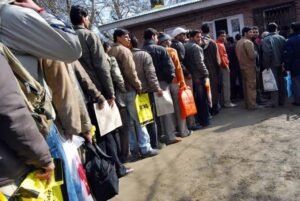
The most striking indicator of recruitment pressure is the volume of applications. The figures reported in October 2026 show that JKPSC and JKSSB received a combined 21,12,121 applications for 15,964 advertised posts during the period covered by the reported recruitment data. The aggregate ratio is approximately 132 applications for every advertised post. This is an indicator of competition, not a claim that 132 different people competed for every individual vacancy, since candidates may apply for several posts and the qualifications, eligibility criteria and applicant pools vary by recruitment. (Kashmir Life, 3 October 2026)
The breakdown of applications makes the pressure clearer. According to The Indian Express, JKPSC received 2,76,065 applications for 4,961 gazetted posts, of which 1,85,808 candidates appeared in the examinations. JKSSB received 18,36,056 applications for 11,003 non-gazetted posts, with 9,38,777 candidates appearing. Thus, approximately 67.3 per cent of applicants in the reported JKPSC figures and 51.1 per cent in the JKSSB figures appeared for the examinations. These are attendance ratios, not pass rates: candidates who appeared may or may not have qualified, and qualification does not necessarily translate into selection. (The Indian Express, recruitment applications and examination attendance)
| Recruitment indicator | Reported figure |
| Applications received | 21.12 lakh |
| Advertised posts | 15,964 |
| Applications per advertised post | Approximately 132:1 |
| Selections reportedly finalised since October 2024 | 7,580 |
Sources: Kashmir Life and The Indian Express. The 7,580 figure covers a different time period and measure from the 15,964-post application dataset.
The reported 7,580 selections finalised since October 2024 require particular attention. They are not directly comparable to the 15,964 posts advertised over the separate reporting period, because the time windows and measures differ. Nor should the difference between those two figures be presented as the number of people who remain unemployed. Some advertised positions may be at different stages of recruitment, while selections may relate to earlier advertisements. The relevant question is how many selections have resulted in actual appointments and joining, and how many advertised posts remain pending, withdrawn, cancelled or unfilled. (Kashmir Life, October 2026)
There is no reliable basis in the figures cited above for stating exactly how many applicants passed each examination, how many were eligible for final selection, or how many remain unemployed after the recruitment cycle. Those numbers require post-wise examination results, category-wise cut-offs, waiting lists and appointment records. A candidate may qualify for one examination but fail another, while a person selected for a post may already be employed elsewhere. Equally, a candidate who fails to secure a government position may be employed in the private sector or self-employed. The number of applications cannot, therefore, be used as a substitute for the number of unique unemployed individuals.
Nevertheless, the competition ratio exposes the scale of the mismatch between aspirations and public-sector absorption. Even if every one of the 15,964 advertised posts were filled, that would amount to appointments equivalent to only about 0.76 per cent of the 21.12 lakh applications received. This is a comparison of posts with applications, not a prediction that 99.24 per cent of applicants will remain unemployed. Its significance lies in showing that public recruitment, by itself, cannot resolve the region’s employment challenge, even if the process is made faster and more efficient.
What if all the vacancies were filled?
The immediate economic benefits of filling genuine vacancies would be substantial, provided recruitment remained merit-based, financially sustainable and aligned with public-service requirements. Filling 40,672 vacant posts would bring a large number of workers into regular employment and improve staffing capacity across departments. It would also provide a predictable income to thousands of households, reduce dependence on family members who are already employed, and potentially increase spending on education, healthcare, housing, transport and local businesses.
The household impact can be illustrated through a hypothetical calculation. If each of 40,672 appointments carried an average gross monthly salary of ₹30,000, the combined gross payroll would amount to approximately ₹1,464 crore annually. At ₹40,000 per month, it would be about ₹1,952 crore annually. These are illustrative scenarios, not estimates of actual government salary costs: the vacancies include posts at different pay levels, and actual expenditure would depend on the pay matrix, allowances, employer contributions and the number of posts that could legitimately be filled. The calculation nevertheless demonstrates the potential scale of the income flow that regular employment can create.
The benefit would extend beyond the employee. Consider a young graduate who has spent several years preparing for competitive examinations while relying on parents for accommodation, coaching fees, travel and daily expenses. A regular appointment can reverse that relationship of dependence. The employee can begin contributing to household expenditure, supporting siblings’ education, helping parents meet medical costs and saving towards housing or marriage. The effects may be especially significant in households where one or two earners support several dependants.
The economic impact would also extend to local markets. Salaries paid to employees are spent partly on goods and services within the region, generating demand for retailers, transport operators, food businesses, housing providers and other service enterprises. This does not mean that every rupee of salary would remain within Jammu and Kashmir, nor that payroll expenditure would automatically produce a particular multiplier. It does mean that timely recruitment can create both direct employment and indirect economic activity.
However, filling all vacancies must not be confused with creating an unlimited number of government jobs. Public employment is financed through public revenue and expenditure. An additional permanent salary creates a recurring commitment, often extending over decades and including pensions or other retirement-related obligations according to the applicable service rules. The government must therefore assess which posts are essential, which vacancies can be abolished or restructured, which services require redeployment, and which functions can be strengthened through technology or alternative delivery models. The objective should be to fill necessary posts promptly, not to preserve every historical sanctioned position regardless of present administrative requirements.
The fiscal argument, however, cannot be used to justify indefinite delay where essential posts remain vacant and the government has already determined that those posts are necessary. The correct approach is transparent workforce planning, budgeted recruitment and a time-bound appointment process. If a post is no longer required, it should be formally reviewed and rationalised. If it is essential, it should not remain vacant merely because the administrative machinery has failed to complete the recruitment process.
Economic growth without sufficient employment absorption
The wider economic context helps explain why the vacancy crisis is only one part of the problem. Jammu and Kashmir’s economy has recorded improvements in several aggregate indicators. The 2024–25 Economic Survey projected real economic growth of approximately 7.06 per cent for that financial year, while the 2025–26 survey continued to report a diversified economic structure in which services make the largest contribution to gross state value added. (The Hindu’s report on the 2024–25 Economic Survey; J&K Economic Survey 2025–26)
Yet growth in output does not automatically translate into employment at the scale required. The Planning and Development Monitoring Department’s summary of the 2025–26 Economic Survey estimates that the primary sector accounted for 20.45 per cent of gross state value added in 2025–26, while agriculture and allied activities continued to absorb the largest share of the workforce, at 42.99 per cent according to PLFS 2023–24. The secondary sector accounted for an estimated 18.52 per cent of gross value added and 25.7 per cent of employment, while the tertiary sector contributed approximately 61.02 per cent of gross value added and 31.31 per cent of employment. (J&K Planning Department, Economic Survey profile)
These figures indicate an important structural imbalance. Agriculture supports a large proportion of workers relative to its contribution to output, while services generate the largest share of economic value but employ a smaller share of the workforce. The implication is not that agriculture should be abandoned or that services are inherently insufficient. Rather, the region must increase productivity, value addition and the quality of jobs in all three sectors.
In agriculture, employment opportunities can be expanded through food processing, horticulture, cold-chain infrastructure, nursery production, storage, grading, packaging, branding and direct market access. In the secondary sector, construction, renewable energy, manufacturing, repair services and small-scale processing can absorb workers with different educational and technical backgrounds. In services, information technology, healthcare, education, tourism, logistics, research, financial services and professional enterprises can offer opportunities for graduates and skilled workers.
The challenge is that these sectors do not necessarily generate stable employment simply because their output grows. Tourism may produce seasonal work; construction may depend on project cycles; agricultural income is vulnerable to weather and price fluctuations; and small businesses may struggle with credit, market access and delayed payments. Employment policy must therefore measure not merely the number of enterprises established or people trained, but the number of jobs sustained, the wages earned, the duration of employment and the proportion of workers who move into secure and productive livelihoods.
The region’s economic performance should consequently be evaluated against an employment-intensity test. If economic output increases while the number of secure jobs grows slowly, the gains from growth may be concentrated among a relatively small number of firms, property owners, capital holders or highly skilled workers. The relevant policy question is not only whether Jammu and Kashmir is growing, but whether that growth is broad-based enough to provide dignified work for its educated and working-age population.
What is the government doing for those who cannot secure public employment?
A credible employment policy must address two distinct populations: people seeking regular government service and those who need alternative routes into productive work. Jammu and Kashmir has introduced and implemented several schemes intended to expand entrepreneurship, skill development, wage employment and self-employment. The question is whether these programmes are sufficiently large, accessible and effective to absorb the number of young people who cannot secure public-sector appointments.
Mission YUVA is among the most significant recent initiatives. The Jammu and Kashmir Economic Survey 2024–25 described a programme intended to facilitate the creation of 1.37 lakh enterprises and generate approximately 4.25 lakh employment opportunities over five years, with a projected outlay of ₹1,830 crore. The scheme seeks to promote entrepreneurship through access to finance, skills, institutional support and market connectivity. (J&K Economic Survey 2024–25)
The Economic Survey 2025–26 subsequently reported that Mission YUVA had received 65,353 applications, approved 44,857 proposals, secured bank sanctions for 13,324 cases and provided financial assistance to 10,329 entrepreneurs. These figures demonstrate administrative reach, but they must be interpreted carefully. Applications, approvals, bank sanctions, disbursements, enterprises actually operating and jobs sustained for several years are different indicators. The reported number of assisted entrepreneurs cannot automatically be treated as the number of permanent jobs created, nor can the five-year employment target be treated as an achievement already realised. (J&K Economic Survey 2025–26)
The distinction matters because entrepreneurship is not a universal substitute for salaried employment. A graduate who has spent years preparing for competitive examinations may not possess the capital, commercial experience, risk tolerance or family resources required to establish a viable enterprise. Even where loans and subsidies are available, a business must find customers, cover operating expenses and generate sufficient income to survive. Credit without reliable market access can leave an unemployed young person with debt rather than a livelihood. Mission YUVA should therefore be evaluated through enterprise survival rates, net employment creation, average monthly earnings, loan repayment performance and the number of businesses that remain operational after two or three years.
The Prime Minister’s Employment Generation Programme (PMEGP) offers another route into self-employment. The J&K Economic Survey 2024–25 reported that, since 2020–21, PMEGP had facilitated 57,244 enterprises and generated an estimated 4.58 lakh employment opportunities across the Union Territory, with ₹1,169.34 crore disbursed in margin money. These are programme-reported estimates and should not be interpreted as a count of independently verified, continuously employed individuals. Nevertheless, they indicate that enterprise-based employment already operates at a scale that deserves sustained policy attention. (J&K Economic Survey 2024–25; Ministry of MSME, PMEGP dashboard)
Skill development and employment facilitation also form part of the policy response. The J&K Economic Survey 2024–25 reported that 1,181 counselling sessions benefited more than 47,151 candidates during 2024–25, while programmes such as Himayat, PMKVY, Mumkin and Tejaswini seek to connect young people with training, wage employment or self-employment. The Jammu and Kashmir Employment Department and the J&K Skill Development Mission provide institutional channels through which these opportunities can be accessed.
However, training figures should not be confused with employment outcomes. A candidate receiving a certificate is not necessarily employed, and a person placed in a short-term job may not have achieved sustainable economic security. The relevant indicators are the proportion of trainees placed in work, their earnings, the relevance of the training to employers’ requirements, retention after six and twelve months, and the proportion who remain unemployed despite completing training.
Rural wage employment provides a further safety net. The Mahatma Gandhi National Rural Employment Guarantee Scheme is designed to provide demand-driven wage employment to eligible rural households, offering a fallback where better opportunities are unavailable. (Ministry of Rural Development, Government of India) Such programmes are important for rural income security, but they are not substitutes for skilled, year-round employment for engineers, postgraduate students, accountants, teachers, researchers or other qualified young people. A scheme designed primarily for rural wage employment cannot, by itself, resolve the structural problem of educated unemployment.
The policy challenge is therefore not a complete absence of programmes. It is the need to establish whether these programmes are collectively creating enough additional, durable and appropriately paid employment to compensate for the limited number of government appointments. This requires a consolidated annual employment report that distinguishes programme expenditure, beneficiaries, actual jobs created, jobs sustained, average earnings and the number of participants who return to unemployment.
Why does government employment dominate youth aspirations?
The preference for government service in Jammu and Kashmir cannot be explained simply by an unwillingness to undertake private work. It reflects the economic and institutional characteristics of the available labour market. A regular government appointment generally offers predictable monthly income, established service rules, defined career progression and a degree of employment security that many small private enterprises cannot match.
For families that have invested heavily in education, coaching and examination preparation, government employment is often perceived as the most reliable return on that investment. The attraction is especially strong when the household has limited access to capital, land, established business networks or professional connections outside the region. A salaried position can transform the financial circumstances of a family, whereas a small business may require additional investment and expose the household to commercial risk.
The difficulty emerges when educational attainment and employment aspirations expand faster than the number of suitable jobs. Repeated competitive examinations can become a holding pattern in which young people postpone other career decisions while waiting for a government vacancy. Every recruitment notification then becomes an event around which months of preparation, household expenditure and personal expectations are organised.
This creates opportunity costs that are rarely captured by conventional unemployment statistics. A graduate spending three years preparing for examinations may not be counted as unemployed if the statistical definition treats the person as outside the labour force because they are not actively seeking work in the reference period. Another graduate may accept a low-paid job unrelated to their qualifications and consequently be classified as employed. Both may nevertheless experience substantial underemployment or dissatisfaction.
The resulting policy problem is one of labour-market segmentation. Public employment offers a relatively secure pathway to a limited number of candidates, while many others must navigate informal work, short-term contracts, self-employment or migration. The government should not attempt to eliminate the legitimate aspiration for public service. It should make recruitment more predictable while creating alternative employment pathways that offer comparable dignity, professional development and economic stability.
This requires stronger links between universities, colleges, technical institutions and employers. Courses should be informed by labour-market demand, but educational reform must not reduce universities to narrow training centres. Research, critical thinking, scientific inquiry and the humanities remain essential. The objective should be to combine intellectual development with opportunities for students to apply their capabilities in public institutions, enterprises, research organisations and community-based development.
The human and social costs of prolonged unemployment
Unemployment is not merely an economic condition. When prolonged, it can affect mental health, family relationships, social participation and the sense of control individuals exercise over their lives. These effects are particularly important when a person has invested years in education and professional preparation but repeatedly fails to secure work.
In many households, employment carries social meaning beyond income. A young person may be expected to support parents, contribute to siblings’ education, establish an independent household or meet other family responsibilities. When employment is delayed, these transitions are postponed. Financial dependence may continue well into adulthood, while the family must keep paying for transport, applications, coaching and examination preparation.
Repeated rejection can also undermine confidence. The difficulty is not necessarily a single unsuccessful examination but the accumulation of uncertainty: an advertised post may be delayed, an examination rescheduled, a result challenged or a selection process prolonged. When young people cannot plan their lives around reliable timelines, the uncertainty itself becomes a source of distress.
These pressures should not be used to stereotype unemployed youth as frustrated, disaffected or vulnerable to harmful behaviour. Most unemployed people navigate difficult circumstances through family support, informal work, further education, entrepreneurship, migration or continued job searches. The problem is that these coping mechanisms may consume resources and postpone opportunities that could otherwise contribute to productive lives.
The relationship between unemployment and suicide requires particular care. Economic insecurity and prolonged joblessness can contribute to psychological distress, but suicide is a complex outcome involving multiple personal, social and health-related factors. It would be incorrect to attribute individual deaths to unemployment alone or to infer a direct causal relationship from unemployment rates. The appropriate response is to strengthen both employment policy and accessible mental-health support, including counselling, community-based services and timely professional care for people experiencing severe distress.
Official suicide statistics can help monitor the wider problem, but they do not by themselves establish the contribution of unemployment to individual cases. The National Crime Records Bureau’s suicide statistics for 2023 provide a starting point for examining the regional burden. These data should be analysed alongside socioeconomic indicators and mental-health evidence, rather than used to make unsupported causal claims.
For Jammu and Kashmir, the stakes extend to social trust. When educated young people see large numbers of vacancies alongside slow recruitment, they may question whether public institutions are responsive to their needs. When entrepreneurship schemes are announced but their outcomes are not transparently reported, they may become sceptical of alternative employment pathways. A government that wishes to build confidence must therefore demonstrate results through reliable data, predictable recruitment and visible opportunities beyond government service.
The way forward: from vacancy announcements to an employment compact
The first requirement is a comprehensive employment and vacancy audit. The government should publish a department-wise register of all sanctioned posts, occupied positions, vacancies, posts referred for recruitment, posts advertised, examinations completed, selections finalised and appointments made. The register should distinguish gazetted, non-gazetted and MTS positions and identify vacancies requiring immediate recruitment, those reserved for promotion and those under legal or administrative review. Every figure should carry a common reference date and be updated at regular intervals.
The second requirement is a time-bound recruitment calendar. JKPSC and JKSSB should publish annual schedules based on the vacancies formally referred to them, with indicative dates for advertisements, examinations, results, verification and recommendations. Where delays are unavoidable, the reasons should be disclosed. Withdrawn advertisements should be accompanied by clear explanations and timely refunds wherever applicable. Recruitment agencies should also publish annual performance indicators covering the average time taken to complete selection processes, the number of examinations conducted, the number of recommendations issued and the number of selected candidates who actually join.
The third requirement is a credible fiscal plan for filling essential vacancies. Departments should identify critical staffing gaps in health, education, agriculture, finance, engineering and other public services, estimate the recurring salary implications and prioritise recruitment according to administrative need. Vacancies that are no longer necessary should be reviewed transparently rather than counted indefinitely. This approach would reconcile fiscal responsibility with the need to strengthen public services and provide employment.
The fourth requirement is to make alternative employment measurable. Mission YUVA, PMEGP, skill-development programmes and other initiatives should report verified employment outcomes rather than relying predominantly on applications, approvals, training completions or projected targets. Each programme should be evaluated on additional jobs created, income generated, enterprise survival, regional distribution, participation by women and disadvantaged groups, and the proportion of beneficiaries who remain economically active after support ends.
The fifth requirement is to expand the productive economy. Horticulture and food processing, handicrafts, tourism, information technology, renewable energy, logistics, healthcare, research and other service industries should be linked to investment, market access and skills. The government should encourage private employers to offer formal contracts, social protection and transparent recruitment practices. Entrepreneurship support should include mentoring, access to customers, business development and protection against avoidable administrative delays, not merely credit disbursement.
Finally, the government needs an employment information system that follows young people from education into work. Such a system, designed with appropriate privacy protections, could help identify the qualifications of jobseekers, their preferred occupations, the skills employers require and the outcomes of government employment programmes. This would make it easier to identify district-level gaps, assess underemployment and design targeted interventions for rural, urban, border and remote communities.
The objective should not be to promise a government job to every graduate. No administration can realistically guarantee that every person will obtain a particular occupation, and public-sector expansion alone would not create a sustainable employment model. The objective should be to ensure that education leads to credible opportunities, recruitment follows predictable rules, essential vacancies do not remain unfilled without justification, and young people who cannot secure government employment have genuine alternatives through which they can earn a dignified livelihood.
Conclusion
Jammu and Kashmir’s unemployment challenge is best understood as a problem of inadequate employment absorption, uneven job quality and the gap between public recruitment and wider economic opportunity. The official youth unemployment estimate of 17.4 per cent for 2023–24, the 40,672 government vacancies reported in September 2026, and the more than 21 lakh applications received for 15,964 advertised posts collectively demonstrate the scale of the challenge, even though these figures measure different aspects of the labour market. (Government of India, youth unemployment data; government vacancy figures; recruitment applications)
Filling essential vacancies would improve public services, create household income and reduce the burden of prolonged dependence for many families. Yet the much larger task is to create an economy in which public employment is one credible career pathway among several, rather than the principal route to financial security for educated youth. That requires effective recruitment, productive investment, viable enterprises, relevant skills, reliable employment data and support for those facing prolonged joblessness.
Economic growth will remain an incomplete measure of development if a substantial proportion of young people cannot translate education and ability into meaningful work. For Jammu and Kashmir, employment policy must therefore move beyond announcements and targets towards verifiable outcomes. The measure of success should be not how many vacancies are identified, how many applications are received or how much money is allocated, but how many people obtain sustainable work, how much they earn, how long they remain employed and whether their livelihoods allow them to participate in society with dignity, independence and hope.
References
Official reports, government data and institutional sources
- Government of Jammu and Kashmir, Planning, Development and Monitoring Department. Economic Survey 2024–25. Government of Jammu and Kashmir. https://jkplanning.gov.in/pdf/Economic%20Survey%202024-25.pdf
- Government of Jammu and Kashmir, Planning, Development and Monitoring Department. Economic Survey 2025–26. Government of Jammu and Kashmir. https://jkplanning.gov.in/pdf/Economic%20Survey%202025-26.pdf
- Government of India, Ministry of Labour and Employment. Rajya Sabha reply on youth unemployment and worker-population ratio in Jammu and Kashmir, 12 March 2026. https://dge.gov.in/sites/default/files/2026-05/2328_eng.pdf
- Government of India, Ministry of Statistics and Programme Implementation. Periodic Labour Force Survey (PLFS), Quarterly Bulletin, July–September 2024. https://mospi.gov.in/sites/default/files/publication_reports/QuarterlyBulletinPLFS_July_September_2024.pdf
- Government of Jammu and Kashmir, Jammu and Kashmir Services Selection Board (JKSSB). Official Advertisement Archive. https://jkssb.nic.in/Advertisement.html
- Government of Jammu and Kashmir, Jammu and Kashmir Services Selection Board (JKSSB). Official Notices and Recruitment Updates. https://www.jkssb.nic.in/Whatsnew.html
- Government of Jammu and Kashmir, Jammu and Kashmir Services Selection Board (JKSSB). Selection Lists and Results Archive. https://www.jkssb.nic.in/SelectionList.html
- Government of Jammu and Kashmir, Employment Department. Jammu and Kashmir Employment Portal. https://jakemp.nic.in/
- Government of Jammu and Kashmir. Jammu and Kashmir Skill Development Mission. https://skill.jk.gov.in/
- Government of India, Ministry of Micro, Small and Medium Enterprises. Prime Minister’s Employment Generation Programme (PMEGP): State-wise Dashboard. https://dashboard.msme.gov.in/Pmegp_StateWise.aspx?FY=2024-25
- Government of India, Ministry of Rural Development. Official government release on rural employment and related programme implementation. https://www.pib.gov.in/Pressreleaseshare.aspx?PRID=2118849&lang=2
- Government of India, National Crime Records Bureau and Open Government Data Platform. State/UT-wise Details of Incidence and Rate of Suicides during 2023. https://www.data.gov.in/resource/stateut-wise-details-incidence-and-rate-suicides-during-2023
- Government of Jammu and Kashmir, Planning, Development and Monitoring Department. Jammu and Kashmir: Economic and Development Profile. https://jkplanning.gov.in/profile.html
News reports and supplementary sources
- The Economic Times Education. (2026). “J&K Has 40,672 Government Vacancies; Health and Medical Education Tops List.” https://education.economictimes.indiatimes.com/news/industry/jk-has-40672-govt-vacancies-health-and-medical-education-tops-list/134403164
- The Indian Express. (2026, October 5). Report on Jammu and Kashmir government recruitment, advertised posts, application fees and recruitment trends. https://indianexpress.com/article/india/jammu-kashmir-job-fees-vacancies-decline-omar-abdullah-10906712/
- Kashmir Life. (2026, October). “21 Lakh Applications, Rs 114 Cr Fee, but Only 7,580 Selections Made by PSC, SSB in Jammu and Kashmir.” https://kashmirlife.net/21-lakh-applications-rs-114-cr-fee-but-only-7580-selections-made-by-psc-ssb-in-jammu-kashmir-454924/
- The Hindu. (2025). “J&K Economy Expected to Grow at 7.06% in 2024–25: Economic Survey.” https://www.thehindu.com/news/national/jammu-and-kashmir/jk-economy-expected-to-grow-at-706-in-2024-25-economic-survey/article69297557.ece
- Rising Kashmir. (2026). Report on more than 77,000 vacant posts across Jammu and Kashmir government departments. https://risingkashmir.com/over-77000-posts-vacant-across-jk-departments-govt/
- Kashmir Life. (2026). Report on more than 59,000 identified vacancies in Jammu and Kashmir. https://kashmirlife.net/jammu-kashmir-vacancy-count-mounts-over-59000-posts-identified-430334/
- Greater Kashmir. (2025). “Youth Unemployment in J&K Soars to 17.4%, Much Higher Than National Average.” https://www.greaterkashmir.com/latest-news/youth-unemployment-in-jk-soars-to-17-4-much-higher-than-national-average/
- Hindustan Times. (2025). “Unemployment Rate in J&K Dips to 6.1% in 2023–24 from 6.7% in 2019–20.” https://www.hindustantimes.com/cities/chandigarh-news/unemployment-rate-in-j-k-dips-to-6-1-in-2023-24-from-6-7-in-201920-101742064091649.html
- Article 14. (2025). “Street Vendor with a PhD in J&K, as Region Struggles with India’s Highest Youth Unemployment.” https://article-14.com/post/street-vendor-with-a-phd-in-j-k-as-region-struggles-with-india-s-highest-youth-unemployment-67e61453ed8fd
- NDTV. (2024). “Jammu and Kashmir Unemployment Rate Is a Staggering 18.3%; the National Average Is…” https://www.ndtv.com/india-news/jammu-and-kashmir-unemployment-rate-is-a-staggering-18-3-the-national-average-is-4242006
- Deccan Herald. (2026). “Jammu and Kashmir’s Urban Youth Unemployment Nearly Double National Average.” https://www.deccanherald.com/india/jammu-and-kashmir/jammu-and-kashmirs-urban-youth-unemployment-nearly-double-national-average-3842374
- Kashmir Observer. (2026, February 9). “Unemployment Rate in J&K Above National Average: Government.” https://kashmirobserver.net/2026/02/09/unemployment-rate-in-jk-above-national-average-govt/
- The Economic Times. (2026). “J&K’s Unemployment Rate of 6.7% Much Above National Average.” https://economictimes.indiatimes.com/news/india/jks-unemployment-rate-of-6-7-much-above-national-average/articleshow/128127346.cms
- The News Now. Report on the Deputy Chief Minister’s remarks concerning Jammu and Kashmir’s unemployment rate relative to the national average. https://www.thenewsnow.co.in/unemployment-rate-in-jk-above-national-average-dy-cm-choudhary/
- Rising Kashmir. Report on the number of registered unemployed youth in Jammu and Kashmir. https://risingkashmir.com/jk-records-highest-number-of-3-52-lakh-unemployed-youth/
- Youth Ki Awaaz. (2025). “Unemployment in Jammu & Kashmir: Current Trends and Challenges.” https://www.youthkiawaaz.com/2025/08/unemployment-in-jammu-kashmir-current-trends-challenges/
- Greater Kashmir. “J&K Unemployment Rate at 6.7%, Nearly Twice National Average.” https://www.greaterkashmir.com/business/jk-unemployment-rate-at-6-7-nearly-twice-national-average/
- Jammu & Kashmir Policy Institute. “Mapping the Unemployment in Jammu and Kashmir.” https://www.jkpi.org/mapping-the-unemployment-in-jammu-and-kashmir/
- Jammu & Kashmir Policy Institute. “Unemployment in India’s Evolving Economy: A Case Study of Jammu & Kashmir.” https://www.jkpi.org/unemployment-in-indias-evolving-economy-a-case-study-of-jammu-kashmir/
- The Hindu. “The Crisis of Unemployment in J&K.” https://www.thehindu.com/opinion/op-ed/the-crisis-of-unemployment-in-jk/article70728225.ece
- Newsonair. “Over 40,000 Government Posts Vacant Across Jammu and Kashmir, Says GAD Commissioner Secretary.” https://newsonair.gov.in/over-40000-government-posts-vacant-across-jammu-and-kashmir-says-gad-commissioner-secretary/
- Kashmir Life. “38,872 Government Posts Vacant Across Jammu and Kashmir; Regularisation Policy for Temporary Workers Still Under Review.” https://kashmirlife.net/38872-govt-posts-vacant-across-jammu-kashmir-regularisation-policy-for-temporary-workers-still-under-review-452693/
- Kashmir Convener. “53,972 Posts Vacant Across J&K Government.” https://kashmirconvener.com/53972-posts-vacant-across-jk-govt/
- The Publish. “Over 40,000 Government Posts Vacant in J&K, Reveals Official Data.” https://thepublish.in/news/over-40000-government-posts-vacant-in-jk-reveals-official-data
- Crosstown News. “Over 77,000 Posts Vacant Across J&K Departments: Government.” https://www.crosstownnews.in/post/153128/over-77000-posts-vacant-across-jk-departments-jk-govt.html
- News Today Network. (2026, October 5). “J&K Collected Rs 114 Crore from Job Aspirants in Three Years.” https://newstodaynet.com/2026/10/05/jk-collected-rs-114-crore-from-job-aspirants-in-three-years/
- Tehelka. “J&K’s Unemployment Rate Stays Well Above National Average.” https://tehelka.com/jks-unemployment-rate-stays-well-above-national-average/
About the Author